
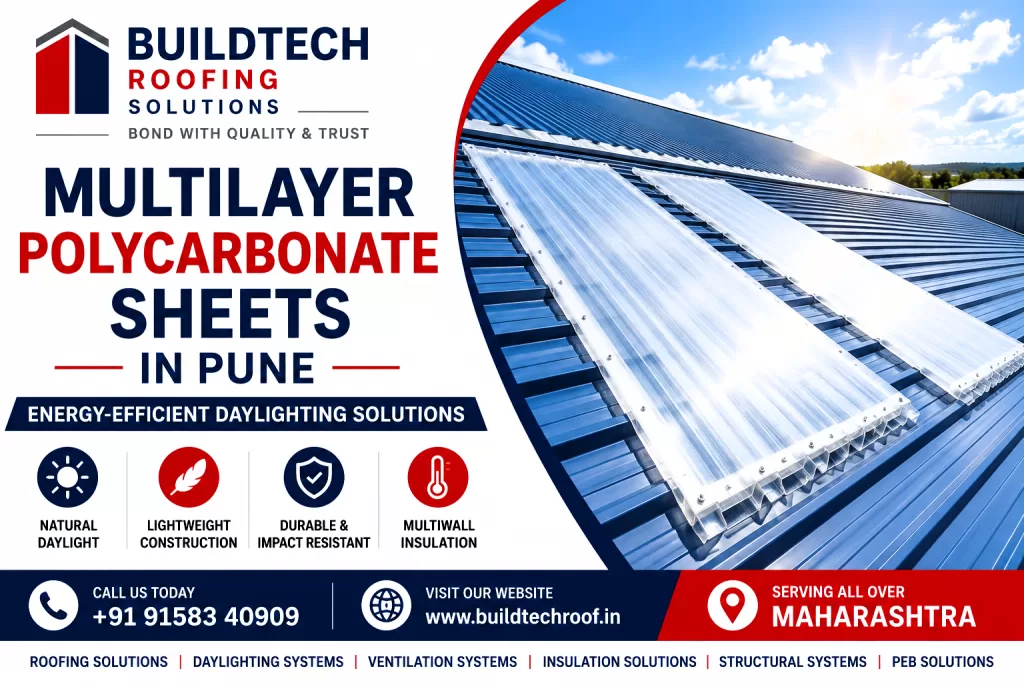
Multilayer Polycarbonate Sheets in Pune: Multiwall Roofing & Daylighting
Natural daylight is an important consideration when designing modern factories, warehouses, workshops, commercial buildings, and other large structures. Large industrial buildings often have extensive roof areas with limited wall openings, which can result in significant dependence on artificial lighting during the day.
Multilayer Polycarbonate Sheets provide a practical daylighting solution for these applications. Their multiwall construction incorporates internal chambers that combine lightweight construction, rigidity, natural light transmission, and useful thermal-performance characteristics.
For industrial projects in Pune, these sheets can be integrated into roofing systems as selected daylighting sections, skylights, canopies, walkways, and other translucent structures.
At Buildtech Roofing Solutions, Multilayer Polycarbonate is part of the company’s Daylighting Systems range, alongside Polycarbonate Sheets, FRP Skylight Sheets, and Roof Light Systems.
What Are Multilayer Polycarbonate Sheets?
Multilayer Polycarbonate Sheets are translucent panels manufactured with multiple layers connected by internal ribs or webs. These components create a multiwall or cellular structure inside the sheet.
The internal construction can provide a combination of:
- Lightweight construction
- Increased rigidity
- Natural daylight transmission
- Useful thermal characteristics
- Impact resistance
- Design flexibility
The exact performance depends on the sheet construction, thickness, chamber configuration, surface treatment, and other product specifications.
Unlike a conventional solid polycarbonate sheet, a multilayer sheet contains internal chambers. These chambers can reduce direct heat transfer compared with a simple single-layer sheet, which is one reason multiwall polycarbonate is used for daylighting and roofing applications.
Why Choose Multilayer Polycarbonate for Industrial Roofing?
Industrial buildings often need to balance several requirements at the same time:
Natural Daylight + Thermal Performance + Weather Protection + Lightweight Construction
Multilayer Polycarbonate Sheets can contribute to this combination while allowing selected sections of an otherwise opaque roof to transmit daylight.
Common Applications
- Industrial Skylights
- Factory Roofing
- Warehouse Roofing
- PEB Buildings
- Industrial Sheds
- Canopies
- Walkways
- Commercial Buildings
- Atriums
- Roof Daylighting Systems
How Multilayer Polycarbonate Sheets Are Constructed
The internal structure is one of the most important characteristics of a multiwall polycarbonate sheet.
A simplified cross-section can be understood as:
Outer Layer → Internal Rib / Air Chamber → Intermediate Layer → Internal Rib / Air Chamber → Inner Layer
The internal ribs contribute to rigidity, while the chambers contribute to the sheet’s lightweight construction and thermal characteristics.
This construction allows multilayer polycarbonate to offer a different performance balance from conventional solid sheets.
Key Features of Multilayer Polycarbonate Sheets
1. Multiwall Construction
Multiple layers and internal chambers create a combination of rigidity and lightweight construction.
Different chamber arrangements can provide different levels of thermal and structural performance.
2. Natural Light Transmission
The translucent construction allows daylight to enter enclosed spaces.
This can be particularly useful for:
- Production areas
- Warehouses
- Workshops
- Circulation areas
- Commercial spaces
3. Lightweight Design
Multilayer polycarbonate provides a relatively lightweight translucent surface compared with many conventional glazing systems.
This can simplify:
- Handling
- Transportation
- Installation
- Structural integration
4. Thermal Performance
Internal air chambers can provide improved thermal resistance compared with a simple single-layer translucent sheet.
Actual performance depends on:
- Number of layers
- Chamber geometry
- Sheet thickness
- Material properties
- Installation
- Building design
5. Impact Resistance
Polycarbonate is known for its impact-resistant characteristics, making it suitable for many industrial and commercial applications where translucent roofing is required.
6. UV Protection Options
Outdoor polycarbonate products can incorporate UV-protection features. The exact UV specification and installation orientation should always be confirmed from the manufacturer’s technical documentation.
Types of Multilayer Polycarbonate Sheets
The appropriate multiwall construction depends on the application, required rigidity, thermal requirements, daylight requirements, and supporting structure.
Twin-Wall Polycarbonate
Twin-wall sheets contain two primary layers connected by internal ribs.
Typical Applications
- Skylights
- Canopies
- Small roofing areas
- Walkways
- Commercial structures
Benefits
- Lightweight
- Good daylight transmission
- Easy handling
- Basic thermal insulation characteristics
Triple-Wall Polycarbonate
Triple-wall construction introduces additional internal structure compared with twin-wall products.
Potential advantages include:
- Increased rigidity
- Improved thermal characteristics
- Lightweight construction
- Suitability for larger applications
Multiwall Polycarbonate
More complex multiwall configurations can provide different levels of:
- Rigidity
- Thermal performance
- Structural efficiency
The exact number of walls and chamber configuration should be selected according to the manufacturer’s technical specification.
Cellular Polycarbonate
The term cellular polycarbonate generally refers to sheets containing internal hollow chambers.
These chambers contribute to the product’s lightweight construction and thermal characteristics.
Diffused Multilayer Polycarbonate
Diffused products distribute incoming daylight more evenly. They can be useful where glare control and uniform illumination are important.
Potential applications include:
- Factories
- Warehouses
- Commercial buildings
- Workspaces
- Agricultural structures
Clear vs Diffused Multilayer Polycarbonate
The highest light-transmission product is not necessarily the best solution for every building.
| Feature | Clear | Diffused |
|---|---|---|
| Light Direction | More direct | More distributed |
| Glare Control | Lower | Better |
| Visual Effect | Brighter/direct | Softer/even |
| Typical Use | Maximum daylight | Uniform illumination |
For industrial buildings, the choice should consider daylight requirements, glare, solar exposure, building use, and roof orientation.
Available Colours and Transparency Options
Depending on the product range, Multilayer Polycarbonate Sheets can be available in different colours and transparency levels.
Clear
Suitable where relatively high daylight transmission is desired.
Opal / Diffused
Suitable where more evenly distributed light is preferred.
Tinted
Can provide lower light transmission and a different visual appearance.
Selection should consider:
- Daylight requirement
- Glare
- Solar exposure
- Building use
- Roof orientation
- Thermal considerations
Benefits of Multilayer Polycarbonate Sheets
Natural Daylighting
The primary advantage is the ability to introduce natural light into enclosed spaces.
Strategically positioned translucent roof sections can reduce dependence on artificial lighting during suitable daylight conditions.
Improved Light Distribution
Diffused multiwall products can distribute daylight more evenly, which can be useful for large workspaces where strong direct sunlight is undesirable.
Useful Thermal Characteristics
The internal chambers can provide improved thermal resistance compared with some single-layer translucent materials.
Lightweight Construction
The relatively low weight can simplify handling and installation.
Impact Resistance
Polycarbonate provides good impact resistance for many industrial and commercial applications.
Flexible Applications
Multilayer Polycarbonate can be used for:
- Roofs
- Skylights
- Canopies
- Walkways
- Facades
- Commercial structures
Modern Appearance
Its translucent appearance can provide industrial and commercial buildings with a clean, modern architectural finish.
Multilayer Polycarbonate for Industrial Roofing
A modern industrial roof can combine opaque metal roofing with selected translucent daylighting panels.
A typical arrangement can be:
Metal Roofing → Multilayer Polycarbonate Daylighting Section → Metal Roofing
This approach allows natural daylight to enter selected areas without replacing the complete roof with translucent material.
The result is a coordinated roofing system that combines weather protection from metal roofing with daylighting from translucent polycarbonate sections.
Multilayer Polycarbonate for Factories
Factories often have large production floors where wall openings alone cannot provide sufficient natural illumination.
Multilayer Polycarbonate panels can be strategically positioned above:
- Production lines
- Assembly areas
- Workstations
- Inspection areas
- Circulation zones
The objective should not simply be to maximise translucent roof area. Instead, the daylighting system should balance natural light, glare control, solar heat management, and overall roof performance.
Multilayer Polycarbonate for Warehouses
Warehouses typically have large roof areas, high internal clearances, limited windows, and extensive storage zones.
Daylighting sections can introduce natural illumination while maintaining the enclosed character of the building.
Properly positioned skylight sections can distribute daylight across warehouse areas while the surrounding metal roofing continues to provide the primary weather barrier.
Multilayer Polycarbonate for PEB Buildings
Pre-Engineered Buildings are widely used for factories, warehouses, workshops, and commercial structures.
Multilayer Polycarbonate can be integrated into selected PEB roof sections.
A typical system involves:
PEB Frame → Purlins → Metal Roofing → Multilayer Polycarbonate → Flashings & Fasteners → Drainage
Coordination is required with:
- PEB rafters
- Purlins
- Roofing sheets
- Fasteners
- Flashings
- Insulation
- Ventilation systems
Ideally, daylighting should be considered during the PEB design stage rather than added after construction.
Multilayer Polycarbonate for Skylights
Skylights replace selected portions of an opaque roof with translucent daylighting elements.
They can be used for:
- Factory skylights
- Warehouse skylights
- Commercial skylights
- Atriums
- Walkways
- Industrial sheds
The major objective is to introduce natural daylight into areas that might otherwise depend heavily on artificial lighting.
Multilayer Polycarbonate for Canopies
The lightweight nature of polycarbonate makes it suitable for many canopy applications.
Common uses include:
- Entrance canopies
- Parking canopies
- Walkways
- Loading areas
- Commercial entrances
- Industrial access areas
Canopy structures should be designed considering applicable structural, wind, and drainage requirements.
Multilayer Polycarbonate with Metal Roofing
Multilayer Polycarbonate and metal roofing generally serve complementary functions.
Metal Roofing Provides
- Weather protection
- Primary roof covering
- Durability
- Exterior protection
Multilayer Polycarbonate Provides
- Natural daylight
- Translucency
- Skylight/daylighting functionality
- Additional thermal-performance characteristics
Using both materials together can create a balanced industrial roofing system.
Multilayer Polycarbonate with Insulation
Daylighting should be considered alongside thermal insulation when designing an industrial building.
Buildtech’s insulation product structure includes:
- PUF Panels
- XLPE Insulation
- Rockwool Insulation
- Glass Wool Insulation
- Bubble Insulation
- Thermal Roofing Systems
- Sandwich Panels
A complete building-envelope strategy should balance:
Daylight + Thermal Control + Ventilation + Weather Protection
Increasing translucent roof area without considering solar heat gain may not always produce the desired indoor environment.
Multilayer Polycarbonate with Ventilation Systems
Daylighting and ventilation perform different functions, but they can be coordinated within one roofing strategy.
For example:
Multilayer Polycarbonate → Natural Daylight
Ridge Ventilator → High-Level Ventilation
Roof Louvers → Controlled Air Openings
Turbo Ventilator → Wind-Assisted Air Extraction
This approach can be useful for industrial buildings that require both daylight and passive ventilation.
Important Selection Factors
Choosing the right Multilayer Polycarbonate Sheet requires more than simply selecting a thickness.
Consider the following:
1. Sheet Thickness
Thickness influences rigidity, thermal characteristics, and application suitability.
2. Number of Layers
Twin-wall, triple-wall, and multiwall configurations offer different performance characteristics.
3. Chamber Design
Internal chamber geometry affects rigidity and thermal performance.
4. Light Transmission
Select according to the desired daylight level.
5. Diffusion
Diffused products may be preferred where uniform illumination is required.
6. UV Protection
Verify the manufacturer’s UV-protection specification.
7. Profile Compatibility
The polycarbonate profile should be compatible with the surrounding roofing system.
8. Supporting Structure
Consider purlin spacing, span, wind exposure, and fixing arrangements.
Technical Specifications of Multilayer Polycarbonate Sheets
The correct specification should be selected according to the application rather than using one standard specification for every project.
Important parameters include:
- Sheet construction
- Number of walls/layers
- Thickness
- Chamber configuration
- Sheet width
- Sheet length
- Light transmission
- Colour
- Surface treatment
- UV protection
- Thermal characteristics
- Impact resistance
- Profile
- Supporting arrangement
For industrial roofing, these specifications should be coordinated with the proposed or existing roofing system.
Installation Process
Professional installation is important because daylighting panels form part of the overall waterproof roof assembly.
Step-1 – Site Inspection
Inspect:
- Roof structure
- Purlins
- Existing roofing
- Roof slope
- Drainage
- Access
- Supporting members
Step-2 – Confirm Roof Layout
Determine where daylighting panels will be installed based on daylight requirements, structural arrangement, roof profile, ventilation, and maintenance access.
Step-3 – Verify Sheet Profile
Confirm compatibility between the polycarbonate profile and the existing or proposed roof system.
Step-4 – Prepare Supporting Structure
Check alignment, corrosion, damage, spacing, and structural condition.
Step-5 – Position the Sheet
Ensure correct alignment, side overlap, end overlap, and orientation.
Step-6 – Install Fasteners
Use suitable roofing fasteners and washers. Avoid over-tightening, which can damage the polycarbonate.
Step-7 – Provide Sealing
Pay particular attention to:
- Laps
- Fastener penetrations
- Flashings
- Roof junctions
Step-8 – Install Flashings
Flashings may be required around ridges, eaves, walls, penetrations, and side junctions.
Step-9 – Final Inspection
Inspect sheet alignment, fasteners, washers, overlaps, sealants, flashings, drainage, and visible damage.
Waterproofing and Thermal Movement
Polycarbonate expands and contracts with temperature changes. Therefore, installation details must accommodate thermal movement according to the manufacturer’s requirements.
Important areas include:
- Fixing holes
- Fastener arrangement
- Overlaps
- Sheet length
- Edge details
Improper allowance for thermal movement can contribute to stress, deformation, or premature failure.
Waterproofing is equally important. Potential leakage points include:
- Side laps
- End laps
- Fasteners
- Flashings
- Ridge
- Eave
- Wall junctions
A reliable installation depends on correct detailing rather than simply applying excessive sealant.
The Multilayer Polycarbonate vs Solid Polycarbonate
| Feature | Multilayer Polycarbonate | Solid Polycarbonate |
|---|---|---|
| Construction | Multiple chambers/layers | Solid |
| Weight | Lightweight | Generally heavier |
| Thermal Characteristics | Multiwall construction provides useful thermal characteristics | Different thermal characteristics |
| Daylighting | Excellent | Excellent |
| Impact Resistance | High | High |
| Typical Use | Roofing, skylights, daylighting | Canopies, glazing, architectural applications |
Neither product is universally better. The correct choice depends on the project requirements.
The Multilayer Polycarbonate vs FRP Skylight Sheets
Buildtech’s Daylighting Systems category includes both Multilayer Polycarbonate and FRP Skylight Sheets.
| Feature | Multilayer Polycarbonate | FRP Skylight |
|---|---|---|
| Construction | Multiwall thermoplastic | Fibre-reinforced translucent sheet |
| Daylighting | Yes | Yes |
| Thermal Characteristics | Multiwall construction provides useful insulation characteristics | Product dependent |
| Impact Resistance | High | Good to high, depending on product |
| Industrial Use | High | High |
| Typical Application | Skylights, roofing, daylighting | Industrial skylights and translucent roofing |
The appropriate choice depends on the specific daylighting, durability, impact, thermal, chemical, profile, and installation requirements.
Multilayer Polycarbonate vs Glass
| Feature | Multilayer Polycarbonate | Glass |
|---|---|---|
| Weight | Lightweight | Heavy |
| Handling | Relatively easier | Requires greater care |
| Impact Resistance | High | Product dependent |
| Daylighting | Excellent | Excellent |
| Roof Integration | Suitable for many roofing systems | Requires specialised design |
| Thermal Performance | Useful multiwall characteristics | Depends on glazing specification |
For many industrial roofing applications, lightweight construction and multiwall characteristics make polycarbonate an attractive daylighting option.
Common Installation Mistakes
Wrong Profile
Profile mismatch can result in poor overlaps and difficult fixing.
Incorrect Fastener Tightening
Over-tightening can damage the sheet.
Poor Flashing
Inadequate flashing can create leakage points.
Incorrect UV Orientation
If the product has a designated UV-protected side, incorrect orientation can affect long-term performance.
Ignoring Thermal Movement
The fixing system must accommodate expansion and contraction.
Poor Storage
Improper storage can result in scratches and edge damage.
Excessive Translucent Area
More daylighting is not automatically better. The design should balance daylight, heat gain, and building requirements.
Maintenance of Multilayer Polycarbonate Sheets
Regular inspection can help preserve the appearance and performance of the system.
Inspect:
- Sheet surfaces
- Edges
- Fasteners
- Washers
- Flashings
- Sealants
- Roof drainage
- Supporting structures
Cleaning
Dust and dirt can reduce the visual quality of translucent roofing.
Use cleaning methods compatible with the specific product and manufacturer’s instructions.
Avoid:
- Abrasive cleaning tools
- Harsh chemicals
- Unapproved solvents
- Excessive pressure
When Should Multilayer Polycarbonate Be Replaced?
Replacement may be considered when the sheets show:
- Significant cracking
- Severe physical damage
- Persistent leakage
- Excessive deterioration
- Loss of required performance
- Failed fixing systems
- Severe surface degradation
A professional roof inspection can determine whether individual sheet replacement or broader roof rehabilitation is appropriate.
Multilayer Polycarbonate for Pune Projects
For projects in Pune and surrounding industrial areas, Multilayer Polycarbonate can be considered for:
- Industrial sheds
- Warehouses
- Manufacturing units
- Workshops
- PEB buildings
- Commercial structures
- Factory extensions
- Roof renovation projects
- Skylight replacement
- Industrial daylighting upgrades
Because roof performance depends heavily on project conditions, the final product specification should always be based on the actual building, roof profile, supporting arrangement, daylighting requirement, and installation conditions.
How to Choose a Multilayer Polycarbonate Supplier in Pune
When comparing suppliers, material price should not be the only consideration.
Product Specification
Confirm the exact sheet construction, thickness, profile, and other technical details.
Technical Support
The supplier should be able to help identify an appropriate product based on the project requirements.
Installation Capability
Industrial roof detailing requires proper understanding of profile matching, fixing, flashing, sealing, and waterproofing.
Compatible Accessories
Check availability of suitable fasteners, flashings, washers, and sealing materials.
Project Experience
Experience with industrial roofing and daylighting applications is an important consideration.
After-Sales Support
Inspection and maintenance assistance can be valuable throughout the roof’s service life.
Why Choose Buildtech Roofing Solutions?
Buildtech Roofing Solutions positions Multilayer Polycarbonate within a broader Daylighting Systems portfolio that includes:
- Polycarbonate Sheets
- Multilayer Polycarbonate
- FRP Skylight Sheets
- Roof Light Systems
The broader roofing ecosystem can also incorporate:
- PEB Structures
- Roofing Sheets
- Insulation Solutions
- Turbo Ventilators
- Ridge Ventilators
- Roof Louvers
- Rainwater Management Systems
This allows daylighting to be considered as part of the complete industrial roofing system rather than as an isolated product.
Frequently Asked Questions
FAQ-1) What are Multilayer Polycarbonate Sheets?
Multilayer Polycarbonate Sheets are translucent panels manufactured with multiple layers and internal chambers. They are used for industrial daylighting, skylights, roofing, canopies, and other applications where natural light and lightweight construction are required.
FAQ-2) What are the main benefits?
Key benefits include natural daylight transmission, lightweight construction, useful multiwall thermal characteristics, good impact resistance, UV-protection options, design flexibility, and suitability for industrial roofing.
FAQ-3) Are Multilayer Polycarbonate Sheets suitable for industrial roofing?
Yes. They can be incorporated into suitable industrial roofing systems as translucent daylighting sections when the sheet, profile, support, and fixing system are correctly selected.
FAQ-4) Can they be installed with metal roofing?
Yes. They can be integrated with compatible metal roofing systems, provided profiles, overlaps, fasteners, flashings, and waterproofing details are properly coordinated.
FAQ-5) Are they suitable for PEB buildings?
Yes. Multilayer Polycarbonate can be incorporated into PEB roofing as selected daylighting sections, subject to coordination with purlins, roof profiles, structural requirements, fasteners, and flashing details.
FAQ-6) Can Multilayer Polycarbonate reduce electricity consumption?
It can introduce natural daylight into suitable building areas and may reduce dependence on artificial lighting during daylight hours. Actual energy savings depend on building design, operating schedule, daylight availability, and lighting controls.
FAQ-7) Do Multilayer Polycarbonate Sheets provide insulation?
Their internal multiwall construction can provide useful thermal-performance characteristics compared with simple single-layer translucent sheets. Actual performance depends on sheet construction, thickness, chamber geometry, and the complete building-envelope system.
FAQ-8) Are Multilayer Polycarbonate Sheets UV resistant?
Outdoor polycarbonate products can be supplied with UV-protection features. The exact UV specification, protected surface, and installation orientation should be confirmed from the manufacturer’s technical documentation.
FAQ-9) How should Multilayer Polycarbonate Sheets be maintained?
Maintenance generally includes cleaning, visual inspection, fastener inspection, flashing and sealant checks, drainage inspection, and checking for cracks or physical damage. Cleaning should follow the manufacturer’s recommendations.
FAQ-10) How much do Multilayer Polycarbonate Sheets cost in Pune?
There is no single fixed price. Cost depends on sheet type, number of layers, thickness, dimensions, colour, UV protection, profile, quantity, fasteners, flashing, supporting structure, installation, and transportation. A project-specific quotation is recommended.
FAQ-11) Which is better: Multilayer Polycarbonate or FRP Skylight Sheets?
Neither is universally better. The appropriate product depends on the project’s daylighting, impact, thermal, chemical, profile, durability, and installation requirements.
Conclusion
Multilayer Polycarbonate Sheets in Pune – A Practical Daylighting Solution
Multilayer Polycarbonate Sheets in Pune can provide an effective daylighting solution for industrial and commercial buildings that require natural illumination combined with lightweight translucent roofing.
Their multiwall construction creates a useful balance of:
Daylight + Lightweight Construction + Rigidity + Impact Resistance + Thermal Characteristics
The most effective results come from treating the product as part of the complete building envelope. Roofing, daylighting, insulation, ventilation, waterproofing, drainage, structural support, and maintenance should be coordinated from the beginning of the project.
If you are planning a factory, warehouse, PEB building, industrial shed, skylight replacement, or roof renovation project in Pune, Buildtech Roofing Solutions can help you evaluate the appropriate daylighting approach based on the existing or proposed roofing system.