
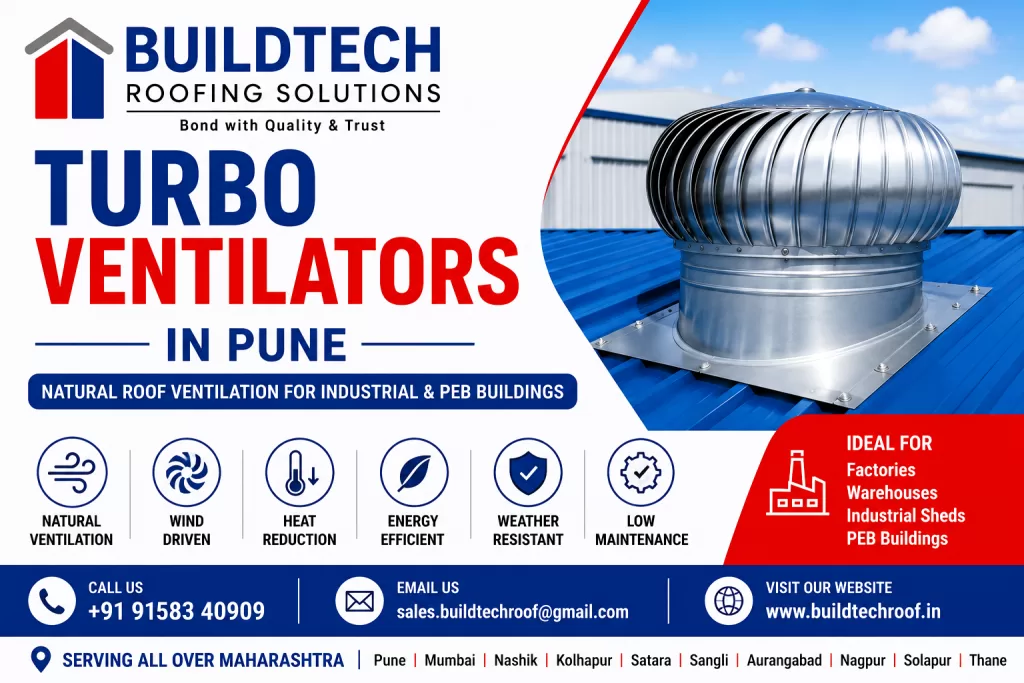
Turbo Ventilators in Pune for Industrial Roof Ventilation Systems
Introduction
Proper ventilation is one of the most important requirements for industrial buildings, warehouses, manufacturing plants, commercial facilities, and Pre-Engineered Buildings (PEBs). Heat generated by machinery, production processes, and solar radiation can quickly accumulate beneath the roof, creating uncomfortable working conditions, increasing energy consumption, and reducing equipment efficiency.
A Turbo Ventilator is one of the most effective natural ventilation solutions for removing hot air, humidity, fumes, smoke, and stale air from industrial buildings. Unlike electrically powered exhaust fans, Turbo Ventilators operate entirely on wind energy and thermal convection, providing continuous ventilation without consuming electricity.
At Buildtech Roofing Solutions, Pune, we manufacture and supply premium-quality Turbo Ventilators designed for high airflow efficiency, durability, and long service life. Our ventilators are suitable for industrial sheds, factories, warehouses, logistics parks, workshops, commercial buildings, and PEB structures across Maharashtra.
Whether you are constructing a new facility or upgrading an existing roof ventilation system, installing a high-quality Turbo Ventilator can improve indoor air quality, lower roof temperatures, reduce humidity, and support a more energy-efficient building.
What is a Turbo Ventilator?
A Turbo Ventilator is a wind-driven, roof-mounted ventilation device that rotates using natural wind and the rising hot air inside a building. As the turbine spins, it extracts hot, stale air from the roof space and continuously replaces it with fresh outside air.
Since it operates without electricity, it offers an economical and environmentally friendly ventilation solution with minimal maintenance requirements.
How Does a Turbo Ventilator Work?
Turbo Ventilators use two natural forces:
Wind Energy
Even a light breeze causes the turbine head to rotate. The spinning action creates negative pressure, drawing hot air upward and out of the building.
Thermal Convection
Hot air naturally rises toward the roof. The rotating ventilator accelerates the removal of this trapped heat, improving continuous airflow inside the building.
Together, these forces provide efficient passive ventilation throughout the day.
Components of a Turbo Ventilator
A standard industrial Turbo Ventilator consists of:
- Turbine Head
- Aluminium or Stainless Steel Blades
- Central Shaft
- Heavy-Duty Bearings
- Base Plate
- Neck Assembly
- Rain Protection Design
- Bird Guard (Optional)
- Fasteners and Flashings
Each component is engineered to withstand continuous operation in industrial environments.
Key Benefits of Turbo Ventilators
1. No Electricity Required
Turbo Ventilators operate entirely on natural wind and thermal movement, eliminating electricity costs.
2. Continuous Air Extraction
They provide uninterrupted ventilation throughout the day, improving airflow even when machinery is operating continuously.
3. Heat Reduction
By removing trapped hot air, Turbo Ventilators help lower indoor temperatures and improve workplace comfort.
4. Improved Indoor Air Quality
They remove:
- Smoke
- Dust
- Chemical fumes
- Moisture
- Hot air
- Stale air
creating a healthier work environment.
5. Energy Savings
Improved natural ventilation can reduce the reliance on exhaust fans and air-conditioning systems, helping lower operating costs.
6. Moisture and Condensation Control
Continuous airflow minimises condensation that could otherwise damage roofing systems, machinery, insulation, and stored goods.
7. Environmentally Friendly
Because Turbo Ventilators require no electrical power, they support sustainable building design and reduce carbon emissions.
8. Low Maintenance
With high-quality bearings and corrosion-resistant materials, Turbo Ventilators require very little maintenance over their service life.
Features of BuildtechRoof Turbo Ventilators
Buildtech Roofing Solutions supplies Turbo Ventilators with:
- High airflow capacity
- Precision-balanced turbine blades
- Corrosion-resistant aluminium construction
- Stainless steel fasteners
- Heavy-duty sealed bearings
- Weather-resistant design
- Long operational life
- Smooth, low-noise rotation
- Compatibility with various roofing profiles
Types of Turbo Ventilators
Aluminium Turbo Ventilators
The most commonly used type due to their lightweight construction and corrosion resistance.
Advantages
- Rust resistant
- Lightweight
- Long-lasting
- Low maintenance
Stainless Steel Turbo Ventilators
Designed for demanding industrial environments that require additional corrosion resistance and strength.
Suitable For
- Chemical plants
- Pharmaceutical industries
- Coastal regions
- Food processing units
Heavy-Duty Industrial Turbo Ventilators
Engineered for buildings with high heat loads and large ventilation requirements.
Common Applications
- Steel plants
- Cement factories
- Automobile manufacturing
- Engineering industries
- Power plants
Common Applications
Turbo Ventilators are widely used in:
- Industrial sheds
- Factories
- Warehouses
- Manufacturing plants
- Logistics parks
- Commercial buildings
- Workshops
- Engineering units
- Food processing industries
- Pharmaceutical facilities
- Textile mills
- Agricultural buildings
- Cold storage support facilities
- PEB structures
Why Turbo Ventilators are Essential
Without adequate ventilation, industrial buildings often experience:
- Excessive heat buildup
- Poor indoor air quality
- Increased humidity
- Worker discomfort
- Higher cooling costs
- Condensation-related damage
- Reduced equipment efficiency
Turbo Ventilators provide a reliable, low-cost solution to these challenges while improving the building’s overall performance and sustainability.
Technical Specifications of Turbo Ventilators
Selecting the right Turbo Ventilator is essential for achieving efficient ventilation, long service life, and reliable performance. The specifications should match the building size, roof height, ventilation requirements, and industrial processes.
At Buildtech Roofing Solutions, every Turbo Ventilator is engineered to deliver maximum airflow with minimal maintenance.
Typical Technical Specifications
| Parameter | Specification |
|---|---|
| Material | Aluminium, Stainless Steel (SS304/SS316) |
| Turbine Diameter | 300mm, 400mm, 500mm, 600mm, 800mm |
| Blade Thickness | 0.4mm – 0.8mm |
| Number of Blades | 28–48 (Model Dependent) |
| Bearing Type | Heavy-Duty Sealed Ball Bearings |
| Shaft Material | Stainless Steel |
| Base Plate | Galvanised Steel / Aluminium |
| Mounting | Roof Mounted |
| Operation | Wind & Thermal Convection |
| Power Requirement | None |
| Maintenance | Minimal |
Material Grades
The material used in a Turbo Ventilator directly affects its durability, corrosion resistance, and operational life.
Aluminium Turbo Ventilators
Aluminium is the preferred material for most industrial applications because it is lightweight and naturally corrosion-resistant.
Advantages
- Rust resistant
- Lightweight
- High strength-to-weight ratio
- Long service life
- Low maintenance
- Suitable for most climates
Stainless Steel Turbo Ventilators
For aggressive environments such as chemical plants and coastal regions, stainless steel provides superior durability.
Benefits
- Excellent corrosion resistance
- High mechanical strength
- Long operational life
- Suitable for high-temperature applications
Galvanised Steel Base
The base assembly is commonly fabricated from galvanised steel for structural strength and weather resistance.
Standard Sizes
Turbo Ventilators are available in different diameters depending on airflow requirements.
| Diameter | Typical Application |
|---|---|
| 300mm | Small workshops and commercial buildings |
| 400mm | Medium industrial sheds |
| 500mm | Warehouses and factories |
| 600mm | Large industrial buildings |
| 800mm | Heavy industrial applications |
The final selection depends on building dimensions, roof height, and required air changes per hour.
Bearing Technology
The bearing system is one of the most important components of a Turbo Ventilator.
Buildtech Turbo Ventilators use high-quality sealed bearings that provide:
- Smooth rotation
- Low friction
- Long operational life
- Minimal maintenance
- Quiet operation
- Reliable performance under continuous use
Airflow Performance
Turbo Ventilators continuously remove:
- Hot air
- Humidity
- Smoke
- Welding fumes
- Dust
- Stale indoor air
Their efficiency increases with wind speed while still functioning through thermal convection in low-wind conditions.
Manufacturing Process
Each Turbo Ventilator manufactured by Buildtech Roofing Solutions follows a strict quality-controlled production process.
Step-1 – Raw Material Selection
Only certified aluminium, stainless steel, and galvanised steel are selected after checking:
- Material grade
- Thickness
- Surface quality
- Corrosion resistance
Step-2 – Precision Cutting
CNC cutting machines produce accurately sized components, ensuring:
- Uniform dimensions
- Reduced material wastage
- Consistent quality
Step-3 – Blade Forming
The turbine blades are shaped using precision forming equipment to achieve:
- Balanced rotation
- Maximum airflow
- Aerodynamic efficiency
Step-4 – Hub Assembly
All blades are securely fixed to the central hub with precise alignment to maintain smooth, vibration-free operation.
Step-5 – Bearing Installation
Premium sealed bearings are installed and tested to ensure reliable performance over extended operating periods.
Step-6 – Base Fabrication
The mounting base is manufactured to suit different roofing profiles, including:
Step-7 – Final Quality Inspection
Each Turbo Ventilator undergoes comprehensive quality checks for:
- Blade balance
- Bearing performance
- Dimensional accuracy
- Rotation smoothness
- Surface finish
- Structural integrity
Installation Process
Proper installation is essential to maximise ventilation efficiency.
Step-1 – Site Assessment
Engineers evaluate:
- Building dimensions
- Heat load
- Roof slope
- Wind direction
- Ventilation requirements
Step-2 – Roof Opening Preparation
Openings are cut according to approved drawings while maintaining structural integrity.
Step-3 – Mounting the Base
The base plate is securely fixed to the roof using corrosion-resistant fasteners.
Step-4 – Waterproof Flashing
Weatherproof flashings and sealants are installed to prevent water leakage.
Step-5 – Ventilator Installation
The turbine assembly is mounted, aligned, and checked for free rotation.
Step-6 – Performance Testing
The completed installation is inspected for:
- Smooth rotation
- Proper alignment
- Secure fixing
- Effective airflow
- Waterproof sealing
Accessories
A complete Turbo Ventilator installation may include:
- Roof Flashings
- EPDM Rubber Gaskets
- Self-Drilling Screws
- Sealing Washers
- Waterproof Sealants
- Bird Mesh (Optional)
- Insect Screens (Optional)
- Customized Mounting Bases
Turbo Ventilator vs Roof Louvers
| Feature | Turbo Ventilator | Roof Louvers |
|---|---|---|
| Operation | Wind-Driven + Thermal Convection | Passive Natural Ventilation |
| Moving Parts | Yes | No |
| Power Requirement | None | None |
| Air Extraction | High | Moderate |
| Maintenance | Low | Very Low |
| Best Use | Heat Extraction | General Ventilation |
Turbo Ventilator vs Ridge Ventilator
| Feature | Turbo Ventilator | Ridge Ventilator |
|---|---|---|
| Installation | Roof Mounted | Along Roof Ridge |
| Airflow | Localized Extraction | Continuous Ridge Ventilation |
| Suitable For | Existing & New Buildings | Large Industrial Roofs |
| Power Requirement | None | None |
| Maintenance | Low | Low |
Performance Advantages
Buildtech Turbo Ventilators offer:
- Continuous natural ventilation
- Reduced indoor heat buildup
- Improved employee comfort
- Better indoor air quality
- Lower energy consumption
- Long-lasting corrosion resistance
- Quiet, reliable operation
- Compatibility with industrial roofing systems
Quality Standards
Every Turbo Ventilator supplied by Buildtech Roofing Solutions is manufactured in accordance with applicable Indian standards and project-specific engineering requirements.
Quality assurance includes:
- Certified raw materials
- Dimensional inspection
- Bearing performance testing
- Blade balancing
- Corrosion-resistant finishes
- Structural integrity verification
- Final visual inspection
Industrial Applications of Turbo Ventilators
Turbo Ventilators are an essential component of modern industrial ventilation systems. They provide continuous natural air extraction without electricity, helping maintain a healthier, cooler, and more productive working environment.
1. Pre-Engineered Buildings (PEBs)
PEB structures are widely used for factories, warehouses, logistics parks, and manufacturing plants. Turbo Ventilators improve natural airflow by continuously exhausting hot air trapped beneath the roof.
Benefits for PEB Buildings
- Reduces roof heat buildup
- Improves employee comfort
- Extends roof sheet life
- Reduces dependence on mechanical ventilation
- Enhances overall energy efficiency
2. Industrial Manufacturing Plants
Manufacturing units generate heat from machinery, furnaces, welding, and production equipment.
Turbo Ventilators help:
- Remove excess heat
- Extract welding fumes
- Improve indoor air quality
- Maintain comfortable working conditions
- Protect machinery from overheating
3. Warehouses & Distribution Centres
Proper ventilation is vital for preserving inventory and ensuring employee comfort.
Advantages
- Prevents heat accumulation
- Controls humidity
- Reduces condensation
- Protects stored materials
- Improves airflow throughout the facility
4. Automobile Workshops
Automotive service centres and assembly plants produce fumes, smoke, and heat from repair and manufacturing activities.
Turbo Ventilators provide:
- Continuous fresh air circulation
- Heat extraction
- Smoke removal
- Better visibility
- Safer working conditions
5. Food Processing Industries
Maintaining a hygienic environment is critical in food production.
Turbo Ventilators assist by:
- Removing steam
- Reducing moisture
- Improving ventilation
- Supporting food safety practices
- Creating a comfortable production environment
6. Pharmaceutical Facilities
Pharmaceutical production requires stable indoor conditions.
Turbo Ventilators contribute by:
- Removing excess heat
- Improving airflow
- Reducing humidity
- Supporting clean manufacturing environments
7. Textile Industries
Textile manufacturing generates lint, heat, and moisture.
Turbo Ventilators help:
- Improve worker comfort
- Reduce airborne fibres
- Control humidity
- Enhance equipment performance
8. Engineering Workshops
Fabrication shops, machine shops, and engineering facilities benefit from efficient ventilation.
Applications include:
- CNC workshops
- Fabrication units
- Machine tool industries
- Metal processing plants
- Steel fabrication facilities
Industries Served
Buildtech Roofing Solutions supplies Turbo Ventilators for:
- Manufacturing Industries
- Automobile Plants
- Engineering Companies
- Warehousing & Logistics
- Food Processing Units
- Pharmaceutical Industries
- Textile Mills
- Chemical Plants
- Infrastructure Projects
- Commercial Buildings
- Educational Institutions
- Agricultural Buildings
- Government Projects
- Industrial Parks
- MIDC Industrial Areas
Benefits of Turbo Ventilators
Natural Heat Removal
Turbo Ventilators continuously extract rising hot air, helping maintain lower indoor temperatures throughout the day.
Improved Indoor Air Quality
They remove:
- Dust
- Smoke
- Chemical vapours
- Welding fumes
- Hot air
- Stale air
This creates a healthier environment for employees and equipment.
Lower Energy Consumption
Since Turbo Ventilators operate without electricity, they help reduce energy usage and operating costs associated with mechanical exhaust systems.
Better Employee Productivity
A cooler and better-ventilated workplace can contribute to improved comfort and productivity while reducing heat-related fatigue.
Moisture & Condensation Control
Continuous airflow helps prevent condensation that can damage:
- Roofing sheets
- Structural steel
- Machinery
- Insulation
- Stored products
Extended Building Life
Lower heat and moisture levels reduce stress on roofing materials and structural components, supporting longer service life.
Environmentally Friendly
Turbo Ventilators use renewable wind energy and natural convection, making them a sustainable ventilation solution for industrial buildings.
Heat Reduction in Industrial Buildings
Industrial buildings often experience significant heat gain due to:
- Solar radiation
- Production machinery
- Welding operations
- Boilers and furnaces
- Manufacturing processes
Turbo Ventilators remove accumulated hot air before it builds up beneath the roof, helping maintain more comfortable indoor conditions and reducing cooling requirements.
Maintenance Best Practices
Turbo Ventilators are designed for low maintenance, but periodic inspections help ensure reliable long-term performance.
Inspect Bearings
Check that bearings rotate smoothly and replace them if signs of excessive wear appear.
Clean the Turbine
Remove accumulated dust, leaves, and debris from the turbine blades to maintain optimal airflow.
Check Fasteners
Inspect mounting bolts, flashing, and roof fasteners to ensure the unit remains securely fixed.
Verify Free Rotation
Confirm that the turbine rotates freely without obstruction or unusual noise.
Inspect Flashings & Sealants
Regularly examine waterproof flashings and sealants to prevent water ingress around the roof opening.
Service Areas
Buildtech Roofing Solutions serves customers across Maharashtra, including:
- Pune
- Mumbai
- Thane
- Nashik
- Kolhapur
- Satara
- Sangli
- Ahmednagar
- Chhatrapati Sambhajinagar (Aurangabad)
- Solapur
- Ratnagiri
- Nagpur
- Jalgaon
- Amravati
We also provide products and support for MIDC industrial estates and major infrastructure projects throughout the state.
Frequently Asked Questions (FAQs)
1. What is a Turbo Ventilator?
A Turbo Ventilator is a roof-mounted, wind-driven ventilation device that removes hot air, humidity, smoke, and stale air from industrial and commercial buildings without using electricity.
2. How does a Turbo Ventilator work?
It operates using two natural forces:
- Wind Energy: Rotates the turbine blades.
- Thermal Convection: Rising hot air creates upward airflow, enhancing air extraction.
This combination provides continuous ventilation with no electrical power.
3. Does a Turbo Ventilator require electricity?
No. Turbo Ventilators are completely electricity-free and rely on natural wind and heat movement, making them an energy-efficient ventilation solution.
4. Where are Turbo Ventilators commonly used?
They are widely installed in:
- Industrial Sheds
- Warehouses
- Factories
- Manufacturing Plants
- Logistics Parks
- PEB Structures
- Engineering Workshops
- Food Processing Units
- Pharmaceutical Facilities
- Commercial Buildings
5. What materials are Turbo Ventilators made from?
Buildtech Turbo Ventilators are available in:
- Aluminium
- Stainless Steel (SS304 / SS316)
Both options offer excellent durability and corrosion resistance.
6. Can Turbo Ventilators reduce indoor temperature?
Yes. By continuously exhausting trapped hot air, Turbo Ventilators help lower indoor temperatures, creating a more comfortable working environment.
7. Are Turbo Ventilators suitable for PEB Buildings?
Yes. Turbo Ventilators are widely used in Pre-Engineered Buildings (PEBs) because they integrate efficiently with steel roofing systems and improve natural ventilation.
8. Do Turbo Ventilators work in low wind conditions?
Yes. Even when wind speeds are low, the natural rise of hot air (thermal convection) helps maintain airflow through the ventilator.
9. What maintenance is required?
Routine maintenance typically includes:
- Cleaning blades
- Inspecting bearings
- Checking fasteners
- Examining flashing and sealants
- Ensuring free turbine rotation
10. Why choose Buildtech Roofing Solutions?
Buildtech Roofing Solutions provides:
- Premium-quality Turbo Ventilators
- Precision manufacturing
- Custom project solutions
- Technical guidance
- Professional support
- Timely delivery across Maharashtra
Why Choose Buildtech Roofing Solutions?
Buildtech Roofing Solutions is a trusted manufacturer and supplier of industrial roofing and ventilation products in Pune and across Maharashtra.
Our Key Strengths
- Premium-quality raw materials
- High-performance Turbo Ventilators
- Advanced manufacturing processes
- Customized engineering solutions
- Experienced technical team
- Competitive pricing
- On-time project delivery
- Installation guidance
- Quality assurance
- Reliable after-sales support
Whether your project involves a factory, warehouse, logistics centre, or commercial building, our ventilation systems are designed to improve airflow, reduce heat, and enhance long-term building performance.
Conclusion
Turbo Ventilators are among the most effective natural ventilation solutions for industrial and commercial buildings. By continuously extracting hot air, moisture, fumes, and stale air without consuming electricity, they improve indoor air quality while reducing operating costs.
Suitable for factories, warehouses, workshops, logistics centres, and PEB structures, Turbo Ventilators contribute to healthier workplaces, better equipment performance, and more energy-efficient buildings. Their durable construction and low maintenance requirements make them a practical long-term investment.
With Buildtech Roofing Solutions, you receive premium-quality Turbo Ventilators, expert technical support, and customised solutions tailored to your project’s ventilation requirements.