
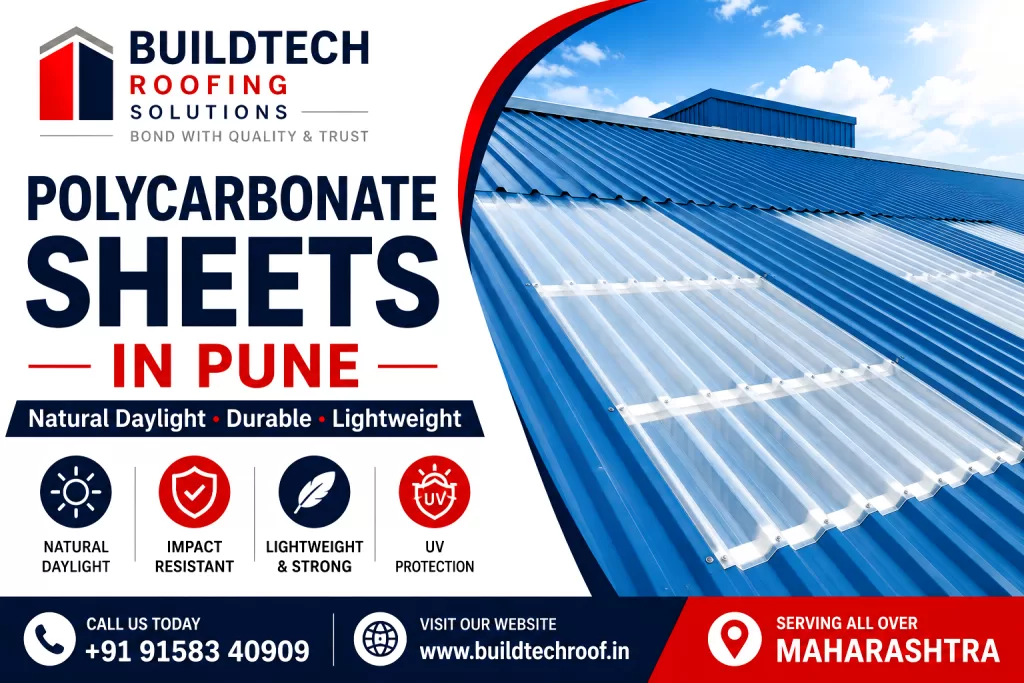
Polycarbonate Sheets in Pune for Roofing, Skylights & Natural Daylighting
Introduction
Natural daylight can play an important role in the design of modern industrial and commercial buildings.
Factories, warehouses, workshops, production facilities and large commercial structures often require substantial lighting during daytime operating hours. A properly designed daylighting system can introduce natural light through selected sections of the roof or walls, reducing reliance on artificial lighting under suitable daylight conditions.
Polycarbonate Sheets are widely used for this purpose because they can combine light transmission with durability and weather resistance.
They can be incorporated into industrial roofing systems as translucent roof sections, skylights, wall panels, canopies and other daylighting applications.
For projects in Pune, Polycarbonate Sheets can be designed and installed alongside metal roofing, PEB structures, insulation, ventilation and rainwater-management systems.
Buildtech Roofing Solutions provides roofing and building-envelope solutions for industrial, commercial, warehouse and PEB projects.
What Are Polycarbonate Sheets?
Polycarbonate Sheets are thermoplastic sheets manufactured from polycarbonate resin.
They are commonly used where a combination of:
- Light transmission
- Impact resistance
- Lightweight construction
- Weather resistance
- UV protection
- Design flexibility
is required.
In roofing applications, translucent Polycarbonate Sheets can be installed between opaque metal roofing sheets to create daylighting zones.
This allows natural light to enter the building while maintaining a continuous weather-resistant roof system when properly designed and installed.
Why Use Polycarbonate Sheets for Roofing?
Traditional metal roofing blocks most natural daylight.
This can result in industrial buildings requiring artificial lighting even during daylight hours.
Polycarbonate daylighting sections can address this issue by allowing controlled quantities of natural light into the building.
Main Advantages
- Natural daylight
- Reduced daytime dependence on artificial lighting
- Lightweight construction
- Good impact resistance
- UV-protection options
- Weather-resistant roofing applications
- Flexible profile options
- Compatibility with industrial roofing systems
The exact performance depends on the selected sheet type, thickness, profile, installation and building design.
How Polycarbonate Roofing Works
A typical industrial daylighting roof uses a combination of opaque roofing sheets and translucent Polycarbonate Sheets.
Basic Arrangement
Metal Roofing → Polycarbonate Daylight Section → Metal Roofing
The polycarbonate section acts as a translucent opening within the roof.
Sunlight passes through the sheet and illuminates the interior space.
The amount of light entering the building depends on:
- Sheet transparency
- Sheet colour
- Profile
- Thickness
- Roof orientation
- Opening size
- Building geometry
- Sun position
- Internal obstructions
Types of Polycarbonate Sheets
Different Polycarbonate Sheets can be selected according to the application.
1. Solid Polycarbonate Sheets
Solid sheets have a continuous cross-section and are known for high impact resistance.
Applications
- Canopies
- Skylights
- Architectural roofing
- Protective glazing
- Commercial structures
Benefits
- High impact resistance
- Good transparency
- Smooth surface
- Modern appearance
- Suitable for demanding applications
2. Multiwall Polycarbonate Sheets
Multiwall sheets contain internal chambers or layers.
They can provide a combination of:
- Natural daylight
- Thermal insulation
- Lightweight construction
- Impact resistance
Your Buildtech product structure separately identifies Multilayer Polycarbonate under Daylighting Systems and describes it as multiwall polycarbonate offering improved insulation and impact resistance.
Applications
- Industrial Skylights
- Canopies
- Walkways
- Commercial Buildings
- Atriums
- Daylighting Systems
3. Corrugated Polycarbonate Roofing Sheets
Corrugated profiles can be manufactured to match or coordinate with common industrial roofing profiles.
Applications
- Factory Roofing
- Warehouse Roofing
- Industrial Sheds
- Canopies
- Agricultural Buildings
Their profile can facilitate integration with profiled metal roofing sheets.
4. Profiled Polycarbonate Sheets
Profiled sheets are shaped to suit specific roofing profiles.
They can be selected where the daylighting panel needs to integrate with:
Proper profile matching is important for overlap, fixing and waterproofing.
5. UV-Protected Polycarbonate Sheets
UV protection can improve resistance to long-term solar exposure.
Depending on the product construction, UV protection may be incorporated as a protective layer or through the material formulation.
Benefits
- Improved outdoor durability
- Better resistance to UV exposure
- Long-term appearance retention
- Suitable for roof and exterior applications
Polycarbonate Sheet Colours
Polycarbonate Sheets can be supplied in different levels of transparency and colour.
Clear
Provides high light transmission.
Opal / Diffused
Distributes light more evenly and can reduce harsh glare.
Bronze or Tinted
Can reduce light transmission and provide a different visual appearance.
Selection Depends On
- Required daylight level
- Building usage
- Heat-control requirements
- Glare considerations
- Roof design
- Climate
- Product specification
The brightest sheet is not automatically the best choice. The objective should be appropriate daylighting, not simply maximum transparency.
Key Features of Polycarbonate Sheets
Lightweight
Polycarbonate sheets are generally lighter than many traditional glazing materials.
This can simplify handling and installation.
Impact Resistance
Polycarbonate is known for high impact resistance compared with many conventional transparent materials.
This makes it useful for industrial and outdoor applications.
Natural Light Transmission
The primary reason for using translucent Polycarbonate Sheets in industrial roofing is their ability to introduce daylight.
UV Protection
Suitable UV protection can help improve the sheet’s resistance to prolonged outdoor exposure.
Weather Resistance
Polycarbonate roofing systems are suitable for outdoor use when the right product, fixing, and sealing system is chosen.
Design Flexibility
Polycarbonate can be used in:
- Roofs
- Skylights
- Canopies
- Facades
- Walkways
- Architectural structures
Benefits of Polycarbonate Sheets
1. Natural Daylighting
The most important benefit is the introduction of natural light.
This can improve visibility and reduce the need for artificial lighting during suitable daylight conditions.
2. Potential Energy Savings
When daylight is sufficient, the building may require less artificial lighting.
The actual energy savings depend on:
- Building operating hours
- Skylight percentage
- Lighting controls
- Daylight availability
- Building orientation
- Internal layout
Energy savings should be part of the overall building design evaluation.
3. Lightweight Roofing Solution
Polycarbonate Sheets can provide daylighting without the weight associated with some traditional glazing systems.
4. High Impact Resistance
Polycarbonate provides good impact resistance, making it suitable for industrial and commercial applications.
5. Architectural Appearance
Translucent roofing sections can create a brighter and more modern building interior.
6. Versatile Applications
Polycarbonate sheets serve both industrial and commercial daylighting needs.
Applications of Polycarbonate Sheets
Industrial Roofing
Polycarbonate sheets serve as translucent daylighting sections in factory and industrial shed roofing.
Warehouse Roofing
Warehouses can benefit from natural daylight, especially in expansive areas where they would otherwise rely on artificial lighting throughout the day.
Factory Skylights
Roof-mounted polycarbonate skylights can introduce daylight into production areas.
Commercial Canopies
Polycarbonate is suitable for:
- Entrance Canopies
- Walkways
- Parking Canopies
- Commercial Shelters
PEB Buildings
Polycarbonate daylighting sections can be used in PEB roofing and wall systems.
Agricultural Buildings
Natural daylight can be beneficial in various settings such as offices, schools, and healthcare facilities. Using daylight in these environments can enhance mood, productivity, and overall well-being. Additionally, natural light can reduce energy consumption and create a more inviting atmosphere.
- Agricultural Storage
- Farm Structures
- Greenhouse-type applications
- Utility Buildings
The choice of the exact sheet type should align with the environmental conditions.
Polycarbonate Sheets for Industrial Buildings
Industrial buildings frequently have large roof areas with limited natural-light openings.
A carefully planned combination of opaque metal roofing and translucent polycarbonate panels can improve daylight distribution.
Typical Arrangement
Opaque Roofing Sheets
↓
Polycarbonate Daylighting Panels
↓
Natural Interior Illumination
This approach can be particularly useful in:
- Manufacturing Plants
- Engineering Factories
- Warehouses
- Workshops
- Logistics Buildings
- PEB Structures
Polycarbonate Sheets for PEB Structures
PEB buildings require coordination between:
- Roof Sheets
- Purlins
- Skylights
- Flashings
- Fasteners
- Insulation
- Ventilation
Polycarbonate Sheets need to be integrated into the PEB roof design instead of being treated as a separate addition.
Important Considerations
- Profile matching
- Purlin spacing
- Sheet overlap
- Fixing arrangement
- Thermal movement
- Flashing
- Waterproofing
- Maintenance access
Polycarbonate Sheets & Metal Roofing
Polycarbonate Sheets work particularly well as daylighting sections within metal roofing systems.
They can be coordinated with:
- Colour Coated Roofing Sheets
- Galvalume Roofing Sheets
- Corrugated Roofing Sheets
- Trapezoidal Roofing Sheets
- Industrial Roofing Sheets
- Standing Seam Roofing Systems
The selected profile should match the roof system wherever applicable.
Polycarbonate Sheets & Ventilation
We can plan daylighting and ventilation together.
A well-designed industrial roof may combine:
Polycarbonate Daylighting + Ridge Ventilation + Roof Louvers + Turbo Ventilators
Each system performs a different function.
Polycarbonate
Provides natural daylight.
Ridge Ventilator
Supports continuous high-level air movement.
Roof Louver
Provides controlled ventilation openings.
Turbo Ventilator
Uses wind-assisted rotation to support air extraction.
This combination can form part of a broader passive building strategy.
Polycarbonate Sheets & Insulation
Daylighting should be considered alongside thermal insulation.
Industrial buildings may use:
- PUF Panels
- Rockwool
- Glass Wool
- XLPE
- Bubble Insulation
- Sandwich Panels
The objective is to balance:
Daylight + Thermal Performance + Ventilation + Weather Protection
Increasing translucent roof area without considering solar heat gain may not always produce the desired thermal result.
Polycarbonate Sheet Selection Factors
Before selecting Polycarbonate Sheets, consider:
1. Application
Roof, wall, canopy, skylight or architectural structure.
2. Profile
The profile should be compatible with the roofing system.
3. Thickness
Thickness affects structural and thermal characteristics.
4. Transparency
Select according to the required daylight level.
5. UV Protection
Important for exterior exposure.
6. Impact Resistance
Consider site conditions and environmental exposure.
7. Thermal Requirements
Multiwall configurations may provide different thermal performance compared with solid sheets.
8. Installation Method
Fixing and sealing must be compatible with the selected sheet.
Why Choose Polycarbonate Sheets for Pune Projects?
For new construction, roofing replacement, and building renovation projects in Pune, consider incorporating daylighting into industrial and commercial buildings.
Polycarbonate Sheets can provide a practical way of introducing natural light while maintaining a lightweight roof construction.
They can be used in:
- Pune Industrial Areas
- MIDC Facilities
- Warehouses
- Manufacturing Plants
- PEB Buildings
- Commercial Projects
Select the correct product based on the building’s actual structural, environmental, and daylighting requirements.
Detailed Polycarbonate Sheet Technical Specifications
Selecting the correct Polycarbonate Sheets in Pune requires more than choosing a transparent roofing material. The sheet should be selected according to the roof profile, structural design, daylight requirement, environmental exposure and intended application.
Important specifications include:
- Sheet type
- Thickness
- Profile
- Width
- Length
- Light transmission
- UV protection
- Impact resistance
- Thermal characteristics
- Colour
- Surface finish
- Installation system
The exact specification must be confirmed with the manufacturer’s technical data and the project’s structural requirements.
Solid vs Multiwall vs Corrugated Polycarbonate Sheets
Polycarbonate Sheets are available in different constructions. Each type serves a different purpose.
| Feature | Solid Polycarbonate | Multiwall Polycarbonate | Corrugated/Profiled Polycarbonate |
|---|---|---|---|
| Construction | Solid sheet | Multiple internal layers | Profiled sheet |
| Light transmission | High | High to moderate | High to moderate |
| Impact resistance | Very high | High | High |
| Thermal insulation | Moderate | Better | Depends on construction |
| Typical application | Canopies, glazing | Skylights, roofs | Industrial roofing |
| Weight | Moderate | Lightweight | Lightweight |
| Roof integration | Good | Good | Excellent for compatible profiles |
The best choice depends on the project rather than one universal specification.
Polycarbonate Sheet Thickness
Thickness is an important consideration when selecting roofing sheets.
Thicker sheets can provide different levels of:
- Rigidity
- Impact resistance
- Thermal performance
- Structural performance
- Serviceability
However, thickness alone does not determine suitability.
The designer should also consider:
- Purlin spacing
- Wind loading
- Span
- Fixing method
- Profile geometry
- Installation conditions
- Expected environmental exposure
For an industrial roofing project, the sheet thickness should therefore be selected based on the actual application and manufacturer’s recommendations.
Polycarbonate Sheet Profile
Profile compatibility is particularly important for industrial roofing.
A profiled Polycarbonate Sheet should be compatible with the surrounding roofing sheet.
Common considerations include:
- Corrugation shape
- Trapezoidal profile
- Rib height
- Pitch
- Sheet overlap
- Fastener position
- Side-lap arrangement
A poorly matched profile can create installation difficulties and increase the risk of leakage.
Light Transmission
One of the major reasons for installing Polycarbonate Sheets is natural daylight.
The amount of light entering the building depends on:
- Transparency
- Sheet colour
- Sheet construction
- Thickness
- Roof area covered
- Solar position
- Building orientation
- Internal obstructions
Clear sheets generally allow greater light transmission, while diffused or tinted products may provide a different balance between daylight and glare.
The objective should be controlled and useful daylight, rather than simply maximum transparency.
UV Protection
Roofing materials are exposed to sunlight for extended periods.
UV protection can help improve the long-term performance of exterior Polycarbonate Sheets.
When selecting a product, check:
- Whether UV protection is provided
- Which surface contains the UV-protective layer
- Manufacturer’s installation instructions
- Warranty conditions
- Recommended orientation of the sheet
The sheet should be installed according to the manufacturer’s instructions so that any UV-protected surface is correctly positioned.
Thermal Performance
Polycarbonate roofing can provide daylight, but thermal performance should also be considered.
Different constructions have different thermal characteristics.
Solid Sheets
Primarily selected for impact resistance, transparency and architectural applications.
Multiwall Sheets
The internal chambers can provide improved insulation compared with a single solid sheet of similar application.
Industrial Daylighting Sheets
Their main purpose may be daylight transmission rather than providing the same thermal performance as an insulated roofing panel.
For factories and warehouses, Polycarbonate Sheets should therefore be evaluated together with the complete roofing and insulation system.
Manufacturing Process of Polycarbonate Sheets
The manufacturing process depends on the particular sheet construction.
A simplified process may involve:
Step-1 – Raw Material Preparation
Polycarbonate resin is prepared according to the required product formulation.
Step-2 – Melting
The material is processed under controlled temperature conditions.
Step-3 – Sheet Formation
The material is formed into the required sheet construction.
Step-4 – Profile Formation
For profiled roofing products, the sheet is shaped according to the required roofing profile.
Step-5 – Surface Treatment
UV protection or other surface treatments may be incorporated according to the product specification.
Step-6 – Cutting
Sheets are cut to the required dimensions.
Step-7 – Quality Inspection
The finished product is checked against the required specifications.
Actual manufacturing processes vary between manufacturers and product ranges.
Quality Inspection Before Installation
Before installing Polycarbonate Sheets, the material should be inspected.
Check for:
- Surface damage
- Cracks
- Scratches
- Manufacturing defects
- Incorrect dimensions
- Profile mismatch
- Damaged edges
- Protective-film condition
The sheets should also be stored correctly before installation.
Improper storage can cause unnecessary damage even when the original product quality is satisfactory.
Polycarbonate Sheet Installation Procedure
Correct installation is essential for long-term performance.
A typical installation process includes the following stages.
Step-1 – Site Inspection
Inspect:
- Roof structure
- Purlins
- Existing roofing
- Roof slope
- Drainage
- Access conditions
- Existing damage
Step-2 – Profile Verification
Confirm that the Polycarbonate Sheet profile matches the surrounding roofing.
This is particularly important when replacing existing daylighting sheets.
Step-3 – Roof Preparation
Remove damaged material and clean the installation area.
The supporting structure should be checked before fixing the new sheets.
Step-4 – Sheet Positioning
Position the sheets according to the approved roof layout.
Ensure proper:
- End overlap
- Side overlap
- Alignment
- Fastener positioning
Step-5 – Fastener Installation
Use suitable roofing fasteners and washers.
Fasteners should be installed following the manufacturer’s recommendations.
Over-tightening can damage the sheet.
Under-tightening can compromise the fixing and sealing system.
Step-6 – Sealing
Suitable sealing materials may be required at overlaps and penetrations.
The sealing system should be compatible with the Polycarbonate Sheet.
Step-7 – Flashing
Flashing details should be provided where the daylighting panel meets:
- Ridge
- Eave
- Wall
- Roof penetration
- Adjacent roofing
Step-8 – Final Inspection
After installation, inspect:
- Fasteners
- Overlaps
- Seals
- Flashings
- Sheet alignment
- Drainage
- Visible damage
A final inspection of watertightness and installation quality should be completed according to the project requirements.
Fasteners & Sealing Requirements
Fasteners are small components but play an important role in roofing performance.
The fixing system should account for:
- Sheet profile
- Supporting structure
- Wind conditions
- Thermal movement
- Washer type
- Fastener spacing
The fixing should not be tightened excessively.
Polycarbonate can experience thermal expansion and contraction, so installation details should allow the material to accommodate movement according to manufacturer specifications.
Waterproofing Details
Waterproofing is particularly important in roof daylighting applications.
Potential leakage points include:
- Side laps
- End laps
- Fastener penetrations
- Flashings
- Ridge connections
- Wall connections
Good waterproofing depends on correct detailing rather than simply applying additional sealant.
The design of the roof should ensure that water flows naturally toward the drainage system.
Polycarbonate vs FRP Skylight Sheets
Polycarbonate and FRP can both serve as materials for translucent roofing and daylighting.
| Feature | Polycarbonate | FRP Skylight |
| Light transmission | Good to high | Good |
| Impact resistance | High | Good to high |
| Lightweight | Yes | Yes |
| Industrial use | High | High |
| Chemical resistance | Product dependent | Often suitable for demanding industrial environments |
| Typical use | Skylights, canopies, daylighting | Industrial skylights and translucent roofing |
Buildtech’s Daylighting Systems category includes both Polycarbonate Sheets and FRP Skylight Sheets, allowing the appropriate product to be considered according to project requirements.
The Polycarbonate vs Glass
Polycarbonate and glass have different performance characteristics.
| Feature | Polycarbonate | Glass |
| Weight | Lightweight | Heavier |
| Impact resistance | High | Product dependent |
| Handling | Easier | Requires greater care |
| Roof application | Highly suitable for many systems | Requires specialised design |
| Daylighting | Excellent | Excellent |
| Design flexibility | High | High |
| Industrial roofing integration | Very suitable | More complex |
Polycarbonate is often considered where lightweight construction and impact resistance are important.
The Polycarbonate Sheet vs Metal Roofing
Metal roofing and Polycarbonate Sheets normally perform different functions.
| Feature | Polycarbonate | Metal Roofing |
| Natural daylight | Yes | No |
| Primary purpose | Daylighting | Weather protection |
| Light transmission | High | Minimal |
| Industrial roof use | Daylight sections | Main roof covering |
| Insulation | Product dependent | Depends on system |
| Typical installation | Selected roof sections | Main roof area |
For many industrial buildings, the two materials are complementary rather than competing products.
Polycarbonate Sheets for Factory Roofs
Factory buildings often have large roof areas.
Daylighting panels can be strategically positioned to improve natural illumination in:
- Production Areas
- Assembly Areas
- Workstations
- Storage Zones
- Inspection Areas
- Circulation Areas
The layout should be designed so that the daylighting system provides useful illumination without unnecessarily increasing heat gain.
Polycarbonate Sheets for Warehouses
Warehouses can benefit from natural daylight because large storage areas may have limited windows.
Applications include:
- Logistics Warehouses
- Distribution Centres
- Industrial Storage Buildings
- Agricultural Storage
- Commercial Warehouses
The roof layout should coordinate daylighting with racks, storage systems, sprinklers, ventilation and electrical installations.
Polycarbonate Sheets for Canopies
Polycarbonate is also suitable for canopy applications.
Examples include:
- Entrance Canopies
- Parking Shelters
- Walkway Covers
- Loading Areas
- Commercial Entrances
- Industrial Access Areas
A canopy design should account for wind, drainage, supporting structure and sheet movement.
Polycarbonate Sheets for Roof Replacement Projects
Existing industrial roofs may contain damaged or aged translucent sheets.
During roof renovation, the daylighting sections should be inspected separately from the main metal roofing.
Possible signs of replacement requirements include:
- Cracking
- Brittleness
- Discolouration
- Leakage
- Surface damage
- Failed fasteners
- Poor sealing
- Reduced daylight transmission
Replacing only the damaged daylighting sections may be appropriate in some projects, while complete roof replacement may be more suitable in others.
A site inspection should determine the correct approach.
Common Installation Mistakes
Mistake 1 – Wrong Profile
Using a sheet that does not match the existing roofing profile can create overlap and fixing problems.
Mistake 2 – Excessive Fastener Tightening
Over-tightening can damage the sheet.
Mistake 3 – Poor Overlap
Incorrect side or end laps can increase leakage risk.
Mistake 4 – Incorrect Sealing
Using unsuitable sealants may affect the sheet or fail under outdoor conditions.
Mistake 5 – Ignoring Thermal Movement
Polycarbonate expands and contracts with temperature changes. Installation should follow the manufacturer’s requirements.
Mistake 6 – Incorrect UV Orientation
If the product has a designated UV-protected surface, it must be installed correctly.
Mistake 7 – Poor Storage
Sheets should be protected from damage before installation.
Mistake 8 – Insufficient Roof Inspection
Installing new sheets over a defective supporting structure can create problems later.
Maintenance of Polycarbonate Sheets
Polycarbonate roofing systems should be periodically inspected.
Recommended Maintenance Activities
- Clean accumulated dirt
- Inspect fasteners
- Check washers
- Inspect overlaps
- Check sealant
- Inspect flashings
- Remove debris
- Check drainage
- Inspect for cracks
- Check for excessive discolouration
Cleaning should be performed using methods and materials compatible with the specific product.
Harsh chemicals or unsuitable cleaning tools should be avoided unless approved by the manufacturer.
How to Improve the Life of Polycarbonate Roofing
The service life of a Polycarbonate Sheet system depends on:
- Product quality
- UV protection
- Correct installation
- Proper fixing
- Weather exposure
- Cleaning
- Maintenance
- Roof design
A high-quality product can still experience premature problems if installation details are incorrect.
Therefore:
Good Product + Correct Design + Professional Installation + Regular Maintenance = Better Roofing Performance
Who Should Consider Polycarbonate Sheets?
Polycarbonate daylighting can be considered by:
- Factory Owners
- Warehouse Owners
- Industrial Developers
- PEB Contractors
- Architects
- Structural Consultants
- Facility Managers
- Commercial Building Owners
- Roofing Contractors
- Manufacturing Companies
It is particularly relevant where natural daylight is desirable, and the roof design can accommodate translucent sections.
Why Choose Buildtech Roofing Solutions?
Buildtech Roofing Solutions can support projects requiring integrated roofing and building-envelope solutions.
The company’s documented product structure covers:
- Roofing Products
- Structural Systems
- PEB Components
- Ventilation Systems
- Daylighting Systems
- Insulation Solutions
- Rainwater Systems
- Specialty Solutions
- Onduline Products
- Roofing Services
This broader portfolio makes it possible to plan Polycarbonate Sheets alongside related roofing, ventilation, insulation and installation requirements.
Frequently Asked Questions
1. What are Polycarbonate Sheets used for?
Polycarbonate Sheets are used for skylights, industrial roof daylighting, canopies, walkways, commercial structures and other applications requiring lightweight translucent roofing.
2. Are Polycarbonate Sheets suitable for industrial roofing?
Yes. Suitable profiled Polycarbonate Sheets can be incorporated into industrial roofing systems as daylighting sections, subject to correct structural design and installation.
3. Can Polycarbonate Sheets be used with metal roofing?
Yes. Polycarbonate daylighting panels are commonly designed to work alongside compatible metal roofing profiles.
4. Are Polycarbonate Sheets UV resistant?
Products can be manufactured with UV protection. The exact UV performance should be verified from the manufacturer’s technical documentation.
5. Are Polycarbonate Sheets better than FRP skylights?
Neither is universally better. The correct choice depends on the required impact resistance, chemical exposure, daylight transmission, durability, profile and project conditions.
6. Can Polycarbonate Sheets reduce electricity consumption?
They can reduce dependence on artificial lighting during periods when sufficient daylight enters the building. Actual savings depend on the building design, operating conditions and lighting controls.
7. Can Polycarbonate Sheets be used in warehouses?
Yes. They can be incorporated into warehouse roofing to introduce natural daylight into large storage areas.
8. How are Polycarbonate Sheets fixed?
Fixing depends on the sheet type and roof profile. Suitable roofing fasteners, washers, overlaps and sealing details should be installed according to the manufacturer’s recommendations.
9. Do Polycarbonate Sheets require maintenance?
Yes. Periodic inspection, cleaning, fastener checks, seal inspection and drainage maintenance can help maintain the roofing system.
10. How much do Polycarbonate Sheets cost in Pune?
There is no single fixed price. Cost depends on sheet construction, thickness, profile, dimensions, UV protection, quantity, accessories and installation requirements. A project-specific quotation is recommended.
Conclusion
Polycarbonate Sheets in Pune provide a practical solution for introducing natural daylight into factories, warehouses, PEB buildings, industrial sheds, commercial buildings and canopy structures.
Their principal advantage is the ability to combine daylight transmission with lightweight construction and impact-resistant material characteristics.
For industrial and commercial projects in Pune, selecting the correct Polycarbonate Sheet specification and installing it with proper roofing details is essential for achieving reliable long-term performance.