
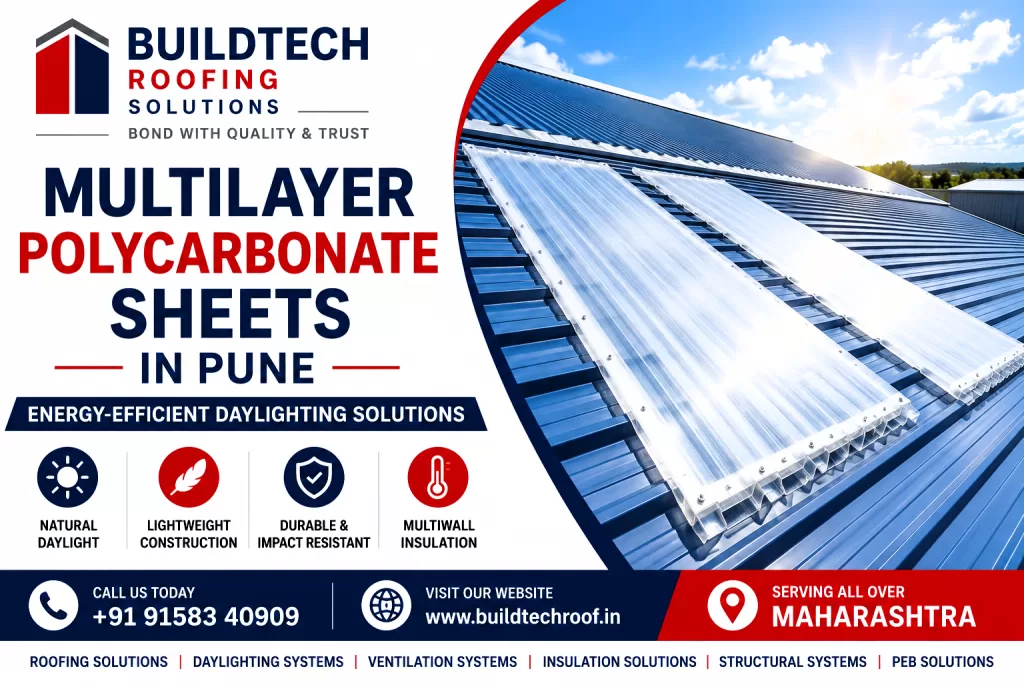
Multilayer Polycarbonate Sheets in Pune
Multilayer Polycarbonate Sheets in Pune: Multiwall Roofing & Daylighting Natural daylight is an important consideration when designing modern factories, warehouses, workshops, commercial buildings, and other large structures. Large industrial buildings often have extensive roof areas with limited wall openings, which can result in significant dependence on artificial lighting during the day. Multilayer Polycarbonate Sheets provide a practical daylighting solution for these applications. Their multiwall construction incorporates internal chambers that combine lightweight construction, rigidity, natural light transmission, and useful thermal-performance characteristics. For industrial projects in Pune, these sheets can be integrated into roofing systems as selected daylighting sections, skylights, canopies, walkways, and other translucent structures. At Buildtech Roofing Solutions, Multilayer Polycarbonate is part of the company’s Daylighting Systems range, alongside Polycarbonate Sheets, FRP Skylight Sheets, and Roof Light Systems. What Are Multilayer Polycarbonate Sheets? Multilayer Polycarbonate Sheets are translucent panels manufactured with multiple layers connected by internal ribs or webs. These components create a multiwall or cellular structure inside the sheet. The internal construction can provide a combination of: The exact performance depends on the sheet construction, thickness, chamber configuration, surface treatment, and other product specifications. Unlike a conventional solid polycarbonate sheet, a multilayer sheet contains internal chambers. These chambers can reduce direct heat transfer compared with a simple single-layer sheet, which is one reason multiwall polycarbonate is used for daylighting and roofing applications. Why Choose Multilayer Polycarbonate for Industrial Roofing? Industrial buildings often need to balance several requirements at the same time: Natural Daylight + Thermal Performance + Weather Protection + Lightweight Construction Multilayer Polycarbonate Sheets can contribute to this combination while allowing selected sections of an otherwise opaque roof to transmit daylight. Common Applications How Multilayer Polycarbonate Sheets Are Constructed The internal structure is one of the most important characteristics of a multiwall polycarbonate sheet. A simplified cross-section can be understood as: Outer Layer → Internal Rib / Air Chamber → Intermediate Layer → Internal Rib / Air Chamber → Inner Layer The internal ribs contribute to rigidity, while the chambers contribute to the sheet’s lightweight construction and thermal characteristics. This construction allows multilayer polycarbonate to offer a different performance balance from conventional solid sheets. Key Features of Multilayer Polycarbonate Sheets 1. Multiwall Construction Multiple layers and internal chambers create a combination of rigidity and lightweight construction. Different chamber arrangements can provide different levels of thermal and structural performance. 2. Natural Light Transmission The translucent construction allows daylight to enter enclosed spaces. This can be particularly useful for: 3. Lightweight Design Multilayer polycarbonate provides a relatively lightweight translucent surface compared with many conventional glazing systems. This can simplify: 4. Thermal Performance Internal air chambers can provide improved thermal resistance compared with a simple single-layer translucent sheet. Actual performance depends on: 5. Impact Resistance Polycarbonate is known for its impact-resistant characteristics, making it suitable for many industrial and commercial applications where translucent roofing is required. 6. UV Protection Options Outdoor polycarbonate products can incorporate UV-protection features. The exact UV specification and installation orientation should always be confirmed from the manufacturer’s technical documentation. Types of Multilayer Polycarbonate Sheets The appropriate multiwall construction depends on the application, required rigidity, thermal requirements, daylight requirements, and supporting structure. Twin-Wall Polycarbonate Twin-wall sheets contain two primary layers connected by internal ribs. Typical Applications Benefits Triple-Wall Polycarbonate Triple-wall construction introduces additional internal structure compared with twin-wall products. Potential advantages include: Multiwall Polycarbonate More complex multiwall configurations can provide different levels of: The exact number of walls and chamber configuration should be selected according to the manufacturer’s technical specification. Cellular Polycarbonate The term cellular polycarbonate generally refers to sheets containing internal hollow chambers. These chambers contribute to the product’s lightweight construction and thermal characteristics. Diffused Multilayer Polycarbonate Diffused products distribute incoming daylight more evenly. They can be useful where glare control and uniform illumination are important. Potential applications include: Clear vs Diffused Multilayer Polycarbonate The highest light-transmission product is not necessarily the best solution for every building. Feature Clear Diffused Light Direction More direct More distributed Glare Control Lower Better Visual Effect Brighter/direct Softer/even Typical Use Maximum daylight Uniform illumination For industrial buildings, the choice should consider daylight requirements, glare, solar exposure, building use, and roof orientation. Available Colours and Transparency Options Depending on the product range, Multilayer Polycarbonate Sheets can be available in different colours and transparency levels. Clear Suitable where relatively high daylight transmission is desired. Opal / Diffused Suitable where more evenly distributed light is preferred. Tinted Can provide lower light transmission and a different visual appearance. Selection should consider: Benefits of Multilayer Polycarbonate Sheets Natural Daylighting The primary advantage is the ability to introduce natural light into enclosed spaces. Strategically positioned translucent roof sections can reduce dependence on artificial lighting during suitable daylight conditions. Improved Light Distribution Diffused multiwall products can distribute daylight more evenly, which can be useful for large workspaces where strong direct sunlight is undesirable. Useful Thermal Characteristics The internal chambers can provide improved thermal resistance compared with some single-layer translucent materials. Lightweight Construction The relatively low weight can simplify handling and installation. Impact Resistance Polycarbonate provides good impact resistance for many industrial and commercial applications. Flexible Applications Multilayer Polycarbonate can be used for: Modern Appearance Its translucent appearance can provide industrial and commercial buildings with a clean, modern architectural finish. Multilayer Polycarbonate for Industrial Roofing A modern industrial roof can combine opaque metal roofing with selected translucent daylighting panels. A typical arrangement can be: Metal Roofing → Multilayer Polycarbonate Daylighting Section → Metal Roofing This approach allows natural daylight to enter selected areas without replacing the complete roof with translucent material. The result is a coordinated roofing system that combines weather protection from metal roofing with daylighting from translucent polycarbonate sections. Multilayer Polycarbonate for Factories Factories often have large production floors where wall openings alone cannot provide sufficient natural illumination. Multilayer Polycarbonate panels can be strategically positioned above: The objective should not simply be to maximise translucent roof area. Instead, the daylighting system should balance natural light, glare control, solar heat management, and overall roof performance. Multilayer Polycarbonate
Multilayer Polycarbonate Sheets in Pune Read More »