
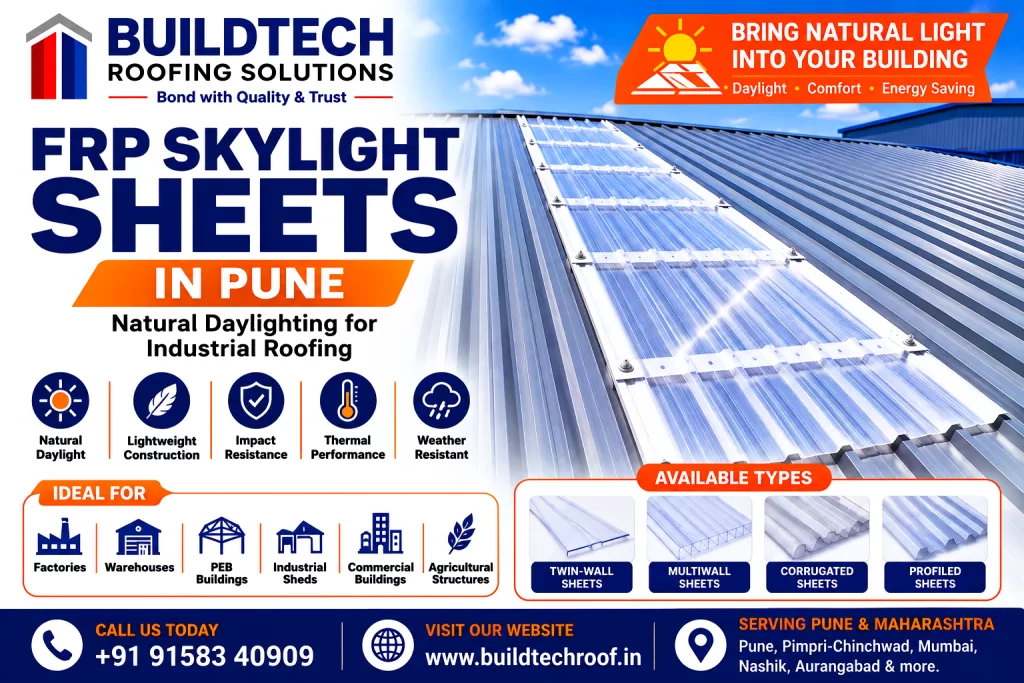
FRP Skylight Sheets in Pune for Industrial Roofing
Natural daylight is an important consideration when designing modern factories, warehouses, industrial sheds and Pre-Engineered Buildings. Large industrial structures often have extensive roof areas, making the roof an effective location for introducing daylight into the interior.
FRP Skylight Sheets Pune provide a practical daylighting solution by allowing natural light to enter through selected sections of an industrial roofing system.
FRP, or Fibre Reinforced Plastic, skylight sheets are translucent roofing products designed for suitable industrial and commercial applications. They can be integrated with compatible metal roofing to create dedicated daylighting sections while maintaining the overall function of the roof.
For industrial projects in Pune and across Maharashtra, proper product selection and installation are essential. Roof profile, supporting structure, sheet specification, fasteners, overlaps, flashing and waterproofing should all be considered as part of the complete roofing system.
Buildtech Roofing Solutions offers FRP Skylight Sheets as part of its Daylighting Systems and broader industrial roofing product range.
What Are FRP Skylight Sheets?
FRP Skylight Sheets are fibre-reinforced translucent roofing sheets designed to transmit natural daylight. Industrial roofing contractors commonly install them within conventional roofing systems instead of using them as the entire roof covering.
A typical roof arrangement may therefore include:
Metal Roofing Sheets → FRP Skylight Section → Metal Roofing Sheets
This arrangement allows selected portions of the roof to transmit daylight into the building.
FRP skylights provide a practical solution for bringing natural daylight into industrial buildings, warehouses, factories, and commercial spaces.:
- Factories
- Industrial sheds
- Warehouses
- Workshops
- PEB buildings
- Manufacturing facilities
- Commercial buildings
- Agricultural structures
The supplied Buildtech content specifically positions FRP Skylight Sheets for industrial roofing and natural daylight applications.
Why Choose FRP Skylight Sheets for Industrial Buildings?
Industrial buildings frequently operate during daytime hours. Therefore, reducing unnecessary dependence on artificial lighting can be an important design consideration.
FRP skylights can help introduce daylight from above, particularly in large buildings where conventional windows may not provide sufficient illumination throughout the interior.
The main objectives include:
- Increasing natural daylight
- Improving daytime visibility
- Supporting energy-efficient building design
- Creating brighter working areas
- Integrating daylighting with industrial roofing
However, the amount of benefit depends on the roof design, skylight arrangement, building orientation, internal layout and operating conditions.
Key Benefits of FRP Skylight Sheets
1. Natural Daylighting
The primary benefit of an FRP skylight is its ability to transmit natural daylight.
Strategically positioned skylight sections can introduce daylight into areas that may otherwise require artificial lighting during daytime.
This makes FRP skylights particularly useful for large factories, warehouses and industrial sheds.
2. Reduced Dependence on Artificial Lighting
When sufficient natural illumination is available, businesses may be able to reduce their use of electric lighting during appropriate daytime periods.
Actual energy savings vary according to the building’s design, operating schedule, skylight area and lighting controls.
Therefore, treat FRP skylights as part of an overall daylighting strategy rather than as a guarantee of fixed energy savings.
3. Compatible with Industrial Roofing
Roofing contractors can incorporate FRP Skylight Sheets into suitable metal roofing systems.
Correct matching between the FRP profile and adjoining roofing sheets is important for proper installation.
The Buildtech source specifically highlights profile matching, laps, fasteners and flashing as important considerations.
4. Suitable for Large Roof Areas
Factories and warehouses often have extensive roof surfaces.
Installing selected translucent sections can provide overhead daylight without converting large areas of the building envelope into transparent openings.
5. Improved Interior Visibility
Better natural illumination can improve visibility in suitable workspaces.
This can be particularly useful in:
- Production areas
- Workshops
- Storage areas
- Assembly zones
- Industrial circulation spaces
6. Practical Daylighting for PEB Buildings
FRP skylights can be incorporated into suitable PEB roofing systems.
The design should coordinate the skylight with:
- Purlin arrangement
- Roofing profile
- Fastening system
- Roof slope
- Structural layout
- Waterproofing details
PEB skylights are specifically identified as a relevant application in the supplied keyword structure.
Applications of FRP Skylight Sheets
FRP Skylights for Factories
Factories often require good visibility across large production floors.
FRP skylight sections can be incorporated into compatible roofing systems to introduce daylight into selected production areas.
The exact skylight arrangement should be based on the building’s operational and roofing requirements.
FRP Skylights for Warehouses
Warehouses commonly have large roof areas and limited external openings.
Warehouse skylights can provide natural overhead illumination for appropriate storage and operational areas.
For light- or heat-sensitive products, however, the skylight arrangement should be carefully evaluated.
FRP Skylights for Industrial Sheds
Industrial sheds are one of the most common applications for translucent roofing products.
FRP Skylight Sheets can be positioned within compatible roofing profiles to improve daylight availability while retaining conventional metal roof coverage.
FRP Skylights for PEB Buildings
Modern PEB structures can incorporate daylighting as part of their overall roof design.
FRP skylights can be coordinated with the PEB’s purlins and roofing sheets to create planned daylighting zones.
FRP Skylights for Workshops
Workshops can benefit from natural overhead light, particularly where the building has limited wall openings.
A properly planned skylight arrangement can help create a brighter working environment during daylight hours.
FRP Skylights for Commercial and Agricultural Buildings
Suitable FRP daylighting products may also be considered for selected commercial, agricultural and utility structures where translucent roofing is appropriate.
Product selection should always account for the specific building environment and roof configuration.
FRP Skylight Sheets and Metal Roofing
A skylight should be considered part of the complete roofing assembly.
Important installation elements include:
Roofing Profile
The FRP sheet profile should correspond with the surrounding roof system.
Sheet Dimensions
The required length and width should be established from the roof layout.
Laps
Correct side and end laps are important for weather protection.
Fasteners
Suitable roofing fasteners and washers should be used according to the selected system.
Flashing
Roof junctions require suitable flashing details.
Sealants
Appropriate sealing should be used where required.
Waterproofing
All roof penetrations, joints and interfaces should be properly detailed.
This integrated approach helps maintain the roofing system’s weather-protection function.
How to Select FRP Skylight Sheets in Pune
Choosing the correct FRP skylight requires more than selecting a sheet based only on price.
1. Check the Roof Profile
The skylight must be compatible with the existing or proposed roofing profile.
2. Determine the Required Sheet Size
Confirm the required length and width based on the roof layout.
3. Evaluate Daylight Requirements
Determine where natural daylight is required and how much translucent roofing is appropriate.
4. Consider the Building Environment
Review exposure to:
- Weather
- Humidity
- Industrial pollutants
- Chemicals
- Dust
- Heat
5. Review Supporting Structure
Purlin spacing and roof framing should be checked before installation.
6. Select Appropriate Fasteners
Fasteners and washers should be compatible with the roofing system.
7. Plan Waterproofing
Laps, flashing and sealing details should be established before installation.
8. Consider Maintenance
The accessibility and cleaning requirements of the skylight should be considered during design.
FRP Skylight Sheets vs Multilayer Polycarbonate
FRP is not automatically the best daylighting material for every application.
Buildtech’s Daylighting Systems category includes both FRP Skylight Sheets and Multilayer Polycarbonate. The supplied comparison identifies FRP as a translucent fibre-reinforced sheet, whereas multilayer polycarbonate uses a multiwall thermoplastic construction with thermal performance advantages associated with its structure.
| Feature | FRP Skylight Sheets | Multilayer Polycarbonate |
|---|---|---|
| Construction | Fibre-reinforced translucent sheet | Multiwall thermoplastic |
| Daylighting | Yes | Yes |
| Thermal characteristics | Product dependent | Multiwall construction can provide insulation advantages |
| Application | Industrial roofing/daylighting | Daylighting and building-envelope applications |
| Selection | Based on project requirements | Based on project requirements |
The correct product should therefore be selected according to the actual building application rather than simply by material preference.
FRP Skylights and Roof Ventilation
Daylighting and ventilation address different building requirements.
A well-planned industrial roof can combine:
FRP Skylight Sheets
for natural daylight
Turbo Ventilators
for roof-level air exhaust
Ridge Ventilators
for ridge-level ventilation
Roof Louvers
for ventilation openings
Buildtech’s product hierarchy places these ventilation systems alongside its Daylighting Systems.
This creates an opportunity to design daylighting and ventilation as complementary parts of the industrial building envelope.
FRP Skylights and Insulation
Daylighting should also be considered alongside thermal requirements.
Buildtech’s related insulation range includes:
- PUF Panels
- XLPE Insulation
- Rockwool Insulation
- Glass Wool Insulation
- Bubble Insulation
- Thermal Roofing Systems
- Sandwich Panels
These products are part of the same broader industrial-building product structure.
For temperature-sensitive environments, the daylighting strategy should be coordinated with the overall thermal design.
FRP Skylights and Rainwater Systems
A roof daylighting system must also work with the roof drainage arrangement.
Relevant components include:
- Eave Gutters
- Valley Gutters
- Down Take Pipes
These systems form part of Buildtech’s Rainwater Systems category.
Proper coordination helps maintain the roof’s overall water-management performance.
FRP Skylight Installation Process
Professional installation is essential for integrating skylights into an industrial roofing system.
Step-1 – Site Survey
Inspect the existing or proposed roof and understand the building’s daylighting requirements.
Step-2 – Roof Assessment
Check the roof profile, purlins, slope and supporting structure.
Step-3 – Skylight Planning
Determine the appropriate locations for the FRP skylight sections.
Step-4 – Material Preparation
Confirm sheet dimensions, fasteners, washers, flashing and sealing materials.
Step-5 – Sheet Installation
Position the FRP sheets correctly with the adjoining roofing sheets.
Step-6 – Fastening
Install suitable fasteners without compromising the sheet or waterproofing arrangement.
Step-7 – Flashing and Sealing
Complete roof junctions, laps and sealing details.
Step-8 – Final Inspection
Check alignment, fixing, laps, flashing and potential water-entry points.
The supplied Buildtech material emphasises that successful FRP integration depends on proper profile matching, overlaps, fasteners, flashing and waterproofing.
Maintenance of FRP Skylight Sheets
Regular maintenance helps preserve the performance of the complete roofing system.
Inspect the following:
- FRP sheets
- Fasteners
- Washers
- Sheet laps
- Flashings
- Sealants
- Roof drainage
- Visible damage
The translucent surface should also be kept reasonably clean because accumulated dirt can reduce the amount of daylight entering the building.
For an existing industrial building, FRP skylight inspection can be incorporated into the broader roof-maintenance schedule.
FRP Skylights During Roof Replacement
Roof replacement is an excellent opportunity to reassess the building’s daylighting requirements.
Before installing new skylights, inspect:
- Existing roofing
- Purlins
- Structural condition
- Roof profile
- Drainage system
- Existing skylight condition
The supplied Buildtech content specifically recommends reassessing daylighting requirements during roof replacement and checking the existing roof and supporting structure before modification.
Important Factors for Industrial Buyers
When purchasing FRP Skylight Sheets in Pune, provide the supplier with sufficient project information.
Project Details
- Building type
- Location
- New construction or existing building
- Approximate roof area
Roofing Details
- Roofing profile
- Roof slope
- Purlin spacing
- Sheet dimensions
Daylighting Details
- Required daylighting area
- Interior application
- Desired daylight distribution
Site Conditions
- Industrial environment
- Chemical exposure
- Humidity
- Dust
- Heat
Installation Details
- Roof height
- Accessibility
- Existing roof condition
- Fastening requirements
- Flashing requirements
This information supports more accurate product selection and quotation.
Frequently Asked Questions
1) What are FRP Skylight Sheets?
FRP Skylight Sheets are translucent, fibre-reinforced roofing sheets designed to allow natural daylight into suitable buildings.
2) Where are FRP Skylight Sheets used?
Factories, warehouses, industrial sheds, workshops, PEB buildings, and other suitable structures can use FRP Skylight Sheets to introduce natural overhead daylight.
3) Can FRP Skylights be installed with metal roofing?
Yes. They can be integrated with compatible metal roofing when the profile, overlaps, fasteners, flashing and waterproofing are properly coordinated.
4) Do FRP Skylights reduce electricity consumption?
They can reduce dependence on artificial lighting during suitable daylight hours. Actual savings depend on the building design and lighting requirements.
5) Are FRP Skylights suitable for warehouses?
Yes. They can be used for warehouse daylighting, subject to appropriate product selection and consideration of stored materials.
6) Are FRP Skylights suitable for PEB buildings?
Yes. They can be incorporated into suitable PEB roofing systems with proper coordination of the roof profile, purlins and fastening system.
7) How do I choose FRP Skylight Sheets in Pune?
Consider the roof profile, sheet dimensions, daylight requirement, environmental exposure, supporting structure, fasteners, flashing, waterproofing and installation requirements.
8) What is the difference between FRP and multilayer polycarbonate?
FRP is a fibre-reinforced translucent sheet, while multilayer polycarbonate is a multiwall thermoplastic daylighting product. The appropriate choice depends on the project’s specific requirements.
9) Can FRP skylights work alongside roof ventilation systems?
Yes. Skylights and ventilation systems serve different functions, and roofing designers can incorporate both into the same industrial roofing design.
10) Should contractors consider FRP skylights during roof replacement?
Yes. Roof replacement provides an opportunity to reassess daylighting requirements and upgrade suitable roof sections.
Conclusion
Better Daylight Starts with Better Roof Planning
FRP Skylight Sheets in Pune provide a practical solution for introducing natural daylight into suitable industrial roofing systems.
Roofing contractors can use FRP Skylight Sheets in factories, warehouses, industrial sheds, workshops, and PEB buildings alongside conventional metal roofing.
However, the best result comes from treating skylights as part of the complete building-envelope design.
The key considerations are:
Roof Profile → Sheet Specification → Daylight Requirement → Structural Support → Fasteners → Laps → Flashings → Waterproofing → Ventilation → Insulation → Drainage → Maintenance
For new construction, designers should consider daylighting during the roof design stage. For existing buildings, qualified professionals should inspect the roof and supporting structure before making any modifications.
Buildtech’s product structure places FRP Skylight Sheets, Polycarbonate Sheets, Multilayer Polycarbonate and Roof Light Systems under Daylighting Systems, creating a strong topical cluster for industrial daylighting solutions.
For industrial buyers, contractors and building owners in Pune, the objective should therefore be to select a daylighting solution that balances natural light, roofing compatibility, waterproofing, durability, ventilation, thermal requirements and maintenance.