
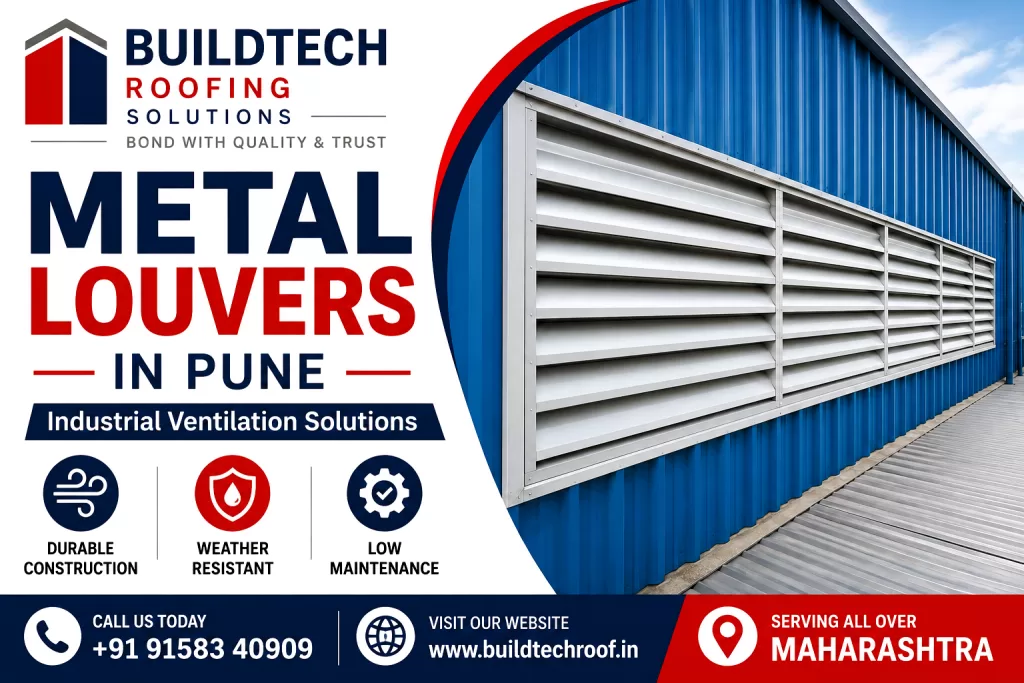
Metal Louvers in Pune for Industrial Ventilation Solutions
Introduction
Proper ventilation is an important part of industrial building design. Factories, warehouses, workshops, manufacturing plants and commercial buildings can experience heat accumulation, humidity and poor air circulation when adequate ventilation openings are not provided.
Metal Louvers provide a practical and durable method of controlling air movement while offering protection against direct weather exposure. They are commonly used as ventilation openings in industrial and commercial buildings and can be integrated with roofing, wall cladding and structural systems.
For industrial projects in Pune, Metal Louvers can be designed according to the building configuration, ventilation requirements, material selection and weather conditions.
Buildtech Roofing Solutions supplies roofing, ventilation, structural and building-envelope solutions for industrial, commercial, warehouse and PEB projects in Pune and across Maharashtra.
What Are Metal Louvers?
Metal Louvers are assemblies made from metal blades or slats arranged at specific angles to allow air to pass through a ventilation opening.
The angled blades create a controlled airflow path while helping reduce direct exposure to rain and other external elements.
Depending on the application, Metal Louvers can be installed in:
- Industrial buildings
- Factory walls
- Warehouse ventilation openings
- PEB structures
- Roof ventilation systems
- Machinery rooms
- Utility buildings
- Commercial buildings
- Mechanical ventilation openings
The louver configuration can be customised according to the required opening dimensions and project requirements.
How Do Metal Louvers Work?
Metal Louvers operate by providing a controlled opening through which air can enter or leave a building.
Step-1 – Air Movement
Air moves because of differences in temperature, pressure and wind conditions between the interior and exterior.
Step-2 – Louver Opening
The angled metal blades create an opening for air movement.
Step-3 – Weather Protection
The blade arrangement helps reduce direct rain penetration while maintaining an airflow path.
Step-4 – Continuous Ventilation
When properly positioned with suitable air inlets and outlets, louvers can contribute to continuous natural or mechanically assisted ventilation.
Why Are Metal Louvers Important?
Large industrial buildings often require controlled ventilation because of:
- Solar heat
- Machinery-generated heat
- Manufacturing processes
- Humidity
- Stale air
- Smoke or process fumes
- High internal occupancy
Metal Louvers can form part of the building’s overall ventilation strategy.
Key Functions
- Facilitate air movement
- Support natural ventilation
- Provide weather protection
- Improve air circulation
- Help remove accumulated warm air
- Provide durable ventilation openings
Types of Metal Louvers
Different Metal Louver designs can be selected according to the location and intended application.
1. Fixed Metal Louvers
Fixed louvers use stationary blades positioned at a specific angle.
Features
- Simple construction
- No moving components
- Low maintenance
- Durable
- Suitable for continuous ventilation
Applications
- Factories
- Warehouses
- Industrial Sheds
- Workshops
- Utility Buildings
2. Weather Metal Louvers
Weather louvers are designed to allow airflow while helping protect the opening from direct rain.
Benefits
- Improved weather protection
- Durable construction
- Natural airflow
- Low maintenance
- Suitable for exposed building openings
3. Industrial Metal Louvers
Industrial Metal Louvers are designed for large ventilation openings in factories, warehouses and industrial structures.
Applications
- Manufacturing Plants
- Engineering Units
- Fabrication Shops
- PEB Buildings
- Large Warehouses
These systems can be manufactured in project-specific dimensions.
4. Architectural Metal Louvers
Metal Louvers can also be used where ventilation needs to be combined with building appearance.
Applications
- Commercial Buildings
- Office Buildings
- Retail Buildings
- Institutional Buildings
- Modern Industrial Facilities
The louver profile and finish can be selected to complement the building’s exterior.
5. Custom Metal Louvers
Custom louvers are useful when standard dimensions do not match the project requirements.
Possible customisation includes:
- Length
- Height
- Width
- Blade angle
- Blade spacing
- Material
- Surface finish
- Frame design
- Mounting arrangement
Materials Used for Metal Louvers
Material selection depends on the building environment, required service life, corrosion exposure, appearance and project budget.
Galvanised Steel Metal Louvers
Galvanised steel is widely suitable for industrial applications where strength and corrosion protection are important.
Advantages
- High strength
- Corrosion resistance
- Durable construction
- Suitable for industrial environments
- Cost-effective
Applications
- Factories
- Industrial Sheds
- Warehouses
- Engineering Plants
- PEB Structures
Colour-Coated Steel Metal Louvers
Colour-coated steel can be used where the louver needs to match the roofing or wall cladding system.
Benefits
- Attractive appearance
- Colour coordination
- Additional surface protection
- Suitable for modern industrial buildings
Aluminium Metal Louvers
Aluminium provides a lightweight and corrosion-resistant alternative.
Benefits
- Lightweight
- Corrosion resistant
- Easy handling
- Low maintenance
- Suitable for demanding environments
Aluminium louvers can be particularly useful where reduced structural weight is desirable.
Stainless Steel Metal Louvers
Stainless steel may be considered for applications where higher corrosion resistance and durability are required.
Applications
- Special industrial environments
- Process facilities
- Commercial buildings
- Areas with increased corrosion exposure
Material grade should be selected according to the actual environmental conditions and project specification.
Main Components of Metal Louvers
A typical Metal Louver assembly may include:
- Louver Blades
- Supporting Frame
- Side Panels
- End Covers
- Mounting Brackets
- Flashing
- Fasteners
- Weather Protection Components
The exact configuration depends on the installation location and design.
Benefits of Metal Louvers
1. Effective Air Movement
Metal Louvers provide controlled ventilation openings for natural or mechanically assisted air movement.
2. Weather Protection
Angled blades help reduce direct rain penetration while maintaining ventilation.
3. Durable Construction
Metal construction provides strength and durability for demanding industrial applications.
4. Low Maintenance
Fixed Metal Louvers have no complex moving mechanism, making routine maintenance relatively simple.
5. Corrosion Protection
Selecting galvanised, coated, aluminium or suitable stainless-steel construction can improve resistance to environmental exposure.
6. Improved Indoor Environment
Proper ventilation can help reduce heat accumulation and improve indoor air circulation.
7. Versatile Applications
Metal Louvers can be used across:
- Factories
- Warehouses
- PEB Buildings
- Industrial Sheds
- Workshops
- Commercial Buildings
- Utility Areas
Metal Louvers for Industrial Buildings
Industrial facilities frequently require ventilation openings because machinery and manufacturing processes generate heat.
Metal Louvers can be positioned strategically to support airflow through the building.
Common Applications
- Manufacturing Plants
- Automobile Facilities
- Engineering Industries
- Fabrication Workshops
- Machinery Areas
- Production Buildings
Metal Louvers for Warehouses
Large warehouses can experience heat accumulation beneath extensive metal roofing.
Metal Louvers can provide controlled ventilation openings to support air movement.
Suitable For
- Distribution Centres
- Logistics Parks
- Storage Warehouses
- E-Commerce Warehouses
- Industrial Storage Facilities
Metal Louvers for PEB Buildings
Pre-Engineered Buildings require coordinated planning between ventilation openings, roofing sheets, structural framing and cladding.
Metal Louvers can be integrated into PEB structures during the design or installation stage.
Applications
- PEB Factories
- PEB Warehouses
- Industrial Sheds
- Logistics Buildings
- Commercial PEB Structures
Metal Louvers for Roof Ventilation
Metal Louvers can also form part of roof-level ventilation systems.
They can be integrated with:
- Roof Louvers
- Ridge Ventilators
- Turbo Ventilators
- Roof Openings
- Fresh-Air Inlets
The final configuration should be based on the building’s ventilation requirements.
Metal Louvers vs Roof Louvers
| Feature | Metal Louvers | Roof Louvers |
|---|---|---|
| Main Purpose | Controlled ventilation opening | Roof-level ventilation |
| Installation | Walls/roof /openings | Roof ventilation zone |
| Blade Design | Fixed or weather blades | Roof-specific louver arrangement |
| Weather Protection | Yes, depending on design | Yes |
| Applications | Industrial & commercial | Primarily roof ventilation |
| Customisation | High | Project-specific |
| Maintenance | Low | Low |
The terminology can overlap depending on the manufacturer’s design and installation configuration.
Technical Specifications of Metal Louvers
Metal Louvers should be selected according to the building’s ventilation requirements, installation location, environmental exposure and structural arrangement. For industrial projects, the louver assembly should provide an appropriate balance between airflow, weather protection, structural strength and durability.
Typical Technical Parameters
| Parameter | Typical Specification |
|---|---|
| Product Type | Fixed / Weather / Industrial Metal Louver |
| Operating Principle | Natural or Mechanical Air Movement |
| Blade Type | Angled Fixed Blades |
| Material | Galvanised Steel / Colour-Coated Steel / Aluminium / Stainless Steel |
| Frame | Galvanised Steel / Aluminium / Project-Specified Material |
| Surface Finish | Galvanised / Colour Coated / Powder Coated |
| Installation | Wall / Roof / Ventilation Opening |
| Weather Protection | Angled Louver Blades |
| Power Requirement | Not Required for Fixed Louvers |
| Maintenance | Low |
| Application | Factories, Warehouses, PEBs, Industrial & Commercial Buildings |
Important: Actual dimensions, sheet thickness, blade spacing, free-area ratio and structural details should be finalised according to project drawings and ventilation requirements. There is no single universal louver size suitable for every building.
Material Grades & Coatings
Material selection directly affects the louver’s service life, corrosion resistance, appearance and cost.
1. Galvanised Steel Metal Louvers
Galvanised steel is a practical choice for industrial buildings requiring good structural strength and corrosion protection.
Advantages
- High strength
- Corrosion resistant
- Durable
- Suitable for industrial applications
- Cost-effective
- Easy to integrate with steel structures
Applications
- Factories
- Industrial Sheds
- Warehouses
- Engineering Plants
- PEB Buildings
2. Colour-Coated Steel Metal Louvers
Colour-coated steel is suitable where the louver needs to coordinate with the building’s roofing or wall-cladding colour.
Benefits
- Attractive appearance
- Colour coordination
- Additional surface protection
- Suitable for modern industrial buildings
- Can complement colour-coated roofing sheets
3. Aluminium Metal Louvers
Aluminium provides a lightweight option with strong corrosion resistance.
Advantages
- Lightweight
- Corrosion resistant
- Easy handling
- Low maintenance
- Suitable for exposed applications
Aluminium can be considered where reducing the weight of the louver assembly is important.
4. Stainless Steel Metal Louvers
Stainless steel can be selected for environments requiring enhanced corrosion resistance.
Potential Applications
- Process Industries
- Special Industrial Environments
- Commercial Buildings
- Utility Areas
- High-Corrosion Locations
The appropriate stainless-steel grade should be selected according to the actual environment and project specification.
Surface Finish Options
Depending on the project, Metal Louvers may be supplied with different surface finishes.
Galvanized Finish
Provides corrosion protection and is widely used in industrial environments.
Colour-Coated Finish
Provides both surface protection and colour coordination with the building envelope.
Powder-Coated Finish
Can provide a durable decorative finish where appearance is important.
Aluminium Finish
Aluminium louvers can be supplied with an appropriate mill, anodized or coated finish according to the project requirement.
Louver Blade Design
The blade configuration is one of the most important factors affecting louver performance.
A properly designed blade arrangement should balance:
Airflow + Weather Protection + Structural Strength
Important Parameters
- Blade angle
- Blade spacing
- Blade depth
- Blade profile
- Louver depth
- Free area
- Frame dimensions
- Airflow direction
The blade design should be selected according to the required airflow and exposure conditions.
Free Area of Metal Louvers
Free area is the effective open area available for air movement after accounting for the louver blades, frame and other obstructions.
For example, two louvers having the same overall dimensions can provide different airflow performance if their blade spacing and geometry are different.
Therefore, product selection should consider:
- Gross opening
- Effective free area
- Required airflow
- Pressure drop
- Building volume
- Heat generation
- Ventilation strategy
For large industrial buildings, the louver should be selected based on an engineering assessment rather than physical dimensions alone.
Airflow Considerations
Metal Louvers can be used for both natural and mechanically assisted ventilation.
Natural Ventilation
Air movement can be driven by:
- Wind pressure
- Temperature differences
- Stack effect
- Building pressure differences
Mechanical Ventilation
Louvers may also be installed as intake or discharge openings associated with mechanical ventilation equipment.
In such cases, louver selection should consider:
- Required airflow rate
- Air velocity
- Pressure drop
- Fan capacity
- Free area
- Noise requirements
Weather Protection
Weather protection is a major consideration when Metal Louvers are installed on exposed building openings.
Angled blades can reduce direct rain penetration while maintaining an airflow path.
Weatherproofing Should Include
- Correct blade orientation
- Appropriate louver depth
- Side flashing
- Top flashing
- End closures
- Proper overlaps
- Weather-resistant fasteners
- Suitable sealants
A louver alone does not guarantee a leak-free roof or wall penetration. Proper flashing and installation are equally important.
Manufacturing Process
A typical Metal Louver manufacturing process includes several stages.
Step-1 – Design & Engineering
The project requirements are reviewed before fabrication.
Typical considerations include:
- Overall dimensions
- Material
- Blade profile
- Blade spacing
- Free area
- Frame arrangement
- Mounting method
- Weather exposure
Step-2 – Raw Material Inspection
Materials are checked for:
- Correct grade
- Thickness
- Surface condition
- Coating
- Dimensional quality
Step-3 – Sheet Cutting
Metal sheets are accurately cut according to approved dimensions.
Benefits
- Consistent dimensions
- Reduced material wastage
- Better assembly accuracy
- Improved appearance
Step-4 – Blade Forming
The metal sheets are bent or formed into the required louver-blade profile.
Consistent forming ensures uniform blade geometry throughout the assembly.
Step-5 – Frame Fabrication
The supporting frame is fabricated according to the approved design.
The frame must provide adequate rigidity and support the louver assembly during installation and service.
Step-6 – Blade Assembly
The blades are fixed to the frame at the specified spacing and angle.
Quality checks should verify:
- Blade alignment
- Blade spacing
- Frame dimensions
- Connection quality
Step-7 – Side & End Panel Installation
Side panels and end closures are installed where required to complete the ventilation assembly and improve weather protection.
Step-8 – Surface Finishing
The finished assembly may be supplied with:
- Galvanized Finish
- Colour-Coated Finish
- Powder-Coated Finish
- Aluminium Finish
Step-9 – Quality Inspection
Finished Metal Louvers should be checked for:
- Overall dimensions
- Blade alignment
- Blade spacing
- Frame strength
- Surface finish
- Fastener positions
- Assembly quality
Metal Louver Installation Guide
Correct installation is essential for airflow performance, structural stability and weather protection.
Step-1 – Inspect the Installation Area
Before installation, inspect:
- Roof or wall profile
- Structural supports
- Opening dimensions
- Existing cladding
- Ventilation requirements
- Drainage arrangement
Step-2 – Prepare the Opening
Prepare the opening according to the approved drawings.
The opening should not compromise the structural integrity of the building.
Step-3 – Install Supporting Frame
Secure the louver support frame to the designated structural members.
For PEB buildings, coordination with the primary and secondary steel structure is important.
Step-4 – Position the Louver
Place the Metal Louver into the prepared opening.
Check:
- Alignment
- Level
- Orientation
- Blade direction
- Connection locations
Step-5 – Install Flashing
Install suitable flashing at the louver-to-roof or louver-to-wall interface.
This is particularly important for external installations.
Step-6 – Seal Joints
Apply appropriate weather-resistant sealing at required joints and penetrations.
Step-7 – Secure Fasteners
Use fasteners suitable for the louvre, roofing/cladding material, and supporting structure.
Avoid excessive tightening that could damage thin-gauge sheets.
Step-8 – Final Inspection
Verify:
- Blade alignment
- Fastener tightness
- Flashing
- Sealant
- Structural connections
- Drainage
- Airflow opening
Metal Louver Placement
Correct placement can significantly affect ventilation performance.
Consider the Following
- Building height
- Heat-generating areas
- Wind direction
- Roof geometry
- Fresh-air inlet locations
- Internal partitions
- Machinery arrangement
- Required airflow pattern
For natural ventilation, high-level openings are particularly useful because warm air tends to rise.
Metal Louvers in PEB Buildings
Pre-Engineered Buildings require careful coordination between the ventilation system and structural components.
Metal Louvers can be integrated with:
- PEB Columns
- PEB Rafters
- Z Purlins
- C Purlins
- Wall Cladding
- Roofing Sheets
- Structural Steel Frames
Important Considerations
- Opening dimensions
- Structural support
- Cladding interface
- Flashing
- Fasteners
- Waterproofing
- Maintenance access
Louver openings should be incorporated into the PEB design wherever possible rather than cutting structural or cladding components without engineering approval.
Metal Louvers with Industrial Roofing
Metal Louvers can complement several roofing systems.
Compatible Roofing Systems
- Colour Coated Roofing Sheets
- Galvalume Roofing Sheets
- Corrugated Roofing Sheets
- Trapezoidal Roofing Sheets
- Standing Seam Roofing
- Double Skin Roofing
Proper flashing and compatibility between the louver frame and roof profile are essential.
Metal Louvers vs Roof Louvers vs Ridge Ventilators vs Turbo Ventilators
| Feature | Metal Louvers | Roof Louvers | Ridge Ventilators | Turbo Ventilators |
|---|---|---|---|---|
| Basic Function | Controlled air opening | Roof-level ventilation | Continuous ridge ventilation | Wind-assisted point extraction |
| Moving Parts | Usually none | Usually none | Usually none | Rotating turbine |
| Electricity | Not required for fixed type | Not required | Not required | Not required |
| Typical Location | Wall /roof /opening | Roof | Roof ridge | Roof |
| Ventilation Coverage | Depends on opening | Depends on arrangement | Continuous along ridge | Localised around each unit |
| Weather Protection | Louver blades | Louver arrangement | Ridge/weather hood | Turbine/weather design |
| Maintenance | Low | Low | Low | Low |
| Customisation | High | High | Project-specific | Size/capacity dependent |
The four products should not be treated as interchangeable. The appropriate system depends on the building’s airflow strategy and project requirements.
Quality Inspection Checklist
Before dispatch and installation, verify the following.
Material
- Correct material
- Correct thickness
- Appropriate coating
- Surface quality
Fabrication
- Accurate dimensions
- Uniform blade spacing
- Correct blade angle
- Strong frame
- Proper joints
Finish
- Uniform coating
- No major surface damage
- No visible corrosion
- Proper edge treatment
Installation
- Correct alignment
- Secure fasteners
- Proper flashing
- Weatherproof joints
- Clear airflow path
Common Installation Mistakes
1. Selecting the Louver by Size Alone
A large louver does not automatically provide the required airflow. Free area and pressure drop must also be considered.
2. Ignoring Fresh-Air Inlets
An exhaust opening needs an appropriate air-supply path for effective natural ventilation.
3. Poor Flashing
Improper flashing can lead to water leakage around the opening.
4. Inadequate Structural Support
Large louver assemblies require properly designed supports.
5. Incorrect Blade Orientation
Improper orientation can reduce airflow or increase rain exposure.
6. Poor Sealing
Unsealed joints and penetrations can compromise weatherproofing.
Applications of Metal Louvers
Metal Louvers are versatile ventilation components suitable for a wide range of industrial, commercial and infrastructure applications. Their primary purpose is to facilitate controlled air movement while providing a degree of protection against direct weather exposure.
For large buildings, the louver should be considered as part of the overall ventilation and building-envelope design rather than as an isolated component.
1. Manufacturing Plants
Manufacturing facilities can generate significant heat through machinery, production processes, welding, furnaces and other industrial operations.
Metal Louvers can provide controlled ventilation openings that help support air circulation.
Suitable Applications
- Automobile Manufacturing
- Engineering Plants
- Machinery Manufacturing
- Fabrication Units
- Steel Processing
- Textile Manufacturing
- General Manufacturing
Potential Benefits
- Improved air movement
- Reduced accumulation of warm air
- Support for workplace comfort
- Durable industrial ventilation openings
2. Industrial Sheds
Industrial sheds frequently use large metal roof and wall-cladding areas. Without sufficient ventilation, heat can accumulate inside the building.
Metal Louvers can be installed at suitable high-level or side-wall locations to support natural air movement.
Applications
- Fabrication Sheds
- Engineering Sheds
- Workshop Buildings
- Production Sheds
- Machinery Sheds
3. Warehouses
Warehouses often have large enclosed volumes and extensive metal roof areas.
Metal Louvers can provide controlled ventilation for:
- Storage Warehouses
- Distribution Centres
- Logistics Facilities
- E-Commerce Warehouses
- Industrial Storage Buildings
Advantages
- Natural air movement
- Low operating requirements
- Durable construction
- Low routine maintenance
4. PEB Buildings
Pre-Engineered Buildings are widely used for industrial and commercial facilities.
Metal Louvers can be incorporated into PEB wall or roof ventilation arrangements.
Suitable Applications
- PEB Factories
- PEB Warehouses
- Logistics Buildings
- Industrial Workshops
- Commercial PEB Structures
Louver openings should be coordinated with the PEB structure, purlins, cladding and flashing details.
5. Commercial Buildings
Metal Louvers can combine ventilation functionality with architectural appearance.
Applications
- Commercial Complexes
- Office Buildings
- Retail Buildings
- Showrooms
- Exhibition Buildings
- Institutional Facilities
Colour-coated or powder-coated finishes can be selected where appearance is an important consideration.
6. Workshops and Engineering Units
Workshops may generate heat, dust, fumes or stale air through welding, cutting, grinding and machinery operations.
Metal Louvers can form part of a ventilation arrangement designed to improve air movement.
For process fumes or hazardous contaminants, however, the louver should be complemented by an appropriately designed mechanical extraction system where required.
7. Food Processing Facilities
Food-processing buildings can experience heat and humidity from production and cleaning activities.
Metal Louvers may support general ventilation where appropriate.
Potential Applications
- Processing Areas
- Packaging Areas
- Utility Areas
- Storage Buildings
Special hygiene, temperature and contamination-control requirements should be incorporated into the ventilation design for specialised food-processing environments.
8. Agricultural Buildings
Metal Louvers can be considered for agricultural structures where controlled natural airflow is required.
Applications
- Agricultural Storage
- Farm Buildings
- Poultry Structures
- Dairy Sheds
- Equipment Storage
The louver design should be selected according to the specific environmental and operational requirements of the facility.
Industries Served
Metal Louvers can be used across several sectors.
Manufacturing
- Automobile
- Engineering
- Textile
- Machinery
- Steel
- General Manufacturing
Warehousing & Logistics
- Distribution
- Storage
- Logistics
- E-Commerce
- Industrial Warehousing
Commercial
- Retail
- Offices
- Showrooms
- Exhibition Facilities
- Commercial Complexes
Infrastructure & Utilities
- Utility Buildings
- Equipment Rooms
- Service Areas
- Industrial Support Buildings
Agriculture
- Poultry
- Dairy
- Farm Storage
- Agricultural Structures
Major Benefits of Metal Louvers
1. Controlled Air Movement
Metal Louvers create a defined opening through which air can enter or leave the building.
This makes them useful for planned ventilation systems.
2. Natural Ventilation
Fixed louvers can support natural airflow without requiring an electric motor.
Air movement can result from:
- Wind pressure
- Temperature differences
- Stack effect
- Building pressure differences
3. Weather Protection
Angled blades help reduce direct exposure to rain while maintaining an airflow path.
Effective weather protection also depends on:
- Blade geometry
- Louver depth
- Flashing
- Installation
- Sealants
- Roof or wall configuration
4. Durable Industrial Construction
Metal provides a strong and durable material option for industrial ventilation openings.
Depending on the environment, suitable materials can include:
- Galvanized Steel
- Colour-Coated Steel
- Aluminium
- Stainless Steel
5. Low Maintenance
Fixed Metal Louvers generally contain no complex rotating mechanism.
Routine maintenance normally focuses on:
- Cleaning
- Corrosion inspection
- Fasteners
- Blades
- Frame
- Flashing
- Sealants
6. Flexible Design
Metal Louvers can be designed according to the required:
- Length
- Height
- Width
- Blade angle
- Blade spacing
- Frame configuration
- Material
- Finish
This makes them suitable for project-specific applications.
7. Architectural Compatibility
Colour-coated and powder-coated Metal Louvers can be coordinated with:
- Roofing Sheets
- Wall Cladding
- PEB Buildings
- Building Facades
This allows ventilation requirements to be incorporated without unnecessarily compromising the appearance of the building.
Energy-Saving & Sustainability Benefits
Metal Louvers can contribute to passive ventilation strategies.
Reduced Dependence on Powered Ventilation
Fixed louvers do not require motor-driven operation.
Support for Passive Cooling
They can help release accumulated warm air when integrated into an appropriate natural ventilation strategy.
Lower Operational Complexity
A fixed louver has no motor, gearbox or rotating turbine requiring electrical operation.
Sustainable Building Design
Metal Louvers can complement other energy-efficient measures such as:
- Roof Insulation
- Wall Insulation
- Daylighting
- Reflective Roofing
- Natural Ventilation
- Efficient Mechanical Systems
Actual energy savings depend on building design, climate, internal heat generation, ventilation requirements and the overall HVAC strategy.
Metal Louver Selection Guide
Choosing a Metal Louver should begin with the building’s requirements.
1. Determine the Installation Location
Identify whether the louver will be installed on:
- External Wall
- Roof
- Ridge
- Equipment Area
- Utility Building
- Mechanical Ventilation Opening
2. Determine the Required Airflow
The required airflow should be established before finalising the louver dimensions.
For mechanical systems, consider:
- Airflow rate
- Pressure drop
- Air velocity
- Fan capacity
- Free area
For natural ventilation, consider:
- Building volume
- Heat load
- Wind conditions
- Opening arrangement
- Stack effect
3. Select the Material
Galvanized Steel
Suitable where strength and corrosion protection are important.
Colour-Coated Steel
Suitable where colour coordination and appearance are important.
Aluminium
Suitable where lightweight and corrosion resistance are priorities.
Stainless Steel
Suitable for applications requiring higher corrosion resistance.
4. Consider Weather Exposure
Buildings exposed to heavy rain or strong winds may require more robust weather-louver configurations.
Consider:
- Blade angle
- Louver depth
- Rain protection
- Flashing
- Sealants
- Drainage
5. Check Structural Support
The louver frame should be properly supported.
For PEB buildings, coordinate the louver with:
- Purlins
- Girts
- Columns
- Rafters
- Cladding
- Secondary steel
Maintenance & Inspection
Metal Louvers are relatively low-maintenance products, but regular inspection is recommended.
Louver Blade Inspection
Check for:
- Damage
- Deformation
- Corrosion
- Loose components
- Blockages
Remove dust, leaves and other debris that could obstruct airflow.
Frame Inspection
Check:
- Structural connections
- Fasteners
- Brackets
- Corrosion
- Physical damage
Flashing Inspection
Inspect the louver-to-roof or louver-to-wall interface for:
- Gaps
- Loose flashing
- Damaged sealant
- Water stains
- Leakage
Roof & Cladding Inspection
The surrounding roofing or wall-cladding system should also be inspected.
Look for:
- Corrosion
- Loose fasteners
- Damaged sheets
- Leakage
- Blocked drainage paths
Recommended Maintenance Schedule
A practical inspection programme can include:
Routine Visual Inspection
Check for visible damage, debris and corrosion.
Periodic Inspection
Inspect fasteners, flashing, sealants and structural connections.
Pre-Monsoon Inspection
For Pune and Maharashtra projects, checking roof penetrations, flashing and drainage before the monsoon is particularly useful.
Post-Monsoon Inspection
Check for:
- Water ingress
- Corrosion
- Loose components
- Damaged sealants
- Debris accumulation
Common Problems & Solutions
| Problem | Possible Cause | Recommended Action |
|---|---|---|
| Poor Airflow | Insufficient free area | Review louver design |
| Water Leakage | Poor flashing | Repair/reinstall flashing |
| Corrosion | Environmental exposure | Inspect coating and affected areas |
| Loose Louver | Inadequate fixing | Check structural connections |
| Blocked Opening | Dust/debris | Clean ventilation opening |
| Excessive Heat | Insufficient overall ventilation | Review complete ventilation strategy |
Metal Louvers for Pune’s Industrial Buildings
Pune and its surrounding industrial areas have extensive manufacturing, warehousing, engineering and commercial activity.
Metal Louvers can be used as part of ventilation strategies for:
- Industrial Estates
- Manufacturing Facilities
- Engineering Plants
- Warehouses
- PEB Buildings
- Logistics Facilities
- Workshops
For Pune projects, the louver should be designed according to the building’s actual operating conditions rather than relying only on a generic product specification.
Why Choose Buildtech Roofing Solutions?
Buildtech Roofing Solutions provides integrated solutions for industrial roofing, ventilation and building structures.
Key Capabilities
- Metal Louvers
- Roof Louvers
- Ridge Ventilators
- Industrial Turbo Ventilators
- Roofing Sheets
- Wall Cladding
- PEB Structures
- Z Purlins
- C Purlins
- Structural Steel Sections
- Insulation
- Daylighting Systems
Service Areas
Buildtech Roofing Solutions can serve industrial and commercial projects in Pune and other locations across Maharashtra.
Major Service Locations
- Pune
- Pimpri-Chinchwad
- Mumbai
- Navi Mumbai
- Thane
- Nashik
- Chhatrapati Sambhajinagar
- Kolhapur
- Sangli
- Satara
- Solapur
- Ahmednagar
- Jalgaon
- Nagpur
- Amravati
- Ratnagiri
Frequently Asked Questions
1. What are Metal Louvers?
Metal Louvers are ventilation assemblies made from angled metal blades or slats that allow controlled air movement through a building opening. They can also help reduce direct rain exposure while maintaining ventilation.
2. Where are Metal Louvers used?
Metal Louvers are commonly used in:
- Factories
- Industrial Sheds
- Warehouses
- PEB Buildings
- Manufacturing Plants
- Engineering Workshops
- Commercial Buildings
- Utility Buildings
- Logistics Centres
3. Do Metal Louvers require electricity?
Fixed Metal Louvers generally do not require electricity because they have no motor or rotating mechanism. They provide a passive opening for natural airflow.
4. What materials are used for Metal Louvers?
Depending on the application, Metal Louvers can be manufactured from:
- Galvanized Steel
- Colour-Coated Steel
- Aluminium
- Stainless Steel
Material selection should consider corrosion exposure, structural requirements, appearance and project specifications.
5. What is the difference between Metal Louvers and Roof Louvers?
Metal Louvers is a broader term describing louvered metal ventilation assemblies. Roof Louvers are specifically configured for roof-level ventilation applications. The terminology can overlap depending on the product design and installation location.
6. Can Metal Louvers be used in PEB buildings?
Yes. Metal Louvers can be integrated into PEB structures when their openings, supporting frames, cladding connections, flashing and weatherproofing are properly coordinated with the building design.
7. Are Metal Louvers suitable for industrial warehouses?
Yes. Metal Louvers can be used in warehouses to provide controlled ventilation and support natural air movement. The required louver size and quantity should be determined from the building’s ventilation requirements.
8. How much do Metal Louvers cost in Pune?
The cost depends on dimensions, material, thickness, blade configuration, free area, finish, supporting structure, flashing, installation, quantity and transportation. A project-specific quotation is therefore more appropriate than a generic price.
9. How should Metal Louvers be maintained?
Regular maintenance should include inspection and cleaning of:
- Louver blades
- Frames
- Fasteners
- Flashing
- Sealants
- Surrounding roofing or cladding
Any corrosion, deformation, loose connections, or leakage should be addressed promptly.
Conclusion
Metal Louvers in Pune are a practical solution for controlled ventilation in factories, warehouses, industrial sheds, PEB buildings, workshops and commercial structures.
Their angled blades allow air movement while helping reduce direct weather exposure. Fixed Metal Louvers generally require no electrical power and have relatively simple maintenance requirements.
However, choosing a louver based only on its physical size is not sufficient. Free area, blade geometry, airflow requirements, building volume, heat load, material, weather exposure, structural support and flashing should all be considered.
For industrial projects, Metal Louvers can also be combined with other ventilation systems such as Roof Louvers, Ridge Ventilators and Industrial Turbo Ventilators. The appropriate combination depends on the building’s ventilation strategy.
Buildtech Roofing Solutions provides Metal Louvers along with roofing, structural, insulation, daylighting and ventilation solutions for industrial and commercial projects in Pune and across Maharashtra.