
📖 Introduction
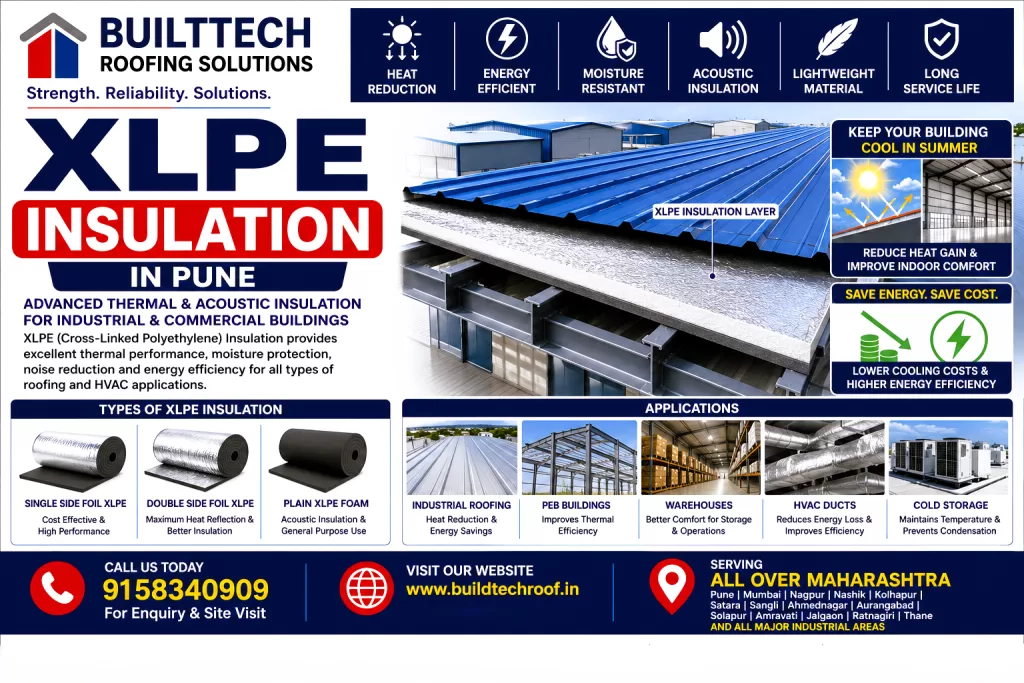
Heat gain, condensation, noise pollution, and energy losses are major challenges faced by industrial buildings, warehouses, factories, commercial complexes, and Pre-Engineered Buildings (PEB). Without proper insulation, roofing systems absorb excessive heat, causing uncomfortable indoor temperatures, increased cooling costs, and reduced operational efficiency.
To overcome these challenges, modern industries increasingly choose XLPE Insulation, one of the most effective thermal and acoustic insulation materials available today.
XLPE (Cross-Linked Polyethene) Insulation offers excellent thermal resistance, moisture protection, durability, and energy efficiency, making it ideal for industrial roofing and building insulation applications.
Buildtech Roofing Solutions supplies and installs premium-quality XLPE Insulation in Pune and across Maharashtra for industrial, commercial, and infrastructure projects.
What is XLPE Insulation?
XLPE stands for Cross-Linked Polyethene Foam.
It is a closed-cell insulation material manufactured through a cross-linking process that improves its:
- ✔ Thermal Performance
- ✔ Mechanical Strength
- ✔ Moisture Resistance
- ✔ Durability
- ✔ Acoustic Properties
The closed-cell structure creates millions of tiny air pockets that reduce heat transfer and improve insulation efficiency.
How XLPE Insulation Works
XLPE insulation acts as a barrier against heat flow.
During Summer
- Reflects radiant heat
- Reduces roof heat transfer
- Maintains cooler indoor temperatures
During Winter
- Retains internal heat
- Improves energy efficiency
Throughout the Year
- Reduces condensation
- Improves acoustic comfort
- Enhances building performance
Why XLPE Insulation is Important
Industrial buildings often face:
- ❌ Excessive Heat Build-Up
- ❌ High Energy Consumption
- ❌ Condensation Problems
- ❌ Worker Discomfort
- ❌ Equipment Overheating
- ❌ Noise Pollution
XLPE Insulation helps solve these issues effectively.
Structure of XLPE Insulation
A typical XLPE insulation system consists of:
Closed-Cell Polyethene Foam
Provides thermal insulation.
Reflective Aluminum Foil (Optional)
Enhances radiant heat reflection.
Protective Facing Layer
Improves durability and installation performance.
Types of XLPE Insulation
Single Side Foil XLPE
Foil facing on one side.
Applications:
- Industrial roofing
- HVAC insulation
Double Side Foil XLPE
Foil facing on both sides.
Benefits:
- ✔ Maximum Heat Reflection
- ✔ Better Thermal Performance
Plain XLPE Foam
Without foil facing.
Used for:
- Acoustic insulation
- Wall insulation
Fire Retardant XLPE
Designed for enhanced fire safety requirements.
Applications:
- Commercial buildings
- Industrial facilities
Key Benefits of XLPE Insulation
1. Excellent Thermal Insulation
One of the primary advantages.
Benefits:
- ✔ Reduced Heat Gain
- ✔ Improved Comfort
- ✔ Lower Energy Costs
2. Closed Cell Structure
Provides:
- ✔ Moisture Resistance
- ✔ Water Vapour Protection
- ✔ Condensation Control
3. Lightweight Material
Advantages:
- ✔ Easy Handling
- ✔ Faster Installation
- ✔ Reduced Structural Load
4. Energy Efficiency
Helps reduce:
- Cooling Loads
- Air Conditioning Costs
- Energy Consumption
5. Acoustic Performance
Reduces:
- ✔ External Noise
- ✔ Rain Noise
- ✔ Machinery Sound Transmission
6. Condensation Prevention
Protects roofing systems from moisture-related issues.
7. Long Service Life
Maintains insulation performance for many years.
8. Corrosion Protection
By reducing condensation, XLPE helps protect metal roofing systems.
Applications of XLPE Insulation
Industrial Roofing
Most common application.
Provides:
- ✔ Heat Reduction
- ✔ Worker Comfort
- ✔ Energy Savings
PEB Buildings
Improves thermal efficiency of pre-engineered structures.
Warehouses
Maintains better storage conditions.
Manufacturing Plants
Controls temperature fluctuations.
Commercial Buildings
Enhances occupant comfort.
HVAC Duct Insulation
Prevents energy loss through air ducts.
Cold Storage Facilities
Supports temperature-controlled environments.
Infrastructure Projects
Airports, terminals, and industrial parks.
XLPE Insulation for Roofing Systems
Widely used beneath:
Colour Coated Roofing Sheets
Galvalume Roofing Sheets
Standing Seam Roofing
PUF Roofing Systems
Industrial Shed Roofing
The insulation layer reduces heat transfer through the roof.
The XLPE Insulation vs Glass Wool
| Feature | XLPE | Glass Wool |
|---|---|---|
| Moisture Resistance | Excellent | Moderate |
| Weight | Lightweight | Heavier |
| Durability | Higher | Moderate |
| Installation | Easier | Moderate |
| Maintenance | Low | Moderate |
The XLPE Insulation vs Rockwool
| Feature | XLPE | Rockwool |
|---|---|---|
| Weight | Lower | Higher |
| Moisture Resistance | Better | Moderate |
| Flexibility | Excellent | Moderate |
| Installation | Easier | More Complex |
XLPE Insulation vs PUF Insulation
| Feature | XLPE | PUF |
|---|---|---|
| Flexibility | High | Moderate |
| Cost | Lower | Higher |
| Installation | Easy | Specialized |
| Maintenance | Low | Low |
Installation Process
Step-1 – Site Assessment
Evaluate roofing requirements.
Step-2 – Material Selection
Choose a suitable thickness and facing.
Step-3 – Surface Preparation
Prepare the roofing support system.
Step-4 – Insulation Placement
Install insulation beneath roofing sheets.
Step-5 – Joint Sealing
Seal joints for maximum efficiency.
Step-6 – Roofing Installation
Install roofing sheets over insulation.
Step-7 – Final Inspection
Verify complete coverage.
Common Problems Solved by XLPE Insulation
Excessive Indoor Heat
Reduces heat transfer.
Condensation Formation
Prevents moisture accumulation.
High Electricity Bills
Improves energy efficiency.
Worker Discomfort
Creates a cooler indoor environment.
Noise Pollution
Improves acoustic performance.
Corrosion Issues
Reduces moisture-related corrosion.
Industries Served
Manufacturing Plants
Warehouses
Logistics Parks
Food Processing Units
Pharmaceutical Facilities
Textile Industries
Commercial Buildings
Infrastructure Projects
Maintenance Tips
- ✔ Periodic Roof Inspection
- ✔ Check Joint Sealing
- ✔ Monitor Roof Leakage
- ✔ Protect Insulation During Maintenance Work
- ✔ Inspect Roofing Fasteners
Cost of XLPE Insulation in Pune
Pricing depends on:
- Thickness
- Foil Configuration
- Density
- Project Quantity
- Installation Requirements
Approximate Cost Range
₹20 – ₹130 per sq.ft
Actual pricing varies according to specifications.
Why Choose Buildtech Roofing Solutions?
Our Advantages
- ✔ Premium XLPE Insulation Materials
- ✔ Industrial Roofing Expertise
- ✔ Professional Installation Team
- ✔ Customised Solutions
- ✔ Fast Project Completion
- ✔ Competitive Pricing
- ✔ Service Across Maharashtra
Service Areas
Serving All Over Maharashtra
Pune
Mumbai
Nagpur
Nashik
Kolhapur
Satara
Sangli
Ahmednagar
Aurangabad
Solapur
Amravati
Jalgaon
Ratnagiri
Thane
And All Major Industrial Areas Across Maharashtra
Frequently Asked Questions
What is XLPE Insulation?
XLPE is Cross-Linked Polyethene Foam insulation used for thermal, acoustic, and moisture protection.
Is XLPE suitable for industrial roofing?
Yes. It is one of the most widely used insulation materials for industrial roofing systems.
Can XLPE reduce roof heat?
Yes. XLPE significantly reduces heat transfer and improves indoor comfort.
Is XLPE waterproof?
Its closed-cell structure provides excellent moisture resistance and condensation control.
How long does XLPE insulation last?
Properly installed XLPE insulation can provide reliable performance for many years with minimal maintenance.
Conclusion
An effective insulation system is essential for maintaining comfortable indoor conditions, reducing energy consumption, and protecting industrial buildings from heat and moisture. XLPE insulation combines thermal efficiency, moisture resistance, lightweight construction, and durability, making it an excellent choice for factories, warehouses, logistics parks, and PEB buildings.
If you are looking for XLPE Insulation in Pune, Buildtech Roofing Solutions provides high-quality insulation materials and professional installation services tailored to your project requirements across Maharashtra.