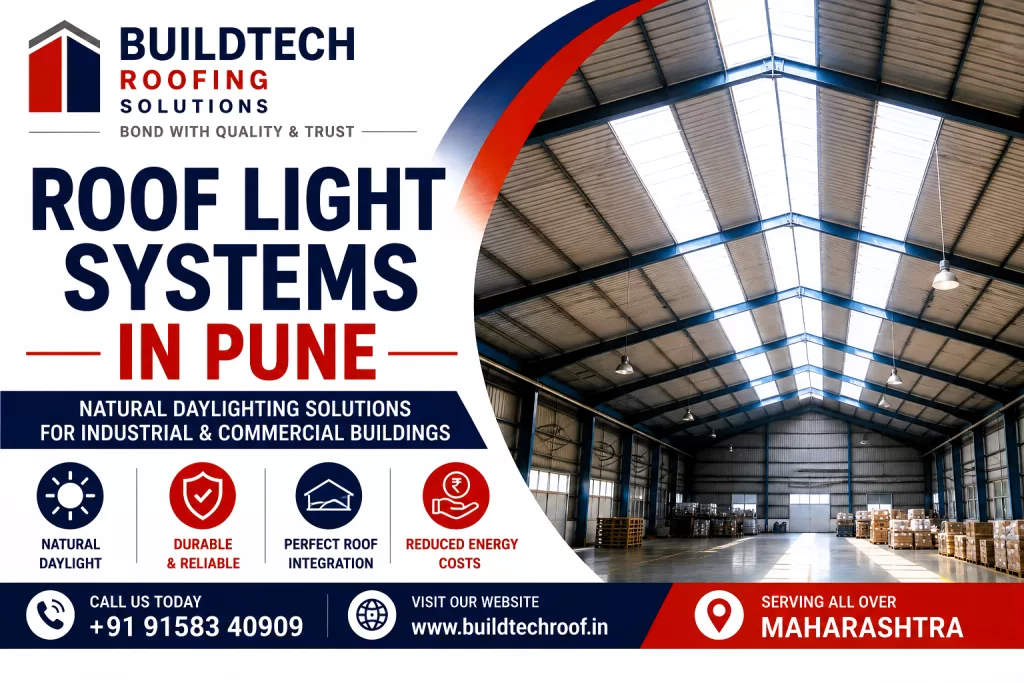
Daylighting Systems

Natural daylighting systems help reduce electricity consumption while providing bright and comfortable industrial workspaces.

Roof Light Systems in Pune | Natural Daylighting Solutions

Roof Light Systems in Pune

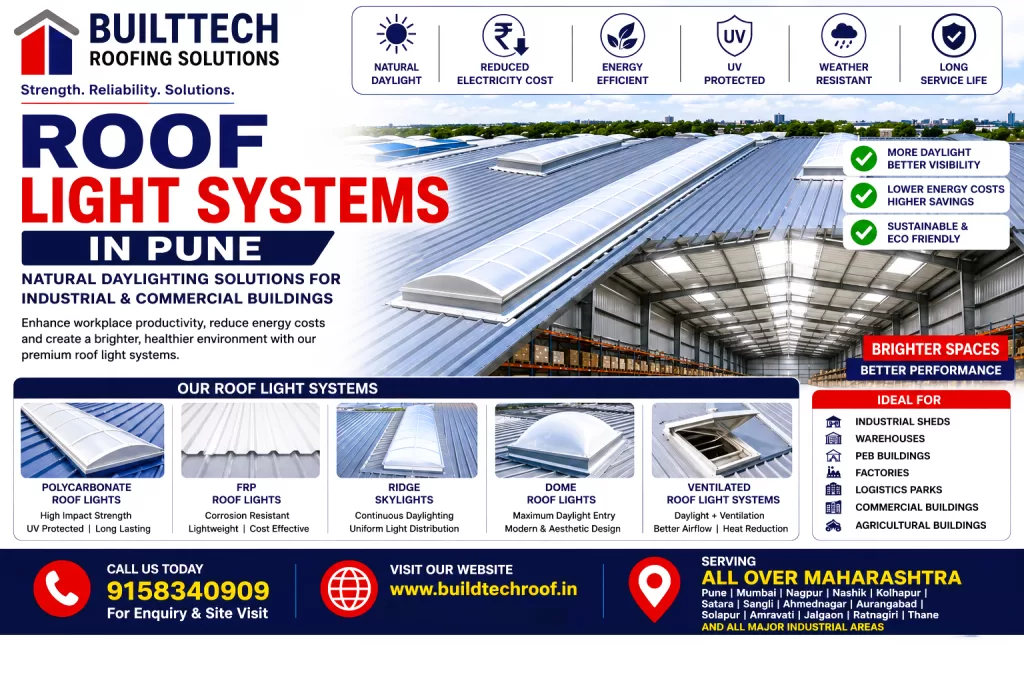
Introduction Lighting is an important part of industrial and commercial building design. Factories, warehouses, logistics centres, manufacturing plants and Pre-Engineered Buildings need adequate illumination for safe and efficient operations. A building that depends entirely on artificial lighting can have significant daytime lighting requirements. Roof Light Systems provide another approach by introducing natural daylight through selected translucent sections of the roof. Roof Light Systems in Pune are therefore suitable for industrial buildings where natural daylight, roof integration and practical building performance are important considerations. A Roof Light System uses translucent roofing components or skylight assemblies to allow daylight to enter the building. The system can be integrated with industrial roofing sheets, PEB structures, warehouses, factories and manufacturing facilities. The supplied Buildtech article describes these systems as daylighting components installed within roofing structures to bring natural sunlight into buildings. Buildtech Roofing Solutions positions Roof Light Systems as part of its broader Daylighting Systems portfolio, alongside polycarbonate and FRP daylighting products. What Are Roof Light Systems? Roof Light Systems are specially designed daylighting components installed within a roofing structure. Their primary purpose is to allow natural daylight to enter an enclosed building through selected roof areas. They can be integrated with: The basic concept is simple: Opaque Roofing + Translucent Roof Light + Supporting Structure = Industrial Daylighting System The translucent section allows daylight to enter while the surrounding roofing continues to provide the primary roof enclosure. Why Roof Light Systems Are Important Large industrial buildings frequently have limited opportunities for daylight through conventional windows. This can create: Roof Light Systems address the daylighting component by introducing natural light from above. Main benefits include: The supplied Buildtech content specifically identifies reduced electricity bills, improved visibility, workplace environment, sustainable design and productivity as key benefits. How Roof Light Systems Work Roof lights are strategically positioned within the roofing system. Sunlight passes through translucent panels and enters the building. The internal roof and floor areas then receive natural illumination. A simplified arrangement is: Sunlight → Translucent Roof Light → Industrial Building Interior → Natural Illumination The effectiveness of the system depends on factors such as: Therefore, Roof Light Systems should be planned rather than installed randomly. Types of Roof Light Systems Different daylighting configurations can be used depending on the building and roofing design. 1. Polycarbonate Roof Light Systems Polycarbonate is one of the daylighting materials used for roof-light applications. The supplied Buildtech source identifies the following characteristics: Typical applications include: Polycarbonate roof lights are particularly useful where the project requires a lightweight translucent material with good impact performance. 2. The FRP Roof Light Systems FRP means Fibreglass Reinforced Plastic. FRP roof lights can be used as translucent roofing sections in suitable industrial applications. The supplied Buildtechroof material identifies: Typical applications include: This makes FRP a useful option when industrial daylighting and profile-compatible roofing are required. 3. Continuous Ridge Skylights Continuous ridge skylights are installed along the roof ridge. They can provide daylight from the highest portion of a large industrial roof. Potential advantages They can be particularly relevant to: The supplied source specifically identifies continuous ridge skylights for large industrial buildings and PEB structures. 4. Dome Roof Lights Dome roof lights use a raised skylight structure. Their geometry can provide a larger daylight-capture surface than a flat translucent panel. Potential benefits The final design should consider the roof structure, weatherproofing and installation requirements. 5. Ventilated Roof Lights Ventilated roof lights combine two functions: Daylighting + Ventilation The supplied Buildtech content identifies: as their principal benefits. This can be useful for industrial buildings where natural daylight and high-level air movement are both required. Key Benefits of Roof Light Systems 1. Natural Daylight The primary benefit is obvious but important: Roof Light Systems introduce natural light into enclosed spaces. This can improve visibility in suitable: 2. Reduced Dependence on Artificial Lighting When sufficient daylight is available, a building may require less artificial illumination during daytime hours. The actual reduction depends on: Therefore, Roof Light Systems should be described as a solution that can reduce reliance on artificial lighting, rather than guaranteeing a fixed percentage of energy savings. 3. Potential Energy Savings Reduced daytime artificial lighting can reduce electricity consumption. However, the actual financial benefit depends on the building’s: The supplied source identifies energy savings and reduced electricity bills as major benefits. 4. Improved Workplace Visibility Good daylight can support visibility for workers. This is particularly useful for: Better visibility can contribute to a more comfortable and functional work environment. 5. Better Workplace Environment A brighter interior can create a more pleasant working environment. Natural daylight can be especially valuable in large industrial buildings where occupants spend long periods indoors. 6. Sustainable Building Design Roof daylighting makes use of naturally available sunlight. This can support building strategies aimed at reducing unnecessary daytime artificial-lighting demand. The supplied Buildtech source associates roof-light systems with sustainable building design and reduced energy demand. 7. Uniform Daylight Distribution A properly planned roof-light arrangement can distribute daylight more effectively than relying on a small number of side windows. This is particularly useful in wide industrial buildings. The exact distribution depends on: 8. Long Service Life The service life of a Roof Light System depends on its material, specification, installation and environmental exposure. Quality products combined with appropriate installation and maintenance can provide long-term service. The supplied Buildtech source identifies long service life as a benefit of premium roof-light systems. Applications of Roof Light Systems Industrial Sheds Industrial sheds can benefit from overhead daylight because large roof areas often provide significant opportunities for controlled daylighting. Roof lights can be positioned above production and working areas. Warehouses Warehouses frequently have large roof spans and limited windows. Roof Light Systems can improve visibility for: The supplied source specifically identifies warehouses as a major application. Manufacturing Plants Manufacturing facilities can use daylighting to improve general workplace illumination. The lighting strategy should still account for process-specific lighting requirements. PEB Buildings Pre-Engineered Buildings are well suited to planned roof daylighting because the roofing system and structural framework can

Roof Light Systems in Pune Read More »
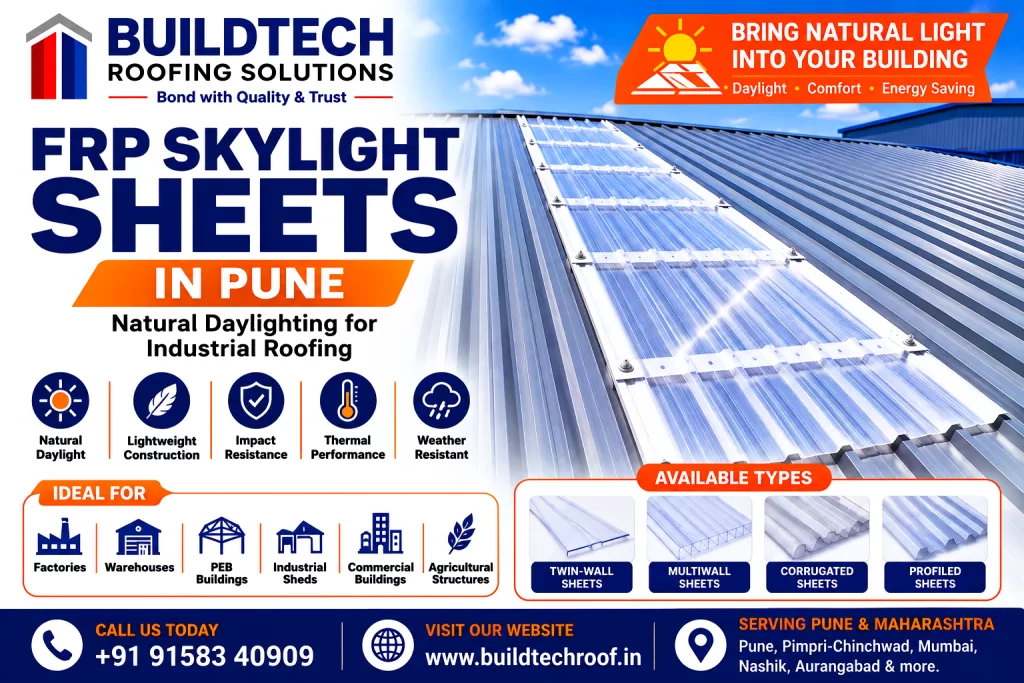
FRP Skylight Sheets Natural Daylight Solutions

FRP Skylight Sheets in Pune for Industrial Roofing

FRP Skylight Sheets in Pune for Industrial Roofing Natural daylight is an important consideration when designing modern factories, warehouses, industrial sheds and Pre-Engineered Buildings. Large industrial structures often have extensive roof areas, making the roof an effective location for introducing daylight into the interior. FRP Skylight Sheets Pune provide a practical daylighting solution by allowing natural light to enter through selected sections of an industrial roofing system. FRP, or Fibre Reinforced Plastic, skylight sheets are translucent roofing products designed for suitable industrial and commercial applications. They can be integrated with compatible metal roofing to create dedicated daylighting sections while maintaining the overall function of the roof. For industrial projects in Pune and across Maharashtra, proper product selection and installation are essential. Roof profile, supporting structure, sheet specification, fasteners, overlaps, flashing and waterproofing should all be considered as part of the complete roofing system. Buildtech Roofing Solutions offers FRP Skylight Sheets as part of its Daylighting Systems and broader industrial roofing product range. What Are FRP Skylight Sheets? FRP Skylight Sheets are fibre-reinforced translucent roofing sheets designed to transmit natural daylight. Industrial roofing contractors commonly install them within conventional roofing systems instead of using them as the entire roof covering. A typical roof arrangement may therefore include: Metal Roofing Sheets → FRP Skylight Section → Metal Roofing Sheets This arrangement allows selected portions of the roof to transmit daylight into the building. FRP skylights provide a practical solution for bringing natural daylight into industrial buildings, warehouses, factories, and commercial spaces.: The supplied Buildtech content specifically positions FRP Skylight Sheets for industrial roofing and natural daylight applications. Why Choose FRP Skylight Sheets for Industrial Buildings? Industrial buildings frequently operate during daytime hours. Therefore, reducing unnecessary dependence on artificial lighting can be an important design consideration. FRP skylights can help introduce daylight from above, particularly in large buildings where conventional windows may not provide sufficient illumination throughout the interior. The main objectives include: However, the amount of benefit depends on the roof design, skylight arrangement, building orientation, internal layout and operating conditions. Key Benefits of FRP Skylight Sheets 1. Natural Daylighting The primary benefit of an FRP skylight is its ability to transmit natural daylight. Strategically positioned skylight sections can introduce daylight into areas that may otherwise require artificial lighting during daytime. This makes FRP skylights particularly useful for large factories, warehouses and industrial sheds. 2. Reduced Dependence on Artificial Lighting When sufficient natural illumination is available, businesses may be able to reduce their use of electric lighting during appropriate daytime periods. Actual energy savings vary according to the building’s design, operating schedule, skylight area and lighting controls. Therefore, treat FRP skylights as part of an overall daylighting strategy rather than as a guarantee of fixed energy savings. 3. Compatible with Industrial Roofing Roofing contractors can incorporate FRP Skylight Sheets into suitable metal roofing systems. Correct matching between the FRP profile and adjoining roofing sheets is important for proper installation. The Buildtech source specifically highlights profile matching, laps, fasteners and flashing as important considerations. 4. Suitable for Large Roof Areas Factories and warehouses often have extensive roof surfaces. Installing selected translucent sections can provide overhead daylight without converting large areas of the building envelope into transparent openings. 5. Improved Interior Visibility Better natural illumination can improve visibility in suitable workspaces. This can be particularly useful in: 6. Practical Daylighting for PEB Buildings FRP skylights can be incorporated into suitable PEB roofing systems. The design should coordinate the skylight with: PEB skylights are specifically identified as a relevant application in the supplied keyword structure. Applications of FRP Skylight Sheets FRP Skylights for Factories Factories often require good visibility across large production floors. FRP skylight sections can be incorporated into compatible roofing systems to introduce daylight into selected production areas. The exact skylight arrangement should be based on the building’s operational and roofing requirements. FRP Skylights for Warehouses Warehouses commonly have large roof areas and limited external openings. Warehouse skylights can provide natural overhead illumination for appropriate storage and operational areas. For light- or heat-sensitive products, however, the skylight arrangement should be carefully evaluated. FRP Skylights for Industrial Sheds Industrial sheds are one of the most common applications for translucent roofing products. FRP Skylight Sheets can be positioned within compatible roofing profiles to improve daylight availability while retaining conventional metal roof coverage. FRP Skylights for PEB Buildings Modern PEB structures can incorporate daylighting as part of their overall roof design. FRP skylights can be coordinated with the PEB’s purlins and roofing sheets to create planned daylighting zones. FRP Skylights for Workshops Workshops can benefit from natural overhead light, particularly where the building has limited wall openings. A properly planned skylight arrangement can help create a brighter working environment during daylight hours. FRP Skylights for Commercial and Agricultural Buildings Suitable FRP daylighting products may also be considered for selected commercial, agricultural and utility structures where translucent roofing is appropriate. Product selection should always account for the specific building environment and roof configuration. FRP Skylight Sheets and Metal Roofing A skylight should be considered part of the complete roofing assembly. Important installation elements include: Roofing Profile The FRP sheet profile should correspond with the surrounding roof system. Sheet Dimensions The required length and width should be established from the roof layout. Laps Correct side and end laps are important for weather protection. Fasteners Suitable roofing fasteners and washers should be used according to the selected system. Flashing Roof junctions require suitable flashing details. Sealants Appropriate sealing should be used where required. Waterproofing All roof penetrations, joints and interfaces should be properly detailed. This integrated approach helps maintain the roofing system’s weather-protection function. How to Select FRP Skylight Sheets in Pune Choosing the correct FRP skylight requires more than selecting a sheet based only on price. 1. Check the Roof Profile The skylight must be compatible with the existing or proposed roofing profile. 2. Determine the Required Sheet Size Confirm the required length and width based on the roof layout. 3. Evaluate Daylight Requirements Determine where natural

FRP Skylight Sheets in Pune for Industrial Roofing Read More »

Multilayer Polycarbonate Sheets in Pune for industrial roofing and daylighting

Multilayer Polycarbonate Sheets in Pune

Multilayer Polycarbonate Sheets in Pune: Multiwall Roofing & Daylighting Natural daylight is an important consideration when designing modern factories, warehouses, workshops, commercial buildings, and other large structures. Large industrial buildings often have extensive roof areas with limited wall openings, which can result in significant dependence on artificial lighting during the day. Multilayer Polycarbonate Sheets provide a practical daylighting solution for these applications. Their multiwall construction incorporates internal chambers that combine lightweight construction, rigidity, natural light transmission, and useful thermal-performance characteristics. For industrial projects in Pune, these sheets can be integrated into roofing systems as selected daylighting sections, skylights, canopies, walkways, and other translucent structures. At Buildtech Roofing Solutions, Multilayer Polycarbonate is part of the company’s Daylighting Systems range, alongside Polycarbonate Sheets, FRP Skylight Sheets, and Roof Light Systems. What Are Multilayer Polycarbonate Sheets? Multilayer Polycarbonate Sheets are translucent panels manufactured with multiple layers connected by internal ribs or webs. These components create a multiwall or cellular structure inside the sheet. The internal construction can provide a combination of: The exact performance depends on the sheet construction, thickness, chamber configuration, surface treatment, and other product specifications. Unlike a conventional solid polycarbonate sheet, a multilayer sheet contains internal chambers. These chambers can reduce direct heat transfer compared with a simple single-layer sheet, which is one reason multiwall polycarbonate is used for daylighting and roofing applications. Why Choose Multilayer Polycarbonate for Industrial Roofing? Industrial buildings often need to balance several requirements at the same time: Natural Daylight + Thermal Performance + Weather Protection + Lightweight Construction Multilayer Polycarbonate Sheets can contribute to this combination while allowing selected sections of an otherwise opaque roof to transmit daylight. Common Applications How Multilayer Polycarbonate Sheets Are Constructed The internal structure is one of the most important characteristics of a multiwall polycarbonate sheet. A simplified cross-section can be understood as: Outer Layer → Internal Rib / Air Chamber → Intermediate Layer → Internal Rib / Air Chamber → Inner Layer The internal ribs contribute to rigidity, while the chambers contribute to the sheet’s lightweight construction and thermal characteristics. This construction allows multilayer polycarbonate to offer a different performance balance from conventional solid sheets. Key Features of Multilayer Polycarbonate Sheets 1. Multiwall Construction Multiple layers and internal chambers create a combination of rigidity and lightweight construction. Different chamber arrangements can provide different levels of thermal and structural performance. 2. Natural Light Transmission The translucent construction allows daylight to enter enclosed spaces. This can be particularly useful for: 3. Lightweight Design Multilayer polycarbonate provides a relatively lightweight translucent surface compared with many conventional glazing systems. This can simplify: 4. Thermal Performance Internal air chambers can provide improved thermal resistance compared with a simple single-layer translucent sheet. Actual performance depends on: 5. Impact Resistance Polycarbonate is known for its impact-resistant characteristics, making it suitable for many industrial and commercial applications where translucent roofing is required. 6. UV Protection Options Outdoor polycarbonate products can incorporate UV-protection features. The exact UV specification and installation orientation should always be confirmed from the manufacturer’s technical documentation. Types of Multilayer Polycarbonate Sheets The appropriate multiwall construction depends on the application, required rigidity, thermal requirements, daylight requirements, and supporting structure. Twin-Wall Polycarbonate Twin-wall sheets contain two primary layers connected by internal ribs. Typical Applications Benefits Triple-Wall Polycarbonate Triple-wall construction introduces additional internal structure compared with twin-wall products. Potential advantages include: Multiwall Polycarbonate More complex multiwall configurations can provide different levels of: The exact number of walls and chamber configuration should be selected according to the manufacturer’s technical specification. Cellular Polycarbonate The term cellular polycarbonate generally refers to sheets containing internal hollow chambers. These chambers contribute to the product’s lightweight construction and thermal characteristics. Diffused Multilayer Polycarbonate Diffused products distribute incoming daylight more evenly. They can be useful where glare control and uniform illumination are important. Potential applications include: Clear vs Diffused Multilayer Polycarbonate The highest light-transmission product is not necessarily the best solution for every building. Feature Clear Diffused Light Direction More direct More distributed Glare Control Lower Better Visual Effect Brighter/direct Softer/even Typical Use Maximum daylight Uniform illumination For industrial buildings, the choice should consider daylight requirements, glare, solar exposure, building use, and roof orientation. Available Colours and Transparency Options Depending on the product range, Multilayer Polycarbonate Sheets can be available in different colours and transparency levels. Clear Suitable where relatively high daylight transmission is desired. Opal / Diffused Suitable where more evenly distributed light is preferred. Tinted Can provide lower light transmission and a different visual appearance. Selection should consider: Benefits of Multilayer Polycarbonate Sheets Natural Daylighting The primary advantage is the ability to introduce natural light into enclosed spaces. Strategically positioned translucent roof sections can reduce dependence on artificial lighting during suitable daylight conditions. Improved Light Distribution Diffused multiwall products can distribute daylight more evenly, which can be useful for large workspaces where strong direct sunlight is undesirable. Useful Thermal Characteristics The internal chambers can provide improved thermal resistance compared with some single-layer translucent materials. Lightweight Construction The relatively low weight can simplify handling and installation. Impact Resistance Polycarbonate provides good impact resistance for many industrial and commercial applications. Flexible Applications Multilayer Polycarbonate can be used for: Modern Appearance Its translucent appearance can provide industrial and commercial buildings with a clean, modern architectural finish. Multilayer Polycarbonate for Industrial Roofing A modern industrial roof can combine opaque metal roofing with selected translucent daylighting panels. A typical arrangement can be: Metal Roofing → Multilayer Polycarbonate Daylighting Section → Metal Roofing This approach allows natural daylight to enter selected areas without replacing the complete roof with translucent material. The result is a coordinated roofing system that combines weather protection from metal roofing with daylighting from translucent polycarbonate sections. Multilayer Polycarbonate for Factories Factories often have large production floors where wall openings alone cannot provide sufficient natural illumination. Multilayer Polycarbonate panels can be strategically positioned above: The objective should not simply be to maximise translucent roof area. Instead, the daylighting system should balance natural light, glare control, solar heat management, and overall roof performance. Multilayer Polycarbonate

Multilayer Polycarbonate Sheets in Pune Read More »

Polycarbonate Sheets in Pune for industrial roofing and natural daylighting

Polycarbonate Sheets in Pune for Roofing & Daylighting Solutions

Polycarbonate Sheets in Pune for Roofing, Skylights & Natural Daylighting Introduction Natural daylight can play an important role in the design of modern industrial and commercial buildings. Factories, warehouses, workshops, production facilities and large commercial structures often require substantial lighting during daytime operating hours. A properly designed daylighting system can introduce natural light through selected sections of the roof or walls, reducing reliance on artificial lighting under suitable daylight conditions. Polycarbonate Sheets are widely used for this purpose because they can combine light transmission with durability and weather resistance. They can be incorporated into industrial roofing systems as translucent roof sections, skylights, wall panels, canopies and other daylighting applications. For projects in Pune, Polycarbonate Sheets can be designed and installed alongside metal roofing, PEB structures, insulation, ventilation and rainwater-management systems. Buildtech Roofing Solutions provides roofing and building-envelope solutions for industrial, commercial, warehouse and PEB projects. What Are Polycarbonate Sheets? Polycarbonate Sheets are thermoplastic sheets manufactured from polycarbonate resin. They are commonly used where a combination of: is required. In roofing applications, translucent Polycarbonate Sheets can be installed between opaque metal roofing sheets to create daylighting zones. This allows natural light to enter the building while maintaining a continuous weather-resistant roof system when properly designed and installed. Why Use Polycarbonate Sheets for Roofing? Traditional metal roofing blocks most natural daylight. This can result in industrial buildings requiring artificial lighting even during daylight hours. Polycarbonate daylighting sections can address this issue by allowing controlled quantities of natural light into the building. Main Advantages The exact performance depends on the selected sheet type, thickness, profile, installation and building design. How Polycarbonate Roofing Works A typical industrial daylighting roof uses a combination of opaque roofing sheets and translucent Polycarbonate Sheets. Basic Arrangement Metal Roofing → Polycarbonate Daylight Section → Metal Roofing The polycarbonate section acts as a translucent opening within the roof. Sunlight passes through the sheet and illuminates the interior space. The amount of light entering the building depends on: Types of Polycarbonate Sheets Different Polycarbonate Sheets can be selected according to the application. 1. Solid Polycarbonate Sheets Solid sheets have a continuous cross-section and are known for high impact resistance. Applications Benefits 2. Multiwall Polycarbonate Sheets Multiwall sheets contain internal chambers or layers. They can provide a combination of: Your Buildtech product structure separately identifies Multilayer Polycarbonate under Daylighting Systems and describes it as multiwall polycarbonate offering improved insulation and impact resistance. Applications 3. Corrugated Polycarbonate Roofing Sheets Corrugated profiles can be manufactured to match or coordinate with common industrial roofing profiles. Applications Their profile can facilitate integration with profiled metal roofing sheets. 4. Profiled Polycarbonate Sheets Profiled sheets are shaped to suit specific roofing profiles. They can be selected where the daylighting panel needs to integrate with: Proper profile matching is important for overlap, fixing and waterproofing. 5. UV-Protected Polycarbonate Sheets UV protection can improve resistance to long-term solar exposure. Depending on the product construction, UV protection may be incorporated as a protective layer or through the material formulation. Benefits Polycarbonate Sheet Colours Polycarbonate Sheets can be supplied in different levels of transparency and colour. Clear Provides high light transmission. Opal / Diffused Distributes light more evenly and can reduce harsh glare. Bronze or Tinted Can reduce light transmission and provide a different visual appearance. Selection Depends On The brightest sheet is not automatically the best choice. The objective should be appropriate daylighting, not simply maximum transparency. Key Features of Polycarbonate Sheets Lightweight Polycarbonate sheets are generally lighter than many traditional glazing materials. This can simplify handling and installation. Impact Resistance Polycarbonate is known for high impact resistance compared with many conventional transparent materials. This makes it useful for industrial and outdoor applications. Natural Light Transmission The primary reason for using translucent Polycarbonate Sheets in industrial roofing is their ability to introduce daylight. UV Protection Suitable UV protection can help improve the sheet’s resistance to prolonged outdoor exposure. Weather Resistance Polycarbonate roofing systems are suitable for outdoor use when the right product, fixing, and sealing system is chosen. Design Flexibility Polycarbonate can be used in: Benefits of Polycarbonate Sheets 1. Natural Daylighting The most important benefit is the introduction of natural light. This can improve visibility and reduce the need for artificial lighting during suitable daylight conditions. 2. Potential Energy Savings When daylight is sufficient, the building may require less artificial lighting. The actual energy savings depend on: Energy savings should be part of the overall building design evaluation. 3. Lightweight Roofing Solution Polycarbonate Sheets can provide daylighting without the weight associated with some traditional glazing systems. 4. High Impact Resistance Polycarbonate provides good impact resistance, making it suitable for industrial and commercial applications. 5. Architectural Appearance Translucent roofing sections can create a brighter and more modern building interior. 6. Versatile Applications Polycarbonate sheets serve both industrial and commercial daylighting needs. Applications of Polycarbonate Sheets Industrial Roofing Polycarbonate sheets serve as translucent daylighting sections in factory and industrial shed roofing. Warehouse Roofing Warehouses can benefit from natural daylight, especially in expansive areas where they would otherwise rely on artificial lighting throughout the day. Factory Skylights Roof-mounted polycarbonate skylights can introduce daylight into production areas. Commercial Canopies Polycarbonate is suitable for: PEB Buildings Polycarbonate daylighting sections can be used in PEB roofing and wall systems. Agricultural Buildings Natural daylight can be beneficial in various settings such as offices, schools, and healthcare facilities. Using daylight in these environments can enhance mood, productivity, and overall well-being. Additionally, natural light can reduce energy consumption and create a more inviting atmosphere. The choice of the exact sheet type should align with the environmental conditions. Polycarbonate Sheets for Industrial Buildings Industrial buildings frequently have large roof areas with limited natural-light openings. A carefully planned combination of opaque metal roofing and translucent polycarbonate panels can improve daylight distribution. Typical Arrangement Opaque Roofing Sheets ↓ Polycarbonate Daylighting Panels ↓ Natural Interior Illumination This approach can be particularly useful in: Polycarbonate Sheets for PEB Structures PEB buildings require coordination between: Polycarbonate Sheets need to be integrated into the PEB

Polycarbonate Sheets in Pune for Roofing & Daylighting Solutions Read More »

FRP Roofing Sheets in Pune | Manufacturer, Supplier & Installation

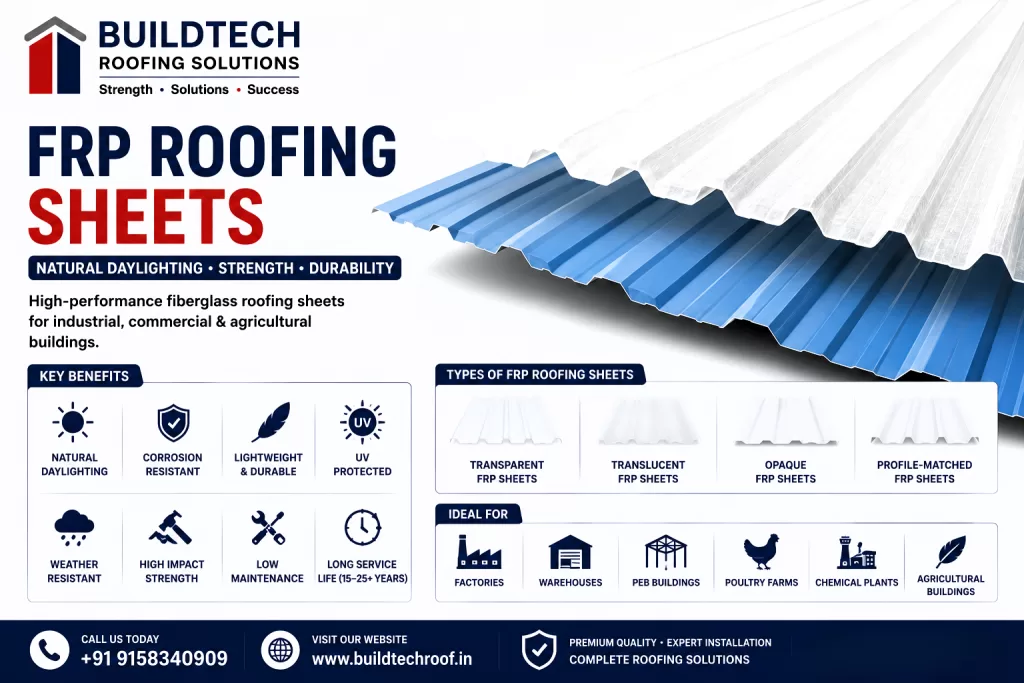
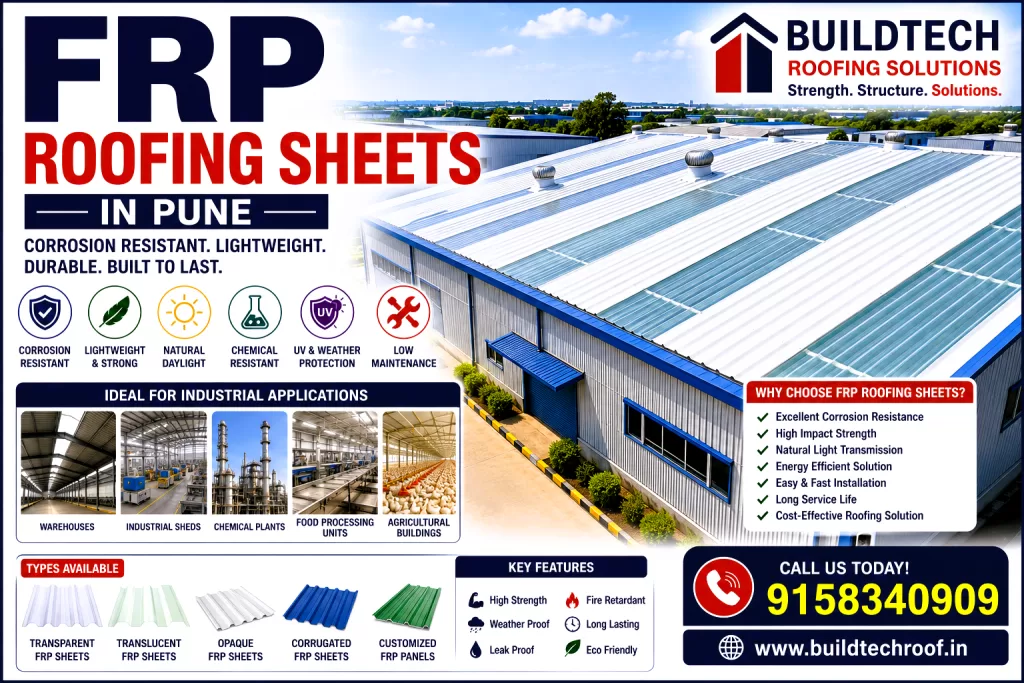
FRP Roofing Sheets in Pune for Durable Industrial Daylighting Solutions Introduction Industrial and commercial buildings require roofing materials that provide durability, natural daylight, weather resistance, and low maintenance. Conventional roofing materials often restrict natural light, resulting in increased electricity consumption and higher operating costs. FRP (Fibreglass Reinforced Plastic) Roofing Sheets have become a preferred solution for factories, warehouses, workshops, agricultural buildings, and commercial structures because they combine excellent light transmission with superior corrosion resistance and lightweight construction. They allow abundant daylight to enter the building while protecting interiors from rain, dust, and harsh environmental conditions. At Buildtech Roofing Solutions, Pune, we manufacture, supply, and install premium-quality FRP Roofing Sheets designed to integrate seamlessly with industrial roofing systems. Our FRP sheets are engineered for long-lasting performance, excellent weather resistance, and reliable daylighting for projects across Maharashtra. Whether you are constructing a new industrial facility or upgrading an existing roof, FRP Roofing Sheets provide an economical and energy-efficient solution that enhances workplace comfort and reduces dependence on artificial lighting. What are FRP Roofing Sheets? FRP Roofing Sheets are roofing panels manufactured by reinforcing high-quality polyester or resin with glass fibres. This combination creates a strong, lightweight, and corrosion-resistant roofing material capable of withstanding demanding industrial environments. Unlike traditional roofing sheets, FRP sheets transmit natural daylight while maintaining structural integrity and weather protection. Why Choose FRP Roofing Sheets? FRP Roofing Sheets offer several advantages for industrial and commercial roofing projects. Key Benefits How FRP Roofing Sheets Work FRP Roofing Sheets are commonly installed as skylight panels alongside colour-coated or Galvalume roofing sheets. They allow sunlight to pass through while: This makes them an ideal solution for factories, warehouses, and industrial sheds where natural lighting is essential. Types of FRP Roofing Sheets Different FRP Roofing Sheet profiles are available to suit various roofing systems and applications. 1. Corrugated FRP Roofing Sheets These sheets are manufactured to match corrugated roofing profiles. Features Applications 2. Trapezoidal FRP Roofing Sheets Designed to match trapezoidal metal roofing sheets used in modern industrial buildings. Advantages Applications 3. Industrial Skylight FRP Sheets These sheets are specifically designed to provide natural lighting in large industrial buildings. Benefits 4. Custom Profile FRP Roofing Sheets Custom-manufactured FRP sheets are available to match specific roof profiles used in industrial and commercial projects. Suitable for: Major Features Buildtech FRP Roofing Sheets are engineered for superior durability and performance. Key Features Advantages of FRP Roofing Sheets Excellent Natural Lighting FRP sheets allow daylight into industrial buildings, reducing dependence on artificial lighting and creating brighter workspaces. Lightweight Construction The lightweight design simplifies transportation, handling, and installation while reducing structural loading. Corrosion Resistance Unlike many conventional materials, FRP Roofing Sheets are highly resistant to corrosion, making them suitable for humid and chemically exposed environments. Weather Resistance FRP Roofing Sheets perform well under: Low Maintenance Routine cleaning and periodic inspection are generally sufficient to maintain long-term performance. Long Service Life When properly installed and maintained, FRP Roofing Sheets provide dependable performance for many years in industrial and commercial applications. Common Applications FRP Roofing Sheets are widely used in: Why Buildtech Roofing Solutions? Buildtech Roofing Solutions supplies premium FRP Roofing Sheets manufactured to meet the needs of modern industrial roofing projects. Our solutions offer: We help customers select the most suitable FRP Roofing Sheet profile based on roof type, daylight requirements, and project specifications. Technical Specifications FRP Roofing Sheets are designed to provide excellent daylight transmission, corrosion resistance, structural durability, and long-term performance in industrial and commercial environments. At Buildtech Roofing Solutions, our FRP Roofing Sheets are manufactured using premium fibreglass reinforcement and high-quality resins to ensure reliable performance under diverse weather conditions. Typical Technical Specifications Parameter Specification Material Fibreglass Reinforced Plastic (FRP) Reinforcement High-Strength Glass Fibre Resin Type Polyester Resin / Isophthalic Resin (Project Dependent) Sheet Type Corrugated, Trapezoidal, Custom Profile Thickness 0.8mm – 3.0mm Standard Length Custom Cut as Per Requirement Standard Width Profile Dependent Light Transmission Up to 85% (Depending on Colour & Thickness) UV Protection UV-Stabilized Surface Operating Temperature Suitable for Wide Temperature Variations Installation Roofing, Skylights, Wall Cladding Material Composition FRP Roofing Sheets are manufactured by combining premium-quality glass fibres with specially formulated resin systems. Primary Components Glass Fibre Reinforcement The fibreglass reinforcement provides: Polyester Resin Polyester resin offers: UV Stabilizers Special UV stabilisers help: Protective Gel Coat (Optional) For demanding environments, FRP sheets may include a protective gel coat that enhances: Thickness Options Different project requirements demand different sheet thicknesses. 0.8mm – 1.0mm Suitable for: 1.2mm – 1.5mm Recommended for: 2mm – 3mm Ideal for: Light Transmission FRP Roofing Sheets are specifically designed to maximise natural daylight while reducing glare and protecting interiors. Typical light transmission varies depending on: Clear Sheets Provide maximum daylight for industrial skylights. Opal White Sheets Diffuse sunlight evenly, reducing glare and creating comfortable indoor lighting. Coloured Sheets Available where controlled daylight and aesthetic appearance are required. Surface Finish Options Buildtech Roofing Solutions offers FRP Roofing Sheets in various finishes. Smooth Finish Ideal for modern architectural applications where appearance is important. Embossed Finish Provides improved light diffusion while helping reduce glare. Matte Finish Suitable for applications requiring softer daylight and a premium appearance. Manufacturing Process Buildtech Roofing Solutions follows a strict quality-controlled manufacturing process to ensure consistency and durability. Step-1 – Raw Material Inspection All incoming materials are inspected for: Step-2 – Resin Preparation The resin is mixed with: Step-3 – Fibreglass Reinforcement High-strength glass fibre mats are carefully positioned to achieve the required structural strength. Step-4 – Lamination Process Resin and fibreglass are combined using controlled lamination techniques to produce uniform sheet thickness and excellent bonding. Step-5 – Profile Forming The laminated sheets are shaped into: to match industrial roofing systems. Step-6 – Curing Sheets are cured under controlled conditions to achieve: Step-7 – Quality Inspection Each production batch is inspected for: Installation Guide Correct installation ensures maximum service life and weatherproof performance. Step-1 – Site Survey The installation team evaluates: Step-2 – Framework Preparation Supporting members are checked for: Step-3 – Sheet Placement FRP Roofing Sheets are

FRP Roofing Sheets in Pune | Manufacturer, Supplier & Installation Read More »

Polycarbonate Roofing Sheets in Pune

Polycarbonate Roofing Sheets in Pune for Durable and Energy-Efficient Roofing Solutions Introduction Modern construction projects demand roofing materials that combine strength, durability, natural daylight transmission, weather resistance, and aesthetic appeal. Traditional roofing materials often limit the amount of natural light entering a building, increasing the dependence on artificial lighting and energy consumption. Polycarbonate Roofing Sheets have become one of the most preferred roofing solutions for industrial, commercial, institutional, and residential buildings because they offer exceptional impact resistance, high light transmission, UV protection, and long service life. Their lightweight nature also makes installation faster and more economical compared to conventional glazing materials. At Buildtech Roofing Solutions, Pune, we manufacture, supply, and install premium-quality Polycarbonate Roofing Sheets for factories, warehouses, commercial complexes, agricultural structures, parking sheds, skylights, canopies, and Pre-Engineered Buildings (PEBs) throughout Maharashtra. Whether your goal is to maximise daylight, improve energy efficiency, or create modern architectural designs, our Polycarbonate Roofing Systems deliver reliable performance with minimal maintenance. What are Polycarbonate Roofing Sheets? Polycarbonate Roofing Sheets are high-performance thermoplastic roofing panels designed to provide excellent light transmission while withstanding extreme weather conditions, impact, and UV exposure. Unlike ordinary plastic sheets, polycarbonate is engineered for structural strength, making it suitable for demanding industrial and commercial environments. These sheets are available in various profiles, thicknesses, and colours to suit different architectural and functional requirements. Why Choose Polycarbonate Roofing Sheets? Polycarbonate Roofing Sheets offer a combination of transparency, durability, and weather resistance that is difficult to achieve with conventional roofing materials. Key Advantages How Polycarbonate Roofing Sheets Work Polycarbonate Roofing Sheets allow sunlight to enter the building while blocking harmful ultraviolet radiation through specialised UV-protective coatings. This creates bright indoor environments that: The sheets also provide excellent structural strength despite being lightweight, making them ideal for a wide range of roofing applications. Types of Polycarbonate Roofing Sheets Selecting the appropriate type depends on the project requirements, insulation needs, roof design, and desired light transmission. 1. Solid Polycarbonate Sheets Solid Polycarbonate Sheets resemble glass in appearance but are significantly stronger and lighter. Features Best Applications 2. Multiwall Polycarbonate Sheets Multiwall sheets contain multiple internal chambers that improve thermal insulation while maintaining excellent light transmission. Benefits Applications 3. Corrugated Polycarbonate Sheets Corrugated Polycarbonate Sheets are designed to match corrugated metal roofing profiles. Advantages Applications 4. Profiled Polycarbonate Sheets These sheets are manufactured to match trapezoidal and other roofing profiles used in industrial buildings. Suitable For Major Features Buildtech Polycarbonate Roofing Sheets are designed with advanced manufacturing technology to provide reliable long-term performance. Key Features Benefits of Polycarbonate Roofing Sheets Excellent Natural Lighting Polycarbonate sheets allow abundant daylight to enter buildings, reducing dependence on artificial lighting during daytime operations. Energy Savings Greater daylight penetration can contribute to lower daytime lighting energy use, helping improve overall building efficiency. High Impact Resistance Polycarbonate is considerably more impact-resistant than conventional glass, making it suitable for industrial environments where durability is essential. Lightweight Construction The low weight of polycarbonate sheets simplifies transportation, handling, and installation while reducing structural loads. Weather Resistance These sheets are engineered to withstand: Long Service Life With proper installation and maintenance, Polycarbonate Roofing Sheets provide dependable performance over many years. Low Maintenance Routine cleaning and periodic inspection are generally sufficient to maintain appearance and performance. Common Applications Polycarbonate Roofing Sheets are widely used in: Why Buildtech Roofing Solutions? Buildtech Roofing Solutions supplies premium Polycarbonate Roofing Sheets that are: Our experienced team helps customers choose the right sheet type, profile, thickness, and installation method based on the specific project requirements. Technical Specifications Polycarbonate Roofing Sheets are engineered to deliver superior strength, excellent light transmission, and long-term weather resistance. Selecting the appropriate specification depends on the building type, roof profile, structural design, and daylighting requirements. At Buildtech Roofing Solutions, our Polycarbonate Roofing Sheets are manufactured to meet demanding industrial and commercial applications. Typical Technical Specifications Parameter Specification Material Virgin Polycarbonate Resin Sheet Types Solid, Multiwall, Corrugated, Profiled Thickness 0.8 mm – 16 mm (Application Dependent) Standard Width Project Specific Standard Length Custom Cut as Required UV Protection Co-extruded UV Protective Layer Light Transmission Up to 90% (Depending on Type & Colour) Temperature Resistance Suitable for Wide Temperature Variations Impact Resistance Extremely High Fire Performance Available in Fire-Retardant Grades Installation Roofing, Skylights, Canopies, Cladding Material Composition Polycarbonate Roofing Sheets are manufactured using premium virgin polycarbonate resin to ensure: Virgin-grade material offers better performance than recycled plastics, especially in applications exposed to sunlight and varying weather conditions. UV Protection Technology One of the most important features of premium Polycarbonate Roofing Sheets is the co-extruded UV protective layer. This specialised coating helps: The UV-protected surface should always face upward during installation, following the manufacturer’s guidelines. Thickness Options The appropriate sheet thickness depends on span, loading conditions, and intended application. 0.8mm – 1.2mm Suitable for: 1.5mm – 2mm Recommended for: 4mm – 10mm Multiwall Commonly used in: 16mm Multiwall Ideal for: Colour Options Polycarbonate Roofing Sheets are available in various colours to suit functional and architectural requirements. Popular options include: Different colours offer varying levels of light transmission, glare control, and heat management. Light Transmission Polycarbonate Roofing Sheets allow natural daylight into buildings while helping protect interiors from direct UV exposure. Typical light transmission varies depending on sheet type, colour, and thickness. Clear Sheets Opal Sheets Bronze & Grey Sheets Manufacturing Process Buildtech Roofing Solutions follows a quality-controlled manufacturing process to ensure consistent product performance. Step-1 – Raw Material Inspection Virgin polycarbonate resin is inspected for: Step-2 – Extrusion The resin is processed through precision extrusion equipment to produce sheets with accurate dimensions and uniform thickness. Step-3 – UV Layer Application A co-extruded UV protective layer is integrated into the sheet during manufacturing, providing long-term outdoor protection. Step-4 – Cooling & Calibration Sheets are cooled under controlled conditions to maintain dimensional accuracy and surface quality. Step-5 – Cutting & Finishing Sheets are cut according to standard or project-specific dimensions. Edge finishing ensures: Step-6 – Quality Inspection Every batch undergoes quality checks for: Installation Guide Proper installation is essential for maximising the lifespan

Polycarbonate Roofing Sheets in Pune Read More »

FRP Roofing Sheets in Pune

FRP Roofing Sheets in Pune for Durable Fibreglass Roofing Solutions Introduction Industrial and commercial buildings require roofing systems that are durable, lightweight, corrosion-resistant, and capable of providing natural daylight where required. FRP Roofing Sheets (Fibre Reinforced Plastic Roofing Sheets) have become one of the most reliable roofing solutions for factories, warehouses, workshops, agricultural buildings, and commercial projects due to their high strength, weather resistance, and excellent light transmission properties. Unlike conventional roofing materials, FRP roofing sheets are manufactured using fibreglass reinforcement combined with high-quality polyester or resin systems. This provides exceptional resistance to corrosion, chemicals, moisture, and UV exposure while maintaining a lightweight structure. Buildtech Roofing Solutions supplies and installs premium FRP Roofing Sheets in Pune and throughout Maharashtra, offering complete daylighting and industrial roofing solutions for modern construction projects. What are FRP Roofing Sheets? FRP (Fibre Reinforced Plastic) Roofing Sheets are composite roofing panels made by reinforcing polyester resin with fibreglass. They provide excellent structural strength while allowing natural daylight transmission and superior corrosion resistance. A typical FRP roofing system includes: These sheets are widely used as skylight panels alongside metal roofing systems to improve indoor lighting and energy efficiency. Why Choose FRP Roofing Sheets? Industries prefer FRP roofing because it offers: Benefits of FRP Roofing Sheets 1. Natural Daylighting FRP roofing allows natural sunlight into industrial buildings, reducing the need for artificial lighting during the daytime. Benefits include: 2. Excellent Corrosion Resistance FRP sheets are resistant to: Making them ideal for chemical plants and coastal industries. 3. Lightweight Construction FRP roofing is much lighter than conventional roofing materials, reducing structural load and simplifying installation. 4. High Impact Strength Fibreglass reinforcement provides excellent resistance against: 5. UV Protection Modern FRP sheets include UV-resistant coatings that reduce yellowing and maintain long-term performance. 6. Weather Resistance FRP roofing performs reliably in: 7. Long Service Life Premium FRP roofing sheets typically provide 15–25 years or more of dependable service with proper installation and maintenance. Types of FRP Roofing Sheets Transparent FRP Roofing Sheets Ideal for: Translucent FRP Roofing Sheets Provide diffused natural light while reducing glare. Suitable for: Opaque FRP Roofing Sheets Used where daylight is not required but corrosion resistance is essential. Profile-Matched FRP Sheets Manufactured to match: Allow seamless integration with metal roofing systems. Applications of FRP Roofing Sheets FRP Roofing Sheets are widely used in: Technical Specifications Typical specifications: Installation Process Step 1 – Roof Framework Inspection Ensure purlins and structural supports are aligned. Step 2 – Sheet Alignment Position FRP sheets according to the roof layout. Step 3 – Fastening Use compatible self-drilling screws with EPDM washers. Step 4 – Sealing Install flashings and weatherproof sealants. Step 5 – Inspection Check waterproofing, alignment, and fasteners. Accessories Used FRP Roofing vs Polycarbonate Roofing Feature FRP Roofing Polycarbonate Roofing Impact Resistance Excellent Excellent Corrosion Resistance Excellent Excellent Light Transmission High Very High Chemical Resistance Excellent Good Cost Moderate Higher Lifespan 15–25+ Years 10–20+ Years Maintenance Tips Why Choose Buildtech Roofing Solutions? Our Advantages Industries We Serve Service Areas Serving All Over Maharashtra Including all MIDC industrial regions across Maharashtra. Frequently Asked Questions 1) What are FRP Roofing Sheets? FRP Roofing Sheets are fibreglass-reinforced plastic roofing panels that provide strength, corrosion resistance, and natural daylight. 2) Where are FRP Roofing Sheets used? They are commonly used in factories, warehouses, industrial sheds, agricultural buildings, and commercial projects. 3) Can FRP Roofing Sheets be used with metal roofing? Yes. They are manufactured in matching corrugated and trapezoidal profiles for seamless integration with metal roofing systems. 4) What is the lifespan of FRP Roofing Sheets? Premium FRP roofing sheets generally last 15–25 years or more with proper installation and maintenance. 5) Do you provide installation services? Yes. Buildtech Roofing Solutions provides complete supply, installation, repair, and replacement services across Maharashtra. Conclusion FRP Roofing Sheets are an excellent solution for industrial and commercial buildings requiring durable roofing with natural daylighting. Their lightweight construction, corrosion resistance, impact strength, and long service life make them ideal for factories, warehouses, agricultural buildings, and PEB projects. Buildtech Roofing Solutions supplies and installs premium FRP Roofing Sheets across Pune and Maharashtra, delivering high-quality products, professional installation, and dependable after-sales support.

FRP Roofing Sheets in Pune Read More »

Roof Light Systems in Pune | Natural Daylighting Solutions for Industrial Buildings

Natural Daylighting Solutions for Industrial Buildings

📖 Introduction Lighting is one of the most important aspects of any industrial or commercial building. Warehouses, factories, logistics centres, manufacturing plants, and Pre-Engineered Buildings (PEB) require adequate illumination for safety, productivity, and operational efficiency. However, relying solely on artificial lighting significantly increases electricity consumption and operating costs. This is where Roof Light Systems become an ideal solution. Roof Light Systems allow natural daylight to enter industrial buildings through specially designed translucent roofing panels and skylight systems. They improve indoor visibility, reduce energy consumption, enhance workplace comfort, and contribute to sustainable building design. Buildtech Roofing Solutions supplies and installs premium Roof Light Systems in Pune and across Maharashtra, helping industries maximise natural daylight while reducing energy costs. What Are Roof Light Systems? Roof Light Systems are specially designed daylighting components installed within roofing structures to allow natural sunlight into a building. They are commonly integrated with: These systems provide controlled daylight without compromising weather protection. Why Roof Light Systems Are Important Industrial buildings often face: Roof Light Systems solve these issues by utilising free natural daylight. Benefits include: How Roof Light Systems Work Roof lights are installed strategically within roofing systems. Sunlight passes through translucent panels and spreads evenly across the interior space. The result: Types of Roof Light Systems 1. Polycarbonate Roof Light Systems One of the most popular daylighting solutions. Features Applications: 2. FRP Roof Light Systems Fibreglass Reinforced Plastic roof lights. Benefits Applications: 3. Continuous Ridge Skylights Installed along the roof ridge. Advantages Applications: 4. Dome Roof Lights Raised skylight structures designed for maximum daylight capture. Benefits 5. Ventilated Roof Lights Combine natural daylight and ventilation. Benefits Key Benefits of Roof Light Systems 1. Energy Savings One of the biggest advantages. Natural daylight reduces the need for electric lighting during the daytime. Benefits: 2. Improved Workplace Productivity Well-lit workspaces improve: 3. Enhanced Building Appearance Natural lighting creates a brighter and more professional environment. 4. Environment Friendly Supports green building initiatives. Reduces: 5. Uniform Light Distribution Properly designed roof lights provide balanced illumination. 6. Reduced Heat Build-Up Modern polycarbonate systems include UV protection and heat-control technologies. 7. Long Service Life Premium roof light systems provide years of reliable performance. Applications of Roof Light Systems Industrial Sheds Provides natural illumination for production areas. Warehouses Improves visibility and inventory management. Manufacturing Plants Enhances worker productivity. PEB Buildings Popular daylighting solution for modern structures. Logistics Parks Reduces operational lighting costs. Commercial Buildings Supports sustainable building design. Agricultural Buildings Ideal for storage and livestock facilities. Infrastructure Projects Airports, terminals, and public facilities. Roof Light Systems for PEB Buildings Pre-Engineered Buildings often integrate roof lights because they: The Polycarbonate vs FRP Roof Lights Feature Polycarbonate FRP Impact Resistance Excellent Good UV Resistance Excellent Moderate Lifespan Longer Moderate Light Transmission Excellent Good Cost Higher Lower Roof Light Systems vs Artificial Lighting Feature Roof Lights Artificial Lighting Operating Cost Very Low Continuous Cost Energy Consumption None High Sustainability Excellent Moderate Maintenance Low Moderate Design Considerations Effective roof light design depends on: Building Orientation Roof Layout Daylight Requirements Climate Conditions Roof Height Internal Operations Professional planning ensures optimal daylight performance. Installation Process Step-1 – Site Assessment Evaluate daylight requirements. Step-2 – System Selection Choose an appropriate roof light type. Step-3 – Structural Preparation Prepare roofing framework. Step-4 – Roof Light Installation Install translucent panels or skylights. Step-5 – Waterproof Sealing Ensure leak-proof performance. Step-6 – Inspection Verify lighting and waterproofing quality. Common Problems Solved by Roof Light Systems High Electricity Bills Reduces daytime lighting costs. Dark Workspaces Improves visibility. Poor Workplace Environment Creates brighter interiors. Sustainability Challenges Supports green building goals. Inadequate Daylight Provides natural illumination. Maintenance Tips Cost of Roof Light Systems in Pune Pricing depends on: Approximate Cost Range ₹190 – ₹950 per sq.ft Actual pricing depends on project specifications. Why Choose Buildtech Roofing Solutions? Our Advantages Industries Served Service Areas Serving All Over Maharashtra PuneMumbaiNagpurNashikKolhapurSataraSangliAhmednagarAurangabadSolapurAmravatiJalgaonRatnagiriThane And All Major Industrial Areas Across Maharashtra Frequently Asked Questions What is a Roof Light System? A Roof Light System is a daylighting solution installed within roofing structures to allow natural sunlight into buildings. Are roof lights suitable for industrial buildings? Yes. They are widely used in factories, warehouses, and PEB buildings. Do roof lights reduce electricity costs? Yes. They significantly reduce daytime dependence on artificial lighting. Which is better: Polycarbonate or FRP roof lights? Polycarbonate offers higher impact resistance and longer lifespan, while FRP is often more economical. Are roof light systems waterproof? Yes. Professional installation ensures complete weatherproofing and leak protection.

Natural Daylighting Solutions for Industrial Buildings Read More »

Polycarbonate Skylight Sheets in Pune

Polycarbonate Skylight Sheets in Pune

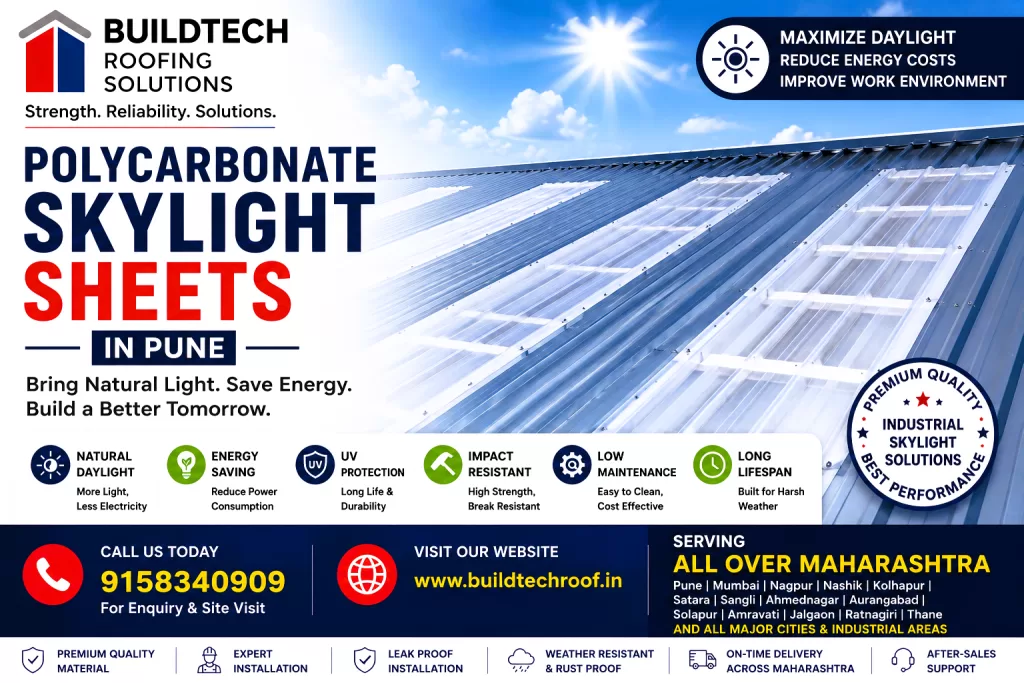
📖 Introduction Modern industrial and commercial buildings increasingly focus on energy efficiency, sustainability, and employee well-being. One of the biggest challenges faced by factories and warehouses is maintaining adequate lighting without increasing electricity consumption. Traditional buildings rely heavily on artificial lighting throughout the day, leading to higher operating costs and increased energy usage. Polycarbonate Skylight Sheets provide an effective solution by allowing natural sunlight to enter buildings while maintaining protection from weather conditions. Buildtech Roofing Solutions supplies and installs high-quality Polycarbonate Skylight Sheets in Pune and across Maharashtra, helping industries create brighter, more productive, and energy-efficient workspaces. What Are Polycarbonate Skylight Sheets? Polycarbonate skylight sheets are transparent or translucent roofing panels designed to transmit natural daylight into industrial, commercial, and residential buildings. These sheets are manufactured using high-impact polycarbonate resin and are engineered to withstand harsh weather conditions while providing excellent light transmission. How Polycarbonate Skylights Work The sheets are integrated into roofing systems and strategically positioned to maximise daylight penetration. Benefits of Natural Daylighting Key Benefits of Polycarbonate Skylight Sheets 1. Excellent Natural Light Transmission Allows up to 80–90% daylight transmission depending on sheet type. Benefits: 2. High Impact Resistance Polycarbonate is significantly stronger than glass. Advantages: 3. UV Protection Modern sheets include UV protective layers. Benefits: 4. Energy Savings Natural daylight reduces daytime lighting requirements. This helps lower: 5. Lightweight Structure Compared with glass skylights, polycarbonate sheets are lightweight and easy to install. 6. Weather Resistance Performs effectively against: 7. Low Maintenance Requires minimal upkeep while providing long-term performance. Types of Polycarbonate Skylight Sheets Solid Polycarbonate Sheets Features: Applications: Multiwall Polycarbonate Sheets Benefits: Applications: Corrugated Polycarbonate Sheets Designed to match metal roofing profiles. Advantages: Embossed Polycarbonate Sheets Provides diffused lighting while reducing glare. Applications of Polycarbonate Skylight Sheets Industrial Factories Improves natural illumination. Warehouses Enhances visibility and storage efficiency. PEB Buildings Supports modern sustainable design. Manufacturing Facilities Reduces lighting costs. Logistics Centers Creates brighter working conditions. Commercial Buildings Enhances interior appearance. Agricultural Buildings Provides natural daylight for operations. The Polycarbonate vs Glass Skylights Feature Polycarbonate Glass Weight Lightweight Heavy Impact Resistance Excellent Low Installation Easy Complex Cost Lower Higher Safety High Moderate Polycarbonate is generally preferred for industrial applications. The Polycarbonate vs FRP Skylight Sheets Feature Polycarbonate FRP Transparency Excellent Moderate Impact Resistance Excellent Good Appearance Superior Standard Cost Higher Lower UV Resistance Excellent Good Importance of Proper Skylight Design A well-designed skylight system improves: Installation Process Step-1 – Site Inspection Evaluate roof structure and daylight requirements. Step-2 – Design Planning Determine skylight locations. Step-3 – Sheet Selection Choose a suitable profile and thickness. Step-4 – Structural Preparation Prepare roofing framework. Step-5 – Installation Secure sheets using approved fasteners. Step-6 – Waterproof Sealing Ensure leak-proof performance. Step-7 – Final Inspection Verify alignment and daylight performance. Common Problems Solved Dark Interiors Increases natural lighting. High Electricity Costs Reduces artificial lighting requirements. Poor Visibility Improves workplace illumination. Outdated Building Design Enhances aesthetics and functionality. Maintenance Tips Cost of Polycarbonate Skylight Sheets in Pune Pricing depends on: Approximate Cost Range ₹120 – ₹450 per sq.ft Actual pricing depends on project specifications. Why Choose Buildtech Roofing Solutions? Our Advantages Industries Served Service Areas PuneMumbaiNagpurNashikKolhapurSataraSangliAhmednagarAurangabadSolapurAmravatiJalgaonRatnagiriThane And All Over Maharashtra Conclusion Polycarbonate Skylight Sheets are an ideal solution for industrial and commercial buildings seeking improved daylighting, lower energy costs, and enhanced workplace environments. Their durability, impact resistance, and long-term performance make them one of the most preferred skylight solutions for modern construction projects. Buildtech Roofing Solutions provides customised Polycarbonate Skylight Sheet installations across Maharashtra, helping businesses create brighter, safer, and more energy-efficient facilities.

Polycarbonate Skylight Sheets in Pune Read More »

FRP Roofing Sheets in Pune | Industrial Roofing & Skylight Solutions

FRP Roofing Sheets Product Guide for Industrial Roofing Solutions

Introduction Industrial roofing systems are constantly exposed to harsh environmental conditions, including heavy rainfall, extreme temperatures, UV radiation, moisture, chemical fumes, and corrosion. Traditional roofing materials often require frequent maintenance and replacement, increasing operational costs over time. Modern industries are increasingly looking for roofing materials that offer durability, corrosion resistance, natural lighting, and long-term performance. One such advanced roofing solution is FRP Roofing Sheets. FRP (Fibre Reinforced Plastic) roofing sheets have become one of the most preferred materials for industrial sheds, warehouses, chemical plants, food processing facilities, agricultural buildings, and commercial structures. Their lightweight design, superior strength, corrosion resistance, and ability to transmit natural daylight make them an ideal choice for modern industrial roofing systems. This is where FRP Roofing Sheets Pune solutions by Buildtech Roofing Solutions provide durable, weather-resistant, and cost-effective roofing systems designed to meet industrial requirements. This comprehensive guide explains everything about FRP roofing sheets, including their composition, benefits, types, applications, installation process, maintenance requirements, and cost considerations. What Are FRP Roofing Sheets? FRP Roofing Sheets are roofing panels manufactured using Fibre Reinforced Plastic, a composite material made by combining resin with reinforcing fibres. This combination creates a strong, lightweight, and corrosion-resistant roofing material. FRP sheets are widely used where durability and resistance to environmental conditions are critical. Composition of FRP Roofing Sheets A standard FRP sheet consists of three major components: 1. Resin Matrix The resin binds the structure together and provides weather resistance. 2. Reinforcing Fibres Glass fibres provide: 3. Protective Surface Layer This layer improves: How FRP Roofing Sheets Work Unlike traditional metal roofing, FRP sheets do not corrode or rust when exposed to moisture or chemicals. They provide: ✔ Structural protection✔ Weather resistance✔ Natural daylight transmission✔ Long-term durability Their composite structure allows them to perform efficiently in harsh industrial environments. Why Industries Choose FRP Roofing Sheets Industrial buildings require roofing systems that can withstand: FRP roofing sheets address all these challenges effectively. Key Benefits of FRP Roofing Sheets 1. Excellent Corrosion Resistance One of the biggest advantages of FRP roofing sheets is their resistance to corrosion. Unlike metal roofing, FRP sheets do not rust. This makes them ideal for: 2. Lightweight Construction FRP sheets are significantly lighter than many conventional roofing materials. Benefits include: 3. Natural Daylight Transmission Transparent and translucent FRP sheets allow sunlight to enter the building. This reduces the need for artificial lighting during the daytime. 4. Chemical Resistance FRP roofing sheets are highly resistant to: This makes them suitable for aggressive industrial conditions. 5. Weather Resistance FRP sheets provide excellent protection against: 6. Long Service Life High-quality FRP roofing systems can provide reliable performance for many years. 7. Low Maintenance Minimal maintenance requirements reduce long-term operational costs. 8. High Strength-to-Weight Ratio FRP sheets offer excellent strength while remaining lightweight. Types of FRP Roofing Sheets 1. Transparent FRP Roofing Sheets These sheets are designed to maximise natural daylight. Applications 2. Translucent FRP Roofing Sheets Allow diffused light while reducing glare. Benefits 3. Opaque FRP Roofing Sheets Used where daylight transmission is not required. Features 4. Corrugated FRP Roofing Sheets The most commonly used industrial profile. Advantages 5. Customised FRP Roofing Panels Manufactured according to specific industrial requirements. Applications of FRP Roofing Sheets Industrial Sheds Provides corrosion-resistant roofing with long service life. Warehouses Allows natural daylight while maintaining structural protection. Chemical Plants Ideal due to chemical resistance properties. Food Processing Units Supports hygienic and corrosion-resistant environments. Textile Industries Provides durable roofing with reduced maintenance requirements. Agricultural Buildings Used for poultry farms, storage facilities, and agricultural sheds. Commercial Buildings Suitable for showrooms, workshops, and service centres. FRP Roofing Sheets vs Polycarbonate Sheets Feature FRP Sheets Polycarbonate Sheets Chemical Resistance Excellent Good Impact Resistance High Very High Cost Moderate Higher UV Resistance Good Excellent Industrial Usage Very High High FRP Roofing Sheets vs Metal Roofing Feature FRP Roofing Metal Roofing Corrosion Resistance Excellent Moderate Light Transmission Yes No Weight Lightweight Heavier Chemical Resistance Excellent Limited Maintenance Low Moderate Why FRP Roofing Is Better for Chemical Industries Chemical facilities often experience: FRP roofing sheets provide superior resistance compared to conventional metal roofing systems. Importance of Proper Roofing Design A well-designed roofing system improves: ✔ Drainage performance✔ Structural stability✔ Ventilation efficiency✔ Roof lifespan Poor roofing design can result in leakage and maintenance issues. FRP Roofing Sheet Installation Process Step-1 – Site Inspection Analyse structural requirements and roofing dimensions. Step-2 – Roof Structure Preparation Ensure purlins and supports are properly aligned. Step-3 – Sheet Alignment Position sheets according to the roofing layout. Step-4 – Fastener Installation Secure sheets using approved fasteners and washers. Step-5 – Waterproof Sealing Seal overlaps and joints to prevent leakage. Step-6 – Final Inspection Verify installation quality and waterproofing performance. Roofing Accessories Used with FRP Sheets A complete roofing system includes: These accessories improve roof performance and durability. Common Roofing Problems Solved by FRP Sheets Corrosion Damage FRP sheets eliminate rust-related problems. Dark Interiors Transparent FRP sheets improve natural lighting. Moisture Problems Non-corrosive surfaces resist moisture damage. Frequent Maintenance Long-lasting materials reduce repair frequency. Chemical Exposure FRP sheets withstand harsh industrial environments. Maintenance Tips for FRP Roofing Sheets Regular maintenance helps maximise service life. Recommended Practices ✔ Clean roof surfaces periodically✔ Inspect fasteners and joints✔ Check sealants annually✔ Remove debris from drainage systems✔ Replace damaged sections promptly Cost of FRP Roofing Sheets in Pune Pricing depends on: Approximate Cost Range ₹100 – ₹250 per sq.ft Actual pricing may vary based on specifications and installation requirements. Factors Affecting FRP Roofing Sheet Cost Material Quality Premium materials provide longer service life. Thickness Thicker sheets offer higher durability. UV Coating Enhanced UV protection increases performance and cost. Custom Profiles Customised sheets may have higher manufacturing costs. Why Choose Buildtech Roofing Solutions Pune Buildtech Roofing Solutions provides advanced FRP roofing systems designed for industrial and commercial applications. Key Advantages ✔ Premium-quality FRP roofing sheets✔ Expert installation team✔ Customised roofing solutions✔ Competitive pricing✔ Fast project execution✔ Industrial roofing expertise Industries Served Service Areas PuneMumbaiNashikKolhapurSangliSataraAhmednagarAurangabad Future of FRP Roofing Technology Modern industrial construction increasingly focuses on: FRP

FRP Roofing Sheets Product Guide for Industrial Roofing Solutions Read More »

©2023 buildtechroof. All Rights Reserved.