buildtech roofing solutions

Buildtech Roofing Solutions offers top-quality roofing supplies and professional roofing services for all types of properties. Trusted by customers of all ages, we provide durable and affordable roofing solutions tailored to your needs.
Suppliers & Appliers of Profile Coated Sheet – Pre-Painted Profile Sheets, Color Cladding Sheets, Colour Profile Sheets, and Color Coated Profile Sheet used on Industrial & residency roofing & cladding sheet providers in Maharashtra, India.

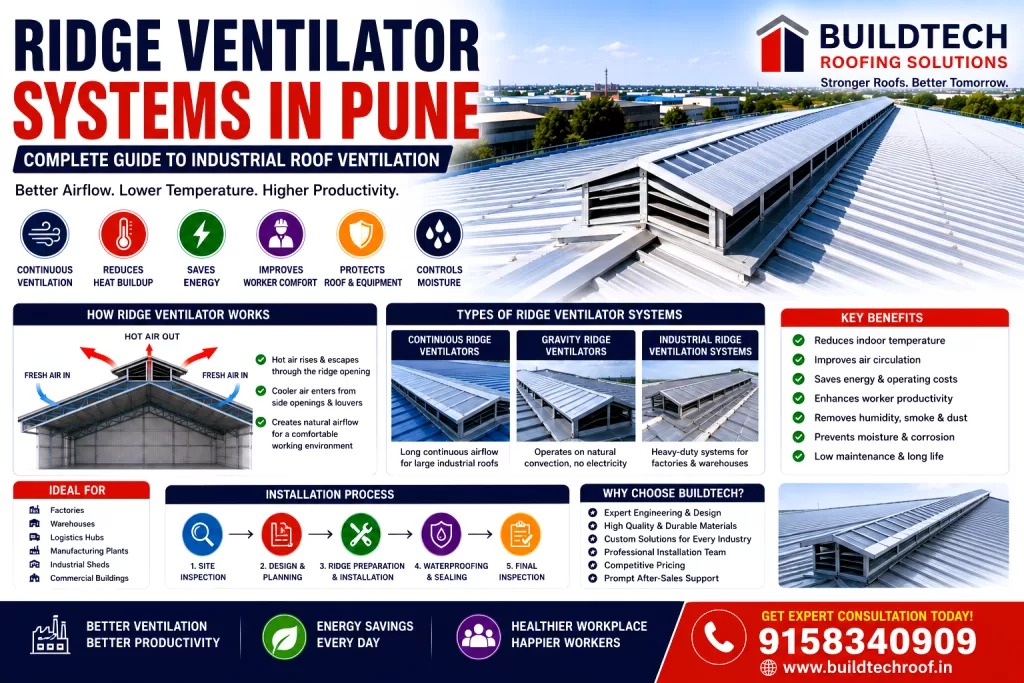
Ridge Ventilator Systems in Pune Product Guide for Industrial Roof Ventilation

Ridge Ventilator Systems Product Guide for Industrial Roof Ventilation

Introduction Industrial buildings generate excessive heat due to machinery, roofing systems, manufacturing operations, and environmental conditions. Without proper airflow management, factories and warehouses become hot, uncomfortable, and inefficient. Poor ventilation inside industrial buildings can lead to: Modern industries now focus on advanced natural ventilation systems that improve airflow without increasing energy consumption. One of the most efficient solutions for industrial roof ventilation is the Ridge Ventilator System. Ridge ventilators provide continuous natural airflow across the entire roof structure, helping remove hot air and maintain comfortable indoor conditions. This is where Ridge Ventilator Pune solutions by Buildtech Roofing Solutions provide advanced industrial ventilation systems for factories, warehouses, logistics hubs, and commercial sheds. This comprehensive guide explains everything about ridge ventilators, including working principles, types, benefits, applications, installation process, maintenance, and cost considerations. What Are Ridge Ventilator Systems? Ridge ventilators are roof-mounted ventilation systems installed along the ridge (highest point) of industrial roofs. They allow continuous exhaust of: Ridge ventilators use natural airflow principles and do not require electricity for operation. How Ridge Ventilators Work Ridge ventilators work based on: Hot air inside industrial buildings naturally rises toward the roof. The ridge ventilator creates an escape path for hot air, while fresh cooler air enters through side openings and louvers. This creates balanced and continuous ventilation throughout the building. Why Industries Need Ridge Ventilation Systems Industrial roofing systems absorb large amounts of heat during the daytime. Without ventilation: Ridge ventilators help maintain proper airflow and improve workplace comfort naturally. Benefits of Ridge Ventilator Systems 1. Continuous Natural Ventilation Ridge ventilators provide uninterrupted airflow across the building. 2. Heat Reduction Hot air is continuously exhausted through the ridge opening. This significantly reduces indoor temperature. 3. Energy Savings Ridge ventilators reduce dependency on: This lowers electricity consumption. 4. Improved Worker Productivity Cooler and fresher work environments improve operational efficiency. 5. Moisture & Condensation Control Industrial buildings often face condensation problems due to trapped humid air. Ridge ventilators help remove moisture and reduce: 6. Better Air Quality Ventilation improves indoor air circulation and removes pollutants. 7. Low Maintenance System Ridge ventilators are durable systems requiring minimal maintenance. Types of Ridge Ventilator Systems 1. Continuous Ridge Ventilators Installed continuously along the roof ridge for maximum airflow. Features: 2. Gravity Ridge Ventilators Operate using thermal air movement and natural convection. Benefits: 3. Industrial Ridge Ventilation Systems Heavy-duty systems designed for industrial sheds and warehouses. Applications: Components of Ridge Ventilator Systems A typical ridge ventilator system includes: Proper flashing and waterproof sealing prevent rainwater entry. Applications of Ridge Ventilator Systems The Ridge ventilators are widely used in: Ridge Vent vs Turbo Ventilators Feature Ridge Ventilators Turbo Ventilators Airflow Coverage Continuous Point-based Ventilation Efficiency Very High High Maintenance Low Low Electricity Requirement No No Best For Large Industrial Buildings Medium & Large Buildings Ridge Vent vs Exhaust Fan Feature Ridge Ventilator Exhaust Fan Electricity Usage No Yes Operating Cost Very Low High Noise Silent Moderate Airflow Natural Continuous Mechanical Importance of Proper Industrial Ventilation Proper ventilation improves: ✔ Worker comfort✔ Machine performance✔ Indoor air quality✔ Heat reduction✔ Energy efficiency Poor ventilation can increase operational costs and affect productivity. Ridge Ventilator Installation Process Step-1 – Site Inspection Analyse building dimensions and airflow requirements. Step-2 – Ventilation Design Determine the ridge opening size and airflow requirement. Step-3 – Roof Preparation Prepare the roof ridge for installation. Step-4 – Ridge Ventilator Installation Install the ridge ventilation structure securely. Step-5 – Waterproof Sealing Apply flashing and waterproof protection. Step-6 – Final Inspection Check ventilation performance and installation quality. Factors Affecting Ridge Ventilator Performance 1. Building Width Large buildings require proper ventilation planning. 2. Roof Height Higher roofs improve natural airflow movement. 3. Ventilator Size Correct sizing ensures balanced airflow. 4. Air Intake Design Proper side airflow improves ventilation efficiency. 5. Roof Design Roof slope affects airflow movement. Common Industrial Ventilation Problems 1. Heat Buildup Metal roofing traps excessive heat. 2. Poor Air Circulation Insufficient airflow affects working conditions. 3. Moisture Accumulation Leads to rust and structural damage. 4. Smoke & Dust Retention Industrial pollutants affect air quality. Advantages of Ridge Ventilation for Warehouses Warehouses benefit from ridge ventilators because they: This helps protect inventory and improve operational efficiency. Energy Efficiency Benefits Ridge ventilators reduce energy usage by minimising dependence on: This leads to long-term operational cost savings. Maintenance Tips for Ridge Ventilator Systems Although ridge ventilators require low maintenance, periodic inspection is recommended. Maintenance Checklist: Common Mistakes to Avoid 1. Improper Ridge Opening Design Reduces airflow performance. 2. Poor Waterproofing Can lead to roof leakage. 3. Using Low-Quality Materials Reduces system lifespan. 4. Incorrect Installation Improper alignment affects ventilation efficiency. Cost of Ridge Ventilator Systems in Pune The cost depends on: Approximate Cost Range: ₹350 – ₹1,200 per running foot (approx.) 💡 Note: Large industrial projects require customised ventilation design. Why Choose Buildtech Roofing Solutions Pune Buildtech Roofing Solutions provides advanced ridge ventilation systems designed for industrial performance and durability. Key Advantages: ✔ Expert ventilation planning✔ High-quality ridge ventilators✔ Customised airflow solutions✔ Professional installation team✔ Competitive pricing✔ Fast project execution Industries Served Service Areas Pune | Mumbai | Nashik | Kolhapur | Sangli | Satara | Ahmednagar Future of Industrial Ventilation Systems Industrial ventilation systems are evolving with: Ridge ventilators are becoming a standard solution for modern industrial infrastructure. Conclusion Ridge ventilator systems provide one of the most effective natural ventilation solutions for industrial buildings. They help improve airflow, reduce heat buildup, enhance worker comfort, and lower energy consumption. With Ridge Ventilator Pune solutions by Buildtech Roofing Solutions, industries can achieve durable, energy-efficient, and long-lasting industrial ventilation systems.

Ridge Ventilator Systems Product Guide for Industrial Roof Ventilation Read More »
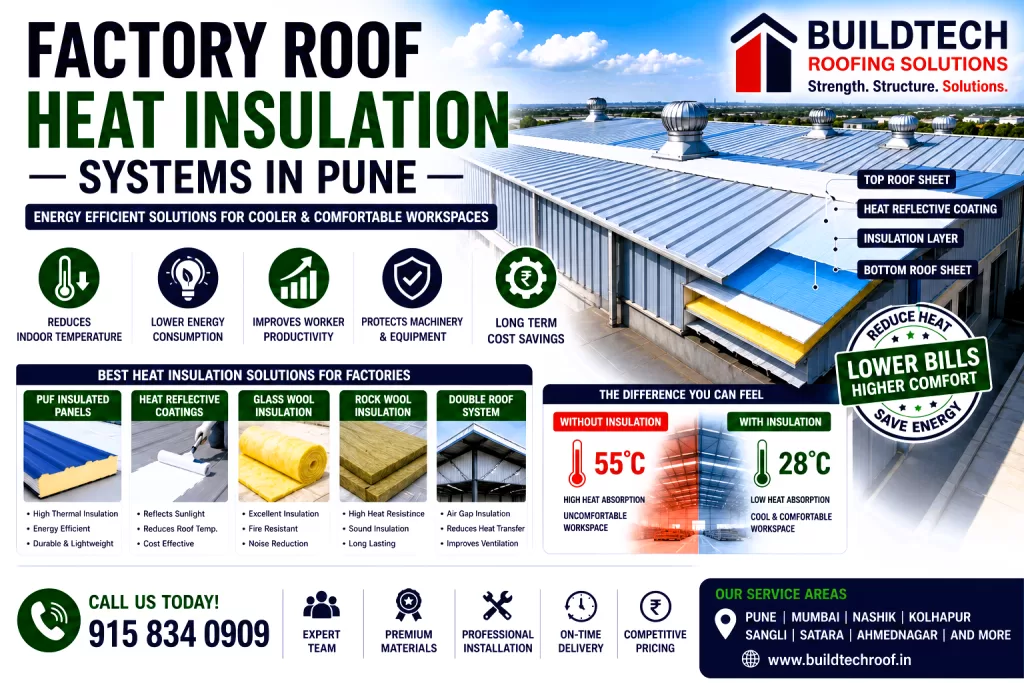
Factory Roof Heat Insulation Systems in Pune – Complete Guide for Energy-Efficient Industrial Roofing

Factory Roof Heat Insulation Systems in Pune

Introduction Industrial buildings and factories in Pune often face extreme indoor temperatures during summer due to heat absorption through roofing systems. Excessive heat inside factories affects worker productivity, machinery performance, and electricity consumption. Without proper insulation, metal roofing systems absorb and transfer large amounts of heat into industrial spaces. This leads to: This is where Factory Roof Heat Insulation Pune solutions by Buildtech Roofing Solutions provide advanced thermal insulation systems for industrial buildings. This comprehensive guide explains different heat insulation methods, roofing systems, insulation materials, benefits, installation processes, and maintenance practices. What is Factory Roof Heat Insulation? Factory roof heat insulation is the process of reducing heat transfer from the roof into the building using specialised insulation materials and roofing systems. The goal is to: Why Heat Insulation is Important for Factories 1. Reduces Indoor Temperature Insulation minimises heat transfer through roofing sheets. 2. Saves Energy Reduces dependence on cooling systems. 3. Improves Worker Productivity Cooler workplaces improve efficiency and comfort. 4. Protects Machinery Reduces overheating risks for industrial equipment. 5. Increases Roof Lifespan Heat protection reduces roofing stress. Types of Factory Roof Heat Insulation Systems 1. PUF Insulated Roofing Panels One of the most effective industrial insulation systems. Features: 2. Heat Reflective Roof Coatings Reflect sunlight and reduce heat absorption. Benefits: 3. Glass Wool Insulation A fibre-based insulation system is used below the roofing sheets. 4. Rock Wool Insulation Provides thermal and sound insulation. 5. Double Roof Systems Creates an air gap for heat reduction. Benefits of Heat Insulation Systems ✔ Reduced electricity bills✔ Improved indoor comfort✔ Better operational efficiency✔ Noise reduction✔ Long-term cost savings Heat Insulation vs Traditional Roofing Feature Insulated Roofing Traditional Roofing Heat Reduction High Low Energy Efficiency High Low Worker Comfort Better Moderate Cost Savings High Low Factory Heat Insulation Installation Process Step-1 – Site Inspection Step-2 – Heat Analysis Step-3 – Material Selection Step-4 – Installation Step-5 – Final Inspection Common Factory Heat Problems 1. Excessive Heat Buildup 2. High Electricity Bills 3. Worker Discomfort 4. Poor Ventilation Maintenance Tips for Heat Insulation Systems Cost of Heat Insulation Systems in Pune Approximate cost depends on: Why Choose Buildtech Roofing Solutions Pune ✔ Advanced insulation systems✔ Expert installation team✔ High-quality materials✔ Customised solutions✔ Competitive pricing Industries Served Service Areas PuneMumbaiNashikKolhapurSangliSatara Conclusion Factory roof heat insulation systems are essential for improving industrial efficiency, reducing energy costs, and enhancing worker comfort. With Factory Roof Heat Insulation Pune solutions by Buildtech Roofing Solutions, industries can achieve cooler, more energy-efficient, and durable industrial spaces.

Factory Roof Heat Insulation Systems in Pune Read More »

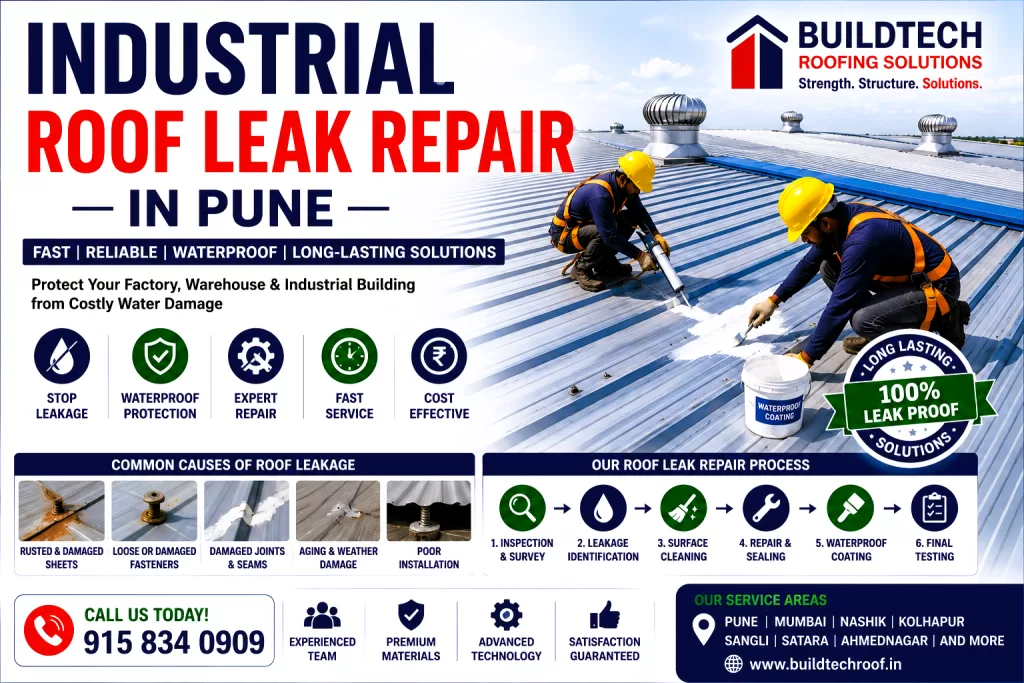
Industrial roof leak repair in Pune

Industrial Roof Leak Repair in Pune – Complete Guide to Fast & Long-Lasting Roofing Solutions

Introduction Industrial roof leakage is one of the most common and costly problems faced by factories, warehouses, and commercial buildings. Even a small leak can lead to major operational disruptions, equipment damage, inventory loss, and structural deterioration. In Pune, industrial roofs are exposed to: Without proper maintenance and timely repair, roof leakage can quickly become a serious issue. This is where Industrial Roof Leak Repair Pune services by Buildtech Roofing Solutions provide reliable, fast, and long-lasting roofing repair solutions for industrial infrastructure. This comprehensive guide explains causes of industrial roof leakage, repair methods, waterproofing systems, maintenance practices, and preventive solutions. What Causes Industrial Roof Leakage? 1. Damaged Roofing Sheets Cracks, holes, or corrosion can allow water penetration. 2. Loose Fasteners Improperly fixed roofing sheets create leakage points. 3. Damaged Joints & Seams Weak joints allow rainwater entry. 4. Ageing Roof Systems Older roofs lose waterproofing performance. 5. Poor Installation Incorrect installation leads to long-term leakage issues. Common Signs of Roof Leakage Industrial Roof Leak Repair Methods 1. Fastener Replacement Loose or damaged fasteners are replaced with waterproof fixing systems. 2. Joint Sealing Special sealants are applied to roofing joints and overlaps. 3. Waterproof Coating Application Protective coatings create leak-proof surfaces. Popular Coatings: 4. Roofing Sheet Replacement Damaged sheets are replaced with new roofing panels. 5. Membrane Waterproofing Advanced membrane systems provide high-level protection. Waterproofing Solutions for Leak Repair 1. PU Waterproofing 2. Acrylic Waterproofing 3. Bitumen Membranes 4. Silicone Coatings Importance of Timely Roof Leak Repair ✔ Prevents structural damage✔ Protects machinery & inventory✔ Reduces maintenance cost✔ Improves roof lifespan✔ Prevents operational downtime Step-by-Step Roof Leak Repair Process Step-1 – Roof Inspection Step-2 – Leakage Identification Step-3 – Surface Cleaning Step-4 – Repair & Sealing Step-5 – Waterproof Coating Step-6 – Final Testing Roof Maintenance Tips Common Roof Leak Repair Mistakes 1. Temporary Patching 2. Using Low-Quality Sealants 3. Ignoring Small Leaks 4. Delayed Maintenance Cost of Industrial Roof Leak Repair in Pune The cost depends on: Why Choose Buildtech Roofing Solutions Pune ✔ Expert leak repair team✔ Advanced waterproofing systems✔ High-quality materials✔ Fast response service✔ Long-lasting solutions Industries Served Service Areas | Pune | Mumbai | Nashik | Kolhapur | Sangli | Satara | And More | Conclusion Industrial roof leakage can lead to major operational and financial losses if ignored. With Industrial Roof Leak Repair Pune solutions by Buildtech Roofing Solutions, industries can achieve leak-proof, durable, and long-lasting roofing protection.

Industrial Roof Leak Repair in Pune – Complete Guide to Fast & Long-Lasting Roofing Solutions Read More »

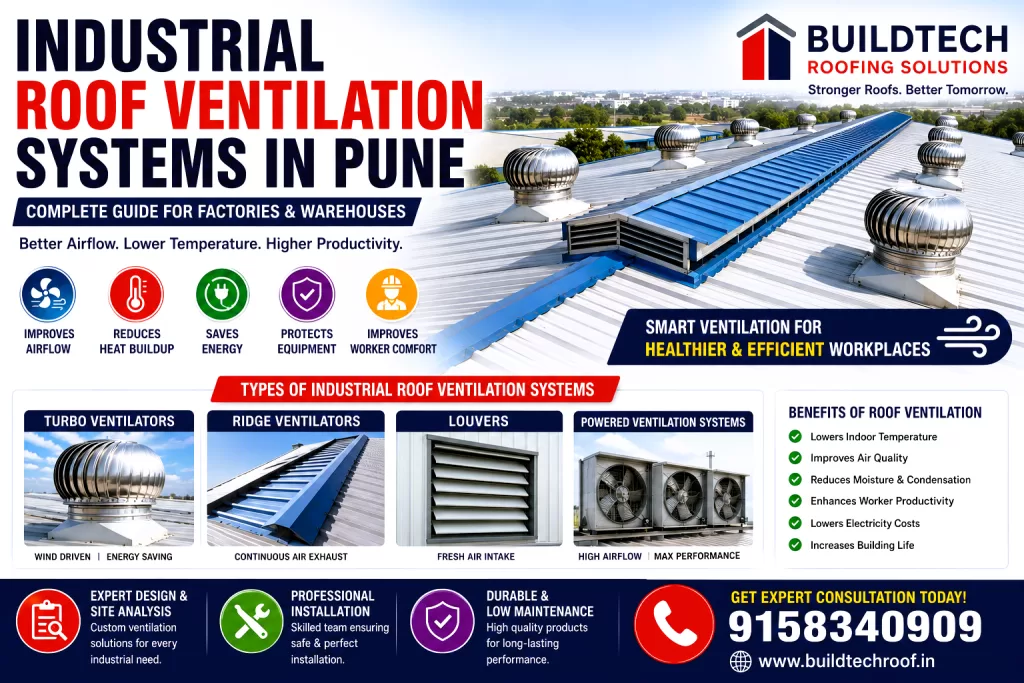
Industrial Roof Ventilation Systems in Pune – Complete Guide for Factories & Warehouses

Industrial Roof Ventilation Systems in Pune – Complete Guide for Factories & Warehouses

Industrial Roof Ventilation Systems in Pune – Guide for Better Airflow & Heat Reduction Introduction Industrial buildings such as factories, warehouses, manufacturing plants, and logistics hubs generate substantial internal heat every day. This heat comes from production machinery, metal roofing systems, manpower, and harsh external weather conditions—especially in Pune’s hot climate. Without proper ventilation, industrial spaces often face: That’s why investing in Industrial Roof Ventilation Systems Pune is essential for every modern industrial facility. At Buildtech Roofing Solutions, we provide advanced industrial ventilation systems designed to improve airflow, reduce roof heat, and create healthier, more productive work environments. This complete guide explains everything you need to know about industrial roof ventilation systems, including types, benefits, installation methods, costs, and how to choose the right solution. What Are Industrial Roof Ventilation Systems? Industrial roof ventilation systems are engineered airflow solutions installed on industrial roofs to remove trapped hot air and improve internal air circulation. Their primary purpose is to: ✔ Remove hot air from inside the building✔ Reduce indoor temperature✔ Control humidity and moisture✔ Improve worker comfort✔ Enhance energy efficiency Proper ventilation helps maintain balanced airflow, which directly impacts operational performance. Why Roof Ventilation Is Important for Industrial Buildings 1. Reduces Excessive Heat Metal roofs absorb intense solar heat. Without ventilation, this heat gets trapped inside. Ventilation removes this trapped hot air and lowers the indoor temperature. 2. Improves Worker Productivity A cooler workplace leads to: 3. Lowers Electricity Bills When ventilation improves naturally, industries rely less on: This significantly reduces energy costs. 4. Prevents Moisture & Condensation Poor airflow causes condensation, leading to: Proper ventilation prevents moisture buildup. 5. Protects Machinery & Inventory Excess heat and humidity can damage: Ventilation protects valuable assets. Types of Industrial Roof Ventilation Systems 1. Turbo Ventilators Turbo ventilators are among the most widely used industrial roof ventilation systems. They are wind-driven rotating ventilators installed on rooftops. Features: ✔ No electricity required✔ Continuous natural ventilation✔ Low maintenance✔ Long lifespan Benefits: Best For: 2. Ridge Ventilators Ridge ventilators are installed along the highest point (ridge) of the roof. They allow continuous hot air exhaust. Features: ✔ Uniform ventilation✔ Natural airflow system✔ Weather-resistant design Benefits: 3. Industrial Louvers Louvers are wall-mounted airflow systems installed on side walls. They allow fresh air intake into the building. Benefits: 4. Powered Roof Ventilators Powered systems use electric motors for forced ventilation. Suitable For: Benefits: ✔ Strong airflow✔ Controlled ventilation✔ High efficiency How Industrial Roof Ventilation Systems Work Industrial ventilation works on three principles: 1. Natural Airflow Cool air enters through side openings or louvers. 2. Hot Air Rise Principle Hot air naturally rises upward. Ventilators installed on the roof remove this hot air. 3. Wind Pressure Movement Wind increases suction inside turbo ventilators, accelerating exhaust. This creates continuous airflow. Benefits of Industrial Roof Ventilation Systems Installing proper roof ventilation offers multiple advantages: ✔ Lowers indoor temperature by 4–10°C✔ Improves air circulation✔ Reduces electricity consumption✔ Prevents moisture damage✔ Enhances worker comfort✔ Increases equipment lifespan✔ Improves overall workplace safety Applications of Industrial Roof Ventilation Roof ventilation systems are ideal for: Roof Ventilation System Installation Process Step-1 – Site Inspection Experts inspect: Step-2 – Airflow Analysis Ventilation requirements are calculated based on: Step-3 – System Design Selection of: Step-4 – Installation Ventilators are installed with: Step-5 – Final Inspection System performance is tested for airflow efficiency. Common Industrial Ventilation Problems Without proper ventilation, industries face: 1. Heat Buildup Causes uncomfortable work environments. 2. Poor Air Circulation Creates stagnant air pockets. 3. Condensation Leads to corrosion and leakage. 4. High Cooling Costs More dependence on electrical cooling. Cost of Industrial Roof Ventilation Systems in Pune Approximate costs vary depending on: Indicative Pricing: System Type Approx Cost Turbo Ventilators ₹8,000 – ₹25,000/unit Ridge Ventilators ₹300 – ₹700/running ft Louvers ₹150 – ₹500/sq.ft Powered Systems Custom quotation 💡 Tip: Proper ventilation delivers long-term ROI through energy savings. Maintenance Tips for Roof Ventilation Systems To maximise performance: Low maintenance ensures long service life. Why Choose Buildtech Roofing Solutions Pune? Buildtech Roofing Solutions is a trusted industrial roofing and ventilation expert. Our Advantages: ✔ Expert airflow analysis✔ High-quality turbo & ridge ventilators✔ Customised ventilation design✔ Competitive pricing✔ Fast installation✔ Complete industrial roofing solutions Industries We Serve Service Areas We serve across Maharashtra and some specific areas: 📍 Pune📍 Mumbai📍 Nashik📍 Kolhapur📍 Sangli📍 Satara📍 Ahmednagar Future of Industrial Ventilation Modern industrial ventilation is moving toward: Ventilation is now a strategic investment—not just a utility. Conclusion Industrial roof ventilation systems are essential for maintaining a cooler, healthier, and more efficient workplace. Whether you need turbo ventilators, ridge ventilators, or a custom airflow solution, Buildtech Roofing Solutions provides reliable and cost-effective industrial ventilation systems tailored to your facility. For expert Industrial Roof Ventilation Systems in Pune, trust Buildtech Roofing Solutions. 📞 Call Now: 9158340909🌐 Buildtech Roofing Solutions

Industrial Roof Ventilation Systems in Pune – Complete Guide for Factories & Warehouses Read More »

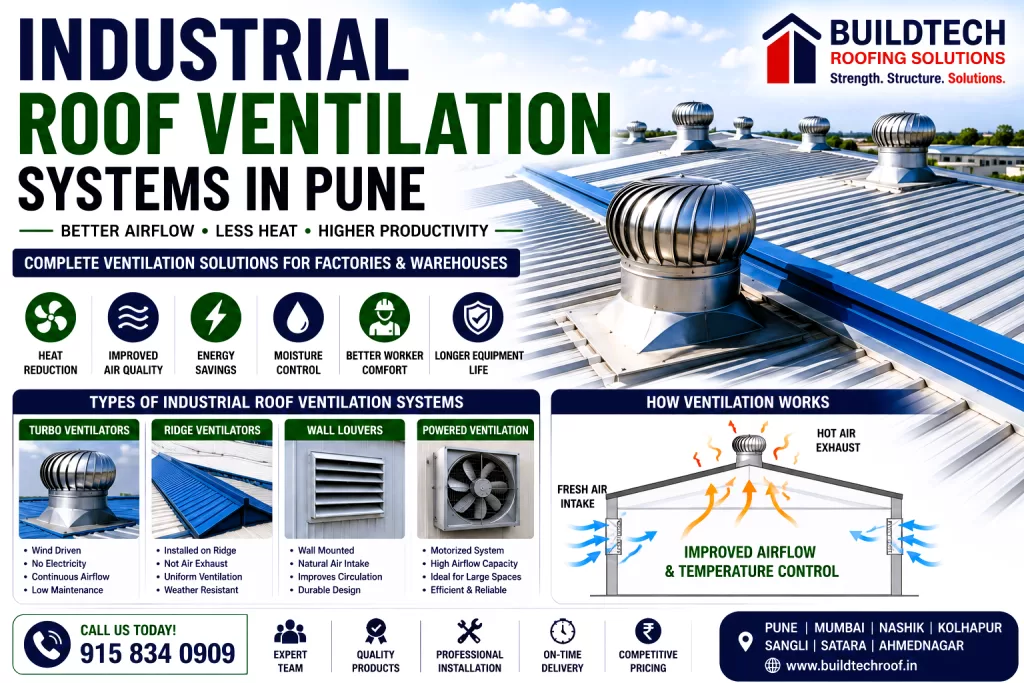
Industrial roof ventilation solutions in Pune

Industrial Roof Ventilation Systems in Pune – Complete Guide for Factories & Warehouses

Introduction Industrial buildings generate significant heat due to machinery, roofing systems, production processes, and environmental conditions. Without proper ventilation, factories and warehouses become excessively hot, uncomfortable, and inefficient. Poor ventilation can lead to: This is where Industrial Roof Ventilation Systems Pune by Buildtech Roofing Solutions provide advanced airflow and heat reduction solutions for industrial infrastructure. This comprehensive guide explains everything about industrial roof ventilation systems, including types, working principles, benefits, installation process, and cost considerations. What Are Industrial Roof Ventilation Systems? Industrial roof ventilation systems are designed to: These systems improve overall industrial efficiency and comfort. Importance of Roof Ventilation 1. Heat Reduction Ventilation removes trapped hot air from industrial sheds. 2. Improved Air Quality Fresh airflow improves workplace conditions. 3. Energy Savings Reduces dependency on cooling systems. 4. Moisture Control Prevents condensation and corrosion. 5. Better Worker Comfort Improves productivity and safety. Types of Industrial Roof Ventilation Systems 1. Turbo Ventilators Wind-driven rotating ventilators are installed on roofs. Features: 2. Ridge Ventilators Installed along roof ridges for natural airflow. Benefits: 3. Louvers Wall-mounted ventilation systems for air circulation. 4. Powered Ventilation Systems Motorised ventilation systems for large industrial buildings. How Roof Ventilation Systems Work Ventilation systems work using: Hot air rises and exits through ventilators, while cooler air enters through side openings. Benefits of Industrial Roof Ventilation Systems ✔ Reduced indoor temperature✔ Improved worker productivity✔ Lower electricity bills✔ Better air circulation✔ Reduced moisture damage✔ Enhanced equipment life Applications of Roof Ventilation Systems Roof Ventilation Installation Process Step-1 – Site Inspection Step-2 – Airflow Analysis Step-3 – Ventilation Design Step-4 – Installation Step-5 – Final Inspection Common Industrial Ventilation Problems 1. Heat Buildup 2. Poor Air Circulation 3. Condensation Issues 4. High Energy Consumption Cost of Roof Ventilation Systems in Maharashtra The cost depends on: Why Choose Buildtech Roofing Solutions Pune ✔ Expert ventilation solutions✔ High-quality ventilators✔ Customised airflow design✔ Competitive pricing✔ Fast installation Service Areas | Pune | Mumbai | Nashik | Kolhapur | Sangli | Satara | & More | Conclusion Industrial roof ventilation systems are essential for improving airflow, reducing heat buildup, and enhancing industrial efficiency. With Industrial Roof Ventilation Systems Pune by Buildtech Roofing Solutions, industries can achieve healthier, cooler, and more energy-efficient workspaces.

Industrial Roof Ventilation Systems in Pune – Complete Guide for Factories & Warehouses Read More »

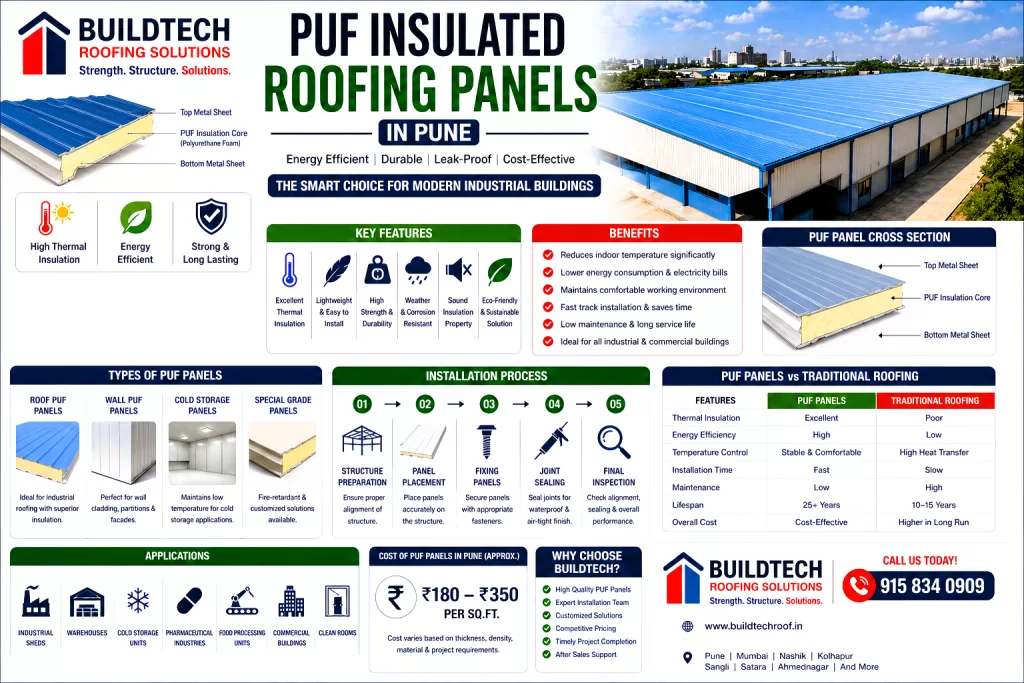
PUF Insulated Roofing Panels in Pune | Energy Efficient Industrial Roofing

PUF Insulated Roofing Panels in Pune

Introduction Industrial infrastructure today demands more than just structural protection—it requires energy efficiency, durability, and climate control. Traditional roofing systems, especially metal sheets, often fail to regulate internal temperatures, leading to excessive heat during the summer and discomfort for workers. In a rapidly growing industrial hub like Pune, where temperature fluctuations and monsoon conditions affect operations, businesses are shifting towards smarter roofing solutions. This is where PUF Insulated Roofing Panels Pune solutions by Buildtech Roofing Solutions offer a highly effective and modern alternative. PUF (Polyurethane Foam) insulated panels are designed to provide superior thermal insulation, reduce energy consumption, and enhance overall building performance. This comprehensive guide explores everything about PUF insulated roofing panels, including their structure, types, features, benefits, applications, installation process, cost, and why they are the preferred choice for industrial buildings. What Are PUF Insulated Roofing Panels? PUF insulated roofing panels are sandwich panels made of three layers: The PUF core acts as an insulating material that minimises heat transfer. How PUF Panels Work PUF panels function by reducing heat transfer through: This results in a stable indoor temperature, regardless of external weather conditions. Types of PUF Insulated Panels 1. Roof PUF Panels Used for industrial roofing systems. 2. Wall PUF Panels Used for walls, partitions, and cladding. 3. Cold Storage Panels Used in temperature-controlled environments like food storage and pharmaceuticals. 4. Sandwich Panels with Different Thickness Available in various thickness options based on insulation requirements. Key Features of PUF Panels 1. High Thermal Insulation PUF panels significantly reduce heat transfer. 2. Lightweight Structure Easy to handle and install. 3. High Strength Strong and durable for industrial use. 4. Weather Resistance Resistant to rain, heat, and dust. 5. Fire Resistance (Optional Grades) Available in fire-retardant variants. 6. Long Lifespan Durable and low maintenance. Benefits of PUF Insulated Roofing Panels 1. Energy Efficiency Reduces energy consumption for cooling systems. 2. Temperature Control Maintains a comfortable indoor temperature. 3. Cost Savings Lower electricity bills and maintenance costs. 4. Faster Installation Prefabricated panels speed up construction. 5. Eco-Friendly Solution Supports sustainable building practices. 6. Noise Reduction Provides sound insulation. Applications of PUF Panels PUF panels are widely used in: PUF Panels vs Traditional Roofing Feature PUF Panels Metal Roofing Insulation High Low Energy Efficiency High Low Temperature Control Excellent Poor Cost Medium Low Lifespan Long Moderate Step-by-Step Installation Process Step-1 – Structural Preparation Ensure framework is ready. Step-2 – Panel Placement Position panels accurately. Step-3 – Fixing Panels Secure panels using fasteners. Step-4 – Joint Sealing Seal joints to prevent leakage. Step-5 – Final Inspection Check alignment and performance. Factors to Consider Before Choosing PUF Panels 1. Thickness of Panels 2. Quality of Materials 3. Insulation Requirements 4. Budget 5. Environmental Conditions Cost of PUF Insulated Roofing Panels in Pune The cost depends on: Approximate Cost: ₹180 – ₹350 per sq.ft 💡 Tip: Higher thickness provides better insulation. Maintenance Tips Common Mistakes to Avoid 1. Choosing Low-Quality Panels 2. Improper Installation 3. Ignoring Thickness Requirements 4. Poor Sealing Why Choose Buildtech Roofing Solutions Pune Buildtech Roofing Solutions is a trusted provider of industrial roofing systems. Key Advantages: ✔ High-quality PUF panels✔ Expert installation team✔ Customised solutions✔ Competitive pricing✔ Fast project completion Industries Served Service Areas | Pune | Mumbai | Nashik | Kolhapur | Sangli | Satara | Ahmednagar | Others Citys | Future of Insulated Roofing Systems With growing demand for: PUF insulated panels are becoming the standard for modern industrial buildings. Conclusion PUF insulated roofing panels offer a powerful combination of insulation, durability, and energy efficiency. With PUF Insulated Roofing Panels Pune solutions by Buildtech Roofing Solutions, businesses can achieve better temperature control, lower energy costs, and improved operational efficiency.

PUF Insulated Roofing Panels in Pune Read More »

Factory Roof Heat Reduction in Pune – Complete Guide to Cool Roofing Solutions for Industries

Factory Roof Heat Reduction in Pune – Complete Guide to Cool Roofing Solutions for Industries

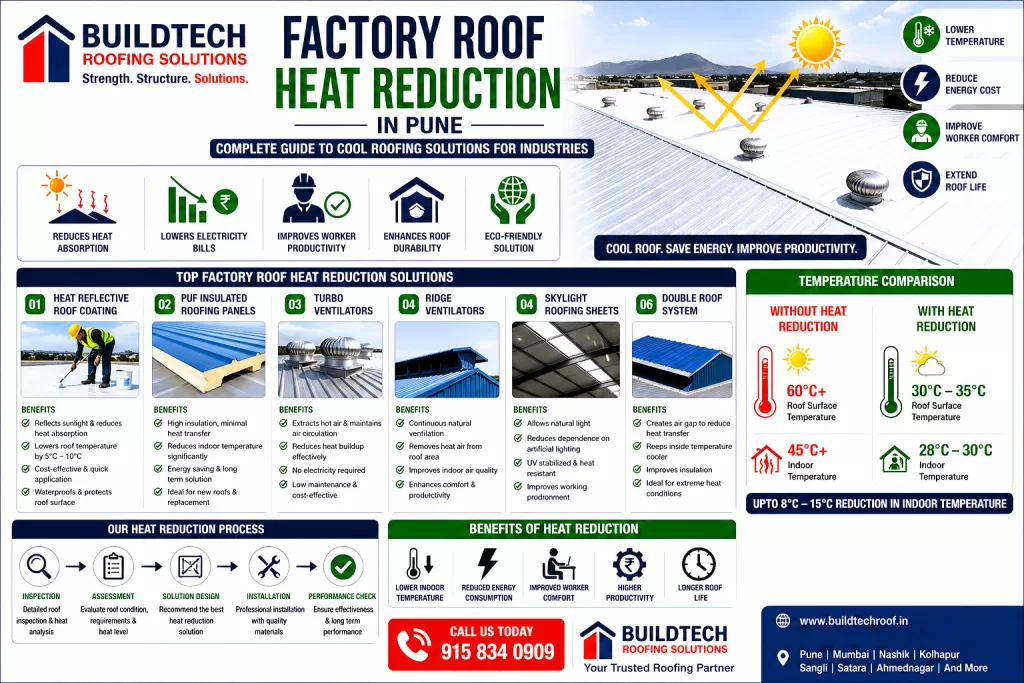
Introduction Industrial facilities across Pune—especially factories, warehouses, and production units—face a persistent and costly challenge: excessive indoor heat. During peak summer, temperatures inside metal-roofed sheds can soar far above ambient conditions, sometimes by 8–15°C. This heat stress impacts worker comfort, productivity, equipment performance, and energy consumption. Most industrial roofs are constructed using metal sheets, which absorb solar radiation and transfer heat into the building. Without mitigation, this leads to: This is where Factory Roof Heat Reduction Pune solutions by Buildtech Roofing Solutions deliver measurable improvements. This comprehensive guide explains the science behind heat buildup, evaluates practical cooling solutions (coatings, insulation, ventilation, and hybrid systems), and provides a step-by-step framework to select and implement the right strategy for your facility. Understanding Heat Buildup in Industrial Roofs 1. Solar Radiation & Absorption Metal roofing (GI/Galvalume/colour-coated sheets) has high thermal conductivity. Under direct sunlight, roof surface temperatures can exceed 60–70°C. A portion of this heat is transmitted indoors via conduction and radiation. 2. Lack of Thermal Resistance (R-Value) Uninsulated roofs have minimal resistance to heat flow. Without insulation layers, heat transfer into the building remains high. 3. Poor Ventilation Hot air rises and accumulates near the roof. Without effective exhaust (ridge/turbo ventilators), this trapped heat increases indoor temperature. 4. Large Surface Area Industrial roofs cover large spans. Even moderate solar gain per square meter compounds into a significant heat load. 5. Internal Heat Gains Machinery, processes, and lighting add to internal heat, worsening the overall thermal environment. Impact of Excess Heat on Industrial Operations Heat Reduction Strategies – Overview Effective heat reduction combines reflectivity, insulation, and ventilation: A hybrid approach typically delivers the best results. 1. Heat Reflective Roof Coatings (Cool Roof Systems) How They Work Cool roof coatings increase solar reflectance (SR) and thermal emittance (TE), reflecting sunlight and emitting absorbed heat back to the atmosphere. Types Benefits Best Use Cases Limitations 2. PUF Insulated Roofing Panels What They Are Sandwich panels with Polyurethane Foam (PUF) core between metal sheets, providing high insulation (low thermal conductivity). Benefits Best Use Cases Considerations 3. Ventilation Systems (Turbo & Ridge Ventilators) Turbo Ventilators Wind-driven rotating units that create negative pressure, extracting hot air continuously without electricity. Ridge Ventilators Static systems are installed along the roof ridge, enabling continuous natural exhaust of hot air. Benefits Best Use Cases 4. Double Roof / False Ceiling Systems Concept Creating an air gap between two layers (double roof) or installing a false ceiling/liner reduces heat transfer. Benefits Considerations 5. Skylight Roofing Sheets (Optimised Daylighting) Role in Heat Management While skylights introduce light, improper selection can add heat. Use diffused, UV-stabilised, low solar heat gain materials. Benefits Best Practices 6. Radiant Barriers & Insulation Liners Reflective foils or insulation liners are installed under roofing sheets to reduce radiant heat transfer. Comparative Analysis of Solutions Solution Capex Heat Reduction Installation Time Best For Cool Roof Coating Low Medium–High Fast Existing roofs PUF Panels High Very High Medium New/Replacement Ventilators Medium High (indirect) Fast All roofs Double Roof Medium–High High Medium Large sheds Skylights (optimized) Medium Indirect Fast Lighting + comfort Step-by-Step Implementation Framework Step-1 – Roof Audit & Thermal Assessment Step-2 – Define Objectives Step-3 – Solution Design Step-4 – Surface Preparation Step-5 – Installation Step-6 – Quality Check & Handover Performance Metrics to Track Cost of Heat Reduction Solutions in Pune (Indicative) Actual costs vary based on thickness, brand, roof condition, height, and access. ROI & Payback Maintenance Best Practices Common Mistakes to Avoid Why Choose Buildtech Roofing Solutions Pune ✔ End-to-end thermal audit and solution design✔ High-quality coatings, panels, and ventilation systems✔ Experienced industrial installation teams✔ Customised hybrid solutions for best ROI✔ Fast execution with safety compliance Industries Served Service Areas Pune | Mumbai Nashik | Kolhapur | Sangli | Satara | Ahmednagar Future of Cool Roofing in Industry Conclusion Factory heat reduction is not just a comfort upgrade—it’s a productivity and cost optimisation strategy. By combining reflective coatings, insulation, and ventilation, industries can achieve significant temperature reduction, lower energy bills, and improved working conditions. With Factory Roof Heat Reduction Pune solutions by Buildtech Roofing Solutions, your facility can become cooler, more efficient, and future-ready.

Factory Roof Heat Reduction in Pune – Complete Guide to Cool Roofing Solutions for Industries Read More »

Industrial Roof Maintenance in Pune – Complete Guide to Extend Roof Life & Prevent Leakage

Industrial Roof Maintenance in Pune – Complete Guide to Extend Roof Life & Prevent Leakage

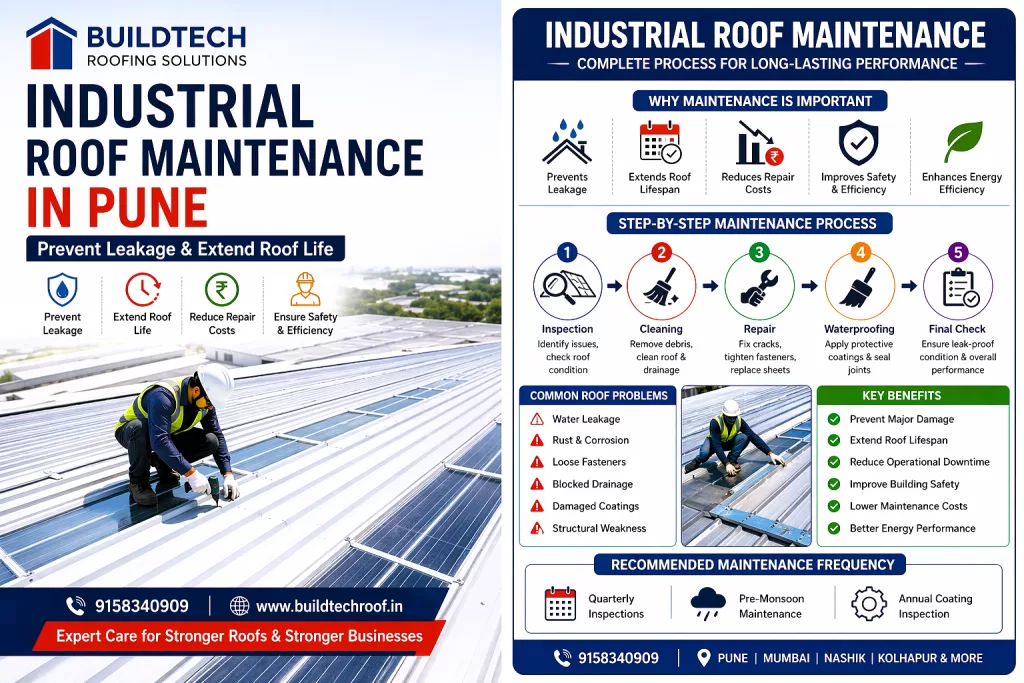
Introduction Industrial roofs are one of the most critical components of any factory, warehouse, or commercial building. They protect machinery, inventory, and operations from harsh environmental conditions such as heavy rainfall, extreme heat, dust, and pollution. However, over time, even the strongest roofing systems begin to deteriorate due to continuous exposure. Without proper maintenance, minor issues like loose fasteners or small cracks can quickly escalate into major problems, including water leakage, structural damage, and costly repairs. This is where Industrial Roof Maintenance services by Buildtech Roofing Solutions become essential. Regular maintenance not only extends the lifespan of your roof but also ensures smooth business operations by preventing unexpected failures. In an industrial city like Pune, where monsoons can be intense and summers extremely hot, proactive roof maintenance is not just recommended—it is necessary. This comprehensive guide covers everything you need to know about industrial roof maintenance, including its importance, common problems, maintenance types, inspection processes, and expert tips. What is Industrial Roof Maintenance? Industrial roof maintenance refers to the routine inspection, cleaning, repair, and protection of roofing systems to ensure they function efficiently over time. It includes activities such as: The goal is to prevent damage before it occurs and maintain the structural integrity of the building. Why Industrial Roof Maintenance is Important 1. Prevents Roof Leakage Leakage is one of the most common problems in industrial buildings. Regular maintenance helps identify vulnerable areas before they turn into leaks. 2. Extends Roof Lifespan Well-maintained roofs last significantly longer, reducing the need for premature replacement. 3. Reduces Repair Costs Preventive maintenance is far more cost-effective than major repairs or replacements. 4. Improves Safety A well-maintained roof ensures the safety of workers, equipment, and operations. 5. Enhances Energy Efficiency Maintained roofs perform better in insulation and heat reduction, lowering energy costs. Common Industrial Roof Problems Understanding common issues helps in timely maintenance. 1. Water Leakage Caused by: 2. Rust & Corrosion Metal roofs are prone to rust due to moisture exposure. 3. Loose Fasteners Fasteners loosen due to vibration, wind, and thermal expansion. 4. Blocked Drainage Systems Clogged gutters cause water accumulation and leakage. 5. Damaged Coatings Protective coatings wear off over time, exposing the roof to damage. 6. Structural Weakness Over time, structural components may weaken, affecting stability. Signs Your Industrial Roof Needs Maintenance Ignoring these signs can lead to serious issues. Types of Industrial Roof Maintenance 1. Preventive Maintenance Scheduled inspections and minor repairs to avoid major problems. 2. Corrective Maintenance Fixing existing issues, such as leaks or damage. 3. Predictive Maintenance Using inspection data to predict future problems. 4. Emergency Maintenance Immediate repair of sudden damage or leakage. Industrial Roof Maintenance Checklist ✔ Inspect roof surface✔ Check joints and seams✔ Tighten fasteners✔ Clean drainage systems✔ Repair cracks✔ Apply waterproof coatings✔ Inspect insulation✔ Check structural components Step-by-Step Maintenance Process Step-1 – Detailed Roof Inspection Step-2 – Cleaning Step-3 – Repair Work Step-4 – Waterproofing Step-5 – Final Inspection Maintenance Frequency Benefits of Regular Roof Maintenance ✔ Prevents major damage✔ Extends roof lifespan✔ Reduces operational disruptions✔ Improves building safety✔ Enhances energy efficiency✔ Saves long-term costs Maintenance Tips for Different Roofing Types Metal Roofing PUF Roofing Skylight Sheets Cost of Industrial Roof Maintenance in Pune The cost varies depending on: 💡 Tip: Preventive maintenance costs are much lower than repair costs. Why Choose Buildtech Roofing Solutions Pune Buildtech Roofing Solutions is a trusted name in industrial roofing maintenance. Key Advantages: ✔ Experienced professionals✔ Advanced maintenance solutions✔ High-quality materials✔ Safety-compliant work✔ Cost-effective services✔ Fast response Industries Served Preventive Maintenance Strategy for Businesses Businesses should adopt a long-term maintenance strategy: Future of Industrial Roof Maintenance With advancements in technology, roof maintenance is becoming more efficient through: Conclusion Industrial roof maintenance is essential for ensuring long-term durability, safety, and cost savings. By choosing Industrial Roof Maintenance services from Buildtech Roofing Solutions, businesses can prevent costly damage, improve performance, and extend the life of their roofing systems.

Industrial Roof Maintenance in Pune – Complete Guide to Extend Roof Life & Prevent Leakage Read More »

Z & C purlins are becoming a core component of modern industrial construction systems.

Z & C Purlins for Industrial Roofing Structures

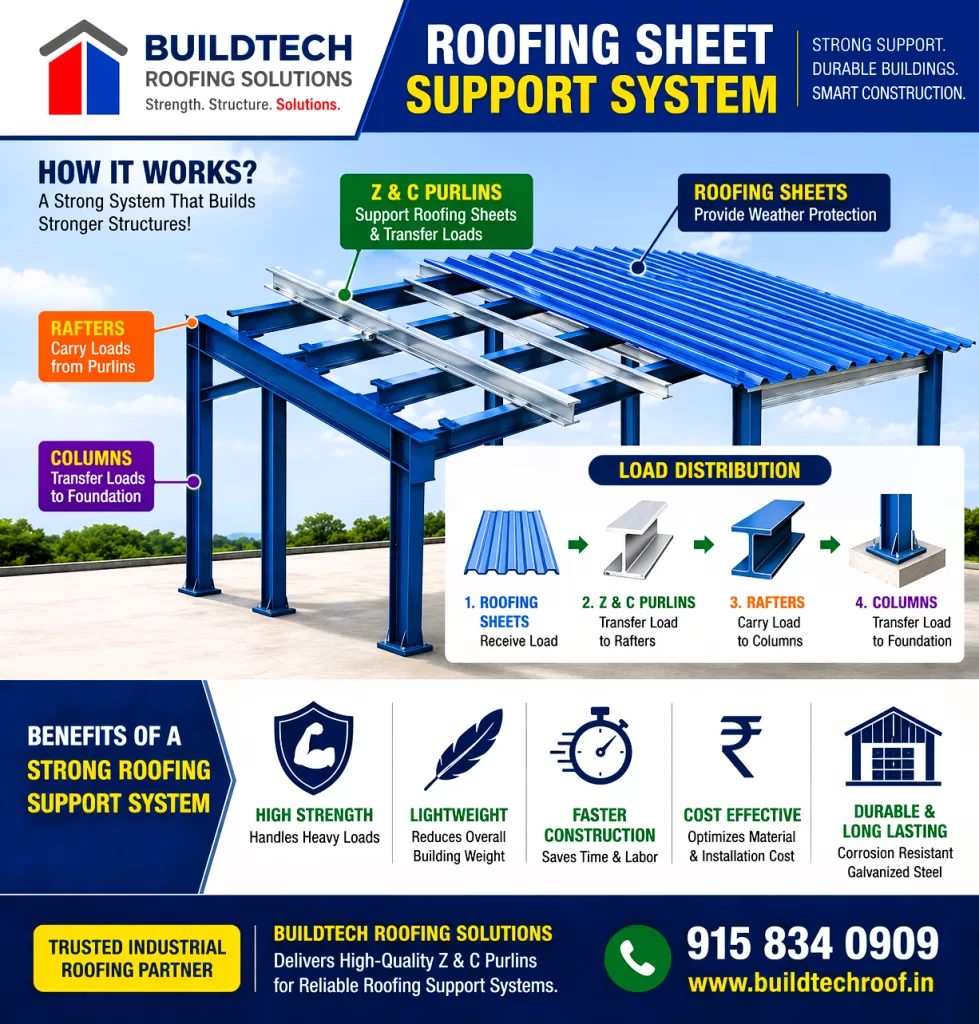
Introduction Industrial construction demands structural components that are strong, lightweight, and capable of supporting heavy loads while maintaining long-term durability. Among the most essential components in modern industrial buildings are Z & C purlins. Purlins play a critical role in supporting roofing sheets, wall cladding, and structural frameworks in factories, warehouses, and commercial buildings. Without proper purlin systems, roofing structures cannot maintain stability or load distribution. This is where Z and C Purlins Pune solutions by Buildtech Roofing Solutions provide high-quality, engineered structural systems tailored for industrial applications. In a rapidly developing industrial city like Pune, where construction efficiency and durability are key, Z & C purlins have become a preferred choice for builders, engineers, and contractors. This comprehensive guide covers everything about Z & C purlins, including types, features, benefits, applications, installation process, and why they are essential for modern construction. What Are Z & C Purlins? Z & C purlins are cold-formed steel structural members used in industrial and commercial construction. They are named based on their cross-sectional shapes: These purlins are installed horizontally and act as support systems for: They transfer loads from the roof to the main structure, ensuring stability and strength. How Z & C Purlins Work Purlins distribute loads efficiently across the structure. Working Mechanism: This system ensures balanced load distribution and structural integrity. Difference Between Z and C Purlins Feature Z Purlins C Purlins Shape Z-shaped C-shaped Span Capacity Higher Moderate Overlapping Possible Not possible Structural Strength High Medium Application Large buildings Small to medium structures Types of Z & C Purlins 1. Galvanised Purlins These are coated with zinc to prevent corrosion. Features: 2. Pre-Engineered Purlins Customised purlins used in PEB (Pre-Engineered Buildings). Benefits: 3. Heavy-Duty Purlins Designed for large-span industrial structures. 4. Light-Duty Purlins Used in smaller structures or secondary support systems. Key Features of Z & C Purlins 1. High Strength-to-Weight Ratio Provides excellent strength while being lightweight. 2. Corrosion Resistance Galvanised coating ensures long-term durability. 3. Dimensional Accuracy Manufactured with precision for a perfect fit. 4. Easy Installation Quick and efficient installation process. 5. Versatility Suitable for roofing, cladding, and structural support. Benefits of Z & C Purlins 1. Strong Structural Support Ensures stability of roofing systems. 2. Faster Construction Prefabricated design reduces construction time. 3. Cost Efficiency Lower material and labour costs. 4. Durability Long-lasting performance with minimal maintenance. 5. Flexibility Can be customised for different project requirements. Applications of Z & C Purlins Z & C purlins are widely used in: Role of Purlins in Industrial Roofing Systems Purlins are essential for: Without purlins, roofing systems would lack strength and stability. Z & C Purlins vs Traditional Structural Members Feature Z & C Purlins Traditional Steel Sections Weight Lightweight Heavy Installation Fast Slow Cost Lower Higher Efficiency High Moderate Step-by-Step Installation Process Step-1 – Structural Design Analyse load requirements and design purlin layout. Step-2 – Material Selection Choose an appropriate thickness and size. Step-3 – Positioning Align purlins across rafters. Step-4 – Fixing Secure purlins using bolts and fasteners. Step-5 – Alignment Check Ensure proper spacing and alignment. Step-6 – Roofing Installation Install roofing sheets over purlins. Factors to Consider Before Choosing Purlins Maintenance Tips Cost of Z & C Purlins in Pune Cost depends on: 💡 Tip: Investing in high-quality purlins reduces long-term maintenance costs. Why Choose Buildtech Roofing Solutions Pune Buildtech Roofing Solutions is a trusted name in industrial roofing and structural systems. Key Advantages: ✔ High-quality galvanised purlins✔ Expert engineering and installation✔ Customised solutions✔ Competitive pricing✔ Timely project execution Industries Served Future of Structural Systems with Purlins With increasing demand for: Z & C purlins are becoming the backbone of modern industrial construction. Conclusion Z & C purlins are essential structural components that provide strength, stability, and efficiency in industrial buildings. With Z and C Purlins Pune solutions by Buildtech Roofing Solutions, businesses can ensure durable, cost-effective, and high-performance construction systems.

Z & C Purlins for Industrial Roofing Structures Read More »

Decking Sheets in Pune – Complete Guide for Industrial & Commercial Construction

Decking Sheets in Pune – Complete Guide for Industrial & Commercial Construction

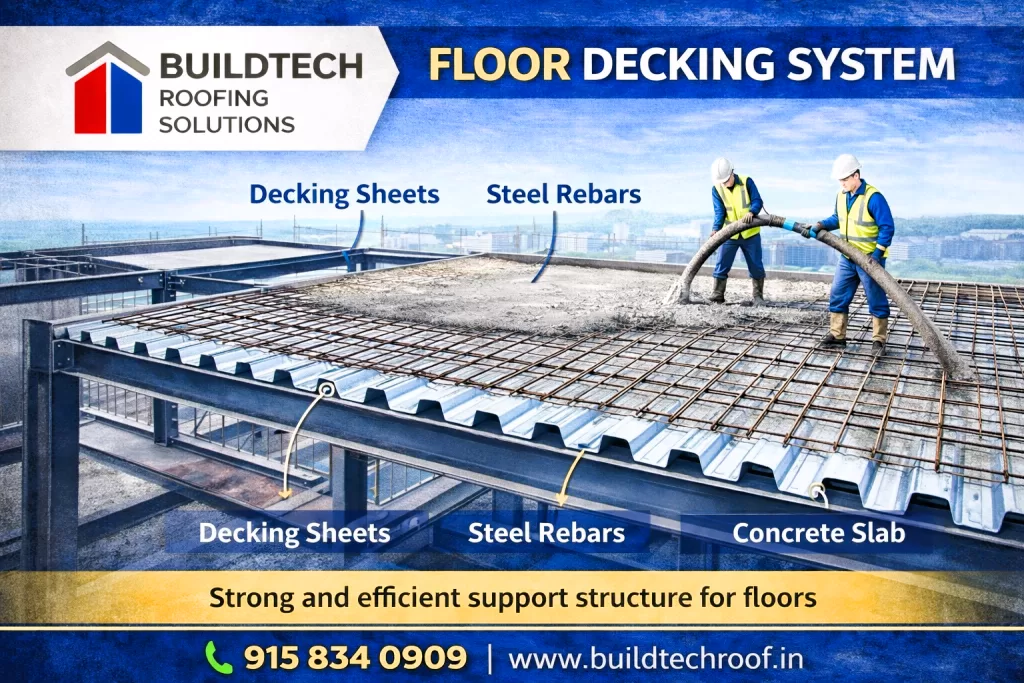
Introduction Modern construction requires materials that are strong, durable, efficient, and cost-effective. Traditional methods for slabs and roofing are often time-consuming, labour-intensive, and expensive. This is where Decking Sheets Pune solutions by Buildtech Roofing Solutions provide a modern alternative. Decking sheets are crucial for industrial and commercial construction due to their strength, lightweight nature, ease of installation, and cost-effectiveness. They find use in factories, warehouses, commercial complexes, and multi-storey buildings. In Pune, a rapidly growing industrial hub, businesses are adopting decking sheets. This choice helps reduce construction time and improve structural performance. This comprehensive guide will help you understand decking sheets, their types, benefits, applications, installation process, and why they are a smart choice for modern construction. What Are Decking Sheets? Decking sheets are corrugated metal sheets that provide structural support for concrete slabs or roofing systems. They act as: These sheets typically consist of galvanised steel, which ensures durability and corrosion resistance. Once you pour concrete over them, they create a composite structure that increases strength and stability. Once we pour concrete over them, they create a composite structure that increases strength and stability. How Decking Sheets Work Decking sheets function as a base layer for concrete slabs. Working Process: This system improves structural performance and minimises material usage, which leads to fewer transit impacts. Types of Decking Sheets 1. Floor Decking Sheets These sheets support concrete floors in multi-storey buildings. Features: Applications: 2. Roof Decking Sheets Used for roofing applications where structural support is required. Benefits: 3. Composite Decking Sheets Designed to work with concrete to create a strong composite structure. Advantages: 4. Non-Composite Decking Sheets Used as simple support systems without bonding with concrete. Key Features of Decking Sheets 1. High Strength Decking sheets are designed to handle heavy loads, making them ideal for industrial use. 2. Lightweight Choosing decking sheets instead of traditional slabs reduces the overall structural weight. This change enhances the building’s efficiency by making it lighter. This solution simplifies construction and enhances efficiency, making it a smarter choice for building projects. 3. Corrosion Resistance Galvanised coating protects sheets from rust and environmental damage. 4. Fast Installation Prefabricated sheets allow quick construction. 5. Cost Efficiency It substantially reduces both material and labor costs. 6. Versatility Can be used for flooring and roofing applications. Benefits of Decking Sheets 1. Faster Construction Decking sheets significantly reduce construction time. 2. Reduced Material Usage Less concrete and steel are required. 3. Improved Structural Performance Composite action increases strength and durability. 4. Cost Savings Lower labor and material costs lead to a decrease in overall project expenses. 5. Safety A stable working platform is created during construction. 6. Long Lifespan Highly durable and resistant to environmental conditions. Applications of Decking Sheets Decking sheets are widely used in: Decking Sheets vs Traditional Slab Construction Feature Decking Sheets Traditional Slab Construction Speed Fast Slow Cost Lower Higher Weight Lightweight Heavy Strength High Medium Labor Requirement Low High Step-by-Step Installation Process Step-1 – Structural Preparation Ensure the steel framework is ready and aligned. Step-2 – Decking Sheet Placement Sheets are placed over beams and aligned properly. Step-3 – Fixing Sheets are secured using fasteners or welding. Step-4 – Reinforcement Placement Steel reinforcement is added if required. Step-5 – Concrete Pouring Concrete is poured over the decking sheets. Step-6 – Finishing & Curing Concrete is allowed to cure for strength development. Advantages for Industrial Projects Maintenance Tips Cost of Decking Sheets in Pune The cost depends on: 💡 Tip: Investing in high-quality decking sheets ensures long-term savings. Why Choose Buildtech Roofing Solutions Pune Buildtech Roofing Solutions is a trusted provider of industrial roofing and structural systems. Key Advantages: ✔ High-quality decking sheets✔ Expert installation team✔ Customised solutions✔ Competitive pricing✔ Fast project execution Industries Served Future of Construction with Decking Sheets Decking sheets are transforming modern construction due to: They are becoming a preferred choice for developers and industrial projects. Conclusion Decking sheets offer a perfect combination of strength, efficiency, and cost-effectiveness. With Decking Sheets Pune solutions by Buildtech Roofing Solutions, businesses can achieve faster construction, stronger structures, and long-term durability.

Decking Sheets in Pune – Complete Guide for Industrial & Commercial Construction Read More »

©2023 buildtechroof. All Rights Reserved.