
Introduction
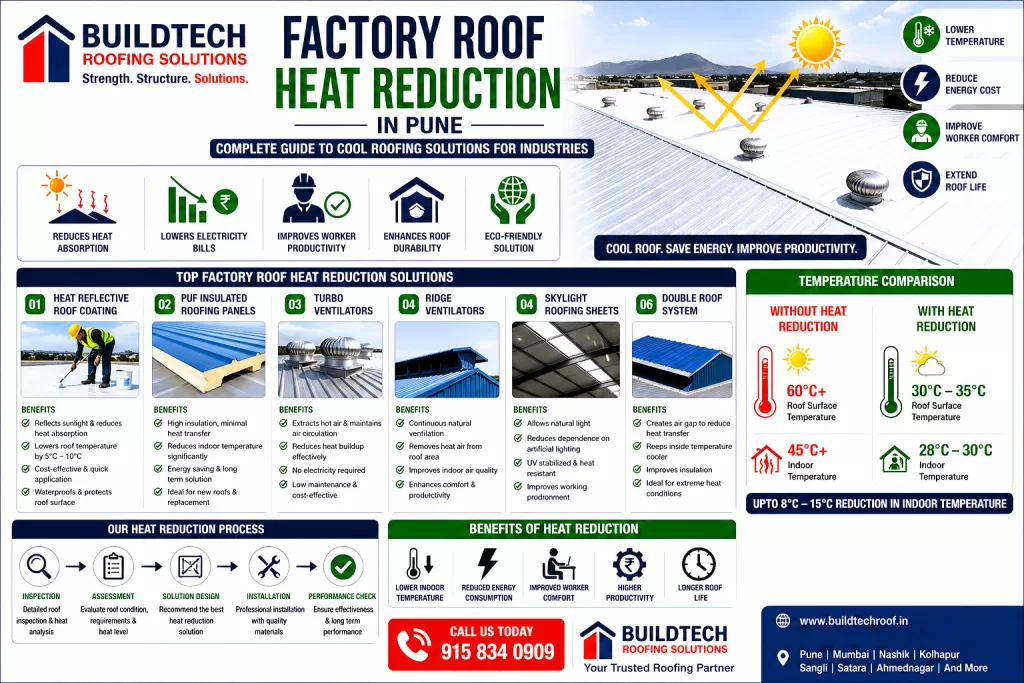
Industrial facilities across Pune—especially factories, warehouses, and production units—face a persistent and costly challenge: excessive indoor heat. During peak summer, temperatures inside metal-roofed sheds can soar far above ambient conditions, sometimes by 8–15°C. This heat stress impacts worker comfort, productivity, equipment performance, and energy consumption.
Most industrial roofs are constructed using metal sheets, which absorb solar radiation and transfer heat into the building. Without mitigation, this leads to:
- Uncomfortable and unsafe working conditions
- Higher electricity bills due to cooling systems
- Reduced operational efficiency
- Accelerated wear of machinery and materials
This is where Factory Roof Heat Reduction Pune solutions by Buildtech Roofing Solutions deliver measurable improvements.
This comprehensive guide explains the science behind heat buildup, evaluates practical cooling solutions (coatings, insulation, ventilation, and hybrid systems), and provides a step-by-step framework to select and implement the right strategy for your facility.
Understanding Heat Buildup in Industrial Roofs
1. Solar Radiation & Absorption
Metal roofing (GI/Galvalume/colour-coated sheets) has high thermal conductivity. Under direct sunlight, roof surface temperatures can exceed 60–70°C. A portion of this heat is transmitted indoors via conduction and radiation.
2. Lack of Thermal Resistance (R-Value)
Uninsulated roofs have minimal resistance to heat flow. Without insulation layers, heat transfer into the building remains high.
3. Poor Ventilation
Hot air rises and accumulates near the roof. Without effective exhaust (ridge/turbo ventilators), this trapped heat increases indoor temperature.
4. Large Surface Area
Industrial roofs cover large spans. Even moderate solar gain per square meter compounds into a significant heat load.
5. Internal Heat Gains
Machinery, processes, and lighting add to internal heat, worsening the overall thermal environment.
Impact of Excess Heat on Industrial Operations
- Worker Health & Productivity: Heat stress reduces efficiency and increases fatigue.
- Energy Costs: More reliance on fans, coolers, or HVAC increases electricity bills.
- Equipment Reliability: Overheating can reduce the lifespan of machines and electronics.
- Product Quality: Heat-sensitive materials may degrade.
- Compliance & Safety: Elevated temperatures can breach workplace safety norms.
Heat Reduction Strategies – Overview
Effective heat reduction combines reflectivity, insulation, and ventilation:
- Reflectivity: Reduce solar heat absorption (cool roof coatings)
- Insulation: Limit heat transfer (PUF panels, liners)
- Ventilation: Remove trapped hot air (ridge/turbo ventilators)
- Daylighting Optimisation: Reduce heat from artificial lighting (skylights with proper spec)
A hybrid approach typically delivers the best results.
1. Heat Reflective Roof Coatings (Cool Roof Systems)
How They Work
Cool roof coatings increase solar reflectance (SR) and thermal emittance (TE), reflecting sunlight and emitting absorbed heat back to the atmosphere.
Types
- Acrylic elastomeric coatings
- Ceramic/IR-reflective coatings
- PU-based coatings (for specific use cases)
Benefits
- Reduces the roof surface temperature significantly
- Lowers indoor temperature by ~5–10°C (varies by conditions)
- Seamless waterproofing layer
- Quick installation, minimal disruption
Best Use Cases
- Existing metal roofs in moderate condition
- Budget-conscious retrofits
Limitations
- Periodic recoating required (3–5 years, depending on product)
- Performance depends on surface prep and thickness
2. PUF Insulated Roofing Panels
What They Are
Sandwich panels with Polyurethane Foam (PUF) core between metal sheets, providing high insulation (low thermal conductivity).
Benefits
- Excellent thermal resistance (high R-value)
- Reduces heat ingress dramatically
- Energy savings for climate-controlled spaces
- Clean, modern finish
Best Use Cases
- New construction
- Full roof replacement
- Temperature-sensitive industries (pharma, food)
Considerations
- Higher upfront cost
- Requires proper detailing at joints to avoid thermal bridging
3. Ventilation Systems (Turbo & Ridge Ventilators)
Turbo Ventilators
Wind-driven rotating units that create negative pressure, extracting hot air continuously without electricity.
Ridge Ventilators
Static systems are installed along the roof ridge, enabling continuous natural exhaust of hot air.
Benefits
- Reduces heat buildup under the roof
- Improves air changes per hour (ACH)
- No/low operating cost
Best Use Cases
- All industrial sheds (especially high-heat environments)
- Combine with coatings/insulation for best results
4. Double Roof / False Ceiling Systems
Concept
Creating an air gap between two layers (double roof) or installing a false ceiling/liner reduces heat transfer.
Benefits
- Air gap acts as an insulation buffer
- Reduces radiant heat entering the workspace
Considerations
- Additional structural elements
- Space constraints
5. Skylight Roofing Sheets (Optimised Daylighting)
Role in Heat Management
While skylights introduce light, improper selection can add heat. Use diffused, UV-stabilised, low solar heat gain materials.
Benefits
- Reduces artificial lighting load
- Improves visibility and comfort
Best Practices
- Controlled spacing (not excessive coverage)
- Use diffused sheets (FRP/polycarbonate with additives)
6. Radiant Barriers & Insulation Liners
Reflective foils or insulation liners are installed under roofing sheets to reduce radiant heat transfer.
Comparative Analysis of Solutions
| Solution | Capex | Heat Reduction | Installation Time | Best For |
|---|---|---|---|---|
| Cool Roof Coating | Low | Medium–High | Fast | Existing roofs |
| PUF Panels | High | Very High | Medium | New/Replacement |
| Ventilators | Medium | High (indirect) | Fast | All roofs |
| Double Roof | Medium–High | High | Medium | Large sheds |
| Skylights (optimised) | Medium | Indirect | Fast | Lighting + comfort |
Step-by-Step Implementation Framework
Step-1 – Roof Audit & Thermal Assessment
- Measure roof type, age, and condition
- Identify hotspots and airflow issues
Step-2 – Define Objectives
- Target temperature reduction (e.g., 6–10°C)
- Budget and ROI expectations
Step-3 – Solution Design
- Choose a single or a hybrid solution
- Calculate ventilator quantity (based on volume/ACH)
- Specify coating type/thickness or panel specs
Step-4 – Surface Preparation
- Cleaning, rust treatment, priming (critical for coatings)
Step-5 – Installation
- Apply coatings / install panels/ventilators
- Ensure proper sealing and detailing
Step-6 – Quality Check & Handover
- Verify coverage, adhesion, and airflow
- Document maintenance plan
Performance Metrics to Track
- Indoor temperature reduction (°C)
- Energy consumption (kWh) before/after
- Worker comfort feedback
- Maintenance frequency
Cost of Heat Reduction Solutions in Pune (Indicative)
- Cool Roof Coating: ₹40 – ₹120/sq.ft
- PUF Panels: ₹180 – ₹350/sq.ft
- Ventilation Systems: ₹20 – ₹80/sq.ft (project-dependent)
Actual costs vary based on thickness, brand, roof condition, height, and access.
ROI & Payback
- Coatings: Payback typically 6–18 months via energy savings + productivity gains
- PUF Panels: Longer payback but superior long-term performance
- Ventilation: Low operating cost → quick ROI
Maintenance Best Practices
- Annual inspection (pre-monsoon recommended)
- Clean the roof to maintain reflectivity
- Check fasteners and seals
- Recoat as per the product lifecycle
Common Mistakes to Avoid
- Skipping surface preparation before coating
- Over-reliance on a single solution (no ventilation)
- Poor quality materials or incorrect thickness
- Ignoring airflow calculations
- Excessive skylight coverage is causing glare/heat
Why Choose Buildtech Roofing Solutions Pune
✔ End-to-end thermal audit and solution design
✔ High-quality coatings, panels, and ventilation systems
✔ Experienced industrial installation teams
✔ Customised hybrid solutions for best ROI
✔ Fast execution with safety compliance
Industries Served
- Manufacturing plants
- Warehouses & logistics hubs
- Automotive & engineering units
- Pharma & food processing
- Textile & packaging
Service Areas
Pune | Mumbai Nashik | Kolhapur | Sangli | Satara | Ahmednagar
Future of Cool Roofing in Industry
- Advanced IR-reflective coatings
- High-performance sandwich panels
- Data-driven predictive maintenance
- Integration with green building standards
Conclusion
Factory heat reduction is not just a comfort upgrade—it’s a productivity and cost optimisation strategy. By combining reflective coatings, insulation, and ventilation, industries can achieve significant temperature reduction, lower energy bills, and improved working conditions.
With Factory Roof Heat Reduction Pune solutions by Buildtech Roofing Solutions, your facility can become cooler, more efficient, and future-ready.