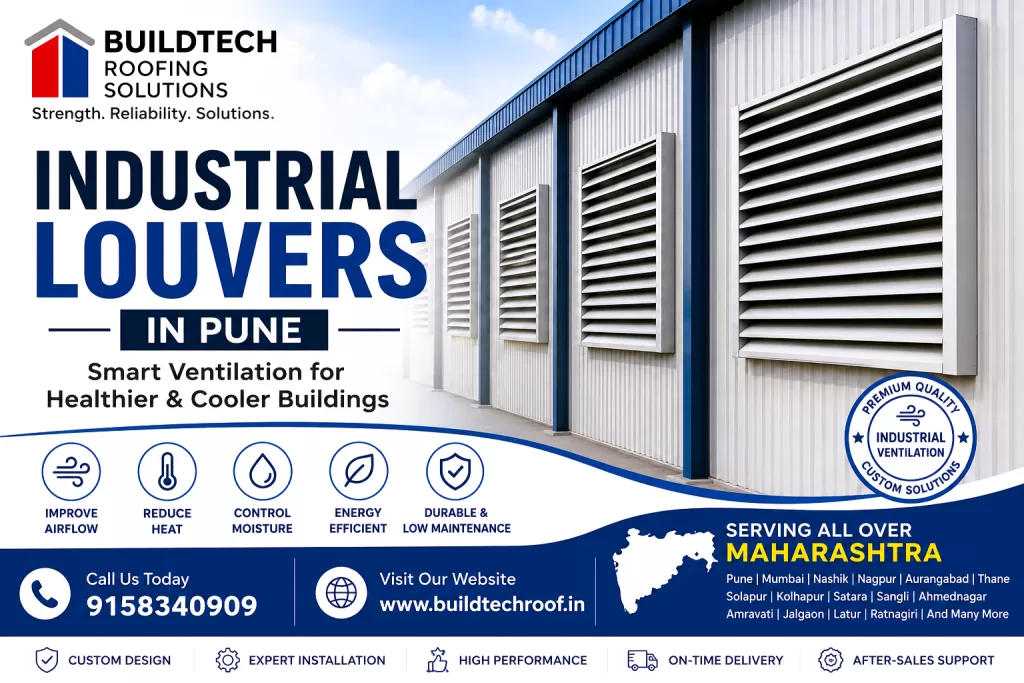
Metal Louver

Ventilation Louvers, Aluminum Louvers, Metal Louvers, Steel Louver. Weather Louvers, Gravity Air Louver, & Ventilation Louvers, Exhaust Fan Louvre manufacturers, suppliers and exporters in Pune, Maharashtra, India.

Industrial Roof Ventilation Systems in Pune – Complete Guide for Factories & Warehouses

Industrial Roof Ventilation Systems in Pune – Complete Guide for Factories & Warehouses

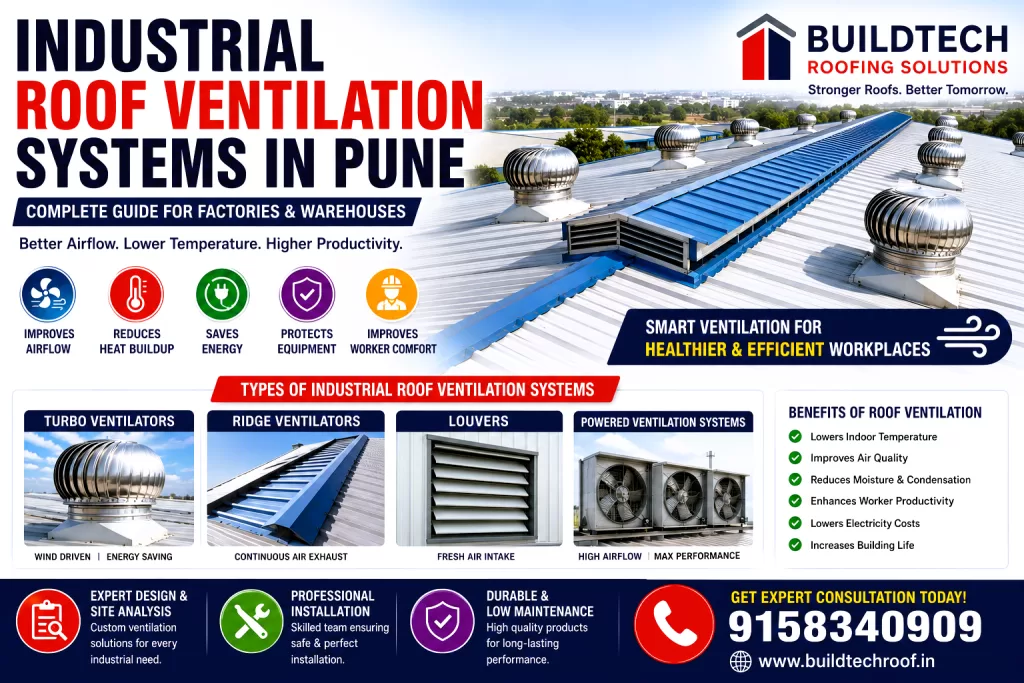
Industrial Roof Ventilation Systems in Pune – Guide for Better Airflow & Heat Reduction Introduction Industrial buildings such as factories, warehouses, manufacturing plants, and logistics hubs generate substantial internal heat every day. This heat comes from production machinery, metal roofing systems, manpower, and harsh external weather conditions—especially in Pune’s hot climate. Without proper ventilation, industrial spaces often face: That’s why investing in Industrial Roof Ventilation Systems Pune is essential for every modern industrial facility. At Buildtech Roofing Solutions, we provide advanced industrial ventilation systems designed to improve airflow, reduce roof heat, and create healthier, more productive work environments. This complete guide explains everything you need to know about industrial roof ventilation systems, including types, benefits, installation methods, costs, and how to choose the right solution. What Are Industrial Roof Ventilation Systems? Industrial roof ventilation systems are engineered airflow solutions installed on industrial roofs to remove trapped hot air and improve internal air circulation. Their primary purpose is to: ✔ Remove hot air from inside the building✔ Reduce indoor temperature✔ Control humidity and moisture✔ Improve worker comfort✔ Enhance energy efficiency Proper ventilation helps maintain balanced airflow, which directly impacts operational performance. Why Roof Ventilation Is Important for Industrial Buildings 1. Reduces Excessive Heat Metal roofs absorb intense solar heat. Without ventilation, this heat gets trapped inside. Ventilation removes this trapped hot air and lowers the indoor temperature. 2. Improves Worker Productivity A cooler workplace leads to: 3. Lowers Electricity Bills When ventilation improves naturally, industries rely less on: This significantly reduces energy costs. 4. Prevents Moisture & Condensation Poor airflow causes condensation, leading to: Proper ventilation prevents moisture buildup. 5. Protects Machinery & Inventory Excess heat and humidity can damage: Ventilation protects valuable assets. Types of Industrial Roof Ventilation Systems 1. Turbo Ventilators Turbo ventilators are among the most widely used industrial roof ventilation systems. They are wind-driven rotating ventilators installed on rooftops. Features: ✔ No electricity required✔ Continuous natural ventilation✔ Low maintenance✔ Long lifespan Benefits: Best For: 2. Ridge Ventilators Ridge ventilators are installed along the highest point (ridge) of the roof. They allow continuous hot air exhaust. Features: ✔ Uniform ventilation✔ Natural airflow system✔ Weather-resistant design Benefits: 3. Industrial Louvers Louvers are wall-mounted airflow systems installed on side walls. They allow fresh air intake into the building. Benefits: 4. Powered Roof Ventilators Powered systems use electric motors for forced ventilation. Suitable For: Benefits: ✔ Strong airflow✔ Controlled ventilation✔ High efficiency How Industrial Roof Ventilation Systems Work Industrial ventilation works on three principles: 1. Natural Airflow Cool air enters through side openings or louvers. 2. Hot Air Rise Principle Hot air naturally rises upward. Ventilators installed on the roof remove this hot air. 3. Wind Pressure Movement Wind increases suction inside turbo ventilators, accelerating exhaust. This creates continuous airflow. Benefits of Industrial Roof Ventilation Systems Installing proper roof ventilation offers multiple advantages: ✔ Lowers indoor temperature by 4–10°C✔ Improves air circulation✔ Reduces electricity consumption✔ Prevents moisture damage✔ Enhances worker comfort✔ Increases equipment lifespan✔ Improves overall workplace safety Applications of Industrial Roof Ventilation Roof ventilation systems are ideal for: Roof Ventilation System Installation Process Step-1 – Site Inspection Experts inspect: Step-2 – Airflow Analysis Ventilation requirements are calculated based on: Step-3 – System Design Selection of: Step-4 – Installation Ventilators are installed with: Step-5 – Final Inspection System performance is tested for airflow efficiency. Common Industrial Ventilation Problems Without proper ventilation, industries face: 1. Heat Buildup Causes uncomfortable work environments. 2. Poor Air Circulation Creates stagnant air pockets. 3. Condensation Leads to corrosion and leakage. 4. High Cooling Costs More dependence on electrical cooling. Cost of Industrial Roof Ventilation Systems in Pune Approximate costs vary depending on: Indicative Pricing: System Type Approx Cost Turbo Ventilators ₹8,000 – ₹25,000/unit Ridge Ventilators ₹300 – ₹700/running ft Louvers ₹150 – ₹500/sq.ft Powered Systems Custom quotation 💡 Tip: Proper ventilation delivers long-term ROI through energy savings. Maintenance Tips for Roof Ventilation Systems To maximise performance: Low maintenance ensures long service life. Why Choose Buildtech Roofing Solutions Pune? Buildtech Roofing Solutions is a trusted industrial roofing and ventilation expert. Our Advantages: ✔ Expert airflow analysis✔ High-quality turbo & ridge ventilators✔ Customised ventilation design✔ Competitive pricing✔ Fast installation✔ Complete industrial roofing solutions Industries We Serve Service Areas We serve across Maharashtra and some specific areas: 📍 Pune📍 Mumbai📍 Nashik📍 Kolhapur📍 Sangli📍 Satara📍 Ahmednagar Future of Industrial Ventilation Modern industrial ventilation is moving toward: Ventilation is now a strategic investment—not just a utility. Conclusion Industrial roof ventilation systems are essential for maintaining a cooler, healthier, and more efficient workplace. Whether you need turbo ventilators, ridge ventilators, or a custom airflow solution, Buildtech Roofing Solutions provides reliable and cost-effective industrial ventilation systems tailored to your facility. For expert Industrial Roof Ventilation Systems in Pune, trust Buildtech Roofing Solutions. 📞 Call Now: 9158340909🌐 Buildtech Roofing Solutions

Industrial Roof Ventilation Systems in Pune – Complete Guide for Factories & Warehouses Read More »

Industrial roof ventilation solutions in Pune

Industrial Roof Ventilation Systems in Pune – Complete Guide for Factories & Warehouses

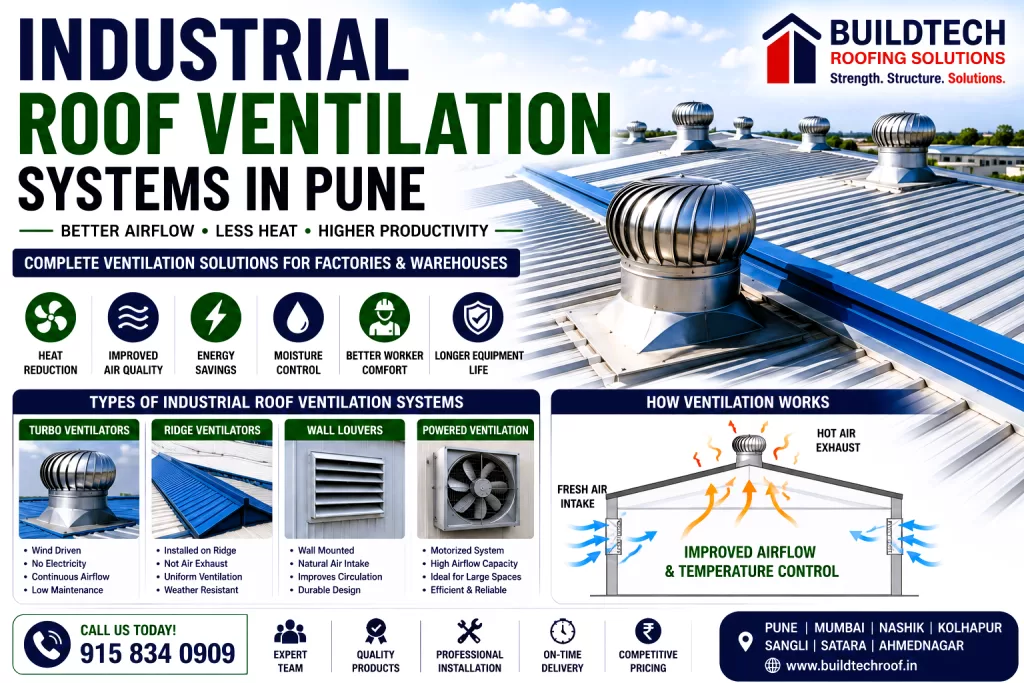
Introduction Industrial buildings generate significant heat due to machinery, roofing systems, production processes, and environmental conditions. Without proper ventilation, factories and warehouses become excessively hot, uncomfortable, and inefficient. Poor ventilation can lead to: This is where Industrial Roof Ventilation Systems Pune by Buildtech Roofing Solutions provide advanced airflow and heat reduction solutions for industrial infrastructure. This comprehensive guide explains everything about industrial roof ventilation systems, including types, working principles, benefits, installation process, and cost considerations. What Are Industrial Roof Ventilation Systems? Industrial roof ventilation systems are designed to: These systems improve overall industrial efficiency and comfort. Importance of Roof Ventilation 1. Heat Reduction Ventilation removes trapped hot air from industrial sheds. 2. Improved Air Quality Fresh airflow improves workplace conditions. 3. Energy Savings Reduces dependency on cooling systems. 4. Moisture Control Prevents condensation and corrosion. 5. Better Worker Comfort Improves productivity and safety. Types of Industrial Roof Ventilation Systems 1. Turbo Ventilators Wind-driven rotating ventilators are installed on roofs. Features: 2. Ridge Ventilators Installed along roof ridges for natural airflow. Benefits: 3. Louvers Wall-mounted ventilation systems for air circulation. 4. Powered Ventilation Systems Motorised ventilation systems for large industrial buildings. How Roof Ventilation Systems Work Ventilation systems work using: Hot air rises and exits through ventilators, while cooler air enters through side openings. Benefits of Industrial Roof Ventilation Systems ✔ Reduced indoor temperature✔ Improved worker productivity✔ Lower electricity bills✔ Better air circulation✔ Reduced moisture damage✔ Enhanced equipment life Applications of Roof Ventilation Systems Roof Ventilation Installation Process Step-1 – Site Inspection Step-2 – Airflow Analysis Step-3 – Ventilation Design Step-4 – Installation Step-5 – Final Inspection Common Industrial Ventilation Problems 1. Heat Buildup 2. Poor Air Circulation 3. Condensation Issues 4. High Energy Consumption Cost of Roof Ventilation Systems in Maharashtra The cost depends on: Why Choose Buildtech Roofing Solutions Pune ✔ Expert ventilation solutions✔ High-quality ventilators✔ Customised airflow design✔ Competitive pricing✔ Fast installation Service Areas | Pune | Mumbai | Nashik | Kolhapur | Sangli | Satara | & More | Conclusion Industrial roof ventilation systems are essential for improving airflow, reducing heat buildup, and enhancing industrial efficiency. With Industrial Roof Ventilation Systems Pune by Buildtech Roofing Solutions, industries can achieve healthier, cooler, and more energy-efficient workspaces.

Industrial Roof Ventilation Systems in Pune – Complete Guide for Factories & Warehouses Read More »

Metal Louvers for Industrial Ventilation: Efficient Airflow Solutions for Modern Buildings

Introduction Industrial buildings require efficient ventilation systems to maintain comfortable indoor conditions, protect equipment, and ensure worker safety. One of the most effective solutions for controlling airflow while protecting buildings from external elements is the Metal Louver System. At Buildtech Roofing Solutions, we manufacture and supply high-performance industrial metal louvers designed to regulate airflow, prevent dust entry, and improve overall building ventilation. Metal louvers are widely used in: • Factories• Warehouses• Industrial plants• Commercial buildings• Data centers• Mechanical ventilation rooms This comprehensive guide explains how metal louvers work, their benefits, applications, and why they are essential for modern industrial buildings. What Are Metal Louvers? Metal louvers are ventilation panels made from metal blades or fins installed in building walls, roofs, or ventilation openings. They allow controlled airflow into and out of a building while preventing: • Rainwater entry• Dust and debris• Direct sunlight• Birds and insects The angled blades of the louver system are engineered to maximise airflow efficiency while protecting the interior environment. Why Industrial Buildings Need Metal Louvers Industrial facilities generate heat, humidity, and airborne particles during daily operations. Without proper ventilation, this can create unsafe and uncomfortable working environments. Metal louvers help solve these problems by providing controlled natural ventilation. Common problems solved by louvers • Heat buildup inside factories• Poor air circulation• Dust entry from outside• Moisture accumulation• Equipment overheating Installing high-quality metal louvers ensures consistent airflow while protecting the building’s interior. How Metal Louvers Work Metal louvers operate using a simple but highly effective airflow design. Ventilation process This process creates passive ventilation, reducing dependence on mechanical systems. Types of Metal Louvers Used in Industrial Buildings Different types of louvers are designed for specific ventilation needs. 1. Fixed Blade Louvers These are the most common types used in factories and warehouses. Features • Fixed angled blades• Low maintenance• Continuous airflow 2. Adjustable Louvers These louvers allow manual or motorised adjustment of blade angles. Advantages • Adjustable airflow control• Flexible ventilation management 3. Storm-Resistant Louvres Designed for areas with heavy rain or strong winds. Benefits • Prevent water penetration• Maintain airflow in harsh weather 4. Acoustic Louvers Used in buildings where noise reduction is important. These louvers allow ventilation while reducing sound transmission. Key Components of Metal Louvers A well-designed metal louver system includes several important components. Louver Frame Provides structural support and ensures proper installation within the wall opening. Louver Blades Angled metal fins that regulate airflow and block rainwater. Bird Mesh Prevents birds and insects from entering the ventilation system. Drainage Channels Helps remove any water that may enter the louver system. Protective Coating Colour-coated metal improves corrosion resistance and durability. Materials Used for Industrial Metal Louvers At Buildtech Roofing Solutions, louvers are manufactured using high-quality metals to ensure long-term performance. Common materials include Galvanized Steel • Strong and durable• Corrosion resistant Aluminium • Lightweight• Excellent weather resistance Colour-Coated Steel • Long lifespan• Attractive finish These materials ensure that louvers can withstand industrial environments and harsh weather conditions. Advantages of Metal Louvers Metal louvers offer several advantages for industrial buildings. Improved Ventilation Louvers allow continuous airflow, improving indoor air quality. Weather Protection Angled blades prevent rainwater and debris from entering the building. Energy Efficiency By enabling natural ventilation, louvers reduce the need for mechanical cooling systems. Long Service Life High-quality metal construction ensures durability and corrosion resistance. Low Maintenance Metal louvers require minimal maintenance compared to mechanical ventilation systems. Better Worker Comfort Proper airflow helps maintain comfortable indoor temperatures. Applications of Industrial Metal Louvers Metal louvers are used across a wide range of industries. Manufacturing Plants Improve ventilation and remove machine heat. Warehouses Control humidity and temperature. Power Plants Ensure proper airflow around equipment. Commercial Buildings Enhance ventilation and building aesthetics. Data Centers Provide ventilation for cooling systems. Integration with Industrial Roofing Systems Metal louvers are typically installed along with other ventilation systems, such as: • Ridge ventilators• Roof ventilators• Exhaust fans• Insulated roofing panels This integrated approach creates a complete industrial ventilation system. Installation Process of Metal Louvers Professional installation is important to ensure maximum performance and durability. Typical installation steps Proper installation ensures efficient airflow and weather protection. Maintenance Tips for Metal Louvers Metal louvers require minimal maintenance, but regular inspection ensures long-term performance. Recommended maintenance practices • Remove dust buildup from blades• Check bird mesh condition• Inspect fasteners for corrosion• Clean louvers periodically Routine maintenance helps maintain optimal airflow efficiency. Why Choose Buildtech Metal Louvers? Buildtech Roofing Solutions provides custom-engineered industrial louvers designed for high-performance ventilation. Key advantages • Precision-engineered louvers• High-quality metal construction• Weather-resistant coating• Custom sizes available• Professional installation support Our products are widely used in factories, warehouses, and commercial infrastructure projects across Maharashtra and India. Future of Industrial Ventilation Modern industrial architecture is increasingly focused on sustainable and energy-efficient building design. Metal louvers play a key role in: • Passive cooling systems• Green building designs• Energy-efficient factories• Sustainable industrial construction As industries move toward environmentally responsible solutions, natural ventilation systems like louvers will become even more important. Conclusion Metal louvers are an essential component of modern industrial ventilation systems. They provide controlled airflow, protect buildings from weather elements, and improve indoor air quality. By choosing Buildtech Roofing Solutions, businesses gain access to high-quality industrial louvers designed for durability, efficiency, and long-term performance. Whether you are building a new factory, upgrading a warehouse, or improving ventilation systems, metal louvers are a reliable and cost-effective solution.

Metal Louvers for Industrial Ventilation: Efficient Airflow Solutions for Modern Buildings Read More »

Industrial Louvers for Factories & Warehouses | Complete Buyer Guide

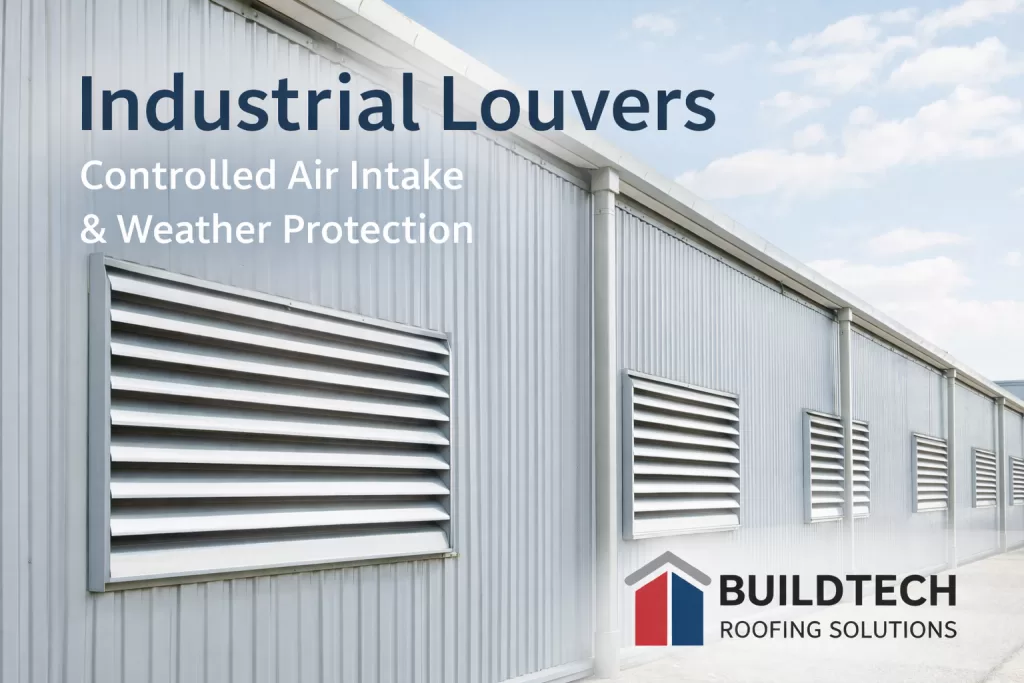
Introduction: Why Industrial Louvers Matter in Modern Industrial Buildings Ventilation is a foundational requirement in industrial and commercial building design. Facilities such as factories, warehouses, manufacturing units, and power plants continuously generate heat, dust, fumes, and moisture. If these elements are not managed effectively, they can affect worker safety, reduce equipment lifespan, and increase operational costs. While roof-based ventilation systems like ridge ventilators and turbo ventilators help release hot air, they cannot function efficiently without a controlled air intake system. This is where industrial louvers become essential. Industrial louvers regulate how fresh air enters and exits a building while protecting interiors from rain, dust, birds, and external contaminants. When designed and installed correctly, they form a critical part of a balanced, energy-efficient ventilation system. This comprehensive buyer’s guide explains industrial louvers in detail, covering their function, types, materials, applications, technical specifications, and selection guidelines for long-term performance. What Are Industrial Louvers? Industrial louvers are engineered airflow management systems installed on building walls, facades, or ventilation openings. They allow controlled air movement while restricting unwanted elements such as rainwater, debris, insects, and birds from entering the structure. Unlike open windows or unprotected vents, louvers use angled blades or fins that direct airflow efficiently and safely. This design ensures ventilation without compromising protection. How Industrial Louvers Work Industrial louvers operate on a passive airflow principle: When paired with ridge ventilators or turbo ventilators, louvers help establish a stable air circulation cycle, enhancing natural ventilation throughout the building. Why Industrial Louvers Are Critical for Industrial Environments Industrial facilities require controlled airflow rather than exposed openings. Louvers deliver this control by managing intake and exhaust in a predictable manner. Without proper louver systems, buildings often face: Industrial louvers address these challenges while improving indoor comfort and safety. Key Benefits of Industrial Louvers 1. Controlled Airflow Louvers regulate air volume, preventing pressure imbalance and sudden airflow changes inside the building. 2. Weather Protection Special blade geometry blocks rainwater even during heavy rainfall or strong winds. 3. Dust and Debris Reduction Industrial designs minimize dust, sand, and external particle entry. 4. Improved Indoor Air Quality Fresh air circulation reduces heat, humidity, and airborne contaminants. 5. Low Maintenance Requirements With no moving parts, industrial louvers require minimal upkeep. 6. Seamless Integration with Ventilation Systems Louvers complement natural and mechanical ventilation solutions effectively. Types of Industrial Louvers 1. Fixed Industrial Louvers These louvers have non-movable blades and are widely used for general ventilation. Key Features: Applications: Warehouses, factories, utility areas 2. Z-Type Industrial Louvers Z-shaped blades enhance rain protection and airflow control. Key Features: Applications: Manufacturing units, electrical rooms 3. Rain-Proof Industrial Louvers Designed for regions with high rainfall intensity. Key Features: Applications: Coastal and high-rainfall zones 4. Sand Trap Louvers Engineered for dusty and sandy environments. Key Features: Applications: Cement plants, mining facilities 5. Bird-Proof Louvers Equipped with bird mesh or integrated protection. Key Features: Applications: Food processing units, warehouses Materials Used in Industrial Louvers Material selection directly affects durability, corrosion resistance, and lifecycle cost. Common Materials Importance of Material Selection Technical Specifications of Industrial Louvers (Typical Range) Parameter Specification Material GI / PPGI / Aluminium Thickness 0.50 – 1.00 mm Blade Type Fixed / Z-Type Finish Plain / Colour-Coated Installation Wall-mounted Maintenance Minimal Applications of Industrial Louvers Industrial louvers are widely used across multiple sectors, including: They are particularly important where fresh air intake and environmental protection must function together. Industrial Louvers vs Open Windows Aspect Industrial Louvers Open Windows Airflow Control Controlled Uncontrolled Weather Protection High Low Dust Resistance High Low Industrial Suitability Ideal Not recommended Maintenance Low Moderate Design Considerations When Choosing Industrial Louvers Airflow Requirement Determine airflow volume based on building size, heat load, and ventilation strategy. Environmental Conditions Dusty, coastal, or high-rainfall regions require specialized louver designs. Installation Location Wall orientation impacts airflow efficiency and weather exposure. Integration with Ventilation Systems Louvers should complement ridge or turbo ventilators for optimal performance. Installation Process Overview Proper installation ensures durability and performance. Typical Steps Include: Correct sealing prevents leakage, vibration, and long-term issues. Common Buyer Mistakes to Avoid Avoiding these mistakes significantly reduces future maintenance costs. Energy Efficiency and Sustainability Benefits Industrial louvers contribute to sustainable building practices by: They support energy-efficient and eco-conscious industrial infrastructure. Why Choose Buildtech Roofing Solutions Buildtech Roofing Solutions delivers complete industrial louver systems designed for performance and longevity. Our Strengths Include: We focus on durability, efficiency, and long-term value. Frequently Asked Questions (FAQ) Q1. Are industrial louvers waterproof?Yes. Rain-proof designs effectively prevent water ingress. Q2. Do louvers help reduce heat inside buildings?Yes. They improve airflow and support roof ventilation systems. Q3. How much maintenance do industrial louvers require?Minimal maintenance is needed due to their fixed design. Q4. Can industrial louvers be customized?Yes. Size, material, thickness, and finish can be customized. Conclusion Industrial louvers are a critical component of efficient industrial ventilation systems. They provide controlled airflow, protect interiors from environmental elements, and enhance indoor air quality. Selecting the right industrial louver system improves worker comfort, safeguards equipment, and reduces operational costs over time. When integrated with a well-designed ventilation strategy, industrial louvers deliver lasting performance and energy efficiency. Final Call to Action 📞 Call: 9158340909📩 Request a Professional Industrial Louver Consultation Today

Industrial Louvers for Factories & Warehouses | Complete Buyer Guide Read More »

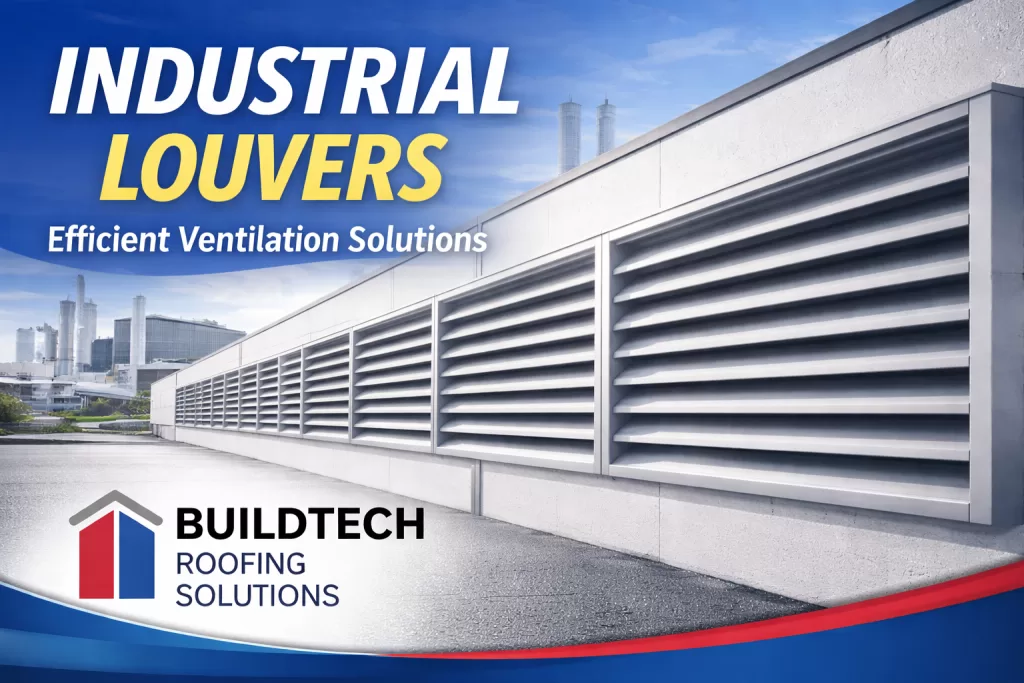
Industrial Louvers – Efficient Ventilation Solutions for Modern Industrial Buildings

Introduction Proper ventilation is essential for maintaining a safe, comfortable, and productive industrial environment. Without effective airflow management, factories and warehouses can suffer from heat buildup, moisture accumulation, and poor air quality. Industrial louvers are one of the most reliable solutions for controlling airflow while protecting buildings from rain, dust, and external elements. At Buildtech Roofing Solutions, we design and supply high-quality industrial louvers that combine durability, efficiency, and custom engineering to suit diverse industrial applications. What Are Industrial Louvers? Industrial louvers are fixed or adjustable slatted structures installed on walls, roofs, or ventilation openings. Their primary function is to allow fresh air to enter and stale air to exit while preventing rainwater, debris, and excessive sunlight from entering the building. They are widely used in factories, warehouses, power plants, and commercial buildings where controlled ventilation is required. Why Industrial Louvers Are Important Efficient ventilation directly impacts building performance and workforce comfort. Industrial louvers help: As a result, buildings equipped with proper louvers experience improved operational efficiency and reduced maintenance costs. Types of Industrial Louvers 1. Fixed Louvers Fixed louvers are permanently angled slats that provide continuous airflow. They are cost-effective and ideal for areas where constant ventilation is required. 2. Adjustable Louvers Adjustable louvers allow control over airflow direction and volume. These are suitable for areas requiring variable ventilation depending on weather or operational needs. 3. Weatherproof Louvers Designed with special blade profiles, weatherproof louvers block rain penetration while maintaining airflow efficiency. 4. Acoustic Louvers Used in noise-sensitive zones, acoustic louvers reduce sound transmission while ensuring proper ventilation. Materials Used in Industrial Louvers Buildtech Roofing Solutions manufactures louvers using high-quality materials such as: These materials offer excellent corrosion resistance, strength, and long-term durability in harsh industrial environments. Key Features of Buildtech Industrial Louvers Each louver system is fabricated to meet specific project requirements. Applications of Industrial Louvers Industrial louvers are suitable for a wide range of applications, including: They can be integrated seamlessly with roofing, wall cladding, and ventilation systems. Technical Specifications (Typical) Parameter Specification Material GI / PPGI / PPGL / Aluminium Thickness 0.45 – 0.80 mm Blade Type Z-type / Aerofoil Finish Galvanized / Colour-coated Installation Wall-mounted / Panel-mounted Customization Size & colour as required Installation Best Practices Proper installation ensures optimal performance and longevity. Buildtech follows industry best practices such as: Why Choose Buildtech Roofing Solutions Buildtech Roofing Solutions is a trusted name in industrial roofing and ventilation systems. Clients choose us for: Our industrial louvers are designed to perform reliably in demanding environments. Integration with Complete Roofing Systems Industrial louvers work best when integrated with a complete roofing solution. Buildtech also supplies: This integrated approach ensures compatibility, efficiency, and long-term value. Conclusion Industrial louvers play a crucial role in maintaining airflow, protecting structures, and enhancing indoor comfort in industrial buildings. With Buildtech Roofing Solutions, you get durable, efficient, and customized louver systems engineered for performance and reliability. For expert consultation and installation support, Buildtech Roofing Solutions delivers ventilation solutions you can trust. 📞 Contact Buildtech Roofing Solutions 📞 Phone: 9158340909📩 Get in touch today to discuss your industrial louver requirements.

Industrial Louvers – Efficient Ventilation Solutions for Modern Industrial Buildings Read More »

Industrial Louvers for Factory Ventilation | Buildtech Roofing Solutions

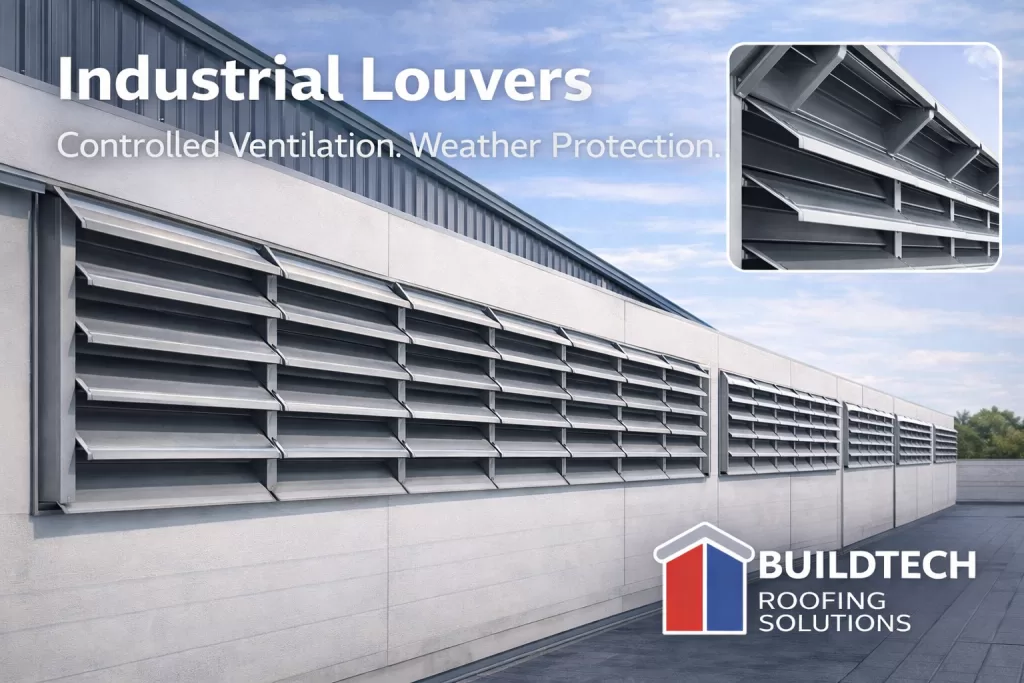
Industrial Louvers – Controlled Ventilation for Modern Industrial Buildings Industrial louvers are essential for managing airflow in modern industrial buildings. They provide controlled ventilation, ensuring that air circulation is efficient and effective. By allowing fresh air to enter while exhausting stale air, these systems help maintain optimal indoor conditions and enhance overall workplace safety. Additionally, louvers can be designed to integrate seamlessly with the architecture of the building, promoting both functionality and aesthetics. This makes them a crucial element in the design of energy-efficient structures. Properly installed, they offer durability and low maintenance, contributing to long-term operational savings As a result, they are widely used in factories, warehouses, substations, and utility buildings. At Buildtech Roofing Solutions, we supply and install high-performance industrial louvers engineered for durability, airflow efficiency, and long service life. These systems are designed to perform consistently in demanding industrial environments. What Are Industrial Louvers? Industrial louvers are metal ventilation panels with angled fins that allow air to pass through while blocking rainwater and airborne particles. Because of their fin geometry, airflow moves inward efficiently, while water drains outward. Therefore, they ensure both ventilation and protection. Types of Industrial Louvers Fixed Industrial Louvers Fixed louvers feature non-adjustable fins and a simple, robust design. Since they provide continuous airflow, they are ideal for areas requiring constant ventilation. Z-Type Industrial Louvers Z-type industrial louvers use specially shaped fins that improve rain protection and dust control. Consequently, they are preferred in heavy industrial and high-exposure environments. Key Advantages of Industrial Louvers Applications of Industrial Louvers Industrial louvers supplied by Buildtech Roofing Solutions are commonly used in: Typical Technical Specifications Parameter Specification Material GI / PPGI / PPGL Thickness 0.45 – 0.60 mm Fin Type Fixed / Z-Type Finish Colour-coated Installation Wall-mounted / façade Installation Best Practices For optimal performance, industrial louvers should be installed with correct fin orientation to ensure rain protection. In addition, proper sealing with flashings and uniform spacing helps maintain durability. When combined with ridge ventilators, airflow efficiency improves significantly. Buildtech’s trained installation teams ensure precise, leak-free execution for long-lasting results. Why Choose Buildtech Roofing Solutions? As a result, clients across Maharashtra and India trust Buildtech for dependable industrial ventilation systems. Conclusion Industrial louvers play a critical role in maintaining airflow while safeguarding interiors from weather and dust. With professionally designed and installed solutions from Buildtech Roofing Solutions, industrial buildings achieve consistent ventilation, improved safety, and long-term performance. 📞 Contact Buildtech Roofing Solutions today to discuss your industrial ventilation requirements.

Industrial Louvers for Factory Ventilation | Buildtech Roofing Solutions Read More »

Colour-Coated Louvers:

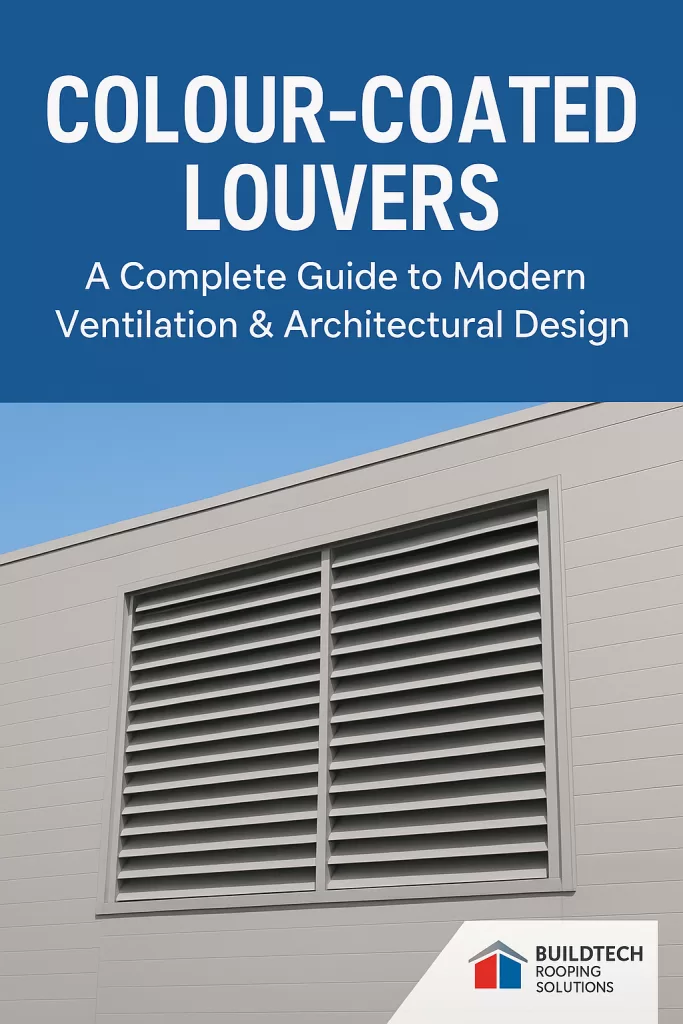
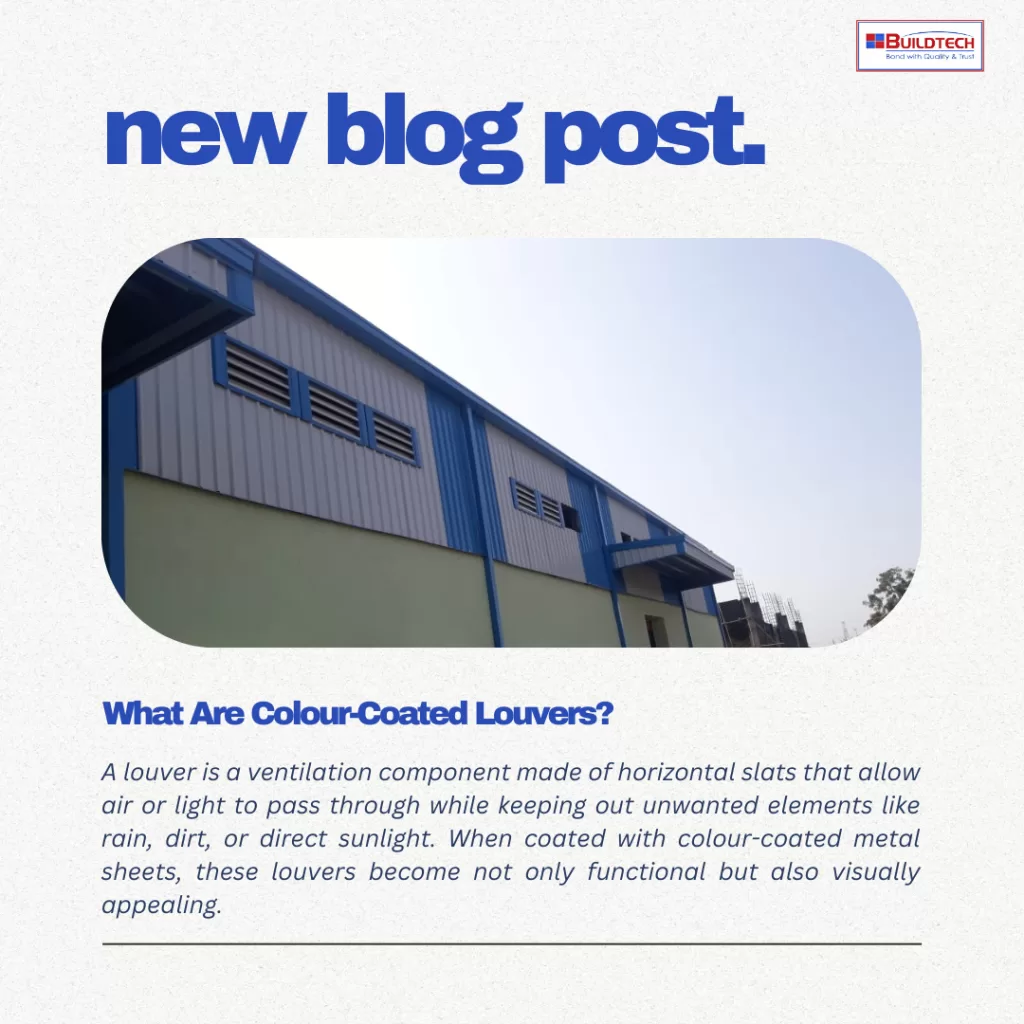
Colour-Coated Louvers: A Complete Guide to Modern Ventilation & Architectural Design 1. Introduction Industrial infrastructure has undergone significant evolution in the past decade. Today, building owners demand not just strength and durability but also ventilation efficiency, aesthetic appeal, energy savings, and long-term sustainability. The colour-coated louver meets these demands comprehensively and effectively. Colour-coated louvers have become a critical element in modern industrial and commercial construction. Louvers help control airflow in places like factories, warehouses, schools, malls, and residential buildings. They keep out rain, dust, insects, and debris. But what makes colour-coated metal louvers so popular among architects, industrial consultants, contractors, and facility owners? This comprehensive 2,500-word guide answers every question. 2. What Are Colour-Coated Louvers? A louver is a ventilation structure consisting of horizontal or vertical slats that are angled to permit airflow but block unwanted elements. When these are made from colour-coated steel or aluminium, the louvers become highly durable, corrosion-resistant, and aesthetically appealing. Modern louvers are manufactured using PPGI (Pre-Painted Galvanized Iron) or PPGL (Pre-Painted Galvalume) coated coils, offering: These features make them ideal for industrial roofing systems, ventilation ducts, façade designs, and mechanical spaces. 3. Why Colour Coating Is Important Metal louvers used in harsh outdoor environments must withstand: Colour coating using specialised paint systems—such as Polyester, SMP, and PVDF coatings—provides a protective layer that enhances durability and boosts aesthetic appeal. Benefits of Colour-Coating 4. Types of Colour-Coated Louvers Different industrial environments require different louver designs. Here are the most common types: ✅ a. Fixed Louvers ✅ b. Adjustable Louvers ✅ c. Acoustic Louvers ✅ d. Sand Trap Louvers ✅ e. Architectural/Decorative Louvers 5. Advantages of Colour-Coated Louvers Colour-coated louvers offer a variety of benefits beyond ventilation. ✅ 1. Durability PPGI/PPGL coating ensures long-term corrosion resistance. ✅ 2. Low Maintenance Only periodic cleaning is needed. ✅ 3. Better Ventilation Reduces heat buildup by enabling consistent airflow. ✅ 4. Energy Efficiency Reduces dependency on exhaust fans or HVAC systems. ✅ 5. Aesthetic Enhancement Gives a polished, modern look to building facades. ✅ 6. Cost-Effective Low lifecycle cost and long material life make them economical. 6. Applications of Colour-Coated Louvers ✅6.1 Industrial Use ✅6.2 Commercial Use ✅6.3 Infrastructure Projects ✅6.4 Residential Use 7. Technical Specifications to Consider When selecting louvers, pay attention to: For industrial use, PPGL with AZ150 coating is recommended due to superior corrosion resistance. 8. Installation Guidelines Proper installation ensures efficiency and lifespan. ✅ Checklist Incorrect installation can cause vibration, noise, or leakage. 9. Maintenance Tips Louvers are low-maintenance, but a few best practices help prolong their life: 10. Cost Factors The pricing of louvers depends on: Investing in high-quality louvers reduces long-term maintenance and enhances efficiency. 11. Why Industries Prefer Colour-Coated Louvers Industries choose colour-coated louvers because they: 12. Why Choose Buildtech Roofing Solutions for Louvers? Buildtech Roofing Solutions specialises in manufacturing and supplying durable, aesthetically appealing, and performance-driven colour-coated louvers. ✅ Our Strengths We guarantee consistent performance, long lifespan, and on-time project execution. 13. Conclusion Colour-coated louvers are a key component in modern industrial and commercial construction. They deliver a perfect blend of functionality, energy efficiency, and architectural beauty. With excellent weather resistance, superior airflow management, and long-term performance, these louvers are a smart investment for any building project. When designed and installed correctly, they significantly improve indoor comfort, reduce energy usage, and enhance the building’s overall appearance.

Colour-Coated Louvers: Read More »

Colour Coated Louvers-001

Everything You Need to Know About Colour-Coated Louvers Introduction In modern construction, ventilation plays a much bigger role than it did in the past. Today, it affects energy efficiency, indoor comfort, and even the overall appearance of a building. Colour-coated louvers meet all these needs in one practical solution. These louvers are widely used in industrial, commercial, and residential buildings. They provide reliable airflow while improving durability and visual appeal. In this article, you will learn what colour-coated louvers are, the different types available, their benefits, and where they are commonly used. What Are Colour-Coated Louvers? Colour-coated louvers are metal ventilation systems made from galvanized or pre-painted steel. Manufacturers apply a protective colour coating to improve corrosion resistance and extend service life. Builders install these louvers on walls, façades, and rooftops. As a result, they allow fresh air to circulate while blocking rain, dust, and excessive sunlight. At the same time, they help maintain a clean and modern building appearance. Types of Colour-Coated Louvers Different projects require different ventilation solutions. Therefore, colour-coated louvers are available in several designs. Fixed Colour-Coated Louvers Fixed louvers have non-movable blades. They provide continuous airflow and work best for permanent ventilation needs. Because of their simple design, they require very little maintenance. Adjustable Colour-Coated Louvers Adjustable louvers include movable blades that allow airflow control. Facility managers often use them where ventilation requirements change during the day. This flexibility makes them suitable for commercial and industrial buildings. Acoustic Colour-Coated Louvers Acoustic louvers reduce noise while maintaining airflow. For this reason, they are commonly installed in generator rooms, power plants, and factories where sound control is important. Sand Trap Colour-Coated Louvers Sand trap louvers filter dust and sand from incoming air. As a result, they perform well in dusty, coastal, or desert environments. Architectural Colour-Coated Louvers Architectural louvers focus on enhancing the building façade. Although they allow limited airflow, they significantly improve the visual design of commercial and corporate buildings. Benefits of Colour-Coated Louvers Colour-coated louvers offer several practical advantages: Because of these benefits, they are a preferred choice for modern construction projects. Applications of Colour-Coated Louvers Colour-coated louvers are suitable for many building types, including: Why Choose Colour-Coated Louvers? Colour-coated louvers provide a balance between performance and design. They improve airflow while maintaining a professional and modern appearance. Moreover, their durable coatings protect against corrosion and environmental damage. When sourced from a trusted manufacturer, these louvers meet industry standards and deliver consistent results over time. Conclusion Colour-coated louvers are a reliable ventilation solution for buildings that demand durability, efficiency, and aesthetic value. With multiple types available, they suit a wide range of industrial and commercial applications. If you are planning a project and need expert guidance, choosing the right colour-coated louvers will ensure long-term performance and comfort.

Colour Coated Louvers-001 Read More »

Essential Insights on LouversUnderstanding Louvers

Essential Insights on Louvers for Homeowners, Industrial Operators, Contractors, and Builders Introduction Louvers are essential components in modern building design. They play a critical role in ventilation, energy efficiency, and overall building performance. Whether you are a homeowner improving indoor comfort, a contractor advising clients, or an industrial operator managing large facilities, understanding louvers is important. In particular, metal louvers have become widely preferred due to their durability and efficiency. This article explains what louvers are, how they function, the different types available, and why they are valuable across residential, commercial, and industrial applications. What Are Louvers? Louvers are architectural elements made of angled slats or blades. These slats allow air to pass through while blocking rain, debris, and pests. As a result, louvers help maintain ventilation without compromising protection. Louvers can be installed on walls, roofs, windows, and doors. They are manufactured using various materials, such as wood, plastic, and metal. However, metal louvers are commonly chosen for their strength, long service life, and resistance to weather conditions. How Louvers Function Louvers serve multiple functions in a building. Each function contributes to improved comfort and performance. Ventilation Louvers allow fresh air to enter while pushing stale air out. This airflow helps maintain indoor air quality and creates a comfortable environment. Water Management Well-designed louvers prevent rain and snow from entering the building. Therefore, they reduce moisture-related problems such as mold and corrosion. Temperature Control By improving airflow, louvers help regulate indoor temperatures. As a result, buildings rely less on mechanical heating and cooling systems. Aesthetic Enhancement Louvers also add architectural value. They enhance the exterior appearance while serving a functional purpose. Noise Reduction Certain louvers are designed to reduce external noise. This feature is especially useful in urban and industrial environments. Types of Louvers Louvers are available in several types, each designed for specific requirements. Fixed Louvers Fixed louvers have blades set at a permanent angle. They allow continuous airflow and require minimal maintenance. These louvers are ideal for passive ventilation systems. Adjustable Louvers Adjustable louvers allow users to change the blade angle. This flexibility helps control airflow and light, making them suitable for spaces with changing ventilation needs. Drainable Louvers Drainable louvers include built-in channels that redirect water away from the building. They are effective in areas with heavy rainfall. Acoustic Louvers Acoustic louvers reduce noise while allowing airflow. They are commonly used in generator rooms, industrial plants, and urban buildings. Metal Louvers Metal louvers are made from aluminium, stainless steel, or galvanized steel. They offer superior durability and are suitable for both residential and industrial applications. Why Metal Louvers Are Important Metal louvers offer several advantages that make them a reliable choice. High Durability Metal louvers withstand extreme weather conditions, including strong winds and heavy rain. Therefore, they provide long-term performance. Low Maintenance Unlike wood or plastic, metal louvers resist corrosion, pests, and rot. As a result, maintenance requirements remain minimal. Design Flexibility Metal louvers are available in various finishes and colours. This versatility allows them to match different architectural styles. Fire Resistance Metal louvers provide better fire resistance than non-metal alternatives. This makes them suitable for commercial and industrial buildings. Eco-Friendly Options Many metal louvers use recyclable materials. Additionally, improved airflow helps reduce energy consumption. Applications of Louvers Louvers are widely used across different building types. Residential Applications Industrial Applications Commercial Applications Benefits of Using Louvers Louvers offer multiple practical benefits: Because of these benefits, louvers remain an essential building component. Installation of Louvers Proper installation ensures optimal performance. Step 1: Assess Ventilation Needs First, evaluate airflow requirements based on the space and usage. Step 2: Select the Right Louver Choose the louver type, size, and material suitable for the application. Step 3: Prepare the Installation Area Ensure the opening is clean, level, and properly measured. Step 4: Install the Frame Secure the frame using appropriate fasteners and anchors. Step 5: Attach the Blades Install the louver blades carefully, following manufacturer instructions. Step 6: Inspect and Test Finally, check airflow and ensure there are no leaks or obstructions. Maintenance of Louvers Regular maintenance extends louver life. Common Misconceptions About Louvers Conclusion Louvers, especially metal louvers, play a vital role in improving ventilation, energy efficiency, and building durability. They are suitable for homeowners, industrial operators, contractors, and builders alike. By choosing the right louvers and ensuring proper installation and maintenance, you can enhance comfort, reduce energy costs, and improve overall building performance.

Essential Insights on LouversUnderstanding Louvers Read More »

Can Louvers Be Vertical?

Can Louvers Be Vertical? Introduction Louvers are essential architectural features used to control airflow, light, and moisture in various structures. They are commonly found in both industrial and residential settings, serving a range of functions from ventilation to aesthetic appeal. One question that often arises is whether louvres can be installed vertically. This article will explore the concept of vertical louvres, their benefits, applications, and considerations for industrial, residential, and small business owners. Understanding Louvers Definition Louvres are slatted structures designed to allow air to flow while preventing water from entering. They can be made from various materials, including metal, wood, and plastic. Louvres come in different styles, including fixed, adjustable, and operable, each serving specific purposes. Types of Louvers Can Louvers Be Vertical? The Concept of Vertical Louvers Yes, louvres can indeed be installed vertically. While horizontal louvres are more common, vertical louvres offer unique advantages and can be implemented effectively in various designs and applications. Benefits of Vertical Louvers Applications of Vertical Louvers Industrial Use In industrial settings, vertical louvres are often used in conjunction with exhaust fan louvres to facilitate efficient ventilation. They can be installed on the exterior of buildings to allow for natural airflow while protecting against water and debris. Vertical louvres can also be used in equipment enclosures, cooling towers, and HVAC systems. Residential Use Homeowners increasingly recognize the benefits of vertical louvers. They can be installed in windows, doors, or as standalone features to enhance ventilation and natural light. Vertical louvers can also contribute to energy efficiency by reducing reliance on mechanical ventilation systems. Small Business Owners For small businesses, vertical louvers can provide an attractive and functional solution for ventilation needs. Whether used in storefronts, office buildings, or workshops, these louvers can enhance the overall environment while ensuring proper airflow. Considerations When Installing Vertical Louvers Design and Placement When considering vertical louvres, it is essential to plan their design and placement carefully. Factors such as the building’s architecture, local climate, and intended use must be taken into account to maximize the effectiveness of louvres. Material Selection Choosing the right material for vertical louvres is crucial. Metal louvers, particularly those made from aluminium or steel, offer durability and resistance to corrosion. The selected material should align with the specific requirements of the application. Maintenance Like any architectural feature, vertical louvers require maintenance to ensure optimal performance. Regular cleaning and inspections are necessary to prevent blockages and damage from environmental factors. Compliance with Building Codes Before installing vertical louvers, it is essential to check local building codes and regulations. Compliance ensures that the installation meets safety standards and functional requirements. Conclusion Vertical louvers are a viable and effective option for enhancing ventilation, aesthetics, and functionality in various applications. Whether for industrial, residential, or small business use, they offer numerous benefits that can improve overall building performance. By understanding the advantages and considerations associated with vertical louvers, property owners can make informed decisions that contribute to energy efficiency, comfort, and style. As building design continues to evolve, vertical louvres will undoubtedly play a significant role in modern architecture. So, contact us if you need product advice or want to discuss your project requirements.  #factory #supplier #performance #india  #productions #thickness #avilablenow #manufacturing #ventilationlouvers #aluminumlouvers #steellouver #weatherlouvers #gravityairlouver #ventilationlouvers #exhaustfanlouvre #louver #buildtechroof

Can Louvers Be Vertical? Read More »

©2023 buildtechroof. All Rights Reserved.