Buildtechroof

Turbo Ventilator in Pune | Industrial Roof Ventilation Solutions

Turbo Ventilator in Pune | Industrial Roof Ventilation Solutions

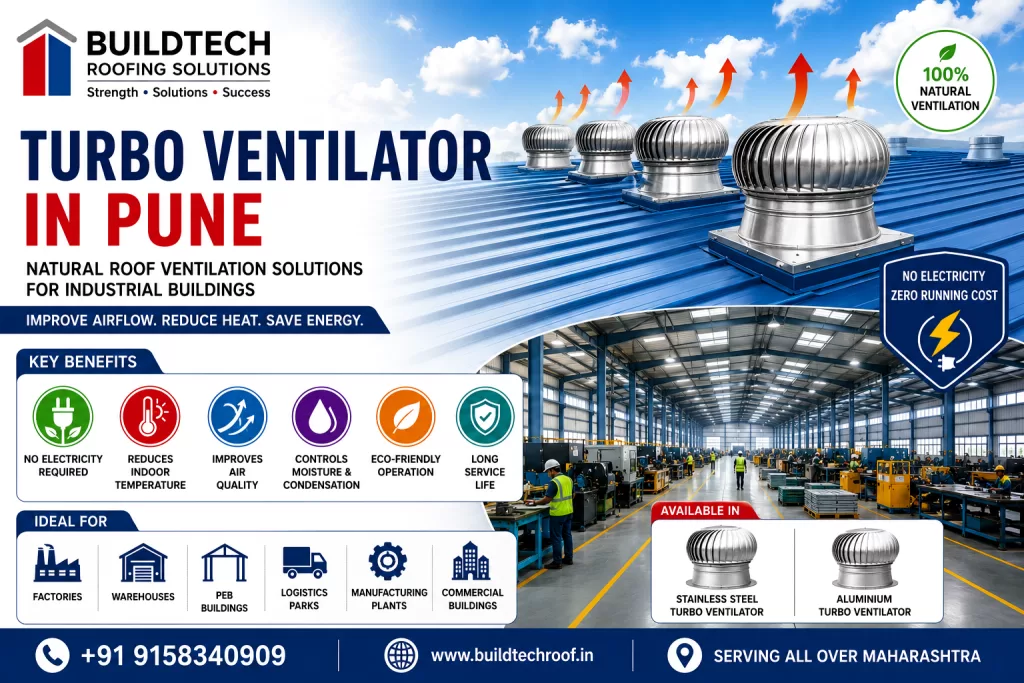
Introduction Industrial buildings, warehouses, factories, logistics parks, and commercial facilities often face one major challenge: excessive indoor heat accumulation. Poor ventilation can lead to uncomfortable working conditions, reduced productivity, moisture buildup, equipment overheating, and higher energy costs. One of the most efficient and cost-effective solutions to this problem is the Turbo Ventilator. Turbo ventilators provide natural roof ventilation without electricity, helping industries maintain cooler, healthier, and more energy-efficient working environments. Buildtech Roofing Solutions supplies and installs premium-quality Turbo Ventilators in Pune and across Maharashtra, helping industrial facilities improve airflow while reducing operational costs. What is a Turbo Ventilator? A Turbo Ventilator is a wind-driven roof ventilation device designed to extract hot, stale, and humid air from inside a building. It operates using: No electricity is required. The rotating turbine creates negative pressure, drawing hot air out through the roof and allowing fresh air to enter through side openings and louvers. How Does a Turbo Ventilator Work? The turbo ventilator rotates when exposed to: Wind Energy Even low wind speeds can rotate the turbine. Thermal Air Movement Hot air naturally rises and escapes through the ventilator. This creates continuous airflow inside the building. Result: Why Industries Need Turbo Ventilators Industrial buildings often suffer from: Turbo ventilators help eliminate these issues naturally. Key Benefits of Turbo Ventilators 1. No Electricity Required One of the biggest advantages. Benefits: 2. Reduces Indoor Temperature Turbo ventilators continuously remove trapped hot air. This helps: 3. Improves Air Quality Removes: Creating a healthier workplace. 4. Controls Condensation Condensation can damage: Turbo ventilation helps control moisture buildup. 5. Low Maintenance High-quality turbo ventilators require minimal maintenance. 6. Environment Friendly Uses renewable wind energy. No electricity consumption. No emissions. 7. Long Service Life Premium stainless steel turbo ventilators can perform efficiently for many years. Types of Turbo Ventilators Stainless Steel Turbo Ventilators Most popular industrial option. Advantages Applications: Aluminium Turbo Ventilators Lightweight and economical. Benefits Applications: Heavy-Duty Industrial Turbo Ventilators Designed for: Components of a Turbo Ventilator Turbine Head Captures wind energy. Base Plate Mounted to the roof. Bearing Assembly Ensures smooth rotation. Flashing System Provides waterproof installation. Neck Assembly Connects the ventilator to the roof opening. Applications of Turbo Ventilators Industrial Sheds Reduces heat buildup and improves ventilation. Warehouses Improves airflow and storage conditions. Manufacturing Plants Removes process heat and stale air. PEB Buildings One of the most common applications. Logistics Parks Supports efficient ventilation. Food Processing Facilities Helps maintain healthier environments. Pharmaceutical Facilities Improves indoor air circulation. Commercial Buildings Provides natural roof ventilation. The Turbo Ventilator vs Exhaust Fan Feature Turbo Ventilator Exhaust Fan Electricity Required No Yes Operating Cost Zero Continuous Maintenance Low Moderate Noise Level Silent Moderate Environmental Impact Eco-Friendly Electricity Dependent Turbo Ventilator vs Ridge Ventilation Feature Turbo Ventilator Ridge Ventilation Air Extraction Excellent Excellent Installation Easy Moderate Cost Moderate Higher Maintenance Low Low Many projects combine both systems for optimal ventilation. How Many Turbo Ventilators Are Required? The number depends on: Building Size Roof Height Heat Load Occupancy Levels Internal Operations Ventilation Requirements A professional site survey ensures proper sizing and placement. Turbo Ventilator Installation Process Step-1 Site Inspection Step-2 Ventilation Assessment Step-3 Roof Marking Step-4 Roof Opening Preparation Step-5 Ventilator Installation Step-6 Waterproof Flashing Step-7 Final Inspection Common Problems Solved by Turbo Ventilators Excessive Heat Continuous heat extraction. Poor Airflow Improved natural ventilation. High Humidity Moisture removal. Condensation Issues Reduced roof condensation. Worker Discomfort Cooler indoor environment. High Cooling Costs Reduced dependence on mechanical cooling. Turbo Ventilators for PEB Buildings PEB structures benefit significantly from turbo ventilators. Advantages include: Turbo Ventilators and Energy Efficiency Turbo ventilators support: Making them ideal for modern industrial facilities. Maintenance Tips Cost of Turbo Ventilators in Pune Pricing depends on: Approximate Price Range ₹3,500 – ₹15,000 Per Unit Project pricing varies according to specifications and installation requirements. Why Choose Buildtech Roofing Solutions? Our Strengths Industries We Serve Service Areas Serving All Over Maharashtra Pune Mumbai Nashik Nagpur Kolhapur Satara Sangli Ahmednagar Aurangabad Solapur Ratnagiri Thane Jalgaon Amravati And All Major Industrial Areas Across Maharashtra Frequently Asked Questions What is a Turbo Ventilator? A turbo ventilator is a wind-driven roof ventilation device that removes hot air and improves airflow without electricity. Does a Turbo Ventilator require electricity? No. It operates entirely using natural wind and thermal air movement. Can Turbo Ventilators reduce indoor temperature? Yes. They continuously remove trapped hot air and improve ventilation. Are Turbo Ventilators suitable for warehouses? Absolutely. Warehouses are one of the most common applications. How long does a Turbo Ventilator last? High-quality stainless steel turbo ventilators can provide reliable performance for many years with minimal maintenance. Conclusion Turbo Ventilators are among the most effective and economical ventilation solutions for industrial and commercial buildings. By improving airflow, reducing heat buildup, controlling humidity, and operating without electricity, they deliver significant long-term value. For factories, warehouses, PEB buildings, logistics parks, and industrial sheds across Maharashtra, Buildtech Roofing Solutions provides premium turbo ventilator supply and installation services tailored to your ventilation requirements.

Turbo Ventilator in Pune | Industrial Roof Ventilation Solutions Read More »
Thermal Roofing Systems in Pune | Energy-Efficient Industrial Roofing Solutions

Thermal Roofing Systems in Pune

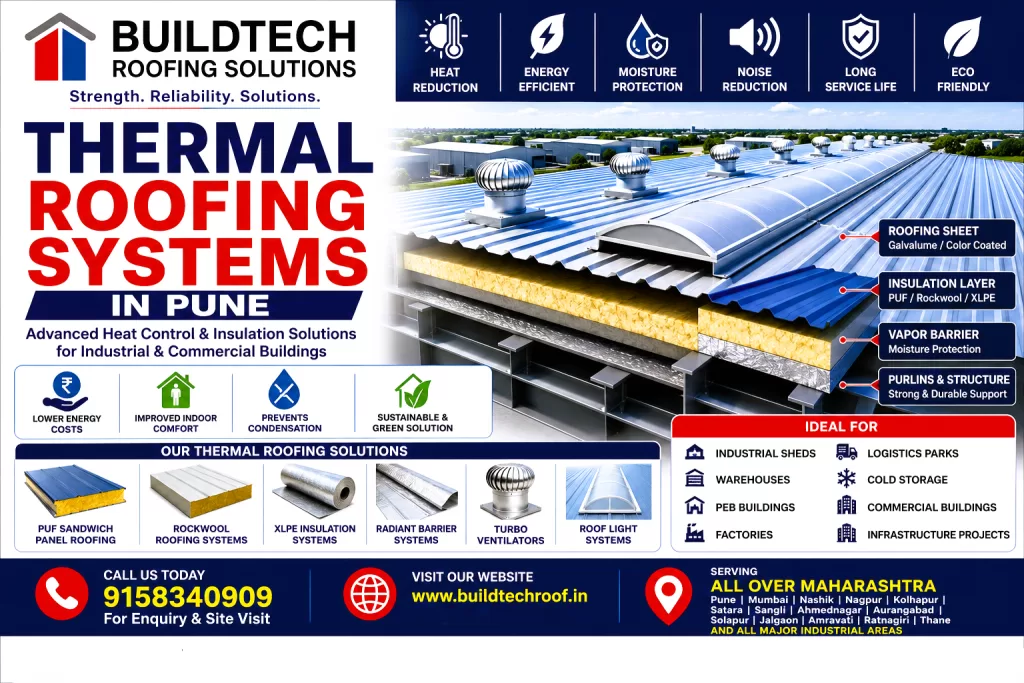
Introduction Industrial and commercial buildings across Pune and Maharashtra face a common challenge—excessive heat gain through roofing systems. During summer months, roof surfaces can reach extremely high temperatures, causing uncomfortable working conditions, increased cooling costs, equipment overheating, and reduced operational efficiency. To address these issues, industries are increasingly investing in Thermal Roofing Systems, which provide superior insulation, temperature control, and energy savings. At Buildtech Roofing Solutions, we specialise in designing and installing advanced thermal roofing systems that help factories, warehouses, logistics parks, manufacturing plants, and commercial buildings maintain comfortable indoor temperatures while reducing electricity consumption. What is a Thermal Roofing System? A Thermal Roofing System is an insulated roofing solution designed to minimise heat transfer from the roof into the building. These systems combine: The result is a roofing structure that keeps interiors cooler during summer and more energy-efficient throughout the year. Why Thermal Roofing is Essential for Industrial Buildings Industrial facilities generate heat from: Without proper insulation, heat accumulates inside the building, leading to: Thermal roofing systems effectively solve these challenges. Key Benefits of The Thermal Roofing Systems 1. Significant Heat Reduction Thermal roofing reduces heat transfer through the roof by creating an insulating barrier. Benefits include: 2. Lower Energy Costs By reducing heat gain, cooling systems work less, resulting in: 3. Enhanced Worker Productivity Comfortable indoor temperatures improve: 4. Condensation Prevention Thermal insulation reduces moisture buildup and condensation, helping protect: 5. Noise Reduction Insulated roofing systems also improve acoustic performance by reducing: 6. Extended Roof Life Thermal roofing minimises thermal stress on roofing sheets, increasing durability and service life. Types of Thermal Roofing Systems PUF Sandwich Panel Roofing PUF (Polyurethane Foam) panels offer excellent thermal insulation and are ideal for: Rockwool Insulated Roofing Provides: Suitable for industrial and commercial projects. XLPE Insulation Roofing Cross-linked polyethene insulation offers: Widely used in PEB buildings and warehouses. Radiant Barrier Roofing Systems Reflective insulation that blocks solar heat radiation and improves roof performance. Ventilated Thermal Roofing Combines insulation with: For maximum heat reduction and airflow. Applications of Thermal Roofing Systems Thermal roofing solutions are ideal for: Industrial Sheds Maintain comfortable indoor temperatures. Warehouses Protect stored materials from excessive heat. Manufacturing Plants Improve working conditions and equipment efficiency. Logistics Parks Reduce operational energy costs. PEB Buildings Enhance overall building performance. Commercial Buildings Improve occupant comfort and energy efficiency. Cold Storage Facilities Maintain temperature-controlled environments. Thermal Roofing vs Conventional Roofing Feature Thermal Roofing Conventional Roofing Heat Reduction Excellent Limited Energy Efficiency High Moderate Indoor Comfort Superior Standard Condensation Control Excellent Poor Electricity Savings Significant Minimal Roof Lifespan Longer Standard Components of a Thermal Roofing System A complete thermal roofing system may include: Galvalume Roofing Sheets Highly durable and corrosion-resistant roofing material. Colour Coated Roofing Sheets Attractive and weather-resistant roofing solution. PUF Insulation Panels High-performance thermal insulation. XLPE Insulation Cost-effective heat and moisture protection. Rockwool Insulation Excellent thermal and acoustic performance. Turbo Ventilators Natural heat extraction systems. Roof Light Systems Natural daylight solutions that reduce lighting costs. Installation Process Step-1: Site Assessment Analyse building dimensions and thermal requirements. Step-2: System Design Develop a customised roofing solution. Step-3: Material Selection Choose roofing sheets and insulation materials. Step-4: Structural Preparation Install purlins and supporting framework. Step-5: Insulation Installation Apply the insulation system. Step-6: Roofing Installation Install roofing sheets and accessories. Step-7: Final Inspection Verify insulation performance and weatherproofing. Why Choose Buildtech Roofing Solutions? Buildtech Roofing Solutions is a trusted provider of industrial roofing and insulation systems in Pune. Our Strengths Industries We Serve Service Areas We serve industries across Maharashtra, including: Frequently Asked Questions What is Thermal Roofing? Thermal roofing is an insulated roofing system that reduces heat transfer and improves building energy efficiency. Which insulation material is best for thermal roofing? PUF panels, Rockwool, and XLPE insulation are among the most effective options, depending on project requirements. Can thermal roofing reduce electricity bills? Yes. By reducing indoor heat gain, thermal roofing lowers cooling energy requirements and electricity costs. Is thermal roofing suitable for industrial sheds? Absolutely. Thermal roofing is widely used in factories, warehouses, and PEB buildings. How long does a thermal roofing system last? A properly installed thermal roofing system can provide excellent performance for 20–30 years or more. Conclusion Thermal Roofing Systems are becoming an essential part of modern industrial and commercial construction. By reducing heat transfer, improving energy efficiency, minimising condensation, and enhancing workplace comfort, these systems provide significant long-term value. If you’re planning a new industrial shed, warehouse, factory, or PEB building in Pune or anywhere in Maharashtra, Buildtech Roofing Solutions can provide a customised thermal roofing solution designed for maximum performance and durability.

Thermal Roofing Systems in Pune Read More »

Roof Light Systems in Pune | Natural Daylighting Solutions for Industrial Buildings

Natural Daylighting Solutions for Industrial Buildings

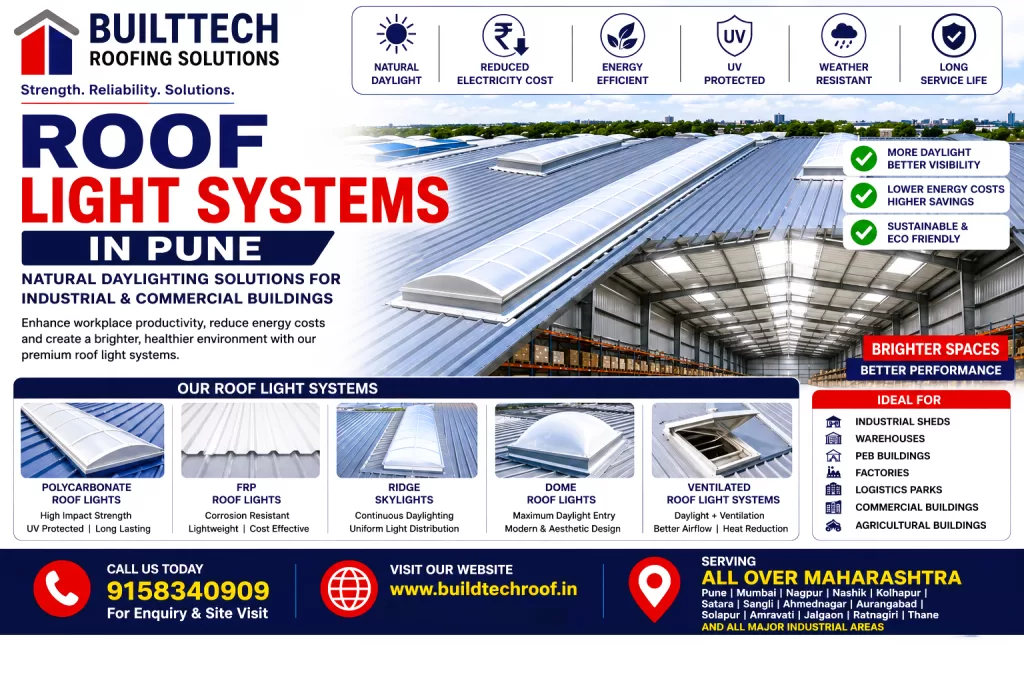
📖 Introduction Lighting is one of the most important aspects of any industrial or commercial building. Warehouses, factories, logistics centres, manufacturing plants, and Pre-Engineered Buildings (PEB) require adequate illumination for safety, productivity, and operational efficiency. However, relying solely on artificial lighting significantly increases electricity consumption and operating costs. This is where Roof Light Systems become an ideal solution. Roof Light Systems allow natural daylight to enter industrial buildings through specially designed translucent roofing panels and skylight systems. They improve indoor visibility, reduce energy consumption, enhance workplace comfort, and contribute to sustainable building design. Buildtech Roofing Solutions supplies and installs premium Roof Light Systems in Pune and across Maharashtra, helping industries maximise natural daylight while reducing energy costs. What Are Roof Light Systems? Roof Light Systems are specially designed daylighting components installed within roofing structures to allow natural sunlight into a building. They are commonly integrated with: These systems provide controlled daylight without compromising weather protection. Why Roof Light Systems Are Important Industrial buildings often face: Roof Light Systems solve these issues by utilising free natural daylight. Benefits include: How Roof Light Systems Work Roof lights are installed strategically within roofing systems. Sunlight passes through translucent panels and spreads evenly across the interior space. The result: Types of Roof Light Systems 1. Polycarbonate Roof Light Systems One of the most popular daylighting solutions. Features Applications: 2. FRP Roof Light Systems Fibreglass Reinforced Plastic roof lights. Benefits Applications: 3. Continuous Ridge Skylights Installed along the roof ridge. Advantages Applications: 4. Dome Roof Lights Raised skylight structures designed for maximum daylight capture. Benefits 5. Ventilated Roof Lights Combine natural daylight and ventilation. Benefits Key Benefits of Roof Light Systems 1. Energy Savings One of the biggest advantages. Natural daylight reduces the need for electric lighting during the daytime. Benefits: 2. Improved Workplace Productivity Well-lit workspaces improve: 3. Enhanced Building Appearance Natural lighting creates a brighter and more professional environment. 4. Environment Friendly Supports green building initiatives. Reduces: 5. Uniform Light Distribution Properly designed roof lights provide balanced illumination. 6. Reduced Heat Build-Up Modern polycarbonate systems include UV protection and heat-control technologies. 7. Long Service Life Premium roof light systems provide years of reliable performance. Applications of Roof Light Systems Industrial Sheds Provides natural illumination for production areas. Warehouses Improves visibility and inventory management. Manufacturing Plants Enhances worker productivity. PEB Buildings Popular daylighting solution for modern structures. Logistics Parks Reduces operational lighting costs. Commercial Buildings Supports sustainable building design. Agricultural Buildings Ideal for storage and livestock facilities. Infrastructure Projects Airports, terminals, and public facilities. Roof Light Systems for PEB Buildings Pre-Engineered Buildings often integrate roof lights because they: The Polycarbonate vs FRP Roof Lights Feature Polycarbonate FRP Impact Resistance Excellent Good UV Resistance Excellent Moderate Lifespan Longer Moderate Light Transmission Excellent Good Cost Higher Lower Roof Light Systems vs Artificial Lighting Feature Roof Lights Artificial Lighting Operating Cost Very Low Continuous Cost Energy Consumption None High Sustainability Excellent Moderate Maintenance Low Moderate Design Considerations Effective roof light design depends on: Building Orientation Roof Layout Daylight Requirements Climate Conditions Roof Height Internal Operations Professional planning ensures optimal daylight performance. Installation Process Step-1 – Site Assessment Evaluate daylight requirements. Step-2 – System Selection Choose an appropriate roof light type. Step-3 – Structural Preparation Prepare roofing framework. Step-4 – Roof Light Installation Install translucent panels or skylights. Step-5 – Waterproof Sealing Ensure leak-proof performance. Step-6 – Inspection Verify lighting and waterproofing quality. Common Problems Solved by Roof Light Systems High Electricity Bills Reduces daytime lighting costs. Dark Workspaces Improves visibility. Poor Workplace Environment Creates brighter interiors. Sustainability Challenges Supports green building goals. Inadequate Daylight Provides natural illumination. Maintenance Tips Cost of Roof Light Systems in Pune Pricing depends on: Approximate Cost Range ₹190 – ₹950 per sq.ft Actual pricing depends on project specifications. Why Choose Buildtech Roofing Solutions? Our Advantages Industries Served Service Areas Serving All Over Maharashtra PuneMumbaiNagpurNashikKolhapurSataraSangliAhmednagarAurangabadSolapurAmravatiJalgaonRatnagiriThane And All Major Industrial Areas Across Maharashtra Frequently Asked Questions What is a Roof Light System? A Roof Light System is a daylighting solution installed within roofing structures to allow natural sunlight into buildings. Are roof lights suitable for industrial buildings? Yes. They are widely used in factories, warehouses, and PEB buildings. Do roof lights reduce electricity costs? Yes. They significantly reduce daytime dependence on artificial lighting. Which is better: Polycarbonate or FRP roof lights? Polycarbonate offers higher impact resistance and longer lifespan, while FRP is often more economical. Are roof light systems waterproof? Yes. Professional installation ensures complete weatherproofing and leak protection.

Natural Daylighting Solutions for Industrial Buildings Read More »

XLPE Insulation in Pune | High Performance Thermal & Acoustic Insulation Solutions

XLPE Insulation in Pune | High Performance Thermal

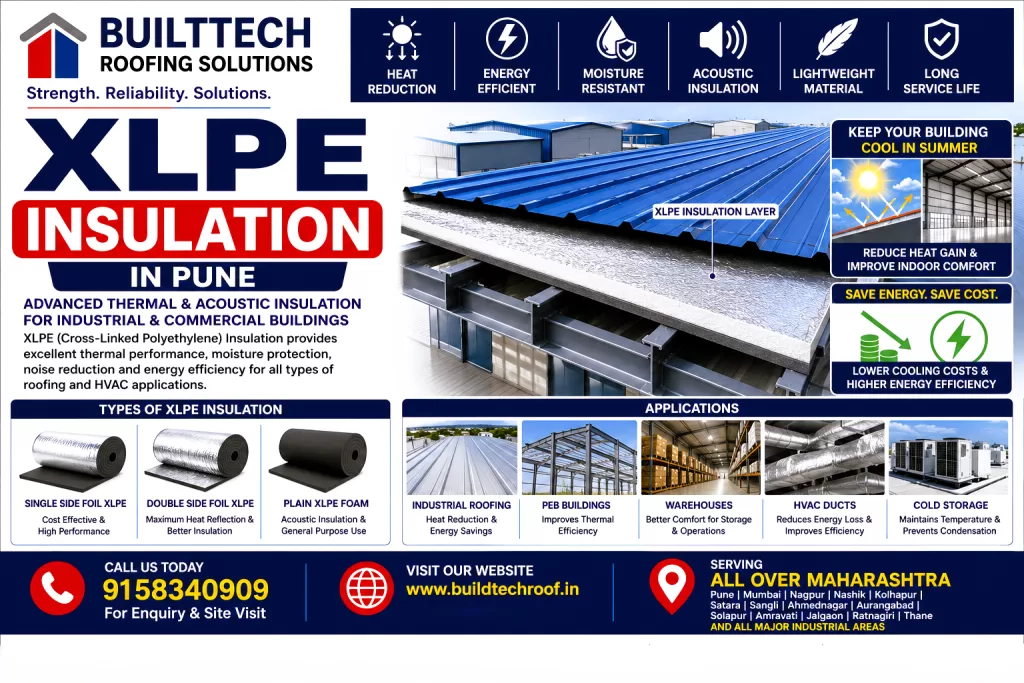
📖 Introduction Heat gain, condensation, noise pollution, and energy losses are major challenges faced by industrial buildings, warehouses, factories, commercial complexes, and Pre-Engineered Buildings (PEB). Without proper insulation, roofing systems absorb excessive heat, causing uncomfortable indoor temperatures, increased cooling costs, and reduced operational efficiency. To overcome these challenges, modern industries increasingly choose XLPE Insulation, one of the most effective thermal and acoustic insulation materials available today. XLPE (Cross-Linked Polyethene) Insulation offers excellent thermal resistance, moisture protection, durability, and energy efficiency, making it ideal for industrial roofing and building insulation applications. Buildtech Roofing Solutions supplies and installs premium-quality XLPE Insulation in Pune and across Maharashtra for industrial, commercial, and infrastructure projects. What is XLPE Insulation? XLPE stands for Cross-Linked Polyethene Foam. It is a closed-cell insulation material manufactured through a cross-linking process that improves its: The closed-cell structure creates millions of tiny air pockets that reduce heat transfer and improve insulation efficiency. How XLPE Insulation Works XLPE insulation acts as a barrier against heat flow. During Summer During Winter Throughout the Year Why XLPE Insulation is Important Industrial buildings often face: XLPE Insulation helps solve these issues effectively. Structure of XLPE Insulation A typical XLPE insulation system consists of: Closed-Cell Polyethene Foam Provides thermal insulation. Reflective Aluminum Foil (Optional) Enhances radiant heat reflection. Protective Facing Layer Improves durability and installation performance. Types of XLPE Insulation Single Side Foil XLPE Foil facing on one side. Applications: Double Side Foil XLPE Foil facing on both sides. Benefits: Plain XLPE Foam Without foil facing. Used for: Fire Retardant XLPE Designed for enhanced fire safety requirements. Applications: Key Benefits of XLPE Insulation 1. Excellent Thermal Insulation One of the primary advantages. Benefits: 2. Closed Cell Structure Provides: 3. Lightweight Material Advantages: 4. Energy Efficiency Helps reduce: 5. Acoustic Performance Reduces: 6. Condensation Prevention Protects roofing systems from moisture-related issues. 7. Long Service Life Maintains insulation performance for many years. 8. Corrosion Protection By reducing condensation, XLPE helps protect metal roofing systems. Applications of XLPE Insulation Industrial Roofing Most common application. Provides: PEB Buildings Improves thermal efficiency of pre-engineered structures. Warehouses Maintains better storage conditions. Manufacturing Plants Controls temperature fluctuations. Commercial Buildings Enhances occupant comfort. HVAC Duct Insulation Prevents energy loss through air ducts. Cold Storage Facilities Supports temperature-controlled environments. Infrastructure Projects Airports, terminals, and industrial parks. XLPE Insulation for Roofing Systems Widely used beneath: Colour Coated Roofing Sheets Galvalume Roofing Sheets Standing Seam Roofing PUF Roofing Systems Industrial Shed Roofing The insulation layer reduces heat transfer through the roof. The XLPE Insulation vs Glass Wool Feature XLPE Glass Wool Moisture Resistance Excellent Moderate Weight Lightweight Heavier Durability Higher Moderate Installation Easier Moderate Maintenance Low Moderate The XLPE Insulation vs Rockwool Feature XLPE Rockwool Weight Lower Higher Moisture Resistance Better Moderate Flexibility Excellent Moderate Installation Easier More Complex XLPE Insulation vs PUF Insulation Feature XLPE PUF Flexibility High Moderate Cost Lower Higher Installation Easy Specialized Maintenance Low Low Installation Process Step-1 – Site Assessment Evaluate roofing requirements. Step-2 – Material Selection Choose a suitable thickness and facing. Step-3 – Surface Preparation Prepare the roofing support system. Step-4 – Insulation Placement Install insulation beneath roofing sheets. Step-5 – Joint Sealing Seal joints for maximum efficiency. Step-6 – Roofing Installation Install roofing sheets over insulation. Step-7 – Final Inspection Verify complete coverage. Common Problems Solved by XLPE Insulation Excessive Indoor Heat Reduces heat transfer. Condensation Formation Prevents moisture accumulation. High Electricity Bills Improves energy efficiency. Worker Discomfort Creates a cooler indoor environment. Noise Pollution Improves acoustic performance. Corrosion Issues Reduces moisture-related corrosion. Industries Served Manufacturing Plants Warehouses Logistics Parks Food Processing Units Pharmaceutical Facilities Textile Industries Commercial Buildings Infrastructure Projects Maintenance Tips Cost of XLPE Insulation in Pune Pricing depends on: Approximate Cost Range ₹20 – ₹130 per sq.ft Actual pricing varies according to specifications. Why Choose Buildtech Roofing Solutions? Our Advantages Service Areas Serving All Over Maharashtra PuneMumbaiNagpurNashikKolhapurSataraSangliAhmednagarAurangabadSolapurAmravatiJalgaonRatnagiriThane And All Major Industrial Areas Across Maharashtra Frequently Asked Questions What is XLPE Insulation? XLPE is Cross-Linked Polyethene Foam insulation used for thermal, acoustic, and moisture protection. Is XLPE suitable for industrial roofing? Yes. It is one of the most widely used insulation materials for industrial roofing systems. Can XLPE reduce roof heat? Yes. XLPE significantly reduces heat transfer and improves indoor comfort. Is XLPE waterproof? Its closed-cell structure provides excellent moisture resistance and condensation control. How long does XLPE insulation last? Properly installed XLPE insulation can provide reliable performance for many years with minimal maintenance. Conclusion An effective insulation system is essential for maintaining comfortable indoor conditions, reducing energy consumption, and protecting industrial buildings from heat and moisture. XLPE insulation combines thermal efficiency, moisture resistance, lightweight construction, and durability, making it an excellent choice for factories, warehouses, logistics parks, and PEB buildings. If you are looking for XLPE Insulation in Pune, Buildtech Roofing Solutions provides high-quality insulation materials and professional installation services tailored to your project requirements across Maharashtra.

XLPE Insulation in Pune | High Performance Thermal Read More »

Roof Accessories in Pune | Industrial Roofing Components & Solutions

Roof Accessories | Industrial Roofing Components & Solutions

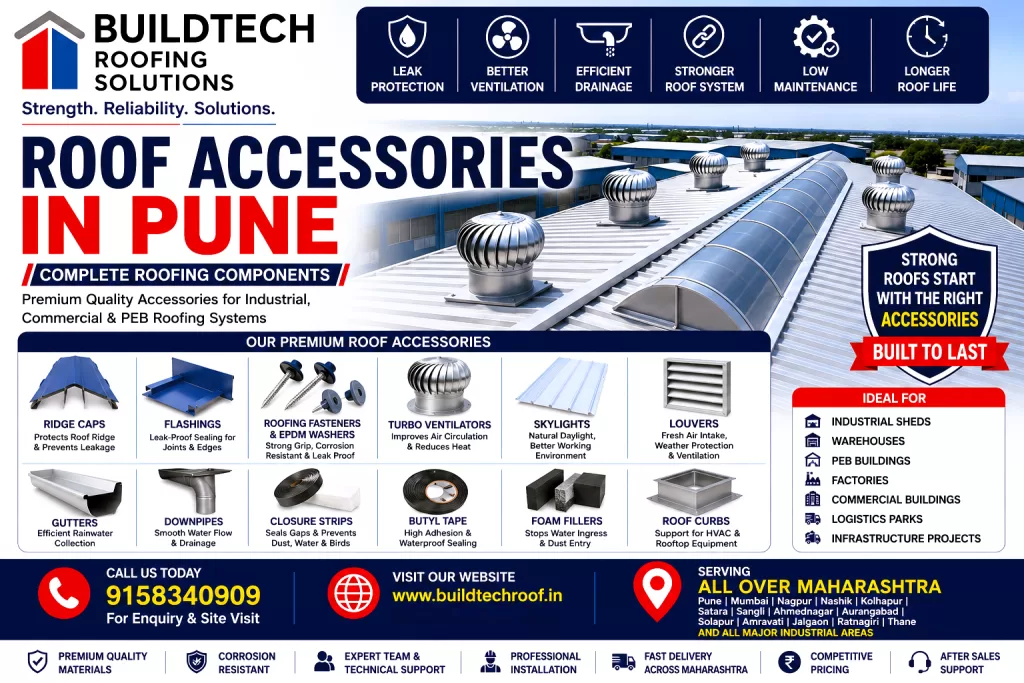
📖 Introduction A roofing system is only as strong as the accessories that support it. While roofing sheets form the primary protective layer, various roof accessories play a critical role in ensuring weather protection, waterproofing, ventilation, structural stability, drainage, and long-term roof performance. Industrial buildings, warehouses, factories, logistics parks, commercial buildings, and PEB structures require carefully selected roofing accessories to prevent leakage, improve airflow, manage rainwater, and extend roof lifespan. Buildtech Roofing Solutions supplies and installs premium-quality Roof Accessories in Pune and across Maharashtra, providing complete roofing system solutions for industrial and commercial projects. What Are Roof Accessories? Roof accessories are supplementary components used alongside roofing sheets and structural systems. They improve: Without proper accessories, even high-quality roofing sheets can experience leakage, corrosion, and premature failure. Why Roof Accessories Are Important Roof accessories help: Types of Roof Accessories 1. Ridge Caps Ridge caps cover the roof peak where two roof slopes meet. Benefits Applications 2. Flashings Flashings seal vulnerable roof areas. Installed around: Benefits 3. Roofing Fasteners Specialised self-drilling screws are used for roofing installation. Features Importance Poor fasteners are among the leading causes of roof leakage. 4. EPDM Washers Rubber sealing washers are used with roofing screws. Benefits 5. Turbo Ventilators Wind-driven ventilation systems. Benefits Applications 6. Ridge Ventilation Systems Continuous roof ventilation along the ridge. Benefits 7. Polycarbonate Skylights Natural daylighting solutions. Advantages 8. FRP Skylight Sheets Economical daylighting systems. Benefits 9. Gutters Rainwater collection and drainage systems. Importance 10. Downpipes Carry rainwater from gutters to drainage systems. Benefits 11. Louvers Wall-mounted ventilation accessories. Benefits 12. Roof Curbs Structural supports for rooftop equipment. Applications: Most Important Roof Accessories for Industrial Buildings Ridge Caps Flashings Fasteners Gutters Downpipes Turbo Ventilators Louvers Skylight Systems These accessories significantly improve roofing performance. Roof Accessories for PEB Buildings PEB structures are commonly used: These components ensure complete roofing functionality. Roof Accessories for Warehouses Warehouses require: Ventilation Systems Skylights Drainage Systems Waterproof Flashings Fasteners Ridge Ventilation These systems improve indoor conditions and roof durability. Benefits of Quality Roof Accessories 1. Leak Prevention Protects against water penetration. 2. Improved Roof Lifespan Reduces wear and tear. 3. Better Ventilation Improves building comfort. 4. Enhanced Drainage Reduces water accumulation. 5. Lower Maintenance Costs Prevents recurring repairs. 6. Improved Safety Supports structural integrity. 7. Better Building Performance Creates a complete roofing system. The Common Roofing Problems Solved by Accessories Problem Solution Roof Leakage Flashings & Ridge Caps Heat Build-Up Turbo Ventilators Dark Interiors Skylights Water Accumulation Gutters & Downpipes Poor Ventilation Louvers Loose Sheets Roofing Fasteners Installation Process Step-1 Roof Inspection Step-2 Accessory Selection Step-3 Material Preparation Step-4 Installation Step-5 Waterproof Sealing Step-6 Performance Testing Step-7 Final Inspection Maintenance Tips Cost of Roof Accessories in Pune Pricing depends on: Approximate Pricing Accessory Approximate Cost Ridge Caps ₹150 – ₹450 per meter Flashings ₹120 – ₹400 per meter Fasteners ₹5 – ₹20 per piece Turbo Ventilators ₹3,500 – ₹15,000 each Skylights Project Based Gutters Project Based Why Choose Buildtech Roofing Solutions? Our Advantages Industries Served Service Areas Serving All Over Maharashtra PuneMumbaiNagpurNashikKolhapurSataraSangliAhmednagarAurangabadSolapurAmravatiJalgaonRatnagiriThane And All Major Industrial Areas Across Maharashtra Frequently Asked Questions What are roof accessories? Roof accessories are supplementary roofing components such as ridge caps, flashings, fasteners, ventilators, skylights, and drainage systems that improve roof performance. Why are roofing accessories important? They help prevent leaks, improve ventilation, enhance drainage, and extend roof lifespan. Which roof accessory is most important? Fasteners, ridge caps, flashings, and ventilation systems are among the most critical roofing accessories. Can roof accessories reduce maintenance costs? Yes. Properly installed accessories prevent many common roofing failures and reduce long-term repair costs.

Roof Accessories | Industrial Roofing Components & Solutions Read More »

Standing Seam Roofing in Pune | Premium Leak-Proof Metal Roofing Solutions

Standing Seam Roofing in Pune

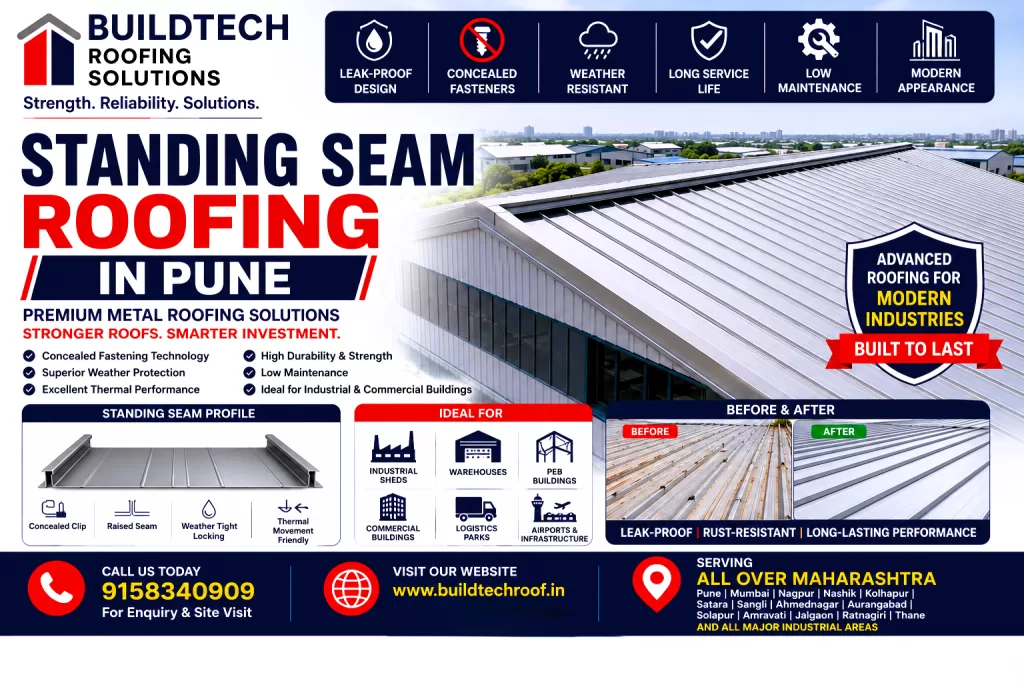
📖 Introduction Modern industrial and commercial buildings require roofing systems that offer exceptional durability, weather resistance, aesthetics, and long-term performance. Traditional screw-fixed roofing systems often face challenges such as leakage, fastener deterioration, thermal movement issues, and ongoing maintenance requirements. To overcome these limitations, many architects, consultants, industrial developers, and warehouse owners are choosing Standing Seam Roofing Systems. Standing Seam Roofing is considered one of the most advanced metal roofing technologies available today. Its concealed fastening system, superior waterproofing capability, sleek appearance, and long service life make it ideal for premium industrial and commercial projects. Buildtech Roofing Solutions provides complete Standing Seam Roofing Solutions in Pune and across Maharashtra for warehouses, industrial sheds, factories, airports, logistics parks, commercial buildings, and modern infrastructure projects. What is Standing Seam Roofing? Standing Seam Roofing is a premium metal roofing system in which adjacent panels are connected by raised seams above the roof surface. Unlike conventional roofing sheets, the fasteners remain hidden beneath the panels. This creates: How Standing Seam Roofing Works The roofing panels are mechanically locked or snap-locked together using vertical seams. Main Components Standing Seam Panels Long continuous metal roofing sheets. Concealed Clips Secure roofing panels without exposed fasteners. Structural Support System Usually Z Purlins and C Purlins. Ridge and Flashing Systems Provide complete weatherproofing. Insulation Systems Optional thermal and acoustic protection. Why Standing Seam Roofing is Popular Industries increasingly prefer standing seam roofing because it provides: Key Benefits of Standing Seam Roofing 1. Leak-Proof Roofing System One of the biggest advantages. Since screws do not penetrate the roof surface: 2. Concealed Fastening Technology Fasteners remain hidden beneath the panels. Benefits: 3. Superior Thermal Expansion Performance Metal roofs expand and contract with temperature changes. Standing seam systems accommodate movement without damaging the roof. 4. Long Service Life A properly installed standing seam roof can last: 30–50 Years+ With minimal maintenance. 5. Excellent Weather Resistance Performs exceptionally well against: 6. Low Maintenance Minimal exposed hardware means fewer maintenance issues. 7. Modern Architectural Appearance Provides a premium and professional aesthetic. Popular in: Types of Standing Seam Roofing Mechanical Lock Standing Seam Panels are mechanically seamed together. Benefits Snap Lock Standing Seam Panels snap together without mechanical seaming. Benefits Structural Standing Seam Roofing Suitable for: Architectural Standing Seam Roofing Used for: Applications of Standing Seam Roofing Industrial Sheds Provides durable and leak-proof roofing. Warehouses Ideal for large-span structures. Logistics Parks Supports long-term operations. PEB Buildings Premium roofing solution for modern steel structures. Commercial Buildings Enhances architectural appeal. Airports Widely used for terminal roofing. Educational Institutions Modern and low-maintenance roofing solution. Infrastructure Projects Railway stations, convention centres, and public buildings. The Standing Seam Roofing vs Conventional Roofing Sheets Feature Standing Seam Conventional Roofing Fasteners Hidden Exposed Leakage Risk Very Low Moderate Maintenance Low Higher Lifespan Longer Moderate Appearance Premium Standard The Standing Seam Roofing vs Colour Coated Roofing Feature Standing Seam Colour Coated Roofing Waterproofing Excellent Good Thermal Movement Excellent Moderate Maintenance Lower Moderate Installation Cost Higher Lower Standing Seam Roofing vs Galvalume Roofing Feature Standing Seam Standard Galvalume Fastening Method Concealed Exposed Leak Resistance Excellent Good Aesthetics Premium Standard Lifespan Longer Long Importance of Proper Installation Standing seam roofing performance depends heavily on installation quality. Critical factors include: Standing Seam Roofing Installation Process Step-1 – Site Inspection Evaluate structural requirements. Step-2 – Structural Preparation Install purlins and support systems. Step-3 – Clip Installation Fix concealed fastening clips. Step-4 – Panel Placement Position standing seam panels. Step-5 – Seaming Process Mechanically lock or snap panels together. Step-6 – Ridge & Flashing Installation Complete weatherproof detailing. Step-7 – Final Inspection Verify waterproof performance. Common Problems Solved by Standing Seam Roofing Roof Leakage Concealed fastening minimises leakage risk. Fastener Corrosion No exposed screws. Thermal Movement Damage Panels move naturally without stress. High Maintenance Costs Durable and long-lasting system. Poor Building Appearance Creates a modern, premium look. Energy Efficiency Benefits Standing seam roofing supports: Cost of Standing Seam Roofing in Pune Pricing depends on: Approximate Cost Range ₹180 – ₹450 per sq.ft Actual pricing varies according to project specifications. Why Choose Buildtech Roofing Solutions? Our Advantages Industries Served Service Areas Serving All Over Maharashtra And All Major Industrial Areas Across Maharashtra Frequently Asked Questions What is Standing Seam Roofing? Standing Seam Roofing is a concealed-fastener metal roofing system that uses raised seams to connect roofing panels. Is Standing Seam Roofing leak-proof? It is one of the most leak-resistant roofing systems available because it eliminates exposed roof fasteners. How long does Standing Seam Roofing last? A professionally installed standing seam roof can last 30–50 years or more. Can solar panels be installed on Standing Seam Roofing? Yes. Standing seam roofs are highly compatible with solar panel mounting systems. Conclusion Standing Seam Roofing is an ideal choice for businesses seeking a durable, leak-resistant, and low-maintenance roofing solution. Its concealed fastening technology, exceptional weather resistance, and modern design make it suitable for factories, warehouses, logistics parks, commercial buildings, and PEB structures. If you’re planning a new industrial project or upgrading an existing roof, Buildtech Roofing Solutions offers comprehensive Standing Seam Roofing Solutions in Pune, with expert engineering, high-quality materials, and professional installation services across Maharashtra.

Standing Seam Roofing in Pune Read More »

Industrial Roof Waterproofing in Pune | Leak-Proof Roofing Solutions

Industrial Roof Waterproofing | Leak-Proof Roofing Solutions

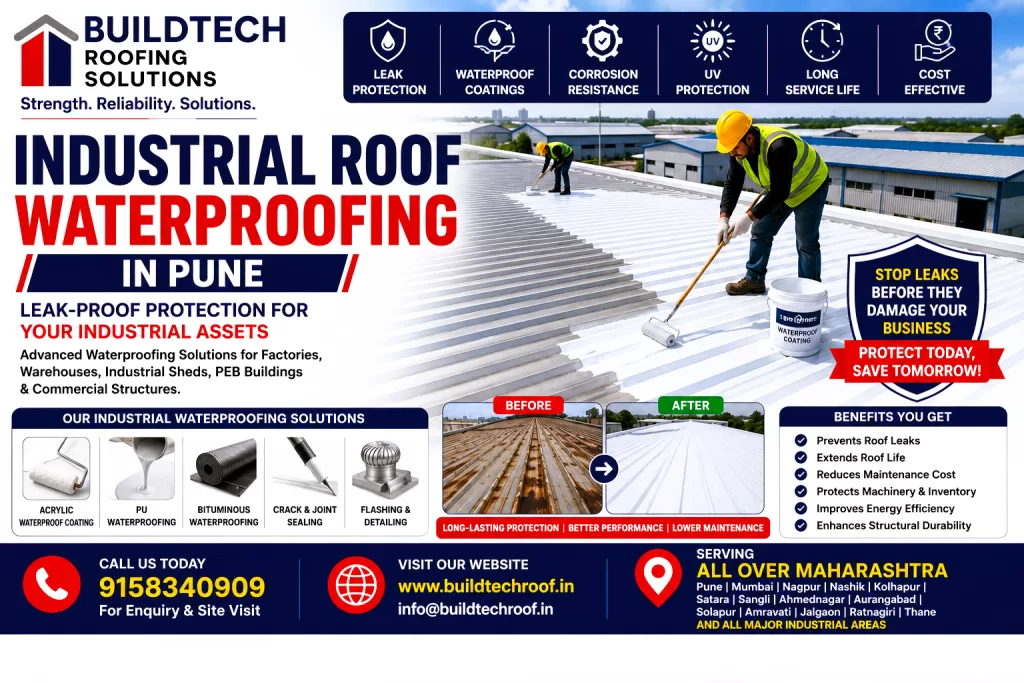
📖 Introduction Industrial roofs are constantly exposed to harsh environmental conditions such as heavy rainfall, UV radiation, temperature fluctuations, dust, pollution, and wind. Over time, these factors can cause cracks, leakage, corrosion, moisture penetration, and structural deterioration. Water leakage is one of the most common and costly problems faced by factories, warehouses, industrial sheds, and commercial buildings. If left untreated, it can damage machinery, inventory, electrical systems, insulation, and structural components. Industrial Roof Waterproofing is a specialised process that creates a protective barrier against water infiltration, ensuring long-term roof performance and structural durability. Buildtech Roofing Solutions provides professional Industrial Roof Waterproofing Services in Pune and across Maharashtra, helping businesses protect their assets, operations, and buildings from water-related damage. What is Industrial Roof Waterproofing? Industrial Roof Waterproofing is the application of specialised waterproofing systems designed to prevent water penetration through roofing structures. These systems protect: The primary objective is to create a seamless, leak-proof roofing surface. Why Waterproofing is Important Without proper waterproofing: Proper waterproofing provides: Common Causes of Roof Leakage Ageing Roofing Materials Over time, roofing materials deteriorate due to weather exposure. Damaged Fasteners Loose or corroded fasteners create water entry points. Cracks & Gaps Thermal expansion and contraction can create openings. Poor Installation Improper roofing installation often causes recurring leakage. Damaged Flashing Roof joints and penetrations become vulnerable. Standing Water Poor drainage accelerates roof deterioration. Signs Your Roof Needs Waterproofing Water Stains on Ceiling Indicates moisture penetration. Visible Roof Leakage Active leakage during rainfall. Rust Formation Corrosion on roofing sheets and structural members. Damp Interior Walls Sign of hidden water ingress. Mould & Mildew Growth Indicates excess moisture. Peeling Paint A Common symptom of water damage. Types of Industrial Roof Waterproofing Systems 1. Acrylic Waterproof Coating A flexible coating system suitable for: Benefits 2. Polyurethane Waterproofing Highly durable waterproof membrane. Advantages 3. Elastomeric Waterproof Coating Provides excellent expansion and contraction resistance. Suitable for: 4. Bituminous Waterproofing Traditional waterproofing solution. Applications: 5. Silicone Roof Coatings Premium waterproofing technology. Benefits: Waterproofing for Different Roof Types Metal Roof Waterproofing Common for: Focus Areas: PEB Roof Waterproofing Specialised systems designed for: Concrete Roof Waterproofing Suitable for: Industrial Roof Waterproofing Process Step-1 – Roof Inspection Detailed roof condition assessment. Inspection includes: Step-2 – Surface Preparation Cleaning and removal of contaminants. Step-3 – Repair Work Address: Step-4 – Primer Application Improves coating adhesion. Step-5 – Waterproof Coating Application Apply the selected waterproofing system. Step-6 – Reinforcement Layer Where required for additional protection. Step-7 – Final Inspection Verify complete waterproof coverage. Benefits of Industrial Roof Waterproofing 1. Leak Prevention Primary protection against water infiltration. 2. Extended Roof Lifespan Reduces weather-related deterioration. 3. Reduced Maintenance Costs Prevents recurring repairs. 4. Improved Energy Efficiency Reflective coatings help reduce heat absorption. 5. Corrosion Protection Protects metal roofing systems. 6. Business Continuity Prevents operational disruptions. 7. Asset Protection Protects machinery, inventory, and equipment. The Waterproofing vs Roof Replacement Feature Waterproofing Roof Replacement Cost Lower Higher Installation Time Faster Longer Operational Disruption Minimal Significant Life Extension Yes Complete Renewal Suitable for Minor Damage Excellent Not Necessary Industries Served Manufacturing Plants Warehouses Logistics Parks Pharmaceutical Facilities Food Processing Units Engineering Industries Textile Industries Commercial Buildings Common Areas Requiring Waterproofing Roof Joints Fasteners Flashing Areas Skylights Ventilator Bases Gutters Drainage Channels Roof Penetrations Maintenance Tips After Waterproofing Cost of Industrial Roof Waterproofing in Pune Pricing depends on: Approximate Cost Range ₹25 – ₹250 per sq.ft Actual project pricing varies according to site conditions and waterproofing specifications. Why Choose Buildtech Roofing Solutions? Our Advantages Industries Served Service Areas Serving All Over Maharashtra PuneMumbaiNagpurNashikKolhapurSataraSangliAhmednagarAurangabadSolapurAmravatiJalgaonRatnagiriThane And All Major Industrial Areas Across Maharashtra Frequently Asked Questions How long does industrial roof waterproofing last? Depending on the system used, waterproofing can last 5–15 years or more with proper maintenance. Can waterproofing stop active roof leaks? Yes. Professional waterproofing systems are specifically designed to stop and prevent roof leaks. Is waterproofing suitable for metal roofs? Absolutely. Metal roofs are among the most common applications for industrial waterproofing. Can waterproofing reduce roof temperature? Yes. Reflective waterproof coatings can help reduce heat absorption and improve energy efficiency. Conclusion Industrial roof waterproofing is more than just a maintenance service—it’s a long-term investment in the safety, efficiency, and durability of your facility. By preventing leaks, corrosion, and moisture damage, a professionally waterproofed roof helps protect your operations while reducing future repair costs. If you’re looking for dependable Industrial Roof Waterproofing in Pune, Buildtech Roofing Solutions offers expert inspections, high-performance waterproofing systems, and customised solutions for industrial, commercial, warehouse, and PEB roofing projects across Maharashtra.

Industrial Roof Waterproofing | Leak-Proof Roofing Solutions Read More »

Roof Repair in Pune | Industrial, Commercial & Warehouse Roof Repair Services

Industrial, Commercial & Warehouse Roof Repair Services

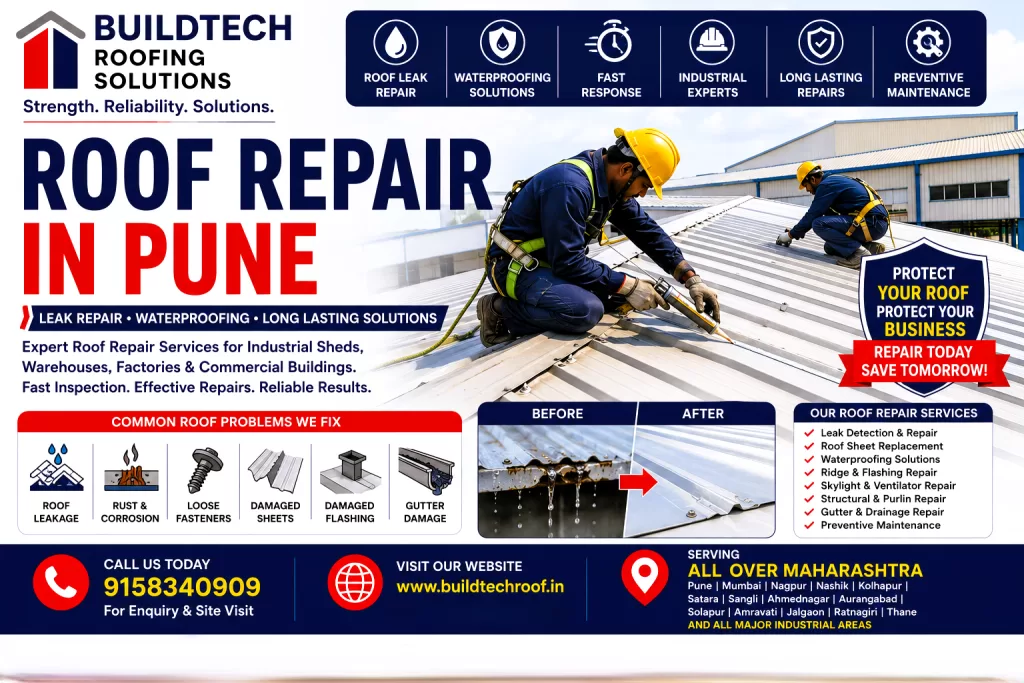
📖 Introduction A damaged roof can lead to water leakage, structural deterioration, insulation failure, production losses, and safety risks. Whether it’s an industrial shed, warehouse, factory, commercial building, or PEB structure, timely roof repair is essential to maintain building performance and prevent costly future damage. Over time, roofing systems are exposed to harsh weather conditions, heavy rainfall, UV radiation, wind pressure, corrosion, and thermal expansion. These factors can cause roof leaks, rust formation, damaged fasteners, loose sheets, and structural weaknesses. Buildtech Roofing Solutions specialises in professional Roof Repair Services in Pune and across Maharashtra, providing complete inspection, maintenance, leak detection, waterproofing, sheet replacement, and structural repair solutions. What is Roof Repair? Roof Repair is the process of identifying and fixing damaged roofing components to restore structural integrity, weather protection, and long-term performance. Roof repair may involve: Why Roof Repair is Important Ignoring roof damage can result in: Timely repairs help: Common Roof Problems Roof Leakage One of the most common industrial roofing issues. Causes: Rust & Corrosion Common in older metal roofing systems. Affects: Damaged Roofing Sheets Caused by: Loose Fasteners Can create: Damaged Flashing Leads to leakage around: Gutter Damage Can cause: Signs You Need Roof Repair Water Leakage Visible water stains or dripping. Rust Formation Corrosion on roofing sheets. Loose Roofing Panels Movement during strong winds. Damaged Fasteners Missing or broken fasteners. High Indoor Temperatures Indicates insulation or ventilation issues. Structural Sagging Requires immediate attention. Roof Repair Services Offered Industrial Roof Repair Factories and manufacturing facilities. Warehouse Roof Repair Large-span warehouse roofing systems. Commercial Roof Repair Commercial buildings and showrooms. PEB Roof Repair Pre-Engineered Building roofing solutions. Metal Roof Repair Galvalume and colour-coated roofing systems. Shed Roof Repair Industrial and agricultural sheds. Skylight Repair Polycarbonate and FRP skylight systems. Ventilator Repair Turbo ventilators and ridge ventilation systems. Roof Repair Process Step-1 – Roof Inspection Detailed site assessment. Inspection includes: Step-2 – Damage Assessment Identify: Step-3 – Repair Planning Develop a customised repair solution. Step-4 – Material Selection Choose appropriate repair materials. Step-5 – Repair Execution Perform repairs according to standards. Step-6 – Waterproofing Apply sealing and waterproofing systems. Step-7 – Final Inspection Verify leak-proof performance. Roof Leak Repair Solutions Fastener Replacement Replace damaged or loose fasteners. Sealant Application Industrial-grade waterproof sealants. Flashing Repairs Restore joint protection. Sheet Replacement Replace severely damaged roofing panels. Waterproof Membrane Systems Additional protection against water ingress. Industrial Roof Repair Solutions Industrial roofs often require: Roofing Sheet Replacement Structural Repairs Waterproofing Ventilation Improvements Skylight Repairs Gutter Rehabilitation The Roof Repair vs Roof Replacement Feature Roof Repair Roof Replacement Cost Lower Higher Time Required Faster Longer Suitable for Minor Damage Yes No Suitable for Severe Damage Limited Yes Operational Disruption Minimal Higher Benefits of Professional Roof Repair 1. Extended Roof Life Delays expensive roof replacement. 2. Reduced Maintenance Costs Fixing small issues prevents major failures. 3. Improved Waterproofing Protects buildings from water damage. 4. Enhanced Safety Reduces risks to occupants and equipment. 5. Improved Energy Efficiency Repairs insulation and ventilation systems. 6. Better Building Appearance Restores roof aesthetics. 7. Increased Property Value Well-maintained roofs improve asset value. Industries Served Manufacturing Plants Warehouses Logistics Parks Pharmaceutical Facilities Food Processing Units Textile Industries Commercial Buildings Infrastructure Projects Why Industrial Roofs Fail Lack of Maintenance Poor Installation Weather Exposure Corrosion Ageing Materials Improper Drainage Preventive Roof Maintenance Tips Cost of Roof Repair in Pune Pricing depends on: Approximate Cost Range ₹15 – ₹250 per sq.ft Project pricing varies according to actual site conditions. Why Choose Buildtech Roofing Solutions? Our Advantages Service Areas Serving All Over Maharashtra PuneMumbaiNagpurNashikKolhapurSataraSangliAhmednagarAurangabadSolapurAmravatiJalgaonRatnagiriThane And All Major Industrial Zones Across Maharashtra Frequently Asked Questions How do I know if my roof needs repair? Signs include leaks, rust, damaged sheets, loose fasteners, and water stains. Is roof repair cheaper than replacement? Yes, roof repair is generally much more cost-effective when damage is limited. Can industrial roof leaks be repaired during the monsoon? Emergency leak repairs can be performed, although permanent repairs are best completed during suitable weather conditions. How long does roof repair take? Most industrial roof repairs can be completed within a few days, depending on project size and damage severity. Conclusion A well-maintained roof is essential for protecting your business operations, assets, and infrastructure. Whether you’re dealing with roof leaks, damaged sheets, corrosion, or structural concerns, timely repairs can prevent costly damage and significantly extend the life of your roofing system. For reliable Roof Repair Services in Pune, trust Buildtech Roofing Solutions to deliver professional inspection, expert repairs, and long-lasting roofing performance.

Industrial, Commercial & Warehouse Roof Repair Services Read More »

Smart roofing solutions for industrial buildings

PEB Roofing in Pune | Pre-Engineered Building Roofing Solutions

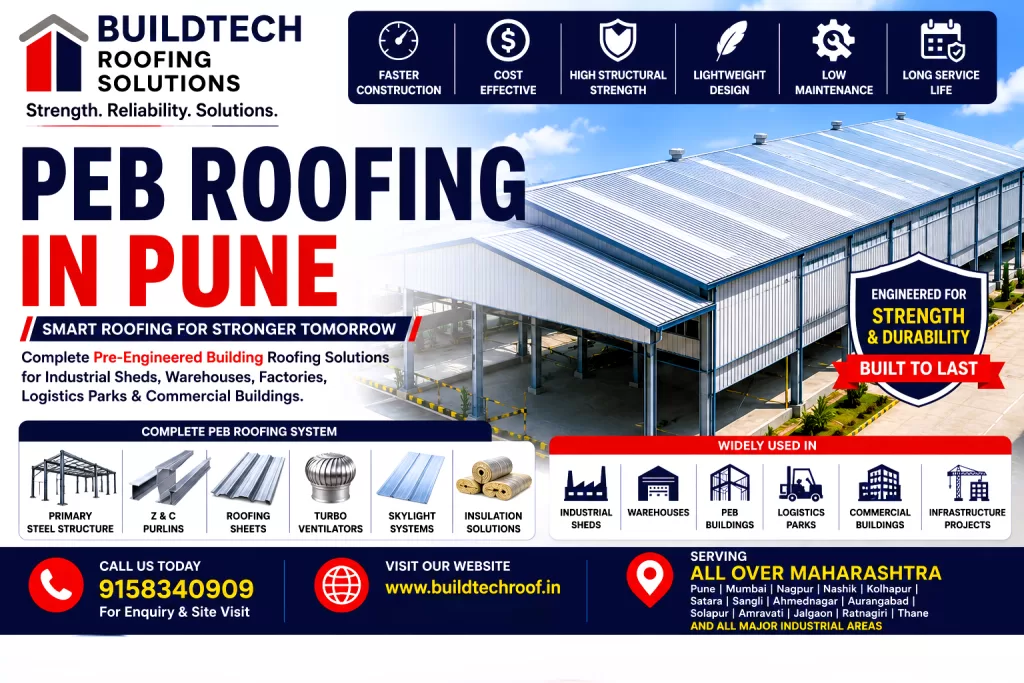
📖 Introduction Modern industries require construction solutions that are fast, economical, durable, and structurally efficient. Traditional construction methods often involve lengthy project timelines, higher labour costs, and increased material consumption. To overcome these challenges, industries increasingly choose Pre-Engineered Building (PEB) Roofing Systems. PEB Roofing has become the preferred solution for factories, warehouses, logistics parks, industrial sheds, commercial buildings, and infrastructure projects because it offers rapid construction, reduced structural weight, and long-term durability. Buildtech Roofing Solutions specialises in PEB Roofing Systems in Pune and across Maharashtra, delivering customised roofing solutions for industrial and commercial applications. What is PEB Roofing? PEB Roofing refers to roofing systems used in Pre-Engineered Buildings (PEB). A PEB structure consists of: All components are engineered and manufactured in factories before being assembled on-site. Why PEB Roofing is Popular Industries prefer PEB Roofing because it provides: Components of a PEB Roofing System Primary Steel Structure Includes: Provides structural stability. Secondary Members Includes: Z Purlins C Purlins Support roofing sheets and wall cladding. Roofing Sheets Common options: Insulation System Used for thermal efficiency. Materials include: Ventilation System Includes: Skylight System Polycarbonate and FRP skylight panels provide natural daylight. Types of PEB Roofing Systems Single Skin Roofing Most economical option. Suitable for: Insulated Roofing Includes insulation layers. Ideal for: PUF Panel Roofing Provides excellent thermal insulation. Applications: Standing Seam Roofing Premium roofing solution. Benefits: Key Benefits of PEB Roofing 1. Faster Construction One of the biggest advantages. Factory-fabricated components reduce installation time dramatically. Benefits: 2. Cost-Effective PEB Roofing reduces: 3. Lightweight Structure Compared to conventional RCC structures. Advantages: 4. High Structural Strength Designed to withstand: 5. Design Flexibility PEB Roofing supports: 6. Energy Efficiency Can be integrated with: 7. Long Service Life Properly designed PEB structures can last for decades. Applications of PEB Roofing Industrial Sheds Manufacturing facilities and factories. Warehouses Storage and logistics facilities. Logistics Parks Large distribution centres. Commercial Buildings Showrooms and commercial complexes. Agricultural Buildings Storage sheds and poultry farms. Infrastructure Projects Airports, railway facilities, and industrial parks. Automobile Facilities Service centres and assembly units. The PEB Roofing vs Conventional Construction Feature PEB Roofing Conventional Construction Construction Speed Fast Slow Weight Lower Higher Cost Efficiency High Moderate Expansion Capability Easy Difficult Material Wastage Low Higher The PEB Roofing vs RCC Roofing Feature PEB Roofing RCC Roofing Construction Time Faster Slower Structural Weight Lower Higher Cost Lower Higher Future Expansion Easy Difficult Roofing Materials Used in PEB Buildings Galvalume Roofing Sheets Excellent corrosion resistance. Colour Coated Roofing Sheets Superior aesthetics and protection. PUF Sandwich Panels Thermal insulation performance. Polycarbonate Skylights Natural daylighting. FRP Roofing Sheets Corrosion-resistant roofing. Importance of Roof Ventilation in PEB Structures Ventilation improves: Common solutions: PEB Roofing Installation Process Step-1 – Site Survey Analyse project requirements. Step-2 – Engineering Design Structural calculations and detailing. Step-3 – Factory Fabrication Manufacture steel components. Step-4 – Material Delivery Transport to the site. Step-5 – Structural Erection Install primary and secondary members. Step-6 – Roofing Installation Fix roofing sheets and accessories. Step-7 – Final Inspection Verify structural and roofing performance. Common Problems Solved by PEB Roofing Long Construction Time Fast-track project execution. High Construction Costs Optimised material usage. Limited Expansion Options Supports future expansion. Heavy Structural Loads Lightweight steel design. Industrial Roofing Challenges Integrated roofing solutions. Maintenance Tips Cost of PEB Roofing in Pune Pricing depends on: Approximate Cost Range ₹450 – ₹1,500 per sq.ft Project pricing varies according to design and specifications. Why Choose Buildtech Roofing Solutions? Our Advantages Industries Served Service Areas Serving All Over Maharashtra PuneMumbaiNagpurNashikKolhapurSataraSangliAhmednagarAurangabadSolapurAmravatiJalgaonRatnagiriThane And All Major Industrial Zones Across Maharashtra Frequently Asked Questions What is PEB Roofing? PEB Roofing is a roofing system designed for Pre-Engineered Buildings using factory-manufactured steel components. Is PEB Roofing durable? Yes. Properly designed PEB roofing systems offer excellent durability and long service life. Can PEB Roofing support solar panels? Yes. Most PEB roofing structures can be designed to support solar installations. Is PEB Roofing suitable for warehouses? Absolutely. Warehouses are among the most common applications for PEB Roofing systems. Conclusion PEB Roofing has transformed industrial construction by offering a faster, stronger, and more cost-effective alternative to traditional building methods. From warehouses and factories to logistics parks and commercial developments, PEB roofing systems provide unmatched flexibility, durability, and long-term value. If you are planning an industrial or commercial project and require a dependable roofing solution, Buildtech Roofing Solutions offers the expertise, materials, and technical support needed to deliver exceptional results.

PEB Roofing in Pune | Pre-Engineered Building Roofing Solutions Read More »

Galvalume Roofing Sheets in Pune | High Performance Industrial Roofing Solutions

Galvalume Roofing Sheets in Pune | Industrial Roofing Solutions

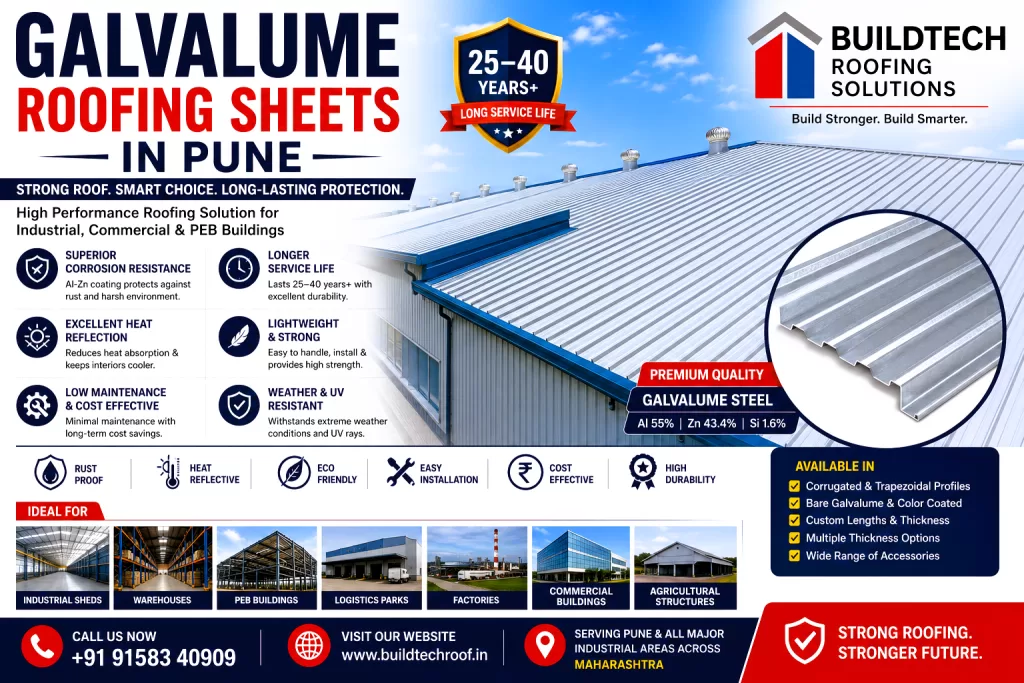
📖 Introduction Industrial and commercial buildings require roofing systems capable of withstanding harsh weather conditions, moisture, industrial pollution, temperature fluctuations, and long-term structural demands. Traditional galvanised roofing sheets offer good performance, but modern industrial projects increasingly prefer Galvalume Roofing Sheets due to their superior corrosion resistance, longer lifespan, and better thermal performance. Galvalume Roofing Sheets are widely used in factories, warehouses, industrial sheds, logistics parks, manufacturing facilities, agricultural structures, and Pre-Engineered Buildings (PEB). Buildtech Roofing Solutions supplies premium-quality Galvalume Roofing Sheets in Pune and across Maharashtra, helping industries achieve stronger, more durable, and cost-effective roofing systems. What Are Galvalume Roofing Sheets? Galvalume Roofing Sheets are steel roofing sheets coated with a special alloy consisting of: 55% Aluminum Provides superior corrosion resistance. 43.4% Zinc Offers sacrificial protection against rust. 1.6% Silicon Improves coating adhesion and durability. This advanced metallic coating delivers significantly better protection than conventional galvanised roofing sheets. How Galvalume Roofing Sheets Work The aluminium-zinc coating acts as a protective barrier against environmental exposure. Aluminum Layer Protects sheet surfaces from oxidation. Zinc Layer Provides sacrificial protection when scratches occur. Silicon Layer Improves coating stability and bonding. Together, these layers create exceptional durability and weather resistance. Why Choose Galvalume Roofing Sheets? Industrial facilities require roofing systems that can withstand: Galvalume roofing systems offer outstanding performance under these conditions. Key Benefits of Galvalume Roofing Sheets 1. Superior Corrosion Resistance One of the biggest advantages. Galvalume roofing sheets provide: Compared to standard galvanised sheets. 2. Longer Service Life Under normal conditions, Galvalume roofing can last: 25–40 Years+ Depending on installation and environmental conditions. 3. Excellent Heat Reflection The aluminium content reflects solar radiation effectively. Benefits: 4. Lightweight Construction Advantages include: 5. High Strength Suitable for: 6. Low Maintenance Galvalume sheets require significantly less maintenance than traditional roofing systems. 7. Cost-Effective Over Time While initial costs may be slightly higher, long-term savings include: Types of Galvalume Roofing Sheets Bare Galvalume Sheets Natural metallic finish. Benefits: Colour Coated Galvalume Sheets Additional paint coating provides: Corrugated Galvalume Sheets Traditional roofing profile. Advantages: Trapezoidal Galvalume Sheets Most commonly used in industrial projects. Benefits: Applications of Galvalume Roofing Sheets Industrial Sheds Ideal for manufacturing facilities. Warehouses Provides long-lasting roof protection. PEB Buildings Widely used in pre-engineered structures. Logistics Centers Supports large-span roofing systems. Commercial Buildings Combines durability and appearance. Agricultural Structures Suitable for farm buildings and storage units. Factories Resists industrial environmental conditions. Infrastructure Projects Airports, terminals, industrial parks, and public facilities. The Galvalume vs Galvanised Roofing Sheets Feature Galvalume Galvanized Corrosion Resistance Excellent Good Lifespan Longer Moderate Heat Reflection Higher Lower Maintenance Lower Moderate Cost Slightly Higher Lower Galvalume generally provides superior long-term performance. The Galvalume vs Colour Coated Roofing Sheets Feature Galvalume Color Coated Corrosion Resistance Excellent Excellent Appearance Metallic Finish Multiple Colors Heat Reflection Excellent Good Maintenance Low Low The Galvalume vs Aluminium Roofing Feature Galvalume Aluminum Strength Higher Moderate Cost Lower Higher Corrosion Resistance Excellent Excellent Structural Performance Excellent Good Importance of Proper Roof Design Proper roofing design ensures: Installation Process Step-1 – Site Inspection Assess project requirements. Step-2 – Material Selection Choose a suitable profile and thickness. Step-3 – Structural Preparation Prepare purlins and support systems. Step-4 – Sheet Installation Align sheets according to design. Step-5 – Fastener Installation Use approved roofing fasteners. Step-6 – Ridge & Flashing Installation Complete waterproof detailing. Step-7 – Final Inspection Verify installation quality. Common Problems Solved by Galvalume Roofing Rust Formation Advanced coating resists corrosion. Roof Leakage Proper installation improves weather protection. High Maintenance Costs Long-lasting roofing reduces repairs. Heat Buildup Reflective surface reduces roof temperatures. Maintenance Tips Cost of Galvalume Roofing Sheets in Pune Pricing depends on: Approximate Cost Range ₹90 – ₹280 per sq.ft Actual project pricing varies according to specifications. Why Choose Buildtech Roofing Solutions? Our Advantages Industries Served Service Areas Serving All Over Maharashtra PuneMumbaiNagpurNashikKolhapurSataraSangliAhmednagarAurangabadSolapurAmravatiJalgaonRatnagiriThane And All Major Industrial Zones Across Maharashtra Frequently Asked Questions What are Galvalume Roofing Sheets? Galvalume roofing sheets are steel sheets coated with aluminium, zinc, and silicon for superior corrosion protection. Are Galvalume Sheets better than galvanised sheets? Yes. Galvalume sheets generally offer longer lifespan, better corrosion resistance, and improved heat reflectivity. Can Galvalume Roofing be used in coastal areas? Yes. Galvalume performs well in many corrosive environments and is widely used for industrial applications. What thicknesses are available? Common thicknesses range from 0.40 mm to 0.60 mm, depending on project requirements. Conclusion Galvalume Roofing Sheets have become one of the most trusted roofing solutions for modern industrial and commercial buildings. Their exceptional corrosion resistance, heat-reflective properties, long service life, and low maintenance requirements make them a smart investment for businesses seeking reliable and cost-effective roofing systems. For premium-quality Galvalume Roofing Sheets in Pune, choose Buildtech Roofing Solutions for products engineered to deliver durability, efficiency, and long-term value. Serving Pune and all major industrial regions across Maharashtra.

Galvalume Roofing Sheets in Pune | Industrial Roofing Solutions Read More »

©2023 buildtechroof. All Rights Reserved.