Buildtechroof

Build Stronger Structures with Premium C Purlins from Buildtech Roofing Solutions

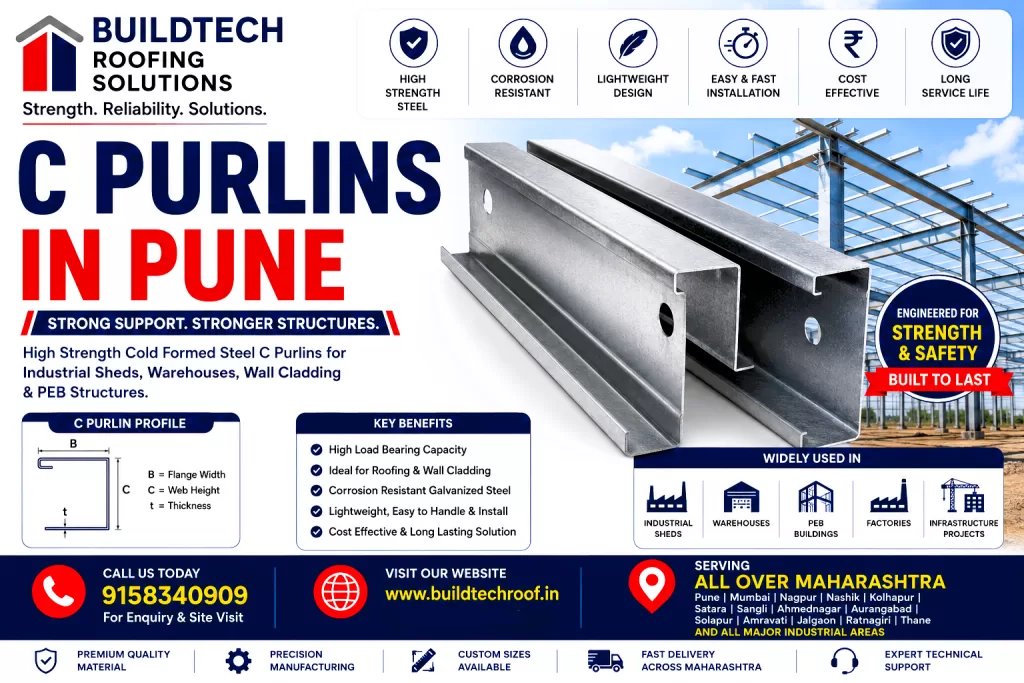
C Purlins in Pune | High Strength Structural Steel Support Systems

📖 Introduction Modern industrial construction demands structural components that are durable, lightweight, cost-effective, and easy to install. Whether it’s a warehouse, factory, industrial shed, logistics centre, commercial building, or PEB structure, a strong support framework is essential for long-term stability. One of the most widely used secondary structural members in steel construction is the C Purlin. C Purlins provide excellent support for roofing systems, wall cladding, mezzanine floors, and structural framing applications. Their versatility and strength make them an integral component of industrial and commercial building projects. Buildtech Roofing Solutions supplies premium-quality galvanised steel C Purlins in Pune and across Maharashtra, delivering reliable structural support solutions for modern construction requirements. What Are C Purlins? C Purlins are cold-formed steel sections shaped like the letter “C”. They are manufactured from galvanised steel coils using precision roll-forming technology. These structural members are primarily used for: They help distribute loads from roofing and wall systems to the primary structural framework. Why Are C Purlins Important? Industrial buildings are exposed to: C Purlins help: Without properly designed purlins, roofing systems may experience sagging, excessive deflection, and reduced lifespan. Design of C Purlins The unique C-shaped profile provides: Structural Benefits The symmetrical design makes C Purlins suitable for a wide range of building applications. Manufacturing Process Step-1 – Steel Coil Selection Premium galvanised steel coils are selected. Step-2 – Roll Forming Cold-forming machines create precise profiles. Step-3 – Hole Punching Bolt holes are created according to specifications. Step-4 – Length Cutting Custom lengths are manufactured. Step-5 – Quality Inspection Dimensions and coating thickness are verified. Types of C Purlins Standard C Purlins Most common industrial application. Suitable for: Heavy-Duty C Purlins Designed for: Galvanised C Purlins Feature zinc coating for corrosion protection. Benefits: Custom C Purlins Available in customised: Key Benefits of C Purlins 1. High Structural Strength C Purlins provide excellent support capacity. Benefits: 2. Lightweight Construction Cold-formed steel reduces overall building weight. Advantages: 3. Corrosion Resistance Galvanised coating protects against: 4. Cost-Effective Optimised steel usage reduces project costs. Benefits: 5. Easy Installation Simple profile design supports fast assembly. 6. Long Service Life Properly installed C Purlins provide decades of performance. 7. Low Maintenance Require minimal upkeep after installation. Applications of C Purlins Industrial Sheds Supports roofing systems and wall cladding. Warehouses Provides structural framing support. Commercial Buildings Used in modern steel structures. PEB Buildings Important secondary structural member. Mezzanine Floors Provides additional floor support. Agricultural Buildings Poultry farms, storage sheds, and agricultural structures. Infrastructure Projects Industrial parks, transportation facilities, and public structures. C Purlins in PEB Buildings Pre-Engineered Buildings commonly use C Purlins for: Benefits include: The C Purlins vs Z Purlins Feature C Purlins Z Purlins Shape C Section Z Section Installation Easy Moderate Wall Cladding Excellent Good Overlapping Limited Excellent Span Capacity Moderate Higher The C Purlins vs Traditional Steel Sections Feature C Purlins Conventional Steel Weight Lower Higher Cost Lower Higher Installation Faster Slower Corrosion Resistance Better Depends on Coating Load Considerations Proper C Purlin design considers: Dead Loads Roofing materials. Live Loads Maintenance personnel. Wind Loads Critical for industrial buildings. Rainwater Loads Especially during monsoon seasons. Equipment Loads Ventilation systems and accessories. Installation Process Step-1 – Structural Layout Review structural drawings. Step-2 – Positioning Place purlins according to design. Step-3 – Alignment Ensure proper spacing and level. Step-4 – Fastening Secure using approved bolts and connections. Step-5 – Final Inspection Verify structural alignment and installation quality. Common Problems Solved by C Purlins Roof Instability Provides reliable structural support. Wall Cladding Support Issues Acts as an effective wall girt. Excessive Structural Weight Lightweight steel profile reduces dead load. High Construction Costs Cost-effective steel solution. Maintenance Tips Cost of C Purlins in Pune Pricing depends on: Approximate Cost Range ₹70 – ₹180 per kg Actual project pricing depends on specifications and volume. Why Choose Buildtech Roofing Solutions? Our Advantages Industries Served Service Areas Serving All Over Maharashtra PuneMumbaiNagpurNashikKolhapurSataraSangliAhmednagarAurangabadSolapurAmravatiJalgaonRatnagiriThane And All Major Industrial Zones Across Maharashtra Frequently Asked Questions What is a C Purlin? A C Purlin is a cold-formed steel structural section shaped like the letter “C” used for roof support, wall cladding, and framing systems. Where are C Purlins used? They are commonly used in industrial sheds, warehouses, commercial buildings, agricultural structures, and PEB buildings. Are galvanised C Purlins rust-resistant? Yes. Galvanised coatings provide excellent corrosion resistance and longer service life. What is the difference between C and Z Purlins? C Purlins are typically used for wall girts and framing support, while Z Purlins are preferred for larger roof spans due to their overlapping capability. Conclusion C Purlins are among the most reliable and versatile structural support systems used in modern construction. Their lightweight design, high strength, corrosion resistance, and ease of installation make them an ideal choice for industrial sheds, warehouses, commercial buildings, and PEB structures. For premium-quality C Purlins in Pune, trust Buildtech Roofing Solutions to provide engineered steel support systems that deliver strength, durability, and long-term value. Contact Buildtech Roofing Solutions 📞 +91 91583 40909 [🌐 www.buildtechroof.in ] 📍 Serving Pune & All Major Industrial Areas Across Maharashtra

C Purlins in Pune | High Strength Structural Steel Support Systems Read More »
Z purlins for robust industrial structures

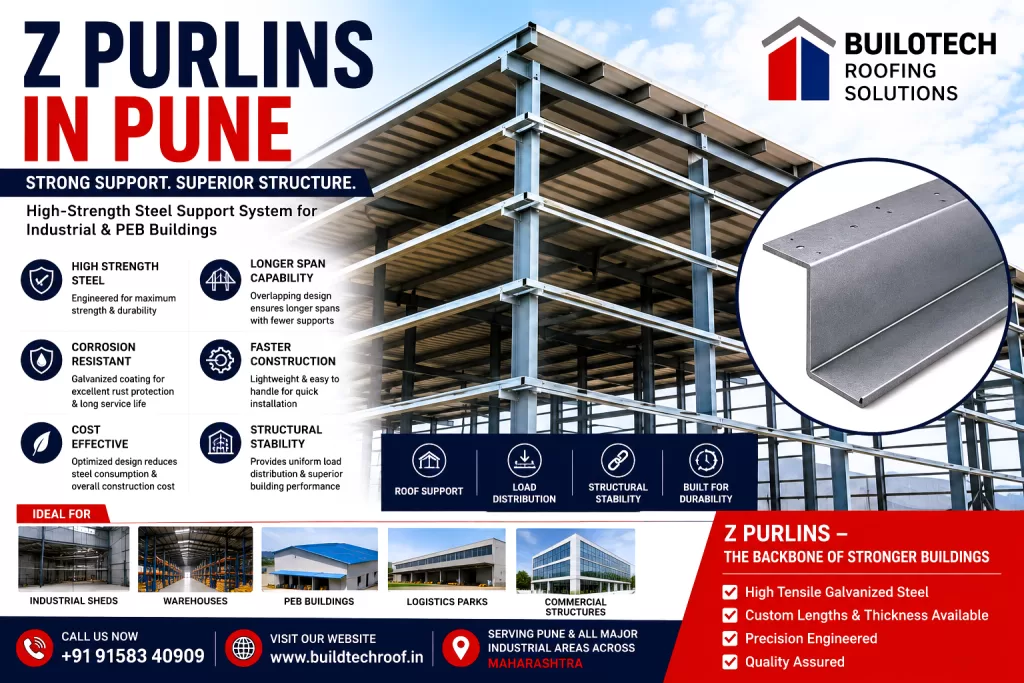
Z Purlins High Strength Structural Steel Roofing Support Systems

📖 Introduction In modern industrial construction, structural efficiency, durability, and cost optimisation are critical factors. Industrial sheds, warehouses, factories, logistics centres, and Pre-Engineered Buildings (PEB) require robust secondary structural members capable of supporting roofing systems under various load conditions. Among the most widely used structural members in industrial roofing systems are Z Purlins. Z Purlins provide excellent load-bearing performance, long-span capabilities, and superior structural efficiency, making them the preferred choice for industrial and commercial construction projects. Buildtech Roofing Solutions supplies premium-quality galvanised steel Z Purlins in Pune and across Maharashtra, helping industries build stronger, safer, and more durable structures. What Are Z Purlins? Z Purlins are cold-formed steel structural members shaped like the letter “Z”. They are installed horizontally between primary steel frames and roofing systems. Their main purpose is to support: Z Purlins transfer roof loads safely to the primary structural framework. Why Are Z Purlins Important? Industrial buildings are exposed to: Without proper purlin support: Z Purlins ensure: Design of Z Purlins The Z-shaped profile offers several engineering advantages. Unique Features The overlapping feature is one of the primary reasons Z Purlins are preferred in large industrial projects. Manufacturing Process Step-1 – Raw Material Selection Premium galvanised steel coils are selected. Step-2 – Roll Forming Steel passes through precision roll-forming machines. Step-3 – Profile Formation The Z-shape is manufactured according to engineering specifications. Step-4 – Punching Bolt holes are created for installation. Step-5 – Quality Inspection Dimensions and coating thickness are verified. Types of Z Purlins Standard Z Purlins Most commonly used. Applications: Heavy Duty Z Purlins Designed for: Galvanised Z Purlins Features a protective zinc coating. Benefits: Custom Z Purlins Manufactured according to project requirements. Available in customised: Key Benefits of Z Purlins 1. Longer Span Capability One of the biggest advantages of Z Purlins. Benefits: 2. Overlapping Design Z Purlins can overlap at supports. Advantages: 3. Lightweight Structure Cold-formed steel reduces overall building weight. Benefits: 4. High Strength Provides excellent resistance against: 5. Corrosion Resistance Galvanised coating protects against: 6. Cost-Effective Optimised design reduces steel consumption. 7. Faster Construction Factory-manufactured components simplify installation. Applications of Z Purlins Industrial Sheds Supports roofing systems effectively. Warehouses Ideal for long-span warehouse roofs. Manufacturing Plants Provides structural roofing support. Logistics Parks Used extensively in large distribution centres. PEB Buildings One of the most important structural components. Commercial Buildings Supports steel roofing systems. Infrastructure Projects Airports, terminals, industrial parks, and transportation facilities. Z Purlins in PEB Buildings Pre-Engineered Buildings heavily rely on Z Purlins. Benefits include: The Z Purlins vs C Purlins Feature Z Purlin C Purlin Shape Z Section C Section Overlapping Yes Limited Span Capacity Higher Moderate Structural Efficiency Excellent Good Large Buildings Ideal Suitable Z Purlins are generally preferred for larger industrial structures. Z Purlins vs Traditional Steel Sections Feature Z Purlin Conventional Steel Weight Lower Higher Installation Faster Slower Cost Lower Higher Corrosion Protection Better Depends on Coating Load Considerations Proper Z Purlin design considers: Dead Loads Roofing sheets and accessories. Live Loads Maintenance personnel. Wind Loads Critical for industrial buildings. Rainwater Loads Important during monsoon conditions. Equipment Loads Solar systems, ventilators, and skylights. Installation Process Step-1 – Structural Layout Review engineering drawings. Step-2 – Positioning Place purlins according to design. Step-3 – Alignment Ensure proper spacing. Step-4 – Fastening Secure using approved bolts. Step-5 – Overlapping Connect overlapping sections where required. Step-6 – Roofing Installation Install roofing sheets over purlins. Common Problems Solved by Z Purlins Roof Sagging Provides strong structural support. Uneven Load Distribution Improves roof stability. Excessive Structural Weight Lightweight design reduces dead load. High Construction Costs Reduces steel usage and installation time. Maintenance Tips Z Purlins require minimal maintenance. Recommended checks: Cost of Z Purlins in Pune Pricing depends on: Approximate Cost Range ₹75 – ₹190 per kg Project pricing varies according to specifications. Why Choose Buildtech Roofing Solutions? Our Advantages Industries Served Service Areas Serving All Over Maharashtra PuneMumbaiNagpurNashikKolhapurSataraSangliAhmednagarAurangabadSolapurAmravatiJalgaonRatnagiriThane And All Major Industrial Zones Across Maharashtra Frequently Asked Questions What is a Z Purlin? A Z Purlin is a cold-formed galvanised steel structural member shaped like the letter “Z” used to support roofing systems. Why are Z Purlins preferred in industrial buildings? They offer longer spans, overlapping capability, and better structural efficiency. Are galvanised Z Purlins rust-resistant? Yes. The galvanised coating provides excellent corrosion protection. Can Z Purlins support solar panels? Yes. Properly designed Z Purlin systems can support rooftop solar installations. Conclusion Z Purlins have become an essential structural component in modern industrial and commercial construction. Their ability to provide superior load distribution, longer spans, reduced structural weight, and cost-effective performance makes them the preferred choice for warehouses, factories, logistics parks, and PEB buildings. For premium-quality Z Purlin in Pune, trust Buildtech Roofing Solutions to deliver engineered structural support systems designed for strength, durability, and long-term performance. Contact Buildtech Roofing Solutions 📞 +91 91583 40909 || 🌐 www.buildtechroof.in 📍 Serving Pune & All Major Industrial Areas Across Maharashtra

Z Purlins High Strength Structural Steel Roofing Support Systems Read More »

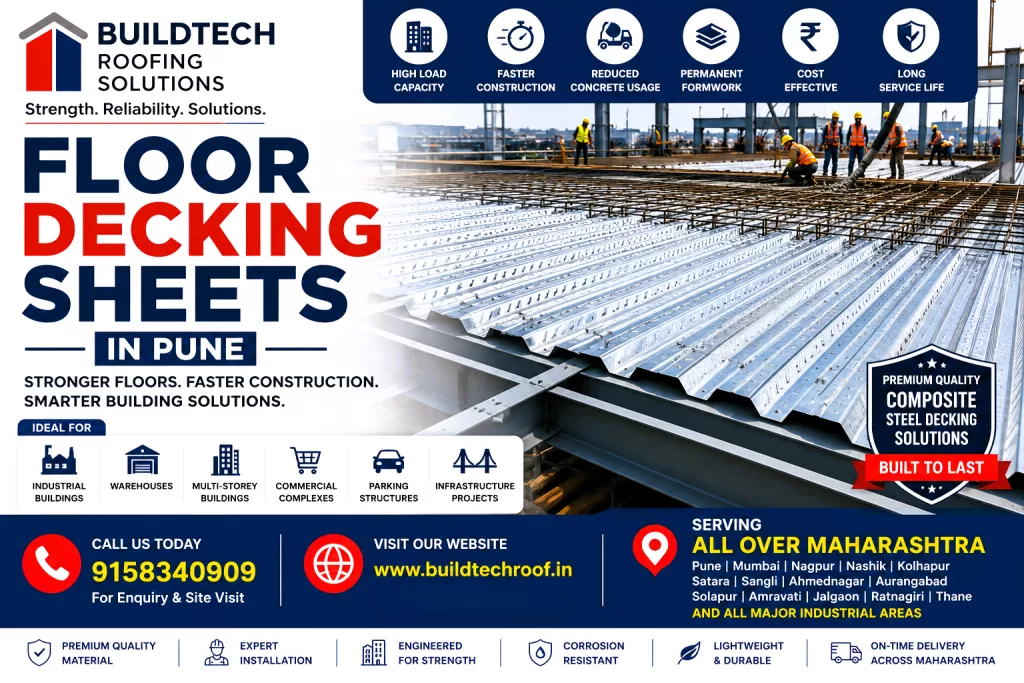
Floor Decking Sheets in Pune | Composite Steel Decking Solutions

Floor Decking Sheets in Pune Product Guide

📖 Introduction Modern construction projects demand faster execution, lower structural costs, and stronger building systems. Traditional slab construction methods often require extensive shuttering, labour, and construction time. Floor Decking Sheets have revolutionised the construction industry by providing a faster and more efficient flooring solution. Widely used in industrial buildings, commercial complexes, warehouses, parking structures, hospitals, educational institutions, and multi-storey buildings, floor decking sheets improve structural performance while reducing project timelines. Buildtech Roofing Solutions supplies premium Floor Decking Sheets in Pune and across Maharashtra for industrial and commercial construction projects. What Are Floor Decking Sheets? Floor decking sheets are specially profiled galvanised steel sheets used as permanent formwork and reinforcement support for reinforced concrete slabs. Once concrete is poured, the decking sheet and concrete work together as a composite slab system. This creates: How Floor Decking Sheets Work The profiled steel deck acts as: Permanent Shuttering No need for conventional plywood shuttering. Reinforcement Support Supports wet concrete during construction. Composite Action After curing, steel and concrete function together structurally. Benefits include: Components of a Floor Decking System Steel Deck Sheet Profiled galvanised steel. Shear Connectors Create a composite action between steel and concrete. Reinforcement Mesh Additional reinforcement where required. Concrete Slab Provides structural floor strength. Supporting Beams Transfer loads to the building framework. Key Benefits of Floor Decking Sheets 1. Faster Construction One of the biggest advantages. Construction time can be reduced significantly compared to conventional slab systems. Benefits: 2. Reduced Shuttering Cost Traditional slab construction requires extensive formwork. Deck sheets act as permanent shuttering. Result: 3. High Structural Strength Composite slabs offer: 4. Reduced Concrete Consumption Optimised slab design lowers concrete usage. Benefits: 5. Lightweight Construction Compared to conventional systems. Advantages: 6. Improved Safety Provides stable working platforms during construction. 7. Long Service Life Galvanised steel protects against corrosion and environmental damage. Types of Floor Decking Sheets Composite Decking Sheets Most commonly used. Features: Non-Composite Decking Sheets Used primarily as permanent shuttering. Applications: Galvanised Floor Deck Sheets Corrosion-resistant steel coating. Ideal for industrial projects. Heavy-Duty Decking Sheets Designed for: Applications of Floor Decking Sheets Industrial Buildings Factories and manufacturing units. Warehouses Large-span floor systems. Commercial Complexes Shopping centres and offices. Multi-Storey Buildings Fast construction and reduced weight. Hospitals Efficient structural systems. Educational Institutions Cost-effective floor construction. Parking Structures High load-bearing capability. Infrastructure Projects Airports, railway stations, and public buildings. Floor Decking Sheets vs Conventional Slab Construction Feature Floor Decking Conventional Slab Construction Speed Fast Slow Shuttering Requirement Minimal High Labor Requirement Lower Higher Concrete Usage Reduced Higher Structural Efficiency High Moderate Floor Decking Sheets vs RCC Slabs Feature Decking System RCC Slab Weight Lower Higher Construction Time Faster Slower Cost Efficiency Better Moderate Structural Performance High High Importance of Proper Deck Design Proper decking design ensures: Installation Process Step-1 – Structural Planning Review building design and load requirements. Step-2 – Deck Sheet Placement Position sheets on supporting beams. Step-3 – Fastening Secure sheets properly. Step-4 – Shear Connector Installation Install composite action connectors. Step-5 – Reinforcement Placement Position reinforcement mesh. Step-6 – Concrete Pouring Apply a concrete slab. Step-7 – Curing & Inspection Verify structural integrity. Common Problems Solved Long Construction Timelines Accelerates project completion. High Labor Costs Reduces manpower requirements. Excessive Shuttering Costs Eliminates temporary formwork. Heavy Structural Loads Provides lighter floor systems. Maintenance Tips Floor decking systems require minimal maintenance. Recommended: Cost of Floor Decking Sheets in Pune Pricing depends on: Approximate Cost Range ₹80 – ₹280 per sq.ft Project pricing varies according to specifications and volume. Why Choose Buildtech Roofing Solutions? Our Advantages Industries Served Service Areas Serving All Over Maharashtra PuneMumbaiNagpurNashikKolhapurSataraSangliAhmednagarAurangabadSolapurAmravatiJalgaonRatnagiriThane And All Major Industrial Zones Across Maharashtra

Floor Decking Sheets in Pune Product Guide Read More »

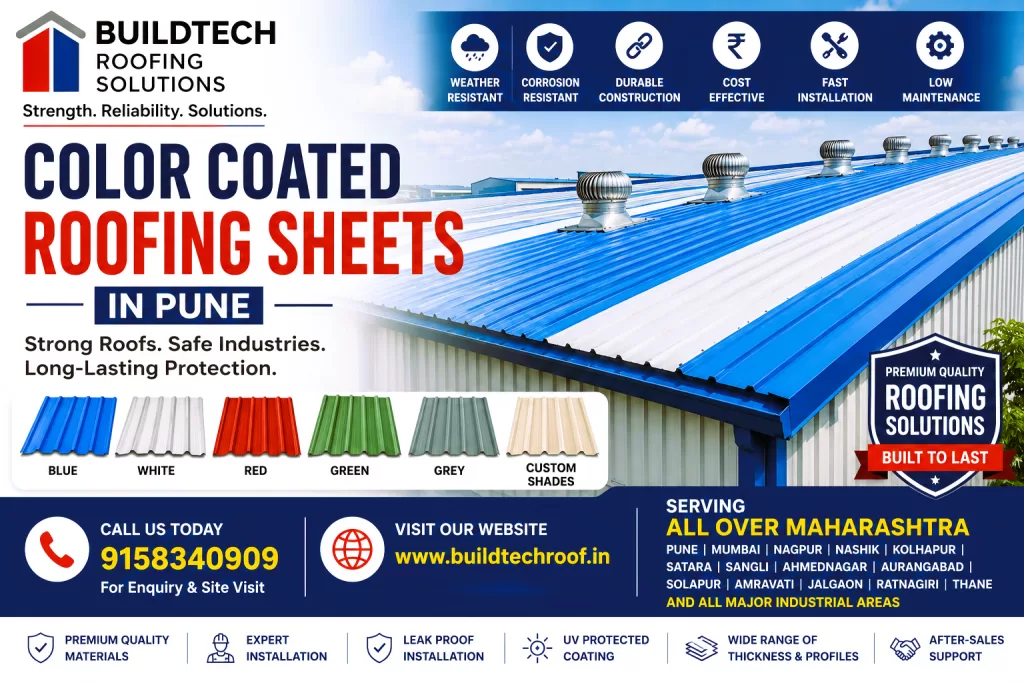
Color Coated Roofing Sheets in Pune

Colour Coated Roofing Sheets in Pune | Industrial & Commercial Roofing Solutions

📖 Introduction Industrial and commercial buildings require roofing systems that are durable, weather-resistant, cost-effective, and visually appealing. Traditional roofing materials often face challenges such as corrosion, leakage, fading, and frequent maintenance. Colour Coated Roofing Sheets have become one of the most preferred roofing solutions for factories, warehouses, industrial sheds, commercial buildings, logistics centres, and agricultural structures. These sheets combine structural strength with protective coatings that enhance durability and appearance while reducing maintenance requirements. Buildtech Roofing Solutions provides premium Colour Coated Roofing Sheets in Pune and across Maharashtra, delivering long-lasting roofing systems designed for industrial performance. What Are Colour Coated Roofing Sheets? Colour-coated roofing sheets are steel or metal roofing sheets coated with protective paint systems and corrosion-resistant layers. The coating protects the metal from: They are widely used in industrial and commercial construction due to their excellent lifespan and low maintenance. Manufacturing Process A typical colour-coated roofing sheet consists of: Base Metal Protective Layers These layers provide superior protection and aesthetics. Key Benefits of Colour Coated Roofing Sheets 1. Excellent Corrosion Resistance Protective coatings help prevent rust formation. Ideal for: 2. Long Service Life Quality roofing sheets can last: 15–30 Years+ Depending on maintenance and environment. 3. Weather Resistance Designed to withstand: 4. Lightweight Construction Benefits include: 5. Attractive Appearance Available in multiple colours: Suitable for modern industrial architecture. 6. Low Maintenance Protective coatings reduce maintenance requirements significantly. 7. Cost-Effective Roofing Solution Offers excellent value through: Types of Colour Coated Roofing Sheets Corrugated Roofing Sheets Most commonly used industrial profile. Benefits: Trapezoidal Roofing Sheets Widely used for: Advantages: Standing Seam Roofing Sheets Premium roofing solution. Benefits: Tile Profile Roofing Sheets Used for: Materials Used Galvanised Roofing Sheets Affordable and durable. Galvalume Roofing Sheets Superior corrosion resistance. Contains: Aluminium Roofing Sheets Advantages: Applications Industrial Sheds Warehouses Manufacturing Plants PEB Buildings Commercial Buildings Logistics Parks Agricultural Structures Institutional Buildings Colour Coated Roofing Sheets vs Traditional Roofing Feature Colour Coated Sheets Conventional Roofing Corrosion Resistance Excellent Moderate Appearance Attractive Standard Maintenance Low Higher Lifespan Long Moderate Installation Fast Slower Colour Coated Roofing Sheets vs PUF Panels Feature Colour Coated Sheets PUF Panels Cost Lower Higher Insulation Limited Excellent Weight Light Moderate Energy Efficiency Moderate High Importance of Proper Roof Design A properly designed roofing system helps: Installation Process Step-1 – Site Inspection Analyse roofing requirements. Step-2 – Material Selection Choose a suitable profile and thickness. Step-3 – Structural Preparation Prepare purlins and supports. Step-4 – Sheet Placement Align sheets properly. Step-5 – Fastener Installation Secure sheets using approved fasteners. Step-6 – Ridge & Flashing Installation Complete waterproof detailing. Step-7 – Final Inspection Verify installation quality. Common Problems Solved Roof Leakage Proper installation reduces leakage risk. Rust Formation Protective coatings prevent corrosion. High Maintenance Costs Long-lasting materials reduce repairs. Poor Building Appearance Modern colours improve aesthetics. Maintenance Tips Cost of Colour Coated Roofing Sheets in Pune Pricing depends on: Approximate Cost Range ₹90 – ₹290 per sq.ft Actual project costs vary based on specifications. Why Choose Buildtech Roofing Solutions? Our Advantages Industries Served Service Areas Serving All Over Maharashtra

Colour Coated Roofing Sheets in Pune | Industrial & Commercial Roofing Solutions Read More »

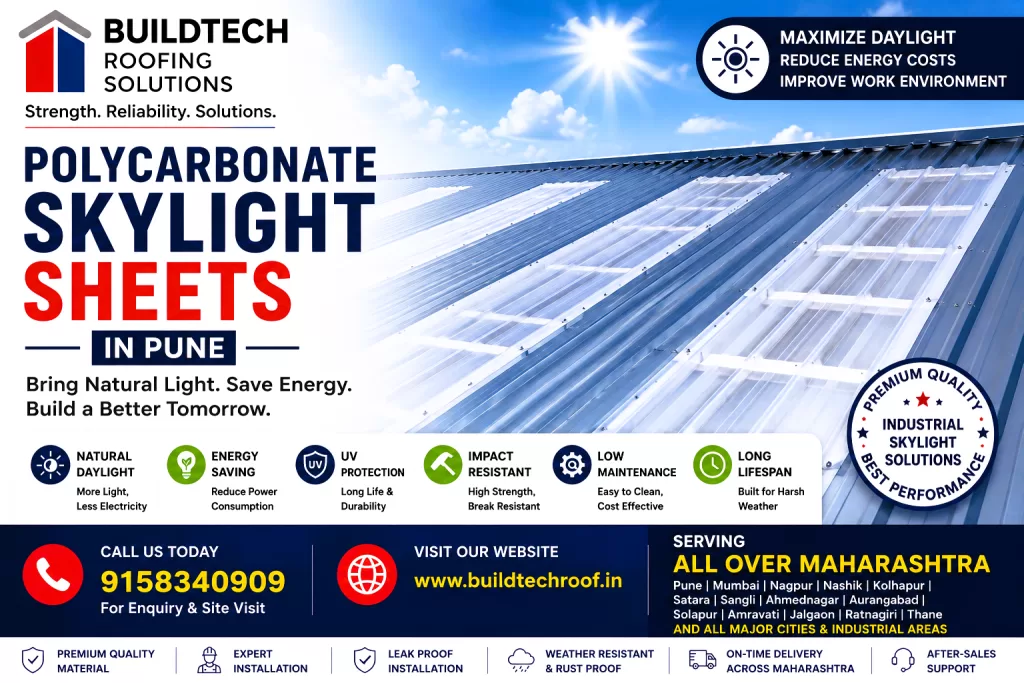
Polycarbonate Skylight Sheets in Pune

Polycarbonate Skylight Sheets in Pune

📖 Introduction Modern industrial and commercial buildings increasingly focus on energy efficiency, sustainability, and employee well-being. One of the biggest challenges faced by factories and warehouses is maintaining adequate lighting without increasing electricity consumption. Traditional buildings rely heavily on artificial lighting throughout the day, leading to higher operating costs and increased energy usage. Polycarbonate Skylight Sheets provide an effective solution by allowing natural sunlight to enter buildings while maintaining protection from weather conditions. Buildtech Roofing Solutions supplies and installs high-quality Polycarbonate Skylight Sheets in Pune and across Maharashtra, helping industries create brighter, more productive, and energy-efficient workspaces. What Are Polycarbonate Skylight Sheets? Polycarbonate skylight sheets are transparent or translucent roofing panels designed to transmit natural daylight into industrial, commercial, and residential buildings. These sheets are manufactured using high-impact polycarbonate resin and are engineered to withstand harsh weather conditions while providing excellent light transmission. How Polycarbonate Skylights Work The sheets are integrated into roofing systems and strategically positioned to maximise daylight penetration. Benefits of Natural Daylighting Key Benefits of Polycarbonate Skylight Sheets 1. Excellent Natural Light Transmission Allows up to 80–90% daylight transmission depending on sheet type. Benefits: 2. High Impact Resistance Polycarbonate is significantly stronger than glass. Advantages: 3. UV Protection Modern sheets include UV protective layers. Benefits: 4. Energy Savings Natural daylight reduces daytime lighting requirements. This helps lower: 5. Lightweight Structure Compared with glass skylights, polycarbonate sheets are lightweight and easy to install. 6. Weather Resistance Performs effectively against: 7. Low Maintenance Requires minimal upkeep while providing long-term performance. Types of Polycarbonate Skylight Sheets Solid Polycarbonate Sheets Features: Applications: Multiwall Polycarbonate Sheets Benefits: Applications: Corrugated Polycarbonate Sheets Designed to match metal roofing profiles. Advantages: Embossed Polycarbonate Sheets Provides diffused lighting while reducing glare. Applications of Polycarbonate Skylight Sheets Industrial Factories Improves natural illumination. Warehouses Enhances visibility and storage efficiency. PEB Buildings Supports modern sustainable design. Manufacturing Facilities Reduces lighting costs. Logistics Centers Creates brighter working conditions. Commercial Buildings Enhances interior appearance. Agricultural Buildings Provides natural daylight for operations. The Polycarbonate vs Glass Skylights Feature Polycarbonate Glass Weight Lightweight Heavy Impact Resistance Excellent Low Installation Easy Complex Cost Lower Higher Safety High Moderate Polycarbonate is generally preferred for industrial applications. The Polycarbonate vs FRP Skylight Sheets Feature Polycarbonate FRP Transparency Excellent Moderate Impact Resistance Excellent Good Appearance Superior Standard Cost Higher Lower UV Resistance Excellent Good Importance of Proper Skylight Design A well-designed skylight system improves: Installation Process Step-1 – Site Inspection Evaluate roof structure and daylight requirements. Step-2 – Design Planning Determine skylight locations. Step-3 – Sheet Selection Choose a suitable profile and thickness. Step-4 – Structural Preparation Prepare roofing framework. Step-5 – Installation Secure sheets using approved fasteners. Step-6 – Waterproof Sealing Ensure leak-proof performance. Step-7 – Final Inspection Verify alignment and daylight performance. Common Problems Solved Dark Interiors Increases natural lighting. High Electricity Costs Reduces artificial lighting requirements. Poor Visibility Improves workplace illumination. Outdated Building Design Enhances aesthetics and functionality. Maintenance Tips Cost of Polycarbonate Skylight Sheets in Pune Pricing depends on: Approximate Cost Range ₹120 – ₹450 per sq.ft Actual pricing depends on project specifications. Why Choose Buildtech Roofing Solutions? Our Advantages Industries Served Service Areas PuneMumbaiNagpurNashikKolhapurSataraSangliAhmednagarAurangabadSolapurAmravatiJalgaonRatnagiriThane And All Over Maharashtra Conclusion Polycarbonate Skylight Sheets are an ideal solution for industrial and commercial buildings seeking improved daylighting, lower energy costs, and enhanced workplace environments. Their durability, impact resistance, and long-term performance make them one of the most preferred skylight solutions for modern construction projects. Buildtech Roofing Solutions provides customised Polycarbonate Skylight Sheet installations across Maharashtra, helping businesses create brighter, safer, and more energy-efficient facilities.

Polycarbonate Skylight Sheets in Pune Read More »

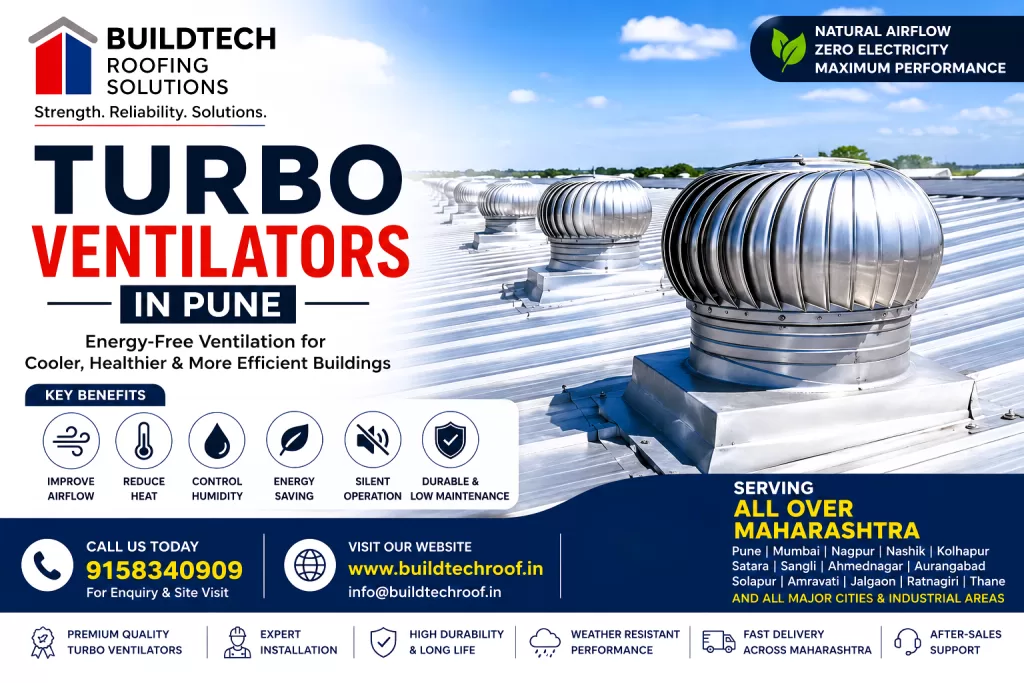
Turbo Ventilators in Pune | Industrial Roof Ventilation Solutions

Turbo Ventilators in Pune Product Guide

📖 Introduction Industrial buildings generate significant amounts of heat from machinery, manufacturing processes, lighting systems, and environmental conditions. Excessive indoor temperatures can reduce employee productivity, increase energy consumption, and negatively impact equipment performance. Modern factories and warehouses require efficient ventilation systems that remove trapped heat while maintaining continuous airflow. One of the most effective and energy-efficient ventilation solutions available today is the Turbo Ventilator System. Turbo Ventilators in Pune are widely used across factories, warehouses, logistics centres, engineering facilities, food processing plants, pharmaceutical units, and commercial buildings to improve air circulation without consuming electricity. Buildtech Roofing Solutions provides premium-quality Turbo Ventilator systems designed to improve workplace comfort, reduce heat buildup, and support sustainable industrial infrastructure across Maharashtra. What Are Turbo Ventilators? Turbo ventilators are roof-mounted ventilation devices that use natural wind energy and thermal pressure differences to remove hot air, fumes, moisture, and stale air from industrial buildings. Turbo ventilators operate without electricity, while powered exhaust systems rely on electrical energy. This distinction highlights the efficiency of turbo ventilators, as they can function effectively even in remote areas where electricity may not be available. By harnessing natural airflow, they reduce energy costs, making them an environmentally friendly choice. The choice between turbo ventilators and powered systems often depends on specific needs and available resources. The rotating turbine head creates negative pressure, pulling hot air upward and exhausting it from the building. How Turbo Ventilators Work Turbo ventilators operate using two natural principles: Wind Energy Turbo ventilators operate without electricity, unlike powered exhaust systems. Thermal Air Movement Hot air naturally rises toward the roof. The rotating ventilator extracts this accumulated hot air and releases it outside. Continuous Ventilation Cycle This creates a healthier and cooler indoor environment. Key Benefits of Turbo Ventilators 1. No Electricity Required Turbo ventilators operate completely on natural wind energy. Benefits include: 2. Significant Heat Reduction Industrial buildings often experience temperatures exceeding 50°C under metal roofs. Turbo ventilators help: 3. Improved Indoor Air Quality Removes: Resulting in a healthier workspace. 4. Reduced Humidity Humidity causes: Turbo ventilators help maintain better environmental conditions. 5. Increased Worker Productivity Comfortable temperatures contribute to: 6. Environment Friendly Turbo ventilators reduce dependence on: Supporting green building practices. 7. Low Maintenance Minimal moving components ensure: Types of Turbo Ventilators Aluminium Turbo Ventilators Most common industrial solution. Benefits: Stainless Steel Turbo Ventilators Ideal for: Advantages: Heavy-Duty Industrial Turbo Ventilators Designed for: Polycarbonate Base Turbo Ventilators Suitable for: Components of a Turbo Ventilator System Turbine Head Captures wind energy. Bearings Enable smooth rotation. Central Shaft Transfers rotational movement. Base Plate Secures the unit to roofing structures. Flashing System Provides waterproof installation. Applications of Turbo Ventilators Manufacturing Plants Removes machinery-generated heat. Warehouses Improves airflow and storage conditions. Food Processing Industries Supports hygiene and ventilation requirements. Pharmaceutical Units Maintains fresh airflow. Textile Industries Controls humidity and heat. Engineering Facilities Enhances worker comfort. Logistics Centers Improves warehouse ventilation. Commercial Buildings Supports sustainable ventilation design. The Turbo Ventilators vs Exhaust Fans Feature Turbo Ventilator Exhaust Fan Electricity No Yes Operating Cost Zero Continuous Maintenance Low Moderate Noise Silent Audible Environmental Impact Low Higher Turbo ventilators provide long-term energy savings. The Turbo Ventilators vs Ridge Ventilators Feature Turbo Ventilator Ridge Ventilator Air Extraction Excellent Excellent Wind Utilization Yes Passive Installation Point-Based Continuous Roof Ridge Cost Moderate Higher Both systems can work together for maximum ventilation. Importance of Proper Roof Ventilation Proper ventilation helps: Turbo Ventilator Installation Process Step-1 – Site Inspection Analyse roof structure and ventilation requirements. Step-2 – Ventilation Design Calculate the required ventilator quantity. Step-3 – Roof Marking Determine installation locations. Step-4 – Roof Cutting Create openings as per specifications. Step-5 – Base Installation Secure ventilator base. Step-6 – Waterproof Sealing Apply flashing and sealants. Step 7 – Final Testing Verify smooth rotation and airflow. Common Problems Solved by Turbo Ventilators Excessive Heat Continuous hot-air extraction. Poor Air Circulation Improves airflow. High Humidity Reduces moisture buildup. Condensation Issues Minimises water vapour accumulation. Employee Discomfort Creates a healthier workplace. Maintenance Tips To maximise performance: Cost of Turbo Ventilators in Pune Pricing depends on: Approximate Cost Range ₹3,500 – ₹15,000 per unit Installation charges vary based on project scope. Why Choose Buildtech Roofing Solutions? Buildtech Roofing Solutions provides customised industrial ventilation systems designed for maximum performance. Our Advantages Industries Served Service Areas PuneMumbaiNagpurNashikKolhapurSataraSangliAhmednagarAurangabadSolapurAmravatiJalgaonRatnagiriThaneAnd All Over Maharashtra Conclusion Turbo Ventilators are among the most cost-effective and energy-efficient ventilation solutions available for industrial and commercial buildings. Utilising natural wind energy removes heat, humidity, and stale air while lowering operating costs and improving workplace comfort. For businesses looking for Turbo Ventilators in Pune and across Maharashtra, Buildtech Roofing Solutions offers high-quality products, expert installation, and customised ventilation solutions tailored to industrial requirements.

Turbo Ventilators in Pune Product Guide Read More »

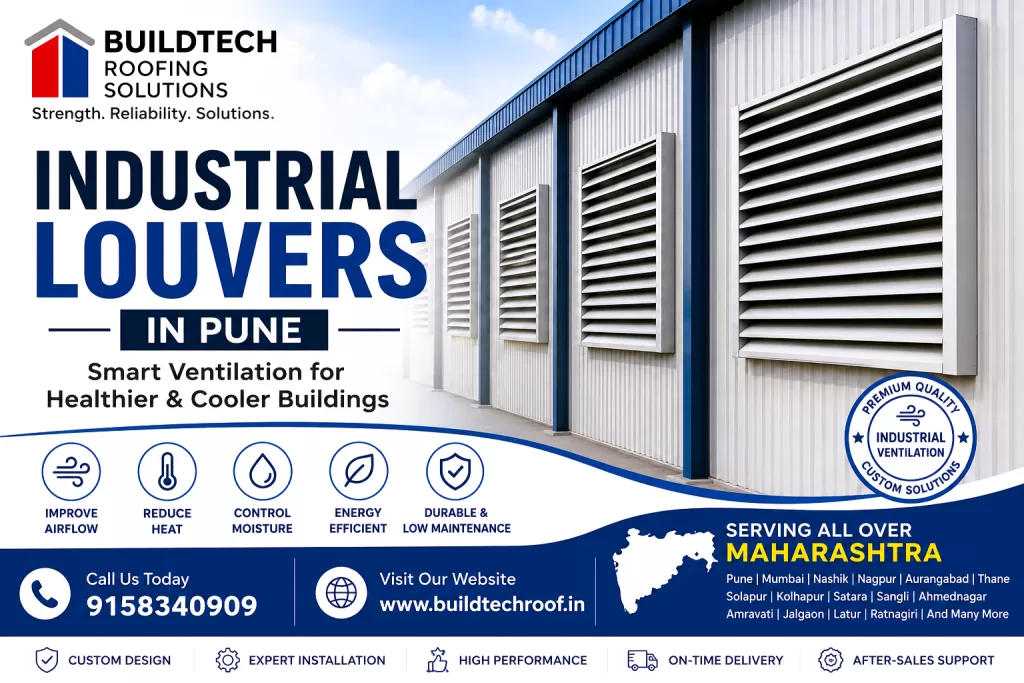
Industrial Louvers in Pune | Factory Ventilation & Airflow Solutions

Industrial Louvers Product Guide

1️⃣ Introduction Modern industrial buildings generate significant heat, humidity, fumes, dust, and airborne contaminants. Without proper ventilation, these factors can negatively impact employee comfort, machinery performance, product quality, and energy efficiency. Factories, warehouses, production units, logistics centres, pharmaceutical plants, food processing facilities, and commercial buildings require continuous airflow to maintain a healthy working environment. One of the most effective passive ventilation systems used in industrial buildings today is the Industrial Louver System. Industrial louvers in Pune are essential for modern industrial infrastructure. They improve airflow, reduce heat buildup, control moisture, and support energy-efficient building design. Buildtech Roofing Solutions provides customised industrial louver systems designed for industrial sheds, warehouses, PEB buildings, factories, and commercial facilities across Pune and Maharashtra. 2️⃣ What Are Industrial Louvers? Industrial louvers are ventilation panels installed on walls, facades, and industrial structures to allow controlled airflow while preventing rainwater, debris, birds, and insects from entering. They help buildings breathe naturally by facilitating fresh air intake and stale air exhaust. Primary Functions 3️⃣ How Industrial Louvers Work Industrial louvers operate using natural airflow principles. Fresh outside air enters through the louver openings. As hot air rises within the facility, roof ventilators and ridge ventilation systems help remove accumulated heat. This creates continuous air circulation inside the building. Airflow Cycle The result is a naturally ventilated building with reduced indoor temperatures. 4️⃣ Benefits of Industrial Louvers Improved Ventilation Louvers continuously allow fresh air to enter industrial buildings. Benefits include: Heat Reduction Industrial facilities often experience excessive heat buildup. Louvers help: Energy Savings Improved natural airflow reduces dependency on: This can significantly reduce energy costs. Moisture Control Excess moisture can cause: Louvers help remove humid air effectively. Better Air Quality Industrial operations often generate: Louvers improve indoor air quality through continuous ventilation. Weather Protection Modern louvers are engineered to: Low Maintenance Industrial louvers require minimal maintenance and provide long service life. 5️⃣ Types of Industrial Louvers Fixed Louvers Most common industrial solution. Features: Applications: Adjustable Louvers Blade angle can be modified. Advantages: Applications: Weather Louvers Designed to resist rainwater penetration. Benefits: Applications: Sand Trap Louvers Used in dusty environments. Ideal for: Acoustic Louvers Reduce noise transmission while maintaining airflow. Applications: 6️⃣ Materials Used in Industrial Louvers Galvanised Steel Louvers Benefits: Aluminum Louvers Advantages: Powder-Coated Louvers Features: Stainless Steel Louvers Used in: 7️⃣ Applications of Industrial Louvers Manufacturing Plants Provides airflow for machinery and workers. Warehouses Improves ventilation and reduces heat buildup. Food Processing Facilities Supports hygienic ventilation systems. Pharmaceutical Industries Maintains controlled air circulation. Commercial Buildings Improves occupant comfort. Power Plants Supports equipment cooling requirements. Logistics Centers Improves indoor environmental conditions. Agricultural Buildings Provides fresh airflow for livestock and storage facilities. 8️⃣ Industrial Louvers Vs Exhaust Fans Feature Industrial Louvers Exhaust Fans Energy Consumption None High Maintenance Low Moderate Operating Cost Zero Continuous Noise Silent Audible Lifespan Long Moderate Industrial louvers are ideal for passive ventilation, while exhaust fans require electrical power. 9️⃣ Industrial Louvers Vs Ridge Ventilation Feature Industrial Louvers Ridge Ventilators Installation Location Walls Roof Ridge Air Intake Excellent Limited Air Exhaust Moderate Excellent Energy Usage Zero Zero Best performance occurs when both systems work together. 🔟 Importance of Proper Ventilation Design A properly designed ventilation system helps: 1️⃣1️⃣ Industrial Louver Installation Process Step-1 – Site Assessment Evaluate building dimensions and airflow requirements. Step-2 – Ventilation Analysis Determine fresh air intake requirements. Step-3 – Louver Selection Choose a suitable material and blade design. Step-4 – Fabrication Custom manufacturing according to project specifications. Step-5 – Installation Secure mounting and weather sealing. Step-6 – Performance Testing Verify airflow performance. 1️⃣2️⃣ Common Problems Solved by Industrial Louvers Excessive Heat Improves natural cooling. Poor Ventilation Enhances airflow. Humidity Issues Reduces moisture accumulation. Employee Discomfort Creates healthier work conditions. High Energy Costs Supports passive ventilation. 1️⃣3️⃣ Maintenance Tips To maximise lifespan: 💰 Cost of Industrial Louvers in Pune Typical pricing depends on: Approximate Cost Range ₹150 – ₹600 per sq.ft Actual project costs vary according to specifications and quantity requirements. 🎯 Why Choose Buildtech Roofing Solutions Pune? Buildtech Roofing Solutions provides customised industrial ventilation systems designed for factories, warehouses, and industrial buildings. Key Advantages Industries Served Service Areas PuneMumbaiNashikSataraSangliKolhapurAhmednagarAurangabad Conclusion Industrial Louvers are one of the most effective and energy-efficient ventilation solutions available for factories, warehouses, and industrial buildings. By improving airflow, reducing heat buildup, controlling moisture, and enhancing indoor air quality, louvers contribute significantly to operational efficiency and worker comfort. For businesses seeking reliable Industrial Louvers in Pune, Buildtech Roofing Solutions offers customised, high-performance ventilation systems tailored to industrial requirements.

Industrial Louvers Product Guide Read More »

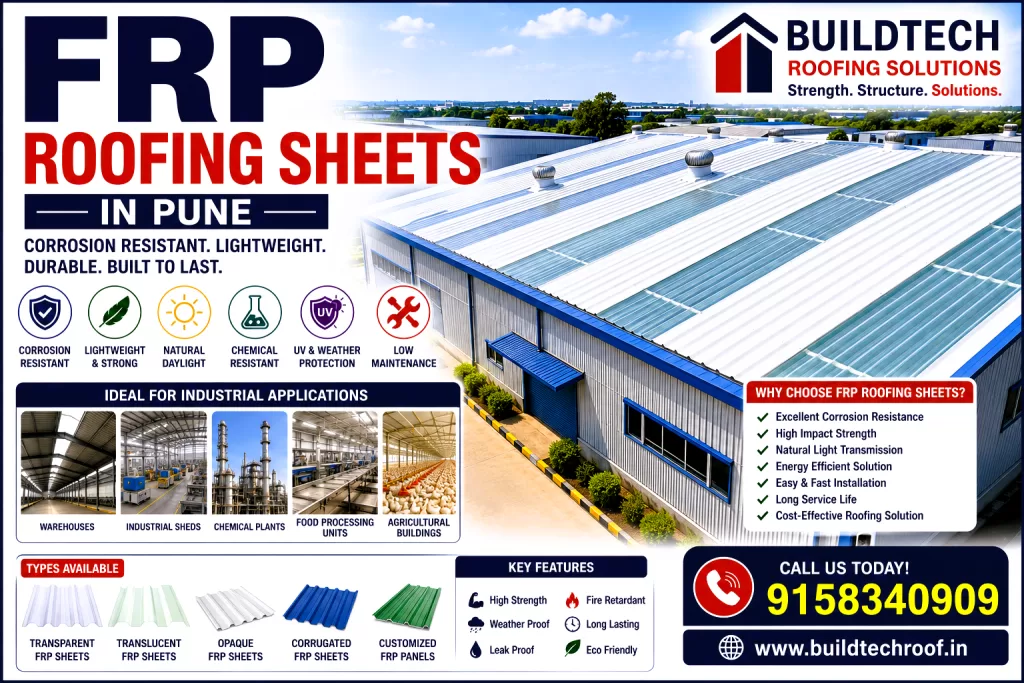
FRP Roofing Sheets in Pune | Industrial Roofing & Skylight Solutions

FRP Roofing Sheets Product Guide for Industrial Roofing Solutions

Introduction Industrial roofing systems are constantly exposed to harsh environmental conditions, including heavy rainfall, extreme temperatures, UV radiation, moisture, chemical fumes, and corrosion. Traditional roofing materials often require frequent maintenance and replacement, increasing operational costs over time. Modern industries are increasingly looking for roofing materials that offer durability, corrosion resistance, natural lighting, and long-term performance. One such advanced roofing solution is FRP Roofing Sheets. FRP (Fibre Reinforced Plastic) roofing sheets have become one of the most preferred materials for industrial sheds, warehouses, chemical plants, food processing facilities, agricultural buildings, and commercial structures. Their lightweight design, superior strength, corrosion resistance, and ability to transmit natural daylight make them an ideal choice for modern industrial roofing systems. This is where FRP Roofing Sheets Pune solutions by Buildtech Roofing Solutions provide durable, weather-resistant, and cost-effective roofing systems designed to meet industrial requirements. This comprehensive guide explains everything about FRP roofing sheets, including their composition, benefits, types, applications, installation process, maintenance requirements, and cost considerations. What Are FRP Roofing Sheets? FRP Roofing Sheets are roofing panels manufactured using Fibre Reinforced Plastic, a composite material made by combining resin with reinforcing fibres. This combination creates a strong, lightweight, and corrosion-resistant roofing material. FRP sheets are widely used where durability and resistance to environmental conditions are critical. Composition of FRP Roofing Sheets A standard FRP sheet consists of three major components: 1. Resin Matrix The resin binds the structure together and provides weather resistance. 2. Reinforcing Fibres Glass fibres provide: 3. Protective Surface Layer This layer improves: How FRP Roofing Sheets Work Unlike traditional metal roofing, FRP sheets do not corrode or rust when exposed to moisture or chemicals. They provide: ✔ Structural protection✔ Weather resistance✔ Natural daylight transmission✔ Long-term durability Their composite structure allows them to perform efficiently in harsh industrial environments. Why Industries Choose FRP Roofing Sheets Industrial buildings require roofing systems that can withstand: FRP roofing sheets address all these challenges effectively. Key Benefits of FRP Roofing Sheets 1. Excellent Corrosion Resistance One of the biggest advantages of FRP roofing sheets is their resistance to corrosion. Unlike metal roofing, FRP sheets do not rust. This makes them ideal for: 2. Lightweight Construction FRP sheets are significantly lighter than many conventional roofing materials. Benefits include: 3. Natural Daylight Transmission Transparent and translucent FRP sheets allow sunlight to enter the building. This reduces the need for artificial lighting during the daytime. 4. Chemical Resistance FRP roofing sheets are highly resistant to: This makes them suitable for aggressive industrial conditions. 5. Weather Resistance FRP sheets provide excellent protection against: 6. Long Service Life High-quality FRP roofing systems can provide reliable performance for many years. 7. Low Maintenance Minimal maintenance requirements reduce long-term operational costs. 8. High Strength-to-Weight Ratio FRP sheets offer excellent strength while remaining lightweight. Types of FRP Roofing Sheets 1. Transparent FRP Roofing Sheets These sheets are designed to maximise natural daylight. Applications 2. Translucent FRP Roofing Sheets Allow diffused light while reducing glare. Benefits 3. Opaque FRP Roofing Sheets Used where daylight transmission is not required. Features 4. Corrugated FRP Roofing Sheets The most commonly used industrial profile. Advantages 5. Customised FRP Roofing Panels Manufactured according to specific industrial requirements. Applications of FRP Roofing Sheets Industrial Sheds Provides corrosion-resistant roofing with long service life. Warehouses Allows natural daylight while maintaining structural protection. Chemical Plants Ideal due to chemical resistance properties. Food Processing Units Supports hygienic and corrosion-resistant environments. Textile Industries Provides durable roofing with reduced maintenance requirements. Agricultural Buildings Used for poultry farms, storage facilities, and agricultural sheds. Commercial Buildings Suitable for showrooms, workshops, and service centres. FRP Roofing Sheets vs Polycarbonate Sheets Feature FRP Sheets Polycarbonate Sheets Chemical Resistance Excellent Good Impact Resistance High Very High Cost Moderate Higher UV Resistance Good Excellent Industrial Usage Very High High FRP Roofing Sheets vs Metal Roofing Feature FRP Roofing Metal Roofing Corrosion Resistance Excellent Moderate Light Transmission Yes No Weight Lightweight Heavier Chemical Resistance Excellent Limited Maintenance Low Moderate Why FRP Roofing Is Better for Chemical Industries Chemical facilities often experience: FRP roofing sheets provide superior resistance compared to conventional metal roofing systems. Importance of Proper Roofing Design A well-designed roofing system improves: ✔ Drainage performance✔ Structural stability✔ Ventilation efficiency✔ Roof lifespan Poor roofing design can result in leakage and maintenance issues. FRP Roofing Sheet Installation Process Step-1 – Site Inspection Analyse structural requirements and roofing dimensions. Step-2 – Roof Structure Preparation Ensure purlins and supports are properly aligned. Step-3 – Sheet Alignment Position sheets according to the roofing layout. Step-4 – Fastener Installation Secure sheets using approved fasteners and washers. Step-5 – Waterproof Sealing Seal overlaps and joints to prevent leakage. Step-6 – Final Inspection Verify installation quality and waterproofing performance. Roofing Accessories Used with FRP Sheets A complete roofing system includes: These accessories improve roof performance and durability. Common Roofing Problems Solved by FRP Sheets Corrosion Damage FRP sheets eliminate rust-related problems. Dark Interiors Transparent FRP sheets improve natural lighting. Moisture Problems Non-corrosive surfaces resist moisture damage. Frequent Maintenance Long-lasting materials reduce repair frequency. Chemical Exposure FRP sheets withstand harsh industrial environments. Maintenance Tips for FRP Roofing Sheets Regular maintenance helps maximise service life. Recommended Practices ✔ Clean roof surfaces periodically✔ Inspect fasteners and joints✔ Check sealants annually✔ Remove debris from drainage systems✔ Replace damaged sections promptly Cost of FRP Roofing Sheets in Pune Pricing depends on: Approximate Cost Range ₹100 – ₹250 per sq.ft Actual pricing may vary based on specifications and installation requirements. Factors Affecting FRP Roofing Sheet Cost Material Quality Premium materials provide longer service life. Thickness Thicker sheets offer higher durability. UV Coating Enhanced UV protection increases performance and cost. Custom Profiles Customised sheets may have higher manufacturing costs. Why Choose Buildtech Roofing Solutions Pune Buildtech Roofing Solutions provides advanced FRP roofing systems designed for industrial and commercial applications. Key Advantages ✔ Premium-quality FRP roofing sheets✔ Expert installation team✔ Customised roofing solutions✔ Competitive pricing✔ Fast project execution✔ Industrial roofing expertise Industries Served Service Areas PuneMumbaiNashikKolhapurSangliSataraAhmednagarAurangabad Future of FRP Roofing Technology Modern industrial construction increasingly focuses on: FRP

FRP Roofing Sheets Product Guide for Industrial Roofing Solutions Read More »

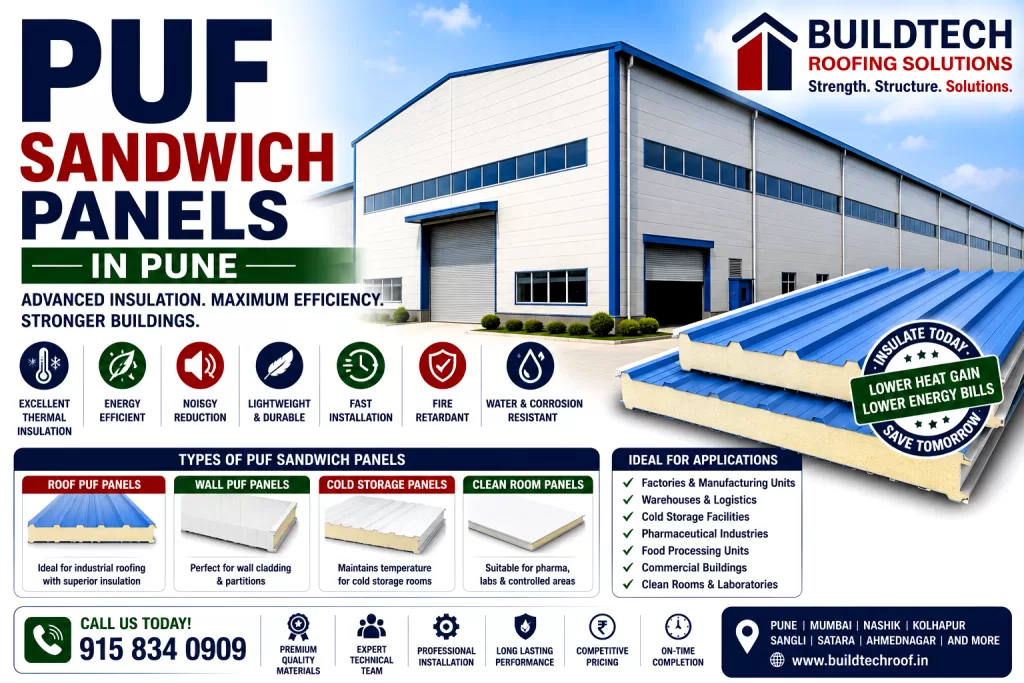
PUF Sandwich Panels Pune

PUF Sandwich Panels for Industrial Insulation

Introduction Industrial buildings today face growing challenges related to heat control, energy consumption, noise reduction, and operational efficiency. Traditional roofing and wall systems often fail to provide adequate insulation, resulting in high electricity costs, uncomfortable working conditions, and increased maintenance expenses. As industries focus on sustainability and energy savings, insulated building materials have become an essential part of modern construction. One of the most advanced and widely used insulation products is the PUF Sandwich Panel. PUF Sandwich Panels provide excellent thermal insulation, structural strength, weather resistance, and fast installation, making them a preferred choice for factories, warehouses, cold storage facilities, pharmaceutical units, food processing plants, and commercial buildings. In Pune’s rapidly expanding industrial sector, businesses are increasingly investing in insulated roofing and wall systems to improve operational efficiency and reduce long-term energy costs. This is where PUF Sandwich Panels Pune solutions by Buildtech Roofing Solutions offer high-performance insulated roofing and cladding systems tailored for industrial and commercial applications. This comprehensive guide explains everything about PUF sandwich panels, including construction, types, benefits, applications, installation methods, maintenance requirements, and cost factors. What Are PUF Sandwich Panels? PUF Sandwich Panels are insulated construction panels made using a rigid polyurethane foam (PUF) core placed between two metal sheets. The sandwich structure provides: These panels are commonly used as roofing panels, wall panels, and insulated partitions. Structure of a PUF Sandwich Panel A standard PUF sandwich panel consists of: Outer Metal Sheet Usually manufactured from: Polyurethane Foam Core The middle layer provides: Inner Metal Sheet Provides structural support and interior finishing. How PUF Panels Work Heat naturally transfers through roofs and walls. PUF insulation significantly reduces this heat transfer. As a result: ✔ Indoor temperatures remain lower✔ Cooling requirements reduce✔ Energy bills decrease✔ Comfort improves This makes PUF panels ideal for industrial and commercial buildings. Why Industries Prefer PUF Sandwich Panels Industrial buildings require: PUF panels provide all these benefits in a single system. Key Benefits of PUF Sandwich Panels 1. Excellent Thermal Insulation The polyurethane foam core acts as a thermal barrier. This reduces heat transfer significantly compared to conventional roofing materials. 2. Energy Efficiency Since less heat enters the building: This provides long-term savings. 3. Noise Reduction Industrial buildings often experience high noise levels. PUF panels help absorb sound and reduce noise transmission. 4. Lightweight Construction PUF panels are lightweight compared to traditional construction materials. Benefits include: 5. Faster Installation Large panel sizes allow quick installation. Projects can be completed much faster than conventional construction methods. 6. Weather Resistance PUF panels provide excellent protection against: 7. Long Service Life High-quality PUF panels can deliver reliable performance for many years with proper maintenance. 8. Attractive Appearance Colour-coated outer surfaces improve building aesthetics. Types of PUF Sandwich Panels 1. Roofing PUF Panels These panels are specifically designed for industrial roofing applications. Features Applications 2. Wall PUF Panels Used as insulated wall systems. Benefits 3. Cold Storage PUF Panels Designed for temperature-controlled environments. Applications 4. Clean Room Panels Used in controlled environments requiring hygiene and insulation. Applications PUF Panel Thickness Guide Selecting the correct thickness depends on insulation requirements. 30mm PUF Panels Suitable for moderate insulation applications. 50mm PUF Panels Commonly used in industrial buildings. 80mm PUF Panels Provides enhanced thermal insulation. 100mm PUF Panels Ideal for cold storage and highly temperature-sensitive applications. Applications of PUF Sandwich Panels PUF panels are widely used in: Industrial Buildings Warehouses Energy-efficient storage facilities. Cold Storage Facilities Temperature-controlled environments. Food Processing Industries Maintains hygiene and temperature control. Pharmaceutical Industries Supports clean and controlled environments. Commercial Buildings Used for roofing and wall cladding. PUF Panels vs Traditional Roofing Feature PUF Panels Traditional Roofing Thermal Insulation Excellent Low Energy Efficiency High Moderate Noise Reduction High Low Installation Speed Fast Moderate Weight Lightweight Heavier Maintenance Low Moderate Why PUF Panels Are Better Than Conventional Roofing Traditional metal roofing transfers heat quickly. PUF panels: ✔ Reduce heat transfer✔ Improve comfort✔ Lower energy bills✔ Increase building efficiency This provides substantial long-term benefits. PUF Panel Installation Process Step-1 – Site Inspection Analyse building dimensions and structural requirements. Step-2 – Structural Preparation Prepare purlins and supporting framework. Step-3 – Panel Placement Position panels according to the layout design. Step-4 – Fastener Installation Secure panels using approved fasteners. Step-5 – Joint Sealing Apply sealants to prevent air and water leakage. Step-6 – Finishing Work Install trims, flashing, and accessories. Step-7 – Final Inspection Verify alignment, sealing, and overall quality. Accessories Used with PUF Panels A complete system includes: These accessories improve waterproofing and durability. Common Problems with Poor-Quality Insulation Systems 1. Joint Leakage Improper installation can cause leakage at panel joints. 2. Heat Loss Low-quality insulation reduces thermal performance. 3. Water Ingress Poor sealing may allow moisture penetration. 4. Physical Damage Improper handling can damage panel surfaces. Maintenance Tips for PUF Sandwich Panels Although maintenance requirements are low, regular inspections improve performance. Recommended Maintenance ✔ Clean panel surfaces periodically✔ Inspect joints and sealants✔ Tighten fasteners if required✔ Check flashing and drainage systems✔ Repair damaged panels promptly Cost of PUF Sandwich Panels in Pune The cost depends on: Approximate Price Range ₹180 – ₹350 per Sq.Ft (approx.) Actual prices vary depending on specifications and project requirements. Factors Affecting PUF Panel Pricing Thickness Higher thickness provides better insulation and a higher cost. Steel Quality Premium steel improves durability. Coating Type Advanced coatings provide enhanced weather resistance. Installation Complexity Large industrial projects may require specialised installation. Why Choose Buildtech Roofing Solutions Pune Buildtech Roofing Solutions provides premium-quality insulated roofing and cladding systems for industrial and commercial buildings. Key Advantages ✔ High-quality PUF sandwich panels✔ Expert installation team✔ Customised insulation solutions✔ Competitive pricing✔ Fast project execution✔ Industrial roofing expertise Industries Served Service Areas PuneMumbaiNashikKolhapurSangliSataraAhmednagarAurangabad Future of Insulated Construction Modern construction increasingly focuses on: PUF sandwich panels are expected to remain one of the most preferred building materials for industrial and commercial construction. Conclusion PUF sandwich panels offer an ideal combination of insulation, durability, energy efficiency, and fast installation. They help industries reduce energy costs, improve indoor comfort, and enhance building performance

PUF Sandwich Panels for Industrial Insulation Read More »

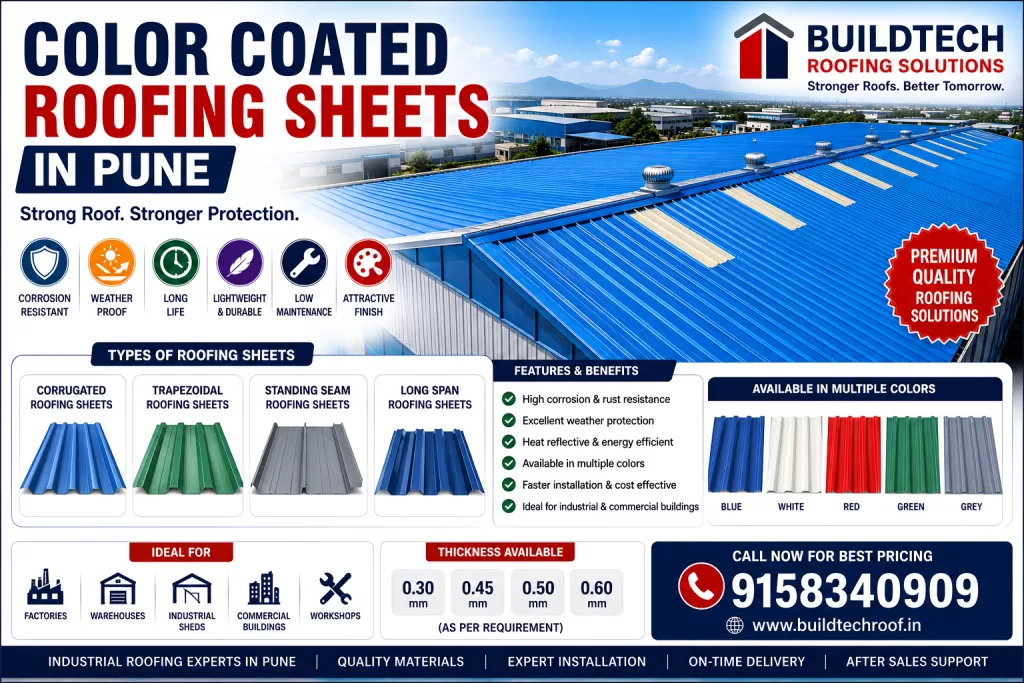
Colour Coated Roofing Sheets in Pune | Industrial Roofing Sheet Solutions

Colour Coated Roofing Sheets – Product Guide for Industrial Roofing Solutions

Introduction Industrial roofing plays a critical role in protecting factories, warehouses, commercial buildings, and industrial sheds from environmental damage, heat, rain, and corrosion. Choosing the right roofing material directly affects building durability, maintenance cost, energy efficiency, and long-term performance. Modern industries are increasingly moving toward advanced roofing systems that combine strength, aesthetics, weather resistance, and cost-effectiveness. Among the most widely preferred industrial roofing products are Colour Coated Roofing Sheets. Colour-coated roofing sheets are highly durable roofing materials manufactured using galvanised steel or galvalume steel with protective colour-coated layers that improve corrosion resistance and appearance. In Pune’s rapidly expanding industrial sector, industries require roofing systems capable of withstanding harsh weather conditions while maintaining structural performance for years. This is where Colour Coated Roofing Sheets Pune solutions by Buildtech Roofing Solutions provide advanced roofing systems designed for durability, weather protection, and industrial performance. This comprehensive guide explains everything about colour-coated roofing sheets, including types, benefits, roofing profiles, applications, installation methods, maintenance practices, and cost factors. What Are Colour Coated Roofing Sheets? Colour-coated roofing sheets are steel roofing sheets coated with protective metallic and paint layers to improve durability and corrosion resistance. These sheets are manufactured using: The sheets are further coated with specialised paint systems to provide weather protection and an attractive finish. Structure of Colour Coated Roofing Sheets A typical colour-coated roofing sheet consists of multiple protective layers: These layers enhance durability and protect the roofing sheet from corrosion and environmental damage. Why Industries Prefer Colour Coated Roofing Sheets Industrial buildings require roofing systems that are: ✔ Durable✔ Lightweight✔ Weather resistant✔ Easy to install✔ Low maintenance Colour-coated roofing sheets fulfil all these requirements efficiently. Benefits of Colour Coated Roofing Sheets 1. Excellent Corrosion Resistance The protective coating prevents rust and corrosion caused by rain, humidity, and industrial pollutants. This significantly increases roofing lifespan. 2. Long Lifespan High-quality colour-coated roofing sheets can last for many years with minimal maintenance. 3. Lightweight Structure These sheets are lightweight compared to conventional roofing systems. This reduces structural load and installation complexity. 4. Attractive Appearance Colour-coated roofing sheets are available in multiple colours and finishes that improve the appearance of industrial buildings. 5. Weather Protection These roofing systems provide excellent protection against: 6. Low Maintenance The coated surface minimises corrosion and dirt accumulation, reducing maintenance requirements. 7. Faster Installation Colour-coated roofing sheets are easy to handle and install, reducing project completion time. 8. Energy Efficiency Reflective coatings help reduce heat absorption and improve indoor comfort. Types of Colour Coated Roofing Sheet Profiles Different roofing profiles are available based on industrial requirements. 1. Corrugated Roofing Sheets Corrugated sheets feature wave-shaped profiles that improve structural strength. Features: Applications: 2. Trapezoidal Roofing Sheets Trapezoidal sheets have modern angular profiles designed for better load-bearing capacity. Benefits: Applications: 3. Standing Seam Roofing Sheets Standing seam roofing systems feature concealed fasteners for enhanced waterproofing. Features: Best For: 4. Long Span Roofing Sheets Long span roofing sheets reduce the need for multiple joints. Benefits: Roofing Sheet Thickness Guide Roofing sheet thickness affects durability, strength, and cost. 0.30 mm Roofing Sheets 0.45 mm Roofing Sheets 0.50 mm Roofing Sheets 0.60 mm Roofing Sheets Applications of Colour Coated Roofing Sheets Colour-coated roofing sheets are widely used in: Colour Coated Roofing Sheets vs GI Sheets Feature Colour Coated Roofing Sheets GI Sheets Corrosion Resistance High Medium Appearance Attractive Basic Lifespan Longer Moderate Maintenance Low Medium Heat Reflection Better Moderate Importance of Roofing Design Proper roofing design improves: ✔ Structural stability✔ Water drainage✔ Ventilation✔ Heat reduction✔ Roofing lifespan Poor roofing design can lead to leakage and maintenance issues. Industrial Roofing Installation Process Step-1 – Roof Structure Preparation Ensure purlins and support systems are aligned correctly. Step-2 – Roofing Sheet Selection Choose a suitable sheet thickness and profile. Step-3 – Sheet Alignment Proper sheet alignment ensures better waterproofing and appearance. Step-4 – Fastener Fixing Roofing sheets are fixed using specialised fasteners with waterproof washers. Step-5 – Ridge & Flashing Installation Install ridge caps and flashing systems for weather protection. Step-6 – Waterproof Sealing Seal overlaps and joints to prevent leakage. Step-7 – Final Inspection Check roofing alignment, fasteners, and waterproofing quality. Roofing Accessories Used in Installation Industrial roofing systems require: These accessories improve roofing performance and waterproofing. Common Roofing Problems 1. Leakage Improper sealing or damaged fasteners may cause leakage. 2. Corrosion Low-quality materials may rust over time. 3. Loose Fasteners Improper installation can loosen fasteners due to vibration and wind pressure. 4. Heat Buildup Metal roofs absorb heat without proper insulation. 5. Structural Damage Poor-quality roofing systems may deform under heavy load. Maintenance Tips for Colour Coated Roofing Sheets Regular maintenance improves roofing lifespan. Recommended Maintenance: Advantages of Choosing High-Quality Roofing Sheets ✔ Long-term durability✔ Reduced maintenance cost✔ Better appearance✔ Improved weather resistance✔ Faster installation✔ Better energy efficiency Cost of Colour Coated Roofing Sheets in Pune The cost depends on: Approximate Price Range: ₹80 – ₹150 per SqFt. (approx.) 💡 Note: Prices vary depending on specifications and installation requirements. Factors Affecting Roofing Sheet Cost 1. Thickness Higher thickness increases durability and price. 2. Coating Quality Premium coatings provide better corrosion resistance. 3. Roofing Profile Different profiles have different manufacturing costs. 4. Installation Complexity Large industrial projects require specialised installation systems. Why Choose Buildtech Roofing Solutions Pune Buildtech Roofing Solutions provides advanced industrial roofing systems tailored for long-term durability and industrial performance. Key Advantages: ✔ Premium quality roofing sheets✔ Expert installation team✔ Customised roofing solutions✔ Competitive pricing✔ Fast project execution✔ Industrial roofing expertise Industries Served Service Areas Pune | Mumbai | Nashik | Kolhapur | Sangli | Satara | Ahmednagar Future of Industrial Roofing Systems Industrial roofing technology is evolving with: Colour-coated roofing sheets continue to be one of the most preferred industrial roofing solutions. Conclusion Colour-coated roofing sheets provide a durable, attractive, and cost-effective roofing solution for industrial and commercial buildings. Their corrosion resistance, lightweight structure, weather protection, and long lifespan make them ideal for factories, warehouses, and industrial sheds. With Colour Coated Roofing Sheets Pune solutions by Buildtech Roofing Solutions, industries can achieve reliable, high-performance,

Colour Coated Roofing Sheets – Product Guide for Industrial Roofing Solutions Read More »

©2023 buildtechroof. All Rights Reserved.