Turbo Ventilator

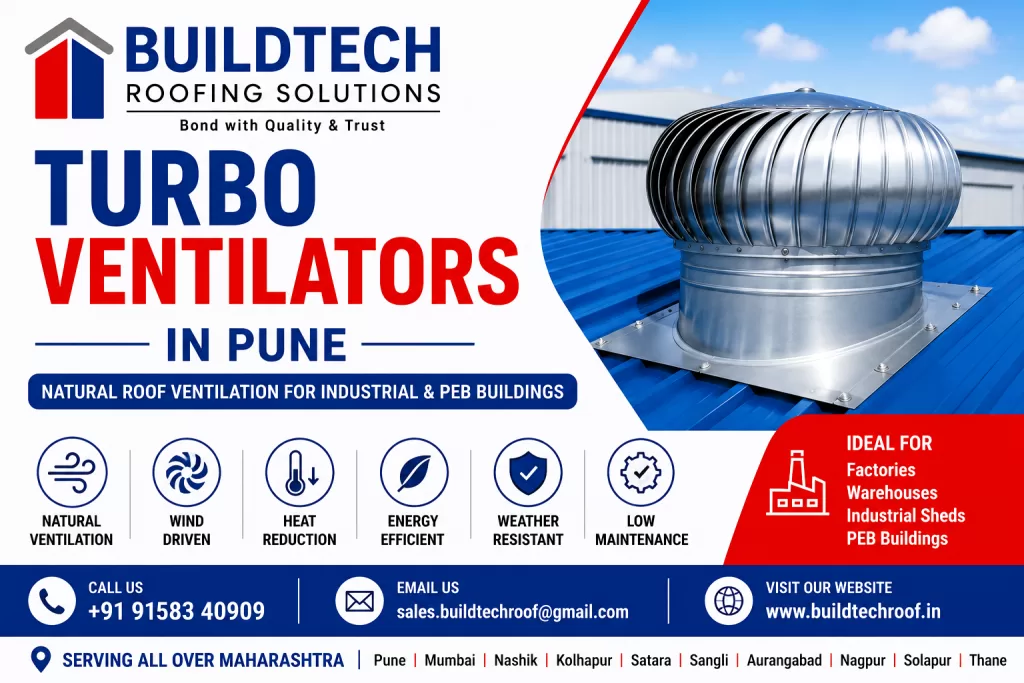
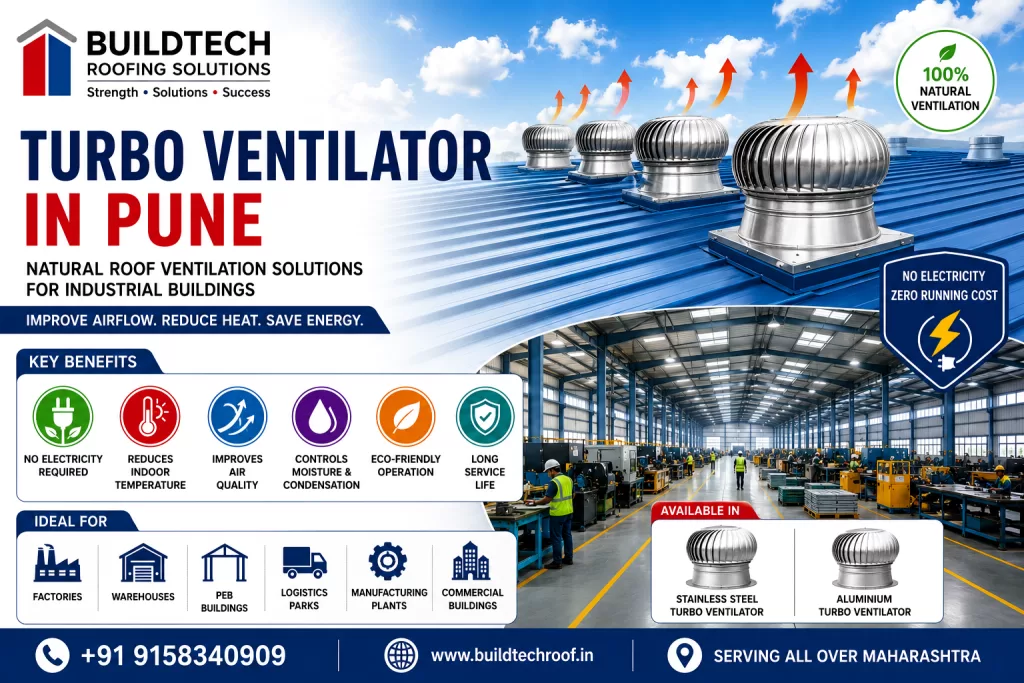
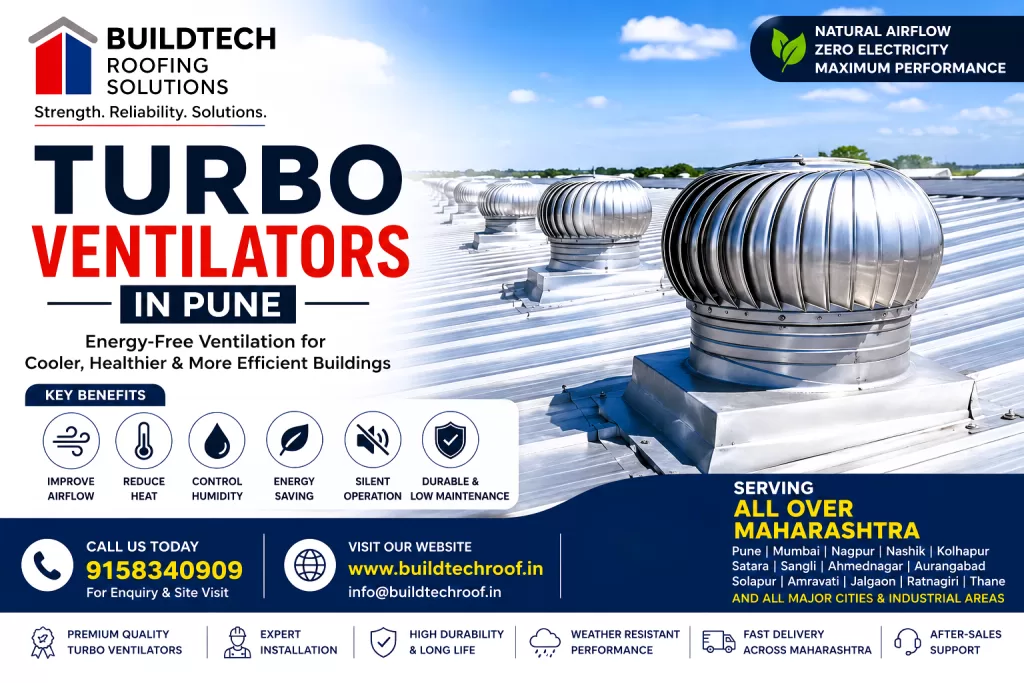
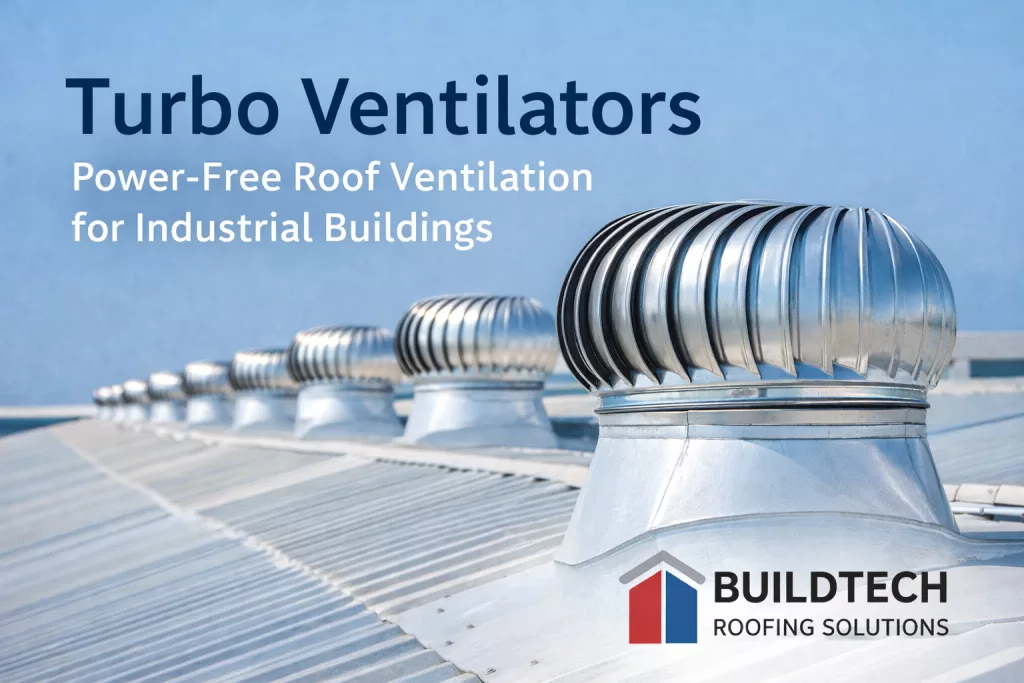
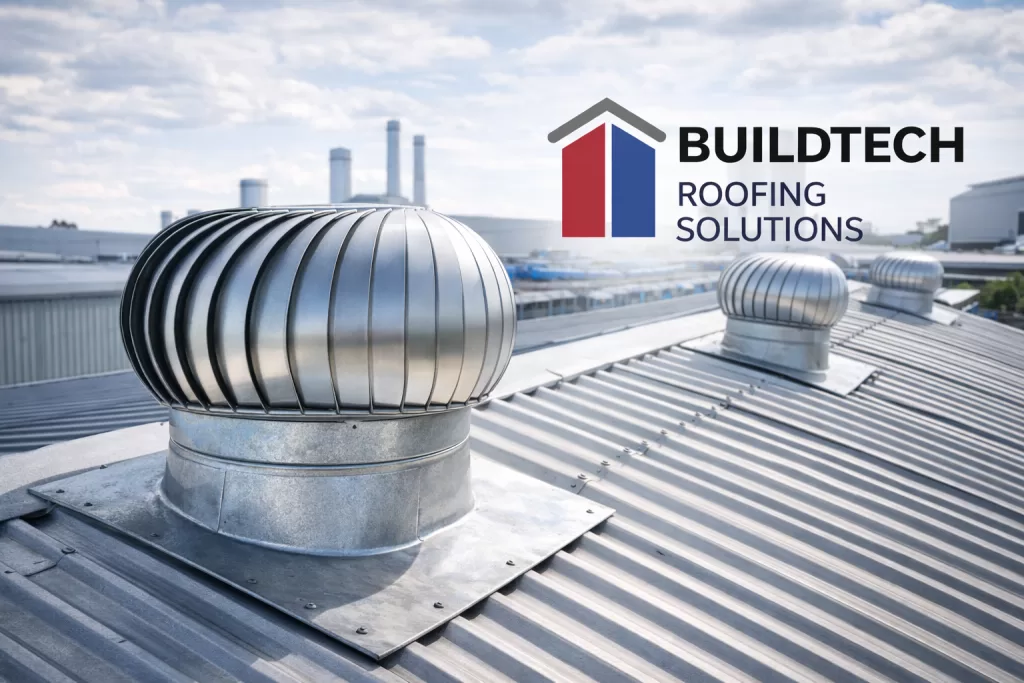
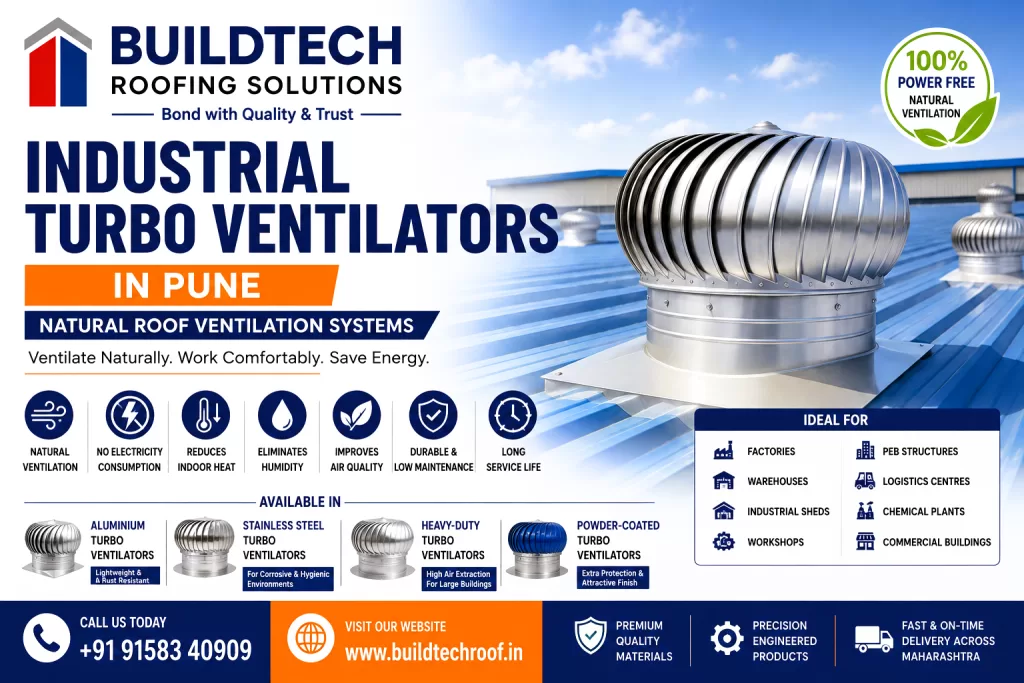
Turbo ventilator, air ventilators, wind ventilators, and roof ventilators provide ventilation solutions for various industries in Maharashtra, India. These wind-driven turbo ventilators use wind power to create effective airflow. They consist of round metal vents with fins that rotate even with a slight breeze. This rotation generates centrifugal force at the tips of the fins, helping to expel stale, hot air from inside buildings. Faster winds increase the turbine’s rotation speed, improving the exhaust of heat, smoke, fumes, and humidity. Wind-driven turbo ventilators provide natural ventilation without electricity. Industrial turbo ventilators in Pune for natural roof ventilation and heat reduction.

Turbo ventilators for industrial buildings

Turbo Ventilators in Pune

Turbo Ventilators in Pune for Industrial Roof Ventilation Systems Introduction Proper ventilation is one of the most important requirements for industrial buildings, warehouses, manufacturing plants, commercial facilities, and Pre-Engineered Buildings (PEBs). Heat generated by machinery, production processes, and solar radiation can quickly accumulate beneath the roof, creating uncomfortable working conditions, increasing energy consumption, and reducing equipment efficiency. A Turbo Ventilator is one of the most effective natural ventilation solutions for removing hot air, humidity, fumes, smoke, and stale air from industrial buildings. Unlike electrically powered exhaust fans, Turbo Ventilators operate entirely on wind energy and thermal convection, providing continuous ventilation without consuming electricity. At Buildtech Roofing Solutions, Pune, we manufacture and supply premium-quality Turbo Ventilators designed for high airflow efficiency, durability, and long service life. Our ventilators are suitable for industrial sheds, factories, warehouses, logistics parks, workshops, commercial buildings, and PEB structures across Maharashtra. Whether you are constructing a new facility or upgrading an existing roof ventilation system, installing a high-quality Turbo Ventilator can improve indoor air quality, lower roof temperatures, reduce humidity, and support a more energy-efficient building. What is a Turbo Ventilator? A Turbo Ventilator is a wind-driven, roof-mounted ventilation device that rotates using natural wind and the rising hot air inside a building. As the turbine spins, it extracts hot, stale air from the roof space and continuously replaces it with fresh outside air. Since it operates without electricity, it offers an economical and environmentally friendly ventilation solution with minimal maintenance requirements. How Does a Turbo Ventilator Work? Turbo Ventilators use two natural forces: Wind Energy Even a light breeze causes the turbine head to rotate. The spinning action creates negative pressure, drawing hot air upward and out of the building. Thermal Convection Hot air naturally rises toward the roof. The rotating ventilator accelerates the removal of this trapped heat, improving continuous airflow inside the building. Together, these forces provide efficient passive ventilation throughout the day. Components of a Turbo Ventilator A standard industrial Turbo Ventilator consists of: Each component is engineered to withstand continuous operation in industrial environments. Key Benefits of Turbo Ventilators 1. No Electricity Required Turbo Ventilators operate entirely on natural wind and thermal movement, eliminating electricity costs. 2. Continuous Air Extraction They provide uninterrupted ventilation throughout the day, improving airflow even when machinery is operating continuously. 3. Heat Reduction By removing trapped hot air, Turbo Ventilators help lower indoor temperatures and improve workplace comfort. 4. Improved Indoor Air Quality They remove: creating a healthier work environment. 5. Energy Savings Improved natural ventilation can reduce the reliance on exhaust fans and air-conditioning systems, helping lower operating costs. 6. Moisture and Condensation Control Continuous airflow minimises condensation that could otherwise damage roofing systems, machinery, insulation, and stored goods. 7. Environmentally Friendly Because Turbo Ventilators require no electrical power, they support sustainable building design and reduce carbon emissions. 8. Low Maintenance With high-quality bearings and corrosion-resistant materials, Turbo Ventilators require very little maintenance over their service life. Features of BuildtechRoof Turbo Ventilators Buildtech Roofing Solutions supplies Turbo Ventilators with: Types of Turbo Ventilators Aluminium Turbo Ventilators The most commonly used type due to their lightweight construction and corrosion resistance. Advantages Stainless Steel Turbo Ventilators Designed for demanding industrial environments that require additional corrosion resistance and strength. Suitable For Heavy-Duty Industrial Turbo Ventilators Engineered for buildings with high heat loads and large ventilation requirements. Common Applications Common Applications Turbo Ventilators are widely used in: Why Turbo Ventilators are Essential Without adequate ventilation, industrial buildings often experience: Turbo Ventilators provide a reliable, low-cost solution to these challenges while improving the building’s overall performance and sustainability. Technical Specifications of Turbo Ventilators Selecting the right Turbo Ventilator is essential for achieving efficient ventilation, long service life, and reliable performance. The specifications should match the building size, roof height, ventilation requirements, and industrial processes. At Buildtech Roofing Solutions, every Turbo Ventilator is engineered to deliver maximum airflow with minimal maintenance. Typical Technical Specifications Parameter Specification Material Aluminium, Stainless Steel (SS304/SS316) Turbine Diameter 300mm, 400mm, 500mm, 600mm, 800mm Blade Thickness 0.4mm – 0.8mm Number of Blades 28–48 (Model Dependent) Bearing Type Heavy-Duty Sealed Ball Bearings Shaft Material Stainless Steel Base Plate Galvanised Steel / Aluminium Mounting Roof Mounted Operation Wind & Thermal Convection Power Requirement None Maintenance Minimal Material Grades The material used in a Turbo Ventilator directly affects its durability, corrosion resistance, and operational life. Aluminium Turbo Ventilators Aluminium is the preferred material for most industrial applications because it is lightweight and naturally corrosion-resistant. Advantages Stainless Steel Turbo Ventilators For aggressive environments such as chemical plants and coastal regions, stainless steel provides superior durability. Benefits Galvanised Steel Base The base assembly is commonly fabricated from galvanised steel for structural strength and weather resistance. Standard Sizes Turbo Ventilators are available in different diameters depending on airflow requirements. Diameter Typical Application 300mm Small workshops and commercial buildings 400mm Medium industrial sheds 500mm Warehouses and factories 600mm Large industrial buildings 800mm Heavy industrial applications The final selection depends on building dimensions, roof height, and required air changes per hour. Bearing Technology The bearing system is one of the most important components of a Turbo Ventilator. Buildtech Turbo Ventilators use high-quality sealed bearings that provide: Airflow Performance Turbo Ventilators continuously remove: Their efficiency increases with wind speed while still functioning through thermal convection in low-wind conditions. Manufacturing Process Each Turbo Ventilator manufactured by Buildtech Roofing Solutions follows a strict quality-controlled production process. Step-1 – Raw Material Selection Only certified aluminium, stainless steel, and galvanised steel are selected after checking: Step-2 – Precision Cutting CNC cutting machines produce accurately sized components, ensuring: Step-3 – Blade Forming The turbine blades are shaped using precision forming equipment to achieve: Step-4 – Hub Assembly All blades are securely fixed to the central hub with precise alignment to maintain smooth, vibration-free operation. Step-5 – Bearing Installation Premium sealed bearings are installed and tested to ensure reliable performance over extended operating periods. Step-6 – Base Fabrication The mounting base is manufactured to suit different roofing profiles, including: Step-7 – Final

Turbo Ventilators in Pune Read More »

Turbo Ventilator in Pune | Industrial Roof Ventilation Solutions

Turbo Ventilator in Pune | Industrial Roof Ventilation Solutions

Introduction Industrial buildings, warehouses, factories, logistics parks, and commercial facilities often face one major challenge: excessive indoor heat accumulation. Poor ventilation can lead to uncomfortable working conditions, reduced productivity, moisture buildup, equipment overheating, and higher energy costs. One of the most efficient and cost-effective solutions to this problem is the Turbo Ventilator. Turbo ventilators provide natural roof ventilation without electricity, helping industries maintain cooler, healthier, and more energy-efficient working environments. Buildtech Roofing Solutions supplies and installs premium-quality Turbo Ventilators in Pune and across Maharashtra, helping industrial facilities improve airflow while reducing operational costs. What is a Turbo Ventilator? A Turbo Ventilator is a wind-driven roof ventilation device designed to extract hot, stale, and humid air from inside a building. It operates using: No electricity is required. The rotating turbine creates negative pressure, drawing hot air out through the roof and allowing fresh air to enter through side openings and louvers. How Does a Turbo Ventilator Work? The turbo ventilator rotates when exposed to: Wind Energy Even low wind speeds can rotate the turbine. Thermal Air Movement Hot air naturally rises and escapes through the ventilator. This creates continuous airflow inside the building. Result: Why Industries Need Turbo Ventilators Industrial buildings often suffer from: Turbo ventilators help eliminate these issues naturally. Key Benefits of Turbo Ventilators 1. No Electricity Required One of the biggest advantages. Benefits: 2. Reduces Indoor Temperature Turbo ventilators continuously remove trapped hot air. This helps: 3. Improves Air Quality Removes: Creating a healthier workplace. 4. Controls Condensation Condensation can damage: Turbo ventilation helps control moisture buildup. 5. Low Maintenance High-quality turbo ventilators require minimal maintenance. 6. Environment Friendly Uses renewable wind energy. No electricity consumption. No emissions. 7. Long Service Life Premium stainless steel turbo ventilators can perform efficiently for many years. Types of Turbo Ventilators Stainless Steel Turbo Ventilators Most popular industrial option. Advantages Applications: Aluminium Turbo Ventilators Lightweight and economical. Benefits Applications: Heavy-Duty Industrial Turbo Ventilators Designed for: Components of a Turbo Ventilator Turbine Head Captures wind energy. Base Plate Mounted to the roof. Bearing Assembly Ensures smooth rotation. Flashing System Provides waterproof installation. Neck Assembly Connects the ventilator to the roof opening. Applications of Turbo Ventilators Industrial Sheds Reduces heat buildup and improves ventilation. Warehouses Improves airflow and storage conditions. Manufacturing Plants Removes process heat and stale air. PEB Buildings One of the most common applications. Logistics Parks Supports efficient ventilation. Food Processing Facilities Helps maintain healthier environments. Pharmaceutical Facilities Improves indoor air circulation. Commercial Buildings Provides natural roof ventilation. The Turbo Ventilator vs Exhaust Fan Feature Turbo Ventilator Exhaust Fan Electricity Required No Yes Operating Cost Zero Continuous Maintenance Low Moderate Noise Level Silent Moderate Environmental Impact Eco-Friendly Electricity Dependent Turbo Ventilator vs Ridge Ventilation Feature Turbo Ventilator Ridge Ventilation Air Extraction Excellent Excellent Installation Easy Moderate Cost Moderate Higher Maintenance Low Low Many projects combine both systems for optimal ventilation. How Many Turbo Ventilators Are Required? The number depends on: Building Size Roof Height Heat Load Occupancy Levels Internal Operations Ventilation Requirements A professional site survey ensures proper sizing and placement. Turbo Ventilator Installation Process Step-1 Site Inspection Step-2 Ventilation Assessment Step-3 Roof Marking Step-4 Roof Opening Preparation Step-5 Ventilator Installation Step-6 Waterproof Flashing Step-7 Final Inspection Common Problems Solved by Turbo Ventilators Excessive Heat Continuous heat extraction. Poor Airflow Improved natural ventilation. High Humidity Moisture removal. Condensation Issues Reduced roof condensation. Worker Discomfort Cooler indoor environment. High Cooling Costs Reduced dependence on mechanical cooling. Turbo Ventilators for PEB Buildings PEB structures benefit significantly from turbo ventilators. Advantages include: Turbo Ventilators and Energy Efficiency Turbo ventilators support: Making them ideal for modern industrial facilities. Maintenance Tips Cost of Turbo Ventilators in Pune Pricing depends on: Approximate Price Range ₹3,500 – ₹15,000 Per Unit Project pricing varies according to specifications and installation requirements. Why Choose Buildtech Roofing Solutions? Our Strengths Industries We Serve Service Areas Serving All Over Maharashtra Pune Mumbai Nashik Nagpur Kolhapur Satara Sangli Ahmednagar Aurangabad Solapur Ratnagiri Thane Jalgaon Amravati And All Major Industrial Areas Across Maharashtra Frequently Asked Questions What is a Turbo Ventilator? A turbo ventilator is a wind-driven roof ventilation device that removes hot air and improves airflow without electricity. Does a Turbo Ventilator require electricity? No. It operates entirely using natural wind and thermal air movement. Can Turbo Ventilators reduce indoor temperature? Yes. They continuously remove trapped hot air and improve ventilation. Are Turbo Ventilators suitable for warehouses? Absolutely. Warehouses are one of the most common applications. How long does a Turbo Ventilator last? High-quality stainless steel turbo ventilators can provide reliable performance for many years with minimal maintenance. Conclusion Turbo Ventilators are among the most effective and economical ventilation solutions for industrial and commercial buildings. By improving airflow, reducing heat buildup, controlling humidity, and operating without electricity, they deliver significant long-term value. For factories, warehouses, PEB buildings, logistics parks, and industrial sheds across Maharashtra, Buildtech Roofing Solutions provides premium turbo ventilator supply and installation services tailored to your ventilation requirements.

Turbo Ventilator in Pune | Industrial Roof Ventilation Solutions Read More »

Turbo Ventilators in Pune | Industrial Roof Ventilation Solutions

Turbo Ventilators in Pune Product Guide

📖 Introduction Industrial buildings generate significant amounts of heat from machinery, manufacturing processes, lighting systems, and environmental conditions. Excessive indoor temperatures can reduce employee productivity, increase energy consumption, and negatively impact equipment performance. Modern factories and warehouses require efficient ventilation systems that remove trapped heat while maintaining continuous airflow. One of the most effective and energy-efficient ventilation solutions available today is the Turbo Ventilator System. Turbo Ventilators in Pune are widely used across factories, warehouses, logistics centres, engineering facilities, food processing plants, pharmaceutical units, and commercial buildings to improve air circulation without consuming electricity. Buildtech Roofing Solutions provides premium-quality Turbo Ventilator systems designed to improve workplace comfort, reduce heat buildup, and support sustainable industrial infrastructure across Maharashtra. What Are Turbo Ventilators? Turbo ventilators are roof-mounted ventilation devices that use natural wind energy and thermal pressure differences to remove hot air, fumes, moisture, and stale air from industrial buildings. Turbo ventilators operate without electricity, while powered exhaust systems rely on electrical energy. This distinction highlights the efficiency of turbo ventilators, as they can function effectively even in remote areas where electricity may not be available. By harnessing natural airflow, they reduce energy costs, making them an environmentally friendly choice. The choice between turbo ventilators and powered systems often depends on specific needs and available resources. The rotating turbine head creates negative pressure, pulling hot air upward and exhausting it from the building. How Turbo Ventilators Work Turbo ventilators operate using two natural principles: Wind Energy Turbo ventilators operate without electricity, unlike powered exhaust systems. Thermal Air Movement Hot air naturally rises toward the roof. The rotating ventilator extracts this accumulated hot air and releases it outside. Continuous Ventilation Cycle This creates a healthier and cooler indoor environment. Key Benefits of Turbo Ventilators 1. No Electricity Required Turbo ventilators operate completely on natural wind energy. Benefits include: 2. Significant Heat Reduction Industrial buildings often experience temperatures exceeding 50°C under metal roofs. Turbo ventilators help: 3. Improved Indoor Air Quality Removes: Resulting in a healthier workspace. 4. Reduced Humidity Humidity causes: Turbo ventilators help maintain better environmental conditions. 5. Increased Worker Productivity Comfortable temperatures contribute to: 6. Environment Friendly Turbo ventilators reduce dependence on: Supporting green building practices. 7. Low Maintenance Minimal moving components ensure: Types of Turbo Ventilators Aluminium Turbo Ventilators Most common industrial solution. Benefits: Stainless Steel Turbo Ventilators Ideal for: Advantages: Heavy-Duty Industrial Turbo Ventilators Designed for: Polycarbonate Base Turbo Ventilators Suitable for: Components of a Turbo Ventilator System Turbine Head Captures wind energy. Bearings Enable smooth rotation. Central Shaft Transfers rotational movement. Base Plate Secures the unit to roofing structures. Flashing System Provides waterproof installation. Applications of Turbo Ventilators Manufacturing Plants Removes machinery-generated heat. Warehouses Improves airflow and storage conditions. Food Processing Industries Supports hygiene and ventilation requirements. Pharmaceutical Units Maintains fresh airflow. Textile Industries Controls humidity and heat. Engineering Facilities Enhances worker comfort. Logistics Centers Improves warehouse ventilation. Commercial Buildings Supports sustainable ventilation design. The Turbo Ventilators vs Exhaust Fans Feature Turbo Ventilator Exhaust Fan Electricity No Yes Operating Cost Zero Continuous Maintenance Low Moderate Noise Silent Audible Environmental Impact Low Higher Turbo ventilators provide long-term energy savings. The Turbo Ventilators vs Ridge Ventilators Feature Turbo Ventilator Ridge Ventilator Air Extraction Excellent Excellent Wind Utilization Yes Passive Installation Point-Based Continuous Roof Ridge Cost Moderate Higher Both systems can work together for maximum ventilation. Importance of Proper Roof Ventilation Proper ventilation helps: Turbo Ventilator Installation Process Step-1 – Site Inspection Analyse roof structure and ventilation requirements. Step-2 – Ventilation Design Calculate the required ventilator quantity. Step-3 – Roof Marking Determine installation locations. Step-4 – Roof Cutting Create openings as per specifications. Step-5 – Base Installation Secure ventilator base. Step-6 – Waterproof Sealing Apply flashing and sealants. Step 7 – Final Testing Verify smooth rotation and airflow. Common Problems Solved by Turbo Ventilators Excessive Heat Continuous hot-air extraction. Poor Air Circulation Improves airflow. High Humidity Reduces moisture buildup. Condensation Issues Minimises water vapour accumulation. Employee Discomfort Creates a healthier workplace. Maintenance Tips To maximise performance: Cost of Turbo Ventilators in Pune Pricing depends on: Approximate Cost Range ₹3,500 – ₹15,000 per unit Installation charges vary based on project scope. Why Choose Buildtech Roofing Solutions? Buildtech Roofing Solutions provides customised industrial ventilation systems designed for maximum performance. Our Advantages Industries Served Service Areas PuneMumbaiNagpurNashikKolhapurSataraSangliAhmednagarAurangabadSolapurAmravatiJalgaonRatnagiriThaneAnd All Over Maharashtra Conclusion Turbo Ventilators are among the most cost-effective and energy-efficient ventilation solutions available for industrial and commercial buildings. Utilising natural wind energy removes heat, humidity, and stale air while lowering operating costs and improving workplace comfort. For businesses looking for Turbo Ventilators in Pune and across Maharashtra, Buildtech Roofing Solutions offers high-quality products, expert installation, and customised ventilation solutions tailored to industrial requirements.

Turbo Ventilators in Pune Product Guide Read More »

Turbo Ventilators for Industrial Buildings

Introduction: Why Industrial Buildings Need Efficient Roof Ventilation Industrial buildings generate large amounts of heat every day. Machinery, welding processes, furnaces, lighting systems, and continuous human activity raise indoor temperatures significantly. When hot air becomes trapped near the roof, working conditions deteriorate quickly. Poor ventilation often leads to uncomfortable environments, reduced productivity, faster equipment wear, and increased electricity costs. Exhaust fans and air-conditioning systems can help, but they consume power and demand ongoing maintenance. As a result, many industries now prefer natural, power-free ventilation systems. Among available solutions, turbo ventilators have proven to be one of the most reliable and cost-effective options for factories, warehouses, and large industrial sheds. This guide explains how turbo ventilators work, where they are used, and how to select the right system for long-term performance. What Are Turbo Ventilators? Turbo ventilators are wind-driven roof ventilation units installed at the highest point of an industrial roof. Each unit consists of a rotating turbine head mounted on a base that connects to the roof opening. As the turbine rotates, it creates negative pressure inside the building. This pressure difference pulls hot air, fumes, and moisture upward and releases them outside. Fresh air enters naturally through doors, louvers, or side openings. The defining advantage of turbo ventilators is their power-free operation. They work without electricity, motors, or electrical wiring. How Turbo Ventilators Work Turbo ventilators operate using a combination of wind movement and thermal convection. Working Principle Even in low-wind conditions, temperature differences between indoor and outdoor air help maintain airflow. This ensures continuous ventilation throughout the day. Why Turbo Ventilators Are Ideal for Industrial Buildings Industrial structures differ from residential or commercial buildings. They usually feature large spans, high roof heights, and continuous heat generation. Turbo ventilators are well suited to these conditions because they provide uninterrupted ventilation without increasing operating costs. Key Reasons Industries Choose Turbo Ventilators Key Benefits of Turbo Ventilators 1. Power-Free Operation Turbo ventilators function without electricity, which eliminates energy expenses over their entire lifespan. 2. Continuous Ventilation Once installed, they operate 24×7 without manual control or power supply. 3. Heat and Humidity Reduction By exhausting hot air, turbo ventilators lower indoor temperatures and reduce moisture buildup. 4. Improved Working Conditions Better airflow enhances comfort, which supports worker productivity and safety. 5. Low Maintenance With no motors or electrical components, maintenance requirements remain minimal. 6. Environment-Friendly Solution Reduced energy consumption helps lower carbon emissions and supports sustainable building practices. Types of Turbo Ventilators Aluminium Turbo Ventilators These are lightweight, corrosion-resistant, and suitable for most industrial environments. Stainless Steel Turbo Ventilators Designed for aggressive or corrosive conditions, including coastal and chemical industries. Base-Mounted Turbo Ventilators Custom-fabricated bases match roof profiles and ensure leak-proof installation. Materials Used in Turbo Ventilators Material selection directly impacts durability and performance. Common materials include: High-quality materials ensure smooth rotation, weather resistance, and long service life. Technical Specifications (Typical Range) Parameter Specification Diameter 18″ / 21″ / 24″ / Custom Material Aluminium / Stainless Steel Operation Wind & thermal driven Power Requirement Nil Installation Roof-mounted Maintenance Minimal Applications of Turbo Ventilators Turbo ventilators are widely used in: They are especially effective on large-span roofs where natural airflow is essential. Turbo Ventilators vs Exhaust Fans Aspect Turbo Ventilators Exhaust Fans Electricity Not required Required Operating Cost Zero High Maintenance Low Moderate Noise Silent Noisy Lifespan Long Moderate Turbo ventilators provide continuous ventilation without ongoing energy expenses. Installation Process Correct installation plays a critical role in performance and leak prevention. Typical Installation Steps Professional installation ensures smooth operation and long-term reliability. How to Choose the Right Turbo Ventilator Roof Size Larger roofs require multiple ventilators placed at proper intervals. Heat Load Higher heat generation demands larger sizes or additional units. Environmental Conditions Coastal or chemical environments require stainless steel models. Budget Planning Initial cost should be evaluated against long-term energy savings. Common Buyer Mistakes to Avoid Avoiding these issues ensures consistent ventilation performance. Energy Efficiency and Sustainability Benefits Turbo ventilators support sustainable construction by: They contribute directly to energy-efficient industrial infrastructure. Why Choose Buildtech Roofing Solutions Buildtech Roofing Solutions delivers complete turbo ventilator solutions, including: Each system is engineered for durability, performance, and long-term value. Frequently Asked Questions Do turbo ventilators work without wind?Yes. Thermal convection supports airflow even during low-wind conditions. Are turbo ventilators waterproof?Proper flashing and installation prevent rain ingress. How many turbo ventilators are required?The number depends on the roof area and internal heat load. Do turbo ventilators reduce electricity bills?Yes. They reduce reliance on exhaust fans and air conditioning systems. Conclusion Turbo ventilators offer one of the most economical and reliable solutions for industrial roof ventilation. Their power-free operation, minimal maintenance, and continuous performance make them a long-term investment for factories and warehouses. By selecting the right turbo ventilator system, industries can improve indoor comfort, reduce operational costs, and enhance sustainability. Final Call to Action 📞 Call: 9158340909📩 Request a Turbo Ventilator Consultation Today

Turbo Ventilators for Industrial Buildings Read More »

Turbo Ventilators for Industrial Roof Ventilation

Turbo Ventilators – Power-Free Roof Ventilation for Industrial Buildings Industrial buildings generate excessive heat, fumes, and humidity during daily operations. Without proper ventilation, this trapped hot air reduces productivity, damages machinery, and increases energy costs. Turbo ventilators provide a reliable, power-free solution by continuously exhausting hot air from the roof using wind energy. At Buildtech Roofing Solutions, we design, supply, and install high-performance industrial turbo ventilators engineered for durability, smooth rotation, and maximum airflow—without electricity. 🔍 What Are Turbo Ventilators? Turbo ventilators are wind-driven roof exhaust systems that rotate with wind movement and thermal pressure. As the turbine spins, it creates negative pressure, pulling hot and stale air out of the building while fresh air enters through side openings or louvers. They operate 24×7, even in low-wind conditions, making them ideal for industrial environments. 🌬️ Why Turbo Ventilators Are Important Turbo ventilators play a crucial role in maintaining a healthy industrial environment: Buildings with proper turbo ventilation experience lower energy bills, better worker comfort, and increased equipment lifespan. 🧩 Types of Turbo Ventilators 1️⃣ Aluminium Turbo Ventilators Lightweight, corrosion-resistant, and suitable for most industrial buildings. 2️⃣ Stainless Steel Turbo Ventilators Ideal for corrosive, coastal, chemical, or high-humidity environments. 3️⃣ Base-Mounted Turbo Ventilators Custom-fabricated bases designed to match different roof profiles. 🧱 Materials Used Buildtech turbo ventilators are manufactured using: All materials are selected for strength, corrosion resistance, and long-term performance. ⚙️ Key Features of Buildtech Turbo Ventilators 🏭 Applications of Turbo Ventilators 📏 Technical Specifications (Typical) Parameter Specification Diameter 18″ / 21″ / 24″ / Custom Material Aluminium / Stainless Steel Operation Wind & thermal driven Power Not required Installation Roof-mounted Maintenance Minimal 🛠 Installation Process Buildtech ensures leak-proof installation and maximum ventilation efficiency. ⭐ Why Choose Buildtech Roofing Solutions? 🧩 Complete Roofing & Ventilation Solutions Along with turbo ventilators, Buildtech also provides: One trusted partner for complete industrial roofing solutions. 📞 Get Expert Turbo Ventilator Solutions 📞 Call: 9158340909📩 Request a Free Consultation Today

Turbo Ventilators for Industrial Roof Ventilation Read More »

Turbo Ventilators for Industrial Roof Ventilation

Turbo Ventilators – Power-Free Roof Ventilation for Industrial Buildings Industrial buildings generate substantial heat, fumes, and moisture due to continuous machinery operation and high occupancy levels. Without proper ventilation, these conditions can affect worker comfort, equipment efficiency, and overall productivity. Turbo ventilators offer a reliable, energy-efficient solution by continuously expelling hot air without electricity. At Buildtech Roofing Solutions, we supply and install high-quality turbo ventilators designed for smooth rotation, long service life, and consistent performance across demanding industrial environments. What Are Turbo Ventilators? A turbo ventilator is a wind-driven roof ventilation system installed at high points of an industrial roof. It works on natural principles of airflow—hot air rises and escapes through the rotating turbine, while fresh air enters from side openings, louvers, or ridge vents. Because turbo ventilators rely on wind movement and thermal pressure, they function continuously without motors, wiring, or power consumption. How Turbo Ventilators Work The operation of a turbo ventilator is simple yet highly effective: This ensures uninterrupted airflow even during power outages. Key Advantages of Turbo Ventilators ✔Zero Energy ConsumptionOperates entirely without electricity, reducing operational costs. ✔Continuous VentilationProvides airflow throughout the day and night. ✔Effective Heat & Moisture ReductionHelps lower indoor temperatures and humidity levels. ✔Silent OperationNo noise or vibration during functioning. ✔Low Maintenance RequirementFew moving parts ensure long-term reliability. ✔Weather-Resistant DesignProper flashing prevents rainwater ingress. Applications of Turbo Ventilators Turbo ventilators are widely used in: Typical Technical Specifications Parameter Specification Material Aluminium / Stainless Steel / PPGI base Throat Size 18”, 21”, 24” (custom sizes available) Operation Wind-driven & thermal pressure Power Requirement Nil Mounting Roof-mounted with flashing Specifications may vary depending on roof design and airflow requirements. Turbo Ventilators vs Exhaust Fans Feature Turbo Ventilator Exhaust Fan Power Consumption None Required Operating Cost Zero Continuous Coverage Area Large roof span Limited Maintenance Very low Regular Noise Level Silent Audible For large industrial buildings, turbo ventilators provide a more economical and sustainable solution. Installation Best Practices Buildtech’s trained installation teams ensure leak-free, stable, and long-lasting installations. Why Choose Buildtech Roofing Solutions? As a result, clients rely on Buildtech for dependable industrial ventilation systems. Conclusion Turbo ventilators are a cost-effective and eco-friendly solution for maintaining comfortable indoor conditions in industrial buildings. By eliminating heat buildup and improving air circulation without electricity, they enhance productivity and protect equipment. With Buildtech Roofing Solutions, you receive professionally engineered turbo ventilators and expert installation that deliver consistent performance for years to come.

Turbo Ventilators for Industrial Roof Ventilation Read More »

©2023 buildtechroof. All Rights Reserved.