
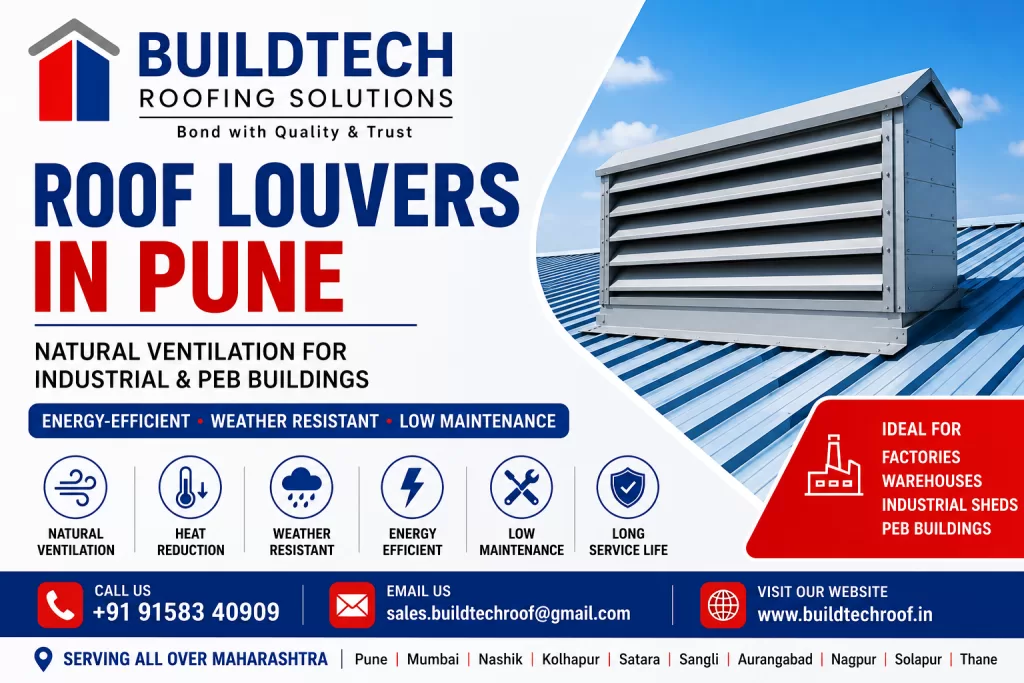
Roof Louvers in Pune for Industrial Roof Ventilation Systems
Introduction
Industrial buildings are designed to support manufacturing, warehousing, logistics, and commercial operations that often generate significant amounts of heat, humidity, dust, smoke, and airborne contaminants. Without an efficient ventilation system, these conditions can affect employee comfort, reduce equipment efficiency, increase maintenance costs, and shorten the lifespan of the building itself.
One of the most reliable and energy-efficient solutions for improving airflow in industrial structures is the Roof Louver. Installed on the roof of a building, Roof Louvers allow trapped hot air and stale indoor air to escape while encouraging fresh outside air to circulate naturally. Unlike powered exhaust systems, Roof Louvers operate without electricity, making them a cost-effective and environmentally friendly solution for factories, warehouses, workshops, logistics centres, and Pre-Engineered Buildings (PEBs).
At Buildtech Roofing Solutions, Pune, we manufacture and supply high-quality Roof Louvers engineered to deliver superior ventilation performance, weather resistance, and long-term durability. Our Roof Louvers are designed to integrate seamlessly with modern steel roofing systems and industrial buildings across Maharashtra.
Whether you are constructing a new industrial shed or upgrading an existing roof ventilation system, choosing the right Roof Louver can significantly improve indoor air quality, reduce heat accumulation, and enhance overall building efficiency.
What are Roof Louvers?
Roof Louvers are roof-mounted ventilation systems designed to facilitate the continuous movement of air through a building. Their angled blades allow hot air, moisture, smoke, and stale air to exit while helping prevent the direct entry of rainwater and debris.
These systems work on the natural principle that warm air rises. As heated air collects beneath the roof, it escapes through the louvers, creating negative pressure that draws cooler outside air into the building through wall openings or other intake vents. This passive ventilation process provides effective air circulation without the need for mechanical fans.
Why Roof Louvers are Important
Proper ventilation is essential for maintaining safe and efficient industrial operations.
Roof Louvers help to:
- Remove accumulated hot air
- Improve indoor air circulation
- Reduce humidity and condensation
- Minimise dust and airborne contaminants
- Enhance employee comfort
- Protect machinery and stored materials
- Lower dependence on mechanical ventilation
By improving natural airflow, Roof Louvers contribute to healthier workplaces and reduced energy consumption.
How Roof Louvers Work
Roof Louvers operate using passive ventilation principles:
- Heat generated inside the building rises toward the roof.
- Warm air exits through the Roof Louvers.
- Fresh outside air enters through wall louvers, doors, or designated intake openings.
- Continuous air exchange maintains balanced indoor conditions.
This process improves air quality, controls temperature, and reduces moisture without consuming electrical power.
Key Benefits of Roof Louvers
1. Natural Ventilation
Roof Louvers provide continuous airflow using natural air movement, eliminating the need for powered exhaust systems in many applications.
2. Heat Reduction
By exhausting trapped hot air, Roof Louvers help lower indoor temperatures, improving comfort and reducing heat stress.
3. Improved Air Quality
Continuous ventilation removes smoke, fumes, dust, and stale air, creating a healthier working environment.
4. Energy Efficiency
Because Roof Louvers require no electricity to operate, they help reduce energy costs associated with mechanical ventilation.
5. Moisture Control
Effective ventilation reduces condensation, helping protect roofing systems, insulation, machinery, and stored goods.
6. Low Maintenance
With no motors or moving mechanical components, Roof Louvers require minimal maintenance while offering reliable long-term performance.
7. Long Service Life
Manufactured from corrosion-resistant materials, quality Roof Louvers are designed to withstand demanding industrial environments.
Types of Roof Louvers
Fixed Roof Louvers
Provide continuous natural ventilation throughout the year and are widely used in industrial and commercial buildings.
Adjustable Roof Louvers
Allow airflow to be regulated by adjusting the angle of the blades, making them suitable for buildings with changing ventilation requirements.
Metal Roof Louvers
Constructed from galvanised steel or aluminium for enhanced strength, durability, and corrosion resistance.
PEB Roof Louvers
Specifically designed for Pre-Engineered Buildings, ensuring compatibility with steel roofing systems and efficient passive ventilation.
Technical Specifications of Roof Louvers
Selecting the right Roof Louver is essential for achieving efficient natural ventilation, long service life, and reliable weather protection. The performance of a Roof Louver depends on factors such as material quality, blade profile, dimensions, airflow capacity, and installation.
At Buildtech Roofing Solutions, every Roof Louver is manufactured with precision to meet the demanding requirements of industrial and commercial roofing projects.
Typical Technical Specifications
| Parameter | Specification |
|---|---|
| Material | Galvanised Steel (GI), Galvalume Steel (GL), Aluminium |
| Thickness | 0.50 mm – 2.00 mm (Project Dependent) |
| Finish | Powder Coated / PVDF / Polyester Coated |
| Blade Type | Fixed / Adjustable |
| Mounting | Roof Mounted |
| Airflow | Engineered as per project requirements |
| Weather Protection | Rain-resistant blade profile |
| Fastening | High-quality self-drilling screws with sealing washers |
Material Grades
Material selection has a direct impact on the durability and performance of Roof Louvers.
Galvanised Steel (GI)
Galvanised steel is one of the most widely used materials due to its excellent corrosion resistance and structural strength.
Advantages
- Cost-effective
- Durable
- Rust resistant
- Easy fabrication
- Long service life
Galvalume Steel (GL)
Galvalume steel combines aluminium, zinc, and silicon coatings to provide enhanced corrosion resistance.
Benefits
- Excellent weather resistance
- Better heat reflectivity
- Longer lifespan
- Suitable for industrial environments
Aluminium Roof Louvers
Aluminium Roof Louvers are lightweight and naturally resistant to corrosion.
Recommended For
- Coastal areas
- Chemical industries
- Commercial buildings
- Architectural projects
Types of Louver Blade Designs
Different blade profiles are designed to optimise airflow while minimising water ingress.
Fixed Blade Louvers
The most common configuration for industrial buildings.
Features
- Continuous ventilation
- No moving parts
- Low maintenance
- High reliability
Drainable Blade Louvers
Designed to divert rainwater away while maintaining airflow.
Applications
- High rainfall regions
- Warehouses
- Factory buildings
Adjustable Blade Louvers
Blade angles can be modified manually or automatically.
Advantages
- Airflow control
- Seasonal adjustment
- Flexible ventilation
Standard Sizes
Roof Louvers are available in multiple sizes to match project ventilation requirements.
Typical widths:
- 600 mm
- 900 mm
- 1200 mm
- 1500 mm
- Custom widths
Typical lengths:
- As per the roof design
- Custom-fabricated to project drawings
Surface Finishes
Roof Louvers can be supplied in several finishes depending on project requirements.
Polyester Coating
Suitable for general industrial and commercial buildings.
PVDF Coating
Provides superior resistance to UV radiation, colour fading, and harsh weather conditions.
Powder Coating
Offers excellent appearance, durability, and corrosion protection.
Plain Galvanised Finish
Ideal for applications where additional painting is not required.
Performance Characteristics
Properly designed Roof Louvers provide:
- High airflow efficiency
- Excellent weather resistance
- Reduced rainwater entry
- Dust control
- Long service life
- Minimal maintenance
- Noise-free operation
Manufacturing Process
Every Roof Louver supplied by Buildtech Roofing Solutions undergoes a systematic manufacturing process to ensure consistent quality and performance.
Step-1 – Material Selection
Certified steel or aluminium sheets are selected according to project specifications.
Quality checks include:
- Material grade
- Thickness
- Surface finish
- Coating quality
Step-2 – Precision Cutting
Advanced CNC machinery is used to cut components accurately.
Benefits include:
- Consistent dimensions
- Clean edges
- Reduced wastage
Step-3 – Blade Forming
Specialised roll-forming equipment creates accurately shaped louver blades.
This ensures:
- Uniform airflow
- Proper drainage
- Improved structural strength
Step-4 – Frame Fabrication
The outer frame is fabricated and prepared for blade assembly.
Quality checks include:
- Squareness
- Alignment
- Structural rigidity
Step-5 – Surface Treatment
Depending on customer requirements, Roof Louvers receive:
- Powder coating
- PVDF coating
- Polyester coating
- Galvanized finish
Step-6 – Assembly
Blades, frames, reinforcement members, and accessories are assembled and secured.
Step-7 – Final Quality Inspection
Each Roof Louver is inspected for:
- Dimensions
- Blade alignment
- Coating quality
- Surface finish
- Structural strength
- Visual appearance
Installation Process
Correct installation is essential for maximising ventilation performance.
Step-1 – Roof Survey
Engineers determine the most suitable Roof Louver locations based on:
- Building size
- Roof design
- Heat load
- Airflow requirements
Step-2 – Structural Preparation
Roof openings are prepared according to approved drawings.
Step-3 – Positioning
Roof Louvers are carefully positioned and aligned.
Step-4 – Fixing
Louvers are secured using corrosion-resistant fasteners and sealing systems.
Step-5 – Waterproof Sealing
Flashing, sealants, and weatherproof components are installed to prevent water ingress.
Step-6 – Final Inspection
The completed installation is checked for:
- Proper alignment
- Structural stability
- Weatherproofing
- Ventilation performance
Accessories Used
A complete Roof Louver system may include:
- Flashings
- Fasteners
- Self-drilling screws
- EPDM sealing washers
- Waterproof sealants
- Reinforcement brackets
- Bird mesh (optional)
- Insect screens (optional)
Roof Louvers vs Ridge Ventilators
| Feature | Roof Louvers | Ridge Ventilators |
|---|---|---|
| Installation | Roof Mounted | Roof Ridge |
| Airflow | Localized Ventilation | Continuous Ridge Ventilation |
| Suitable For | Small to Medium Roof Areas | Large Industrial Buildings |
| Rain Protection | Excellent | Excellent |
| Maintenance | Low | Low |
Roof Louvers vs Turbo Ventilators
| Feature | Roof Louvers | Turbo Ventilators |
|---|---|---|
| Power Requirement | None | None |
| Moving Parts | No | Yes |
| Maintenance | Very Low | Low |
| Air Movement | Natural Passive Flow | Wind-Driven Extraction |
| Best Application | General Industrial Ventilation | Heat Extraction |
Quality Standards
Buildtech Roofing Solutions manufactures Roof Louvers in accordance with applicable Indian standards and project-specific engineering requirements.
Quality checks include:
- Material certification
- Dimensional accuracy
- Coating thickness
- Structural integrity
- Blade alignment
- Weather resistance
- Visual inspection
Advantages of BuildtechRoof Louvers
Choosing Buildtech Roofing Solutions provides:
- Precision engineering
- Premium raw materials
- Excellent airflow performance
- Long-lasting corrosion protection
- Customized fabrication
- Fast project execution
- Professional installation support
- Reliable after-sales service
Compatibility with BuildtechRoof Products
Roof Louvers integrate seamlessly with other Buildtech Roofing Solutions products, including:
- Colour Coated Roofing Sheets
- Galvalume Roofing Sheets
- Standing Seam Roofing
- Z Purlins
- C Purlins
- PEB Structures
- Structural Steel Sections
- Ridge Ventilators
- Turbo Ventilators
- Polycarbonate Skylight Sheets
- FRP Skylight Sheets
- Roof Flashings
This compatibility helps create a complete, high-performance roofing and ventilation system for industrial and commercial buildings.
Industrial Applications of Roof Louvers
Roof Louvers are widely used across industrial and commercial sectors because they provide efficient natural ventilation without consuming electricity. They help remove excess heat, humidity, smoke, and airborne contaminants while maintaining continuous airflow throughout the building.
1. Pre-Engineered Buildings (PEBs)
Roof Louvers are an integral part of modern PEB structures, improving ventilation and maintaining a comfortable indoor environment.
Benefits for PEB Buildings
- Reduces heat accumulation beneath the roof
- Improves employee comfort
- Protects machinery from overheating
- Increases the lifespan of roofing systems
- Reduces dependence on mechanical ventilation
2. Industrial Sheds
Industrial sheds often house machinery that generates significant heat during operation. Roof Louvers help maintain a cooler and healthier work environment.
Suitable Industries
- Engineering workshops
- Automobile industries
- Fabrication units
- Textile mills
- Packaging plants
3. Warehouses
Warehouses require continuous air circulation to protect stored goods from excessive heat and moisture.
Advantages
- Reduces condensation
- Improves product storage conditions
- Prevents mould growth
- Maintains consistent ventilation
- Enhances employee productivity
4. Manufacturing Plants
Factories with heavy machinery generate heat, fumes, and airborne particles.
Roof Louvers assist by:
- Removing hot air
- Ventilating production areas
- Reducing indoor temperature
- Improving workplace safety
5. Commercial Buildings
Commercial facilities also benefit from passive roof ventilation.
Typical applications include:
- Shopping complexes
- Exhibition halls
- Office buildings
- Retail showrooms
- Educational institutions
6. Food Processing Industries
Proper ventilation is essential to maintain hygiene and reduce moisture.
Roof Louvers help:
- Remove steam
- Improve fresh air circulation
- Reduce humidity
- Support food safety standards
7. Pharmaceutical Industries
Pharmaceutical manufacturing requires controlled environmental conditions.
Roof Louvers assist in:
- Air circulation
- Heat reduction
- Moisture control
- Equipment protection
8. Agricultural Buildings
Agricultural facilities require proper ventilation for livestock, equipment, and produce storage.
Applications include:
- Poultry farms
- Dairy farms
- Grain storage
- Farm equipment sheds
Industries Served
Buildtech Roofing Solutions supplies Roof Louvers for:
- Industrial Manufacturing
- Warehousing & Logistics
- Automobile Industry
- Pharmaceutical Industry
- Food Processing
- Engineering Companies
- Infrastructure Projects
- Chemical Industries
- Textile Industries
- Cold Storage Facilities
- Commercial Developers
- Government Projects
- Educational Institutions
- Agricultural Infrastructure
Benefits of Roof Louvers
Improved Indoor Comfort
Continuous ventilation creates a healthier and more productive working environment.
Lower Energy Costs
Natural ventilation reduces dependence on exhaust fans and air-conditioning systems, helping lower electricity consumption.
Better Equipment Protection
Lower indoor temperatures improve the operating conditions for machinery and electrical equipment.
Reduced Roof Temperature
Removing trapped hot air reduces thermal stress on roofing sheets and structural components.
Moisture Management
Roof Louvers help control humidity, reducing condensation that can damage insulation, equipment, and stored goods.
Environmentally Friendly
Since Roof Louvers require no electricity to operate, they support sustainable building design and lower carbon emissions.
Long-Term Cost Savings
Although Roof Louvers are a one-time investment, they provide long-term savings through reduced maintenance and energy costs.
Roof Louvers in PEB Buildings
Modern Pre-Engineered Buildings rely on proper ventilation to maintain structural performance and occupant comfort.
Roof Louvers integrate seamlessly with:
- Colour Coated Roofing Sheets
- Galvalume Roofing Sheets
- Standing Seam Roofing
- Z Purlins
- C Purlins
- Ridge Ventilators
- Turbo Ventilators
- Polycarbonate Skylights
Together, these components create a complete roofing and ventilation system.
Heat Reduction Benefits
One of the primary reasons industries install Roof Louvers is to reduce heat buildup.
Roof Louvers help by:
- Exhausting trapped hot air
- Improving air circulation
- Lowering indoor temperatures
- Enhancing employee comfort
- Reducing cooling costs
- Protecting temperature-sensitive materials
This makes them particularly valuable in factories operating furnaces, welding equipment, ovens, or heavy machinery.
Cost Factors in Pune
The cost of Roof Louvers varies depending on several project-specific factors:
- Material (GI, Galvalume, Aluminium)
- Thickness
- Louver size
- Blade design
- Surface coating
- Quantity required
- Roof profile compatibility
- Installation complexity
- Transportation and project location
For accurate pricing, a review of architectural drawings and ventilation requirements is recommended before preparing a quotation.
Maintenance Tips
Roof Louvers are designed for low maintenance; however, routine inspections ensure long-term performance.
Clean the Louvers
Remove accumulated dust, leaves, and debris to maintain unrestricted airflow.
Inspect Fasteners
Check screws, brackets, and flashing periodically to ensure secure fixing.
Examine Protective Coatings
Inspect painted or coated surfaces for signs of wear and touch up coatings where necessary.
Verify Drainage
Ensure that rainwater drainage paths remain clear to prevent water accumulation.
Check for Damage
Inspect blades and frames after severe weather to identify and repair any impact damage.
Why Choose Buildtech Roofing Solutions?
Buildtech Roofing Solutions is a trusted supplier of industrial roofing and ventilation products, serving businesses across Pune and Maharashtra.
Our Advantages
- Premium-quality materials
- Precision manufacturing
- Custom-built Roof Louvers
- Complete roofing and PEB solutions
- Competitive pricing
- Timely delivery
- Professional installation guidance
- Experienced technical support
- Quality assurance
- Reliable after-sales service
Our solutions are designed to improve ventilation, reduce energy costs, and enhance the performance of industrial and commercial buildings.
Service Areas
Buildtech Roofing Solutions proudly serves customers across Maharashtra, including:
- Pune
- Mumbai
- Thane
- Nashik
- Kolhapur
- Satara
- Sangli
- Ahmednagar
- Aurangabad
- Solapur
- Ratnagiri
- Nagpur
- Jalgaon
- Amravati
We also supply products to MIDC industrial areas and major industrial corridors throughout the state.
Frequently Asked Questions (FAQs)
1. What are Roof Louvers used for?
Roof Louvers are passive roof ventilation systems that allow hot air, humidity, smoke, and stale air to escape while promoting fresh air circulation inside industrial and commercial buildings.
2. How do Roof Louvers improve ventilation?
Roof Louvers operate on the principle of natural convection. Hot air rises and exits through the louver blades, while cooler outside air enters through wall openings or other ventilation inlets, creating continuous airflow without electricity.
3. Are Roof Louvers suitable for Pre-Engineered Buildings (PEBs)?
Yes. Roof Louvers are widely used in PEB structures because they integrate seamlessly with steel roofing systems and provide energy-efficient ventilation for factories, warehouses, and industrial sheds.
4. Which material is best for Roof Louvers?
The choice depends on the project environment:
- Galvanised Steel (GI): Durable and cost-effective.
- Galvalume Steel (GL): Enhanced corrosion resistance and heat reflectivity.
- Aluminium: Lightweight and ideal for coastal or corrosive environments.
5. Can Roof Louvers reduce indoor temperature?
Yes. Roof Louvers continuously exhaust trapped hot air, reducing roof cavity temperatures and improving indoor comfort, particularly in industrial buildings with heat-generating machinery.
6. Do Roof Louvers require electricity?
No. Roof Louvers are passive ventilation systems that work naturally without motors, fans, or electrical power, making them highly energy-efficient.
7. What maintenance do Roof Louvers require?
Maintenance is minimal and generally includes:
- Cleaning dust and debris.
- Inspecting fasteners and flashings.
- Checking protective coatings.
- Ensuring airflow openings remain unobstructed.
8. Are Roof Louvers waterproof?
Quality Roof Louvers are designed with weather-resistant blade profiles that minimise rainwater entry while maintaining effective airflow.
9. Can Roof Louvers be customised?
Yes. Buildtech Roofing Solutions offers custom sizes, blade configurations, coatings, and mounting details to suit specific project requirements.
10. Which industries commonly use Roof Louvers?
Roof Louvers are commonly installed in:
- Industrial sheds
- Warehouses
- Manufacturing plants
- Logistics parks
- Food processing units
- Pharmaceutical facilities
- Commercial buildings
- Engineering workshops
- Agricultural structures
- Cold storage facilities
Conclusion
Roof Louvers are one of the most effective passive ventilation solutions for modern industrial and commercial buildings. By improving airflow, reducing heat accumulation, controlling moisture, and enhancing indoor air quality, they contribute to safer, healthier, and more energy-efficient workplaces.
Whether installed in a Pre-Engineered Building (PEB), warehouse, manufacturing plant, logistics centre, or commercial facility, Roof Louvers provide long-term performance with minimal maintenance. Their ability to operate without electricity makes them an environmentally friendly choice that supports sustainable building design.
If you are planning a new industrial construction project or upgrading an existing facility, selecting high-quality Roof Louvers from Buildtech Roofing Solutions ensures reliable ventilation, durable performance, and professional support throughout your project.