
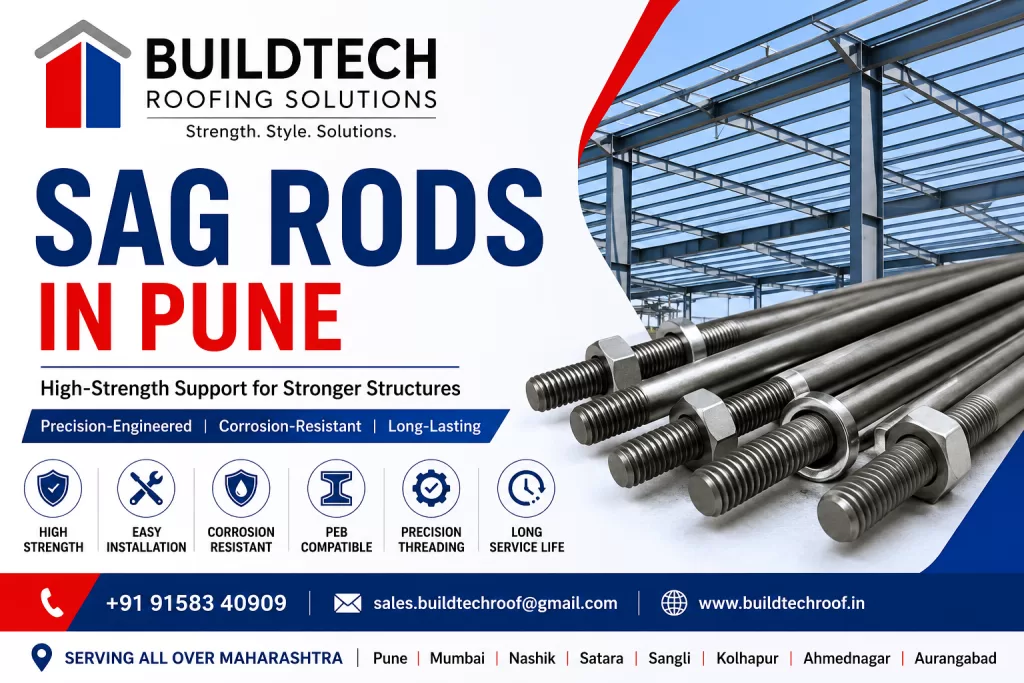
Sag Rods in Pune for High-Strength PEB Support Systems
Introduction
Modern industrial buildings demand structural systems that are not only strong and durable but also engineered for long-term stability. Every component in a Pre-Engineered Building (PEB) plays an important role in maintaining the integrity and performance of the structure. While primary members such as columns and rafters receive most of the attention, secondary structural components like Sag Rods are equally essential for ensuring the stability of roofing and wall systems.
Sag Rods are widely used in industrial sheds, warehouses, manufacturing plants, logistics centres, commercial buildings, and agricultural structures. They help maintain the alignment of purlins, reduce deflection, distribute loads efficiently, and improve the overall structural performance of a PEB building.
Without properly designed Sag Rods, roofing systems may experience excessive movement, uneven loading, or structural instability under wind and other environmental conditions.
Buildtech Roofing Solutions is one of the trusted suppliers of Sag Rods in Pune, offering precision-manufactured steel Sag Rods designed for modern industrial and commercial construction projects across Maharashtra. Our products are manufactured using high-quality steel, ensuring excellent strength, corrosion resistance, and long service life.
Whether you are constructing a new PEB warehouse, expanding an industrial shed, or upgrading an existing steel structure, Buildtech Roofing Solutions provides complete support with premium-quality Sag Rods and related structural accessories.
What are Sag Rods?
Sag Rods are high-strength threaded steel rods installed between adjacent roof purlins or wall girts to prevent excessive sagging, twisting, or lateral movement. They serve as secondary structural members that improve the stability and rigidity of the roofing framework.
Although relatively simple in design, Sag Rods perform a critical engineering function by maintaining the proper spacing and alignment of structural members. They also help transfer and distribute loads evenly throughout the roof structure.
Sag Rods are typically manufactured from Mild Steel (MS) or Galvanised Iron (GI) and are supplied with threaded ends, nuts, washers, and fixing accessories for quick installation.
How Sag Rods Work
Sag Rods connect adjacent purlins or girts, creating a stable framework that resists movement caused by:
- Wind pressure
- Roof dead loads
- Live loads
- Thermal expansion
- Structural vibration
- Construction tolerances
By tying structural members together, Sag Rods reduce bending stress and improve the overall stiffness of the roofing system.
Importance of Sag Rods in PEB Structures
A modern Pre-Engineered Building consists of many interconnected structural components. While primary members carry the major structural loads, secondary members, such as purlins, require additional support to perform efficiently.
Sag Rods provide that support by:
- Maintaining purlin alignment
- Preventing lateral displacement
- Minimising structural deformation
- Reducing deflection
- Improving roof stability
- Increasing structural safety
- Supporting long-span roof systems
Without Sag Rods, purlins may experience excessive movement, particularly during high winds or heavy rainfall, which can affect roofing performance and reduce the lifespan of the structure.
Why Sag Rods are Essential for Industrial Buildings
Industrial buildings are subjected to demanding operating conditions, including:
- Heavy wind loads
- Crane vibrations
- Equipment-induced vibrations
- Thermal expansion and contraction
- Dynamic loading
- Continuous operational stress
Sag Rods improve the building’s ability to withstand these conditions while maintaining structural stability.
They are commonly installed in:
- PEB Structures
- Industrial Sheds
- Warehouses
- Manufacturing Plants
- Logistics Parks
- Commercial Buildings
- Agricultural Buildings
- Cold Storage Facilities
- Workshop Buildings
- Engineering Industries
Key Benefits of Sag Rods
1. Improved Structural Stability
The primary purpose of Sag Rods is to stabilise purlins and wall girts.
Benefits include:
- Reduced structural movement
- Better load distribution
- Increased rigidity
- Enhanced safety
2. Reduced Purlin Deflection
Long-span purlins naturally tend to bend under load.
Sag Rods:
- Reduce sagging
- Minimize deformation
- Improve load sharing
- Extend structural life
3. Better Wind Resistance
Industrial roofing systems are constantly exposed to strong wind pressure.
Properly installed Sag Rods help:
- Resist uplift forces
- Improve lateral stability
- Prevent purlin twisting
- Reduce vibration
4. Longer Roof Life
Stable purlins create a more reliable roofing system.
This results in:
- Better sheet alignment
- Reduced fastener stress
- Fewer roof leaks
- Lower maintenance costs
5. Cost-Effective Solution
Despite being a relatively small structural component, Sag Rods significantly improve building performance.
Advantages include:
- Low installation cost
- High structural value
- Minimal maintenance
- Long service life
6. Faster Installation
Sag Rods are supplied with threaded ends for quick installation.
Advantages:
- Easy alignment
- Reduced labour
- Faster erection
- Improved construction efficiency
7. Increased Structural Safety
Proper bracing minimises unwanted movement throughout the roofing system.
This improves:
- Worker safety
- Building performance
- Roof reliability
- Structural durability
Types of Sag Rods
Different projects require different Sag Rod configurations depending on span, loading conditions, and structural design.
1. Mild Steel (MS) Sag Rods
The most commonly used option for industrial buildings.
Features
- High tensile strength
- Economical
- Easy fabrication
- Suitable for painted structures
Applications
- Warehouses
- Industrial sheds
- PEB buildings
- Manufacturing plants
2. Galvanised Sag Rods
Manufactured using galvanised steel for improved corrosion resistance.
Advantages
- Rust resistant
- Longer lifespan
- Low maintenance
- Suitable for humid environments
Applications
- Coastal projects
- Food processing units
- Chemical plants
- Fertilizer industries
3. Threaded Sag Rods
Supplied with precision-machined threads at both ends.
Benefits
- Easy installation
- Accurate adjustment
- Secure tightening
- Reliable structural performance
4. Heavy-Duty Sag Rods
Designed for larger spans and heavy industrial loads.
Ideal For
- Heavy engineering plants
- Steel fabrication workshops
- Large warehouses
- High-bay industrial buildings
5. Custom Fabricated Sag Rods
Manufactured according to project-specific requirements.
Available in:
- Custom lengths
- Various diameters
- Different thread sizes
- Special coatings
These are ideal for unique PEB designs and specialised industrial applications.
Common Applications
Sag Rods are extensively used in:
- PEB Structures
- Industrial Warehouses
- Factory Buildings
- Logistics Parks
- Manufacturing Units
- Commercial Buildings
- Cold Storage Facilities
- Agricultural Structures
- Engineering Workshops
- Steel Building Projects
Technical Specifications of Sag Rods
The performance of a Sag Rod depends on its material quality, dimensions, thread accuracy, and installation. Properly manufactured Sag Rods ensure structural stability while maintaining the alignment of purlins and girts in Pre-Engineered Buildings (PEBs).
Standard Material Grades
Buildtech Roofing Solutions supplies Sag Rods manufactured from premium-quality steel conforming to industry standards.
Typical material grades include:
- IS 2062 E250 Mild Steel
- IS 2062 E350 Mild Steel
- High Tensile Steel (Project Specific)
- Galvanised Steel (GI)
These materials provide excellent mechanical strength, weldability, and long-term durability.
Available Diameters
Sag Rods are available in multiple diameters depending on structural requirements.
Common sizes include:
- 10mm
- 12mm
- 16mm
- 20mm
- 24mm
Custom diameters are also available for heavy-duty industrial applications.
Standard Lengths
Sag Rod lengths vary according to roof span and purlin spacing.
Typical lengths include:
- 1.5 meter
- 2.0 meter
- 2.5 meter
- 3.0 meter
- 4.0 meter
Custom-cut lengths can be supplied for project-specific requirements.
Thread Specifications
Precision threading ensures secure installation and easy adjustment.
Available options:
- Full Thread
- Half Thread
- Double-End Thread
- Custom Thread Length
High-quality threads allow accurate tensioning and improve installation efficiency.
Surface Finish Options
Depending on the project environment, Sag Rods are available with different protective finishes.
Mill Finish
Suitable for indoor structural applications where additional coating is provided after installation.
Primer Coated
Provides temporary protection during transportation and construction.
Advantages:
- Improved corrosion resistance
- Ready for final painting
- Better storage life
Hot-Dip Galvanized
Recommended for:
- Coastal Areas
- Chemical Plants
- Food Processing Units
- Fertilizer Plants
- High-Humidity Environments
Benefits include:
- Superior corrosion resistance
- Longer service life
- Reduced maintenance
Mechanical Properties
Premium Sag Rods offer:
- High Tensile Strength
- Excellent Yield Strength
- Superior Ductility
- Good Impact Resistance
- Reliable Fatigue Performance
- Excellent Thread Strength
These properties ensure long-term structural performance under dynamic loading conditions.
Manufacturing Process
Quality manufacturing plays a vital role in ensuring the performance of Sag Rods.
Step-1 – Raw Material Inspection
Only certified steel is selected after checking:
- Chemical composition
- Material grade
- Surface quality
- Dimensional accuracy
Step-2 – Cutting
Steel rods are cut using precision machinery to achieve the required project length.
This ensures:
- Accurate dimensions
- Minimal wastage
- Better fitment
Step-3 – Threading
Threads are produced using precision threading machines.
Benefits include:
- Smooth installation
- Secure fastening
- Accurate alignment
- Reliable load transfer
Step-4 – Straightness Inspection
Every rod is checked for:
- Straightness
- Surface defects
- Thread accuracy
- Dimensional tolerance
Step-5 – Surface Treatment
Depending on customer requirements, rods are:
- Painted
- Primer coated
- Galvanized
- Oil protected
Step-6 – Final Quality Inspection
Before dispatch, each batch undergoes inspection for:
- Diameter
- Length
- Thread quality
- Surface finish
- Material certification
Accessories Used with Sag Rods
A complete Sag Rod assembly includes several accessories for proper installation.
Hex Nuts
Provide secure tightening and allow adjustment during installation.
Flat Washers
Help distribute tightening pressure and protect structural members.
Spring Washers
Prevent loosening caused by vibration.
Cleats
Support rod positioning and ensure accurate alignment.
Brackets
Used where special structural arrangements are required.
High-Tensile Fasteners
Provide reliable structural connections.
Installation Process
Proper installation is essential for achieving the designed structural performance.
Step-1 – Structural Layout
The engineering team marks Sag Rod locations according to approved structural drawings.
Step-2 – Purlin Alignment
Roof purlins are aligned and temporarily fixed.
Step-3 – Rod Positioning
Sag Rods are installed between adjacent purlins using the specified fixing arrangement.
Step-4 – Nut Tightening
Both ends are tightened uniformly to maintain structural alignment.
Step-5 – Level Checking
Engineers verify:
- Purlin spacing
- Straightness
- Roof alignment
- Structural geometry
Step-6 – Final Inspection
The completed installation is checked for:
- Tightness
- Stability
- Thread engagement
- Proper positioning
Sag Rods vs Tie Rods
| Feature | Sag Rod | Tie Rod |
|---|---|---|
| Primary Purpose | Supports purlins | Supports structural bracing |
| Installation | Between purlins | Between structural frames |
| Function | Prevents sagging | Resists tensile forces |
| Load Type | Secondary support | Structural load transfer |
| Application | Roof systems | Main steel framework |
Although both are steel rods, their functions within a building are different, and they are not interchangeable.
Sag Rods vs Roof Bracing
| Feature | Sag Rod | Roof Bracing |
|---|---|---|
| Location | Between purlins | Across structural bays |
| Function | Controls purlin movement | Stabilises the building frame |
| Installation | Horizontal | Diagonal |
| Purpose | Reduce deflection | Resist lateral loads |
| Importance | Secondary member support | Primary structural stability |
Both systems work together to improve the overall performance of a PEB structure.
Quality Standards
Buildtech Roofing Solutions supplies Sag Rods manufactured in accordance with applicable Indian and project-specific standards.
Quality checks include:
- Material Traceability
- Dimensional Accuracy
- Thread Inspection
- Tensile Strength Verification
- Surface Finish Inspection
- Corrosion Protection Assessment
This ensures reliable performance and compatibility with modern industrial roofing and PEB systems.
Advantages of Precision-Manufactured Sag Rods
Choosing accurately manufactured Sag Rods provides several long-term benefits:
- Improved structural alignment
- Better load distribution
- Faster installation
- Reduced maintenance
- Increased service life
- Enhanced roof stability
- Better overall PEB performance
Compatibility with Other Buildtech Products
Sag Rods integrate seamlessly with:
- Z Purlins
- C Purlins
- Structural Steel Sections
- PEB Structures
- Colour Coated Roofing Sheets
- Galvalume Roofing Sheets
- Standing Seam Roofing
- Decking Sheets
- Ridge Ventilators
- Turbo Ventilators
- Roof Louvers
- Polycarbonate Sheets
Using compatible components from a single supplier helps ensure proper fitment and efficient installation across the entire roofing and structural system.
Applications of Sag Rods
Sag Rods are an essential component in steel structures where roof purlins and wall girts require additional lateral support. Although small compared to primary structural members, they play a significant role in improving the stability, alignment, and overall performance of industrial roofing systems.
Buildtech Roofing Solutions supplies high-quality Sag Rods suitable for a wide range of industrial and commercial construction projects.
1. Pre-Engineered Buildings (PEB)
Sag Rods are one of the most important secondary structural components in modern PEB construction.
They help:
- Maintain purlin alignment
- Reduce roof deflection
- Increase structural rigidity
- Improve roof stability
- Enhance overall building performance
Applications include:
- Industrial PEB Buildings
- Commercial PEB Structures
- Logistics Parks
- Manufacturing Units
2. Industrial Sheds
Industrial sheds often have large roof spans that require additional support between purlins.
Sag Rods provide:
- Better load distribution
- Reduced purlin movement
- Improved roofing performance
- Enhanced structural safety
Typical industries include:
- Engineering Industries
- Automobile Plants
- Textile Industries
- Pharmaceutical Units
3. Warehouses
Modern warehouses require lightweight yet strong roofing systems.
Sag Rods help maintain the structural integrity of long-span warehouse roofs.
Benefits include:
- Better roof alignment
- Increased durability
- Reduced maintenance
- Improved structural performance
4. Factory Buildings
Factories experience constant vibration from machinery and production equipment.
Sag Rods improve structural stability by minimising unwanted movement in roof framing systems.
Suitable for:
- Heavy Engineering
- Food Processing
- Chemical Industries
- Packaging Units
- Electronics Manufacturing
5. Commercial Buildings
Steel-framed commercial buildings also benefit from Sag Rod systems.
Applications include:
- Shopping Complexes
- Commercial Complexes
- Exhibition Halls
- Office Buildings
- Retail Showrooms
6. Agricultural Buildings
Agricultural structures require economical yet durable roofing support systems.
Common applications include:
- Poultry Farms
- Dairy Farms
- Cattle Sheds
- Storage Buildings
- Agricultural Warehouses
7. Logistics & Distribution Centres
Large-span logistics facilities depend on properly aligned roofing systems for long-term reliability.
Sag Rods contribute to:
- Structural stability
- Reduced maintenance
- Better roofing performance
- Longer building life
8. Cold Storage Buildings
Cold storage projects require precision-engineered steel framing.
Sag Rods help maintain alignment while supporting insulated roofing systems.
Industries Served
Buildtech Roofing Solutions supplies Sag Rods for numerous industries throughout Maharashtra.
Our customers include:
- Manufacturing Industries
- Warehousing Companies
- Automobile Industries
- Pharmaceutical Companies
- Food Processing Units
- Textile Industries
- Engineering Companies
- Chemical Plants
- Logistics Companies
- Cold Storage Facilities
- Commercial Developers
- Infrastructure Contractors
- Agricultural Projects
- Educational Institutions
- Government Projects
Advantages of Using Buildtech Sag Rods
Every Sag Rod supplied by Buildtech Roofing Solutions is manufactured with precision and designed for dependable performance.
High Structural Strength
Manufactured using premium-quality steel for superior load-bearing performance.
Precision Threading
Accurate threads provide:
- Faster installation
- Better tightening
- Reliable structural connections
Corrosion Resistance
Available with:
- Primer Coating
- Painted Finish
- Hot-Dip Galvanizing
Suitable for demanding industrial environments.
Excellent Dimensional Accuracy
Each rod is manufactured to precise specifications, ensuring easy installation and proper alignment.
Long Service Life
Premium raw materials and protective finishes contribute to a long operational lifespan with minimal maintenance.
Cost-Effective Solution
Sag Rods provide excellent value by improving roof stability and reducing long-term maintenance costs.
Factors Affecting Sag Rod Selection
Selecting the right Sag Rod depends on several engineering considerations.
Building Span
Larger roof spans may require:
- Larger rod diameters
- Additional Sag Rod rows
- Heavier-duty configurations
Wind Load
High-wind zones require enhanced support to resist uplift and lateral forces.
Roof Design
The type of roofing system influences Sag Rod spacing and placement.
Compatible roof systems include:
- Colour Coated Roofing Sheets
- Galvalume Roofing Sheets
- Standing Seam Roofing
- Double Skin Roofing
- Insulated Roofing Panels
Purlin Spacing
The spacing between Z and C Purlins determines:
- Rod length
- Thread size
- Quantity required
Environmental Conditions
Projects in coastal or corrosive environments often benefit from galvanised Sag Rods for improved durability.
Cost Factors in Pune
The cost of Sag Rods depends on several project-specific factors.
These include:
- Steel grade
- Rod diameter
- Length
- Surface finish
- Galvanised or painted option
- Quantity ordered
- Installation requirements
- Transportation distance
- Project location
For accurate pricing, a structural drawing and bill of quantities (BOQ) are typically reviewed before preparing a quotation.
Maintenance Tips
Although Sag Rods require minimal maintenance, periodic inspections help maximise service life.
Inspect Connections
Check nuts, washers, and threaded joints for tightness during routine maintenance.
Monitor Corrosion
Inspect exposed rods for signs of rust, particularly in aggressive environments.
Reapply Protective Coatings
Where required, repaint or touch up protective coatings to maintain corrosion resistance.
Check Structural Alignment
During scheduled inspections, verify that purlins remain properly aligned and that Sag Rods are functioning as intended.
Replace Damaged Components
Replace bent, damaged, or excessively corroded Sag Rods promptly to maintain structural performance.
Why Choose Buildtech Roofing Solutions?
Buildtech Roofing Solutions is committed to delivering high-quality roofing and structural solutions tailored to industrial and commercial projects.
Our Strengths
- Premium Quality Steel Products
- Precision Manufacturing
- Complete PEB Solutions
- Experienced Engineering Team
- Customized Fabrication
- Competitive Pricing
- Timely Delivery
- Professional Installation Support
- Quality Assurance
- After-Sales Assistance
Service Areas
Buildtech Roofing Solutions proudly serves customers across Maharashtra, including:
- Pune
- Mumbai
- Nashik
- Nagpur
- Kolhapur
- Satara
- Sangli
- Ahmednagar
- Aurangabad
- Solapur
- Thane
- Ratnagiri
- Jalgaon
- Amravati
We also serve MIDC industrial zones and surrounding industrial clusters throughout the state.
Frequently Asked Questions (FAQs)
1. What are Sag Rods used for?
Sag Rods are steel rods installed between roof purlins or wall girts to improve structural stability, reduce sagging, maintain alignment, and distribute loads efficiently in Pre-Engineered Buildings (PEBs), industrial sheds, and warehouses.
2. Which material is best for Sag Rods?
High-quality Mild Steel (MS) and Galvanised Iron (GI) are the most commonly used materials. Galvanised Sag Rods are preferred for coastal, humid, or corrosive environments because of their superior rust resistance.
3. Are Sag Rods required in PEB structures?
Yes. Sag Rods are an important secondary structural component in PEB systems. They help stabilise purlins, reduce lateral movement, and improve the overall rigidity and performance of the roofing system.
4. What sizes of Sag Rods are available?
Common diameters include:
- 10mm
- 12mm
- 16mm
- 20mm
- 24mm
Custom sizes and lengths can also be manufactured according to project requirements.
5. What is the difference between Sag Rods and Tie Rods?
Sag Rods primarily support roof purlins and reduce deflection, while Tie Rods are designed to resist tensile forces within the primary structural framework. Although both are steel rods, they serve different structural functions.
6. Can Sag Rods be galvanised?
Yes. Hot-dip galvanised Sag Rods provide excellent corrosion resistance and are recommended for chemical plants, coastal regions, food processing facilities, and other aggressive environments.
7. How long do Sag Rods last?
When manufactured from quality steel and installed correctly, Sag Rods can provide reliable performance for decades. Regular inspections and appropriate protective coatings help maximise their service life.
8. Do Sag Rods require regular maintenance?
Maintenance requirements are minimal. Periodic inspections should include checking for corrosion, ensuring nuts and washers remain tight, and replacing any damaged components.
9. Can Buildtech Roofing Solutions supply custom Sag Rods?
Yes. Buildtech Roofing Solutions offers customised Sag Rods in project-specific diameters, lengths, thread configurations, and protective finishes to meet individual engineering requirements.
10. Which industries commonly use Sag Rods?
Sag Rods are widely used in:
- Pre-Engineered Buildings (PEBs)
- Industrial sheds
- Warehouses
- Manufacturing plants
- Logistics parks
- Commercial buildings
- Cold storage facilities
- Agricultural structures
- Engineering workshops
- Infrastructure projects
Conclusion
Sag Rods are a vital component of modern steel building systems. Although relatively small compared with primary structural members, they contribute significantly to the stability, durability, and long-term performance of industrial roofing systems. By reducing purlin deflection, improving load distribution, and maintaining structural alignment, Sag Rods enhance the reliability and safety of Pre-Engineered Buildings, warehouses, factories, and commercial structures.
Choosing precision-manufactured Sag Rods helps reduce maintenance costs, improve roofing performance, and extend the lifespan of the entire building. Whether your project involves a new industrial shed, a warehouse expansion, or a large-scale PEB installation, selecting the correct Sag Rod system is an important part of achieving a durable and efficient structure.
Buildtech Roofing Solutions, Pune, supplies premium-quality MS and GI Sag Rods manufactured to industry standards. Backed by experienced technical support, customised fabrication, and dependable project assistance, we help customers across Maharashtra build stronger, safer, and longer-lasting steel structures.