
📖 Introduction
Industrial buildings generate significant amounts of heat from machinery, manufacturing processes, lighting systems, and environmental conditions. Excessive indoor temperatures can reduce employee productivity, increase energy consumption, and negatively impact equipment performance.
Modern factories and warehouses require efficient ventilation systems that remove trapped heat while maintaining continuous airflow.
One of the most effective and energy-efficient ventilation solutions available today is the Turbo Ventilator System.
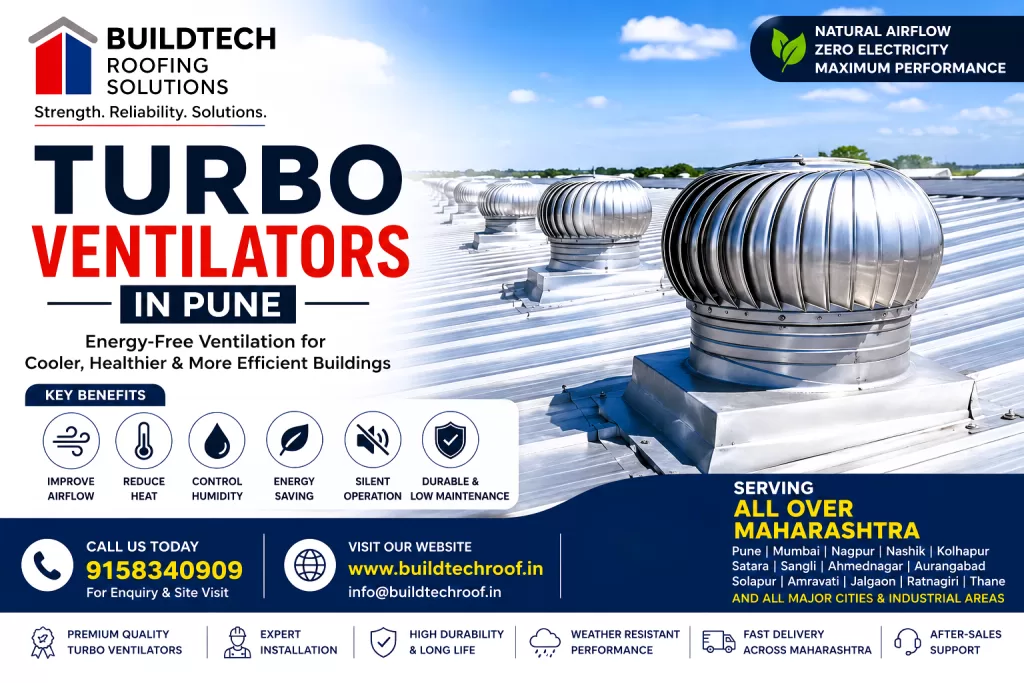
Turbo Ventilators in Pune are widely used across factories, warehouses, logistics centres, engineering facilities, food processing plants, pharmaceutical units, and commercial buildings to improve air circulation without consuming electricity.
Buildtech Roofing Solutions provides premium-quality Turbo Ventilator systems designed to improve workplace comfort, reduce heat buildup, and support sustainable industrial infrastructure across Maharashtra.
What Are Turbo Ventilators?
Turbo ventilators are roof-mounted ventilation devices that use natural wind energy and thermal pressure differences to remove hot air, fumes, moisture, and stale air from industrial buildings.
Turbo ventilators operate without electricity, while powered exhaust systems rely on electrical energy. This distinction highlights the efficiency of turbo ventilators, as they can function effectively even in remote areas where electricity may not be available. By harnessing natural airflow, they reduce energy costs, making them an environmentally friendly choice. The choice between turbo ventilators and powered systems often depends on specific needs and available resources.
The rotating turbine head creates negative pressure, pulling hot air upward and exhausting it from the building.
How Turbo Ventilators Work
Turbo ventilators operate using two natural principles:
Wind Energy
Turbo ventilators operate without electricity, unlike powered exhaust systems.
Thermal Air Movement
Hot air naturally rises toward the roof.
The rotating ventilator extracts this accumulated hot air and releases it outside.
Continuous Ventilation Cycle
- Fresh air enters through louvers and openings.
- Heat rises toward the roof.
- The Turbo ventilator rotates.
- Hot air is exhausted.
- Fresh air replaces stale air.
This creates a healthier and cooler indoor environment.
Key Benefits of Turbo Ventilators
1. No Electricity Required
Turbo ventilators operate completely on natural wind energy.
Benefits include:
- ✔ Zero operating cost
- ✔ No power consumption
- ✔ Sustainable ventilation
2. Significant Heat Reduction
Industrial buildings often experience temperatures exceeding 50°C under metal roofs.
Turbo ventilators help:
- ✔ Remove trapped heat
- ✔ Improve worker comfort
- ✔ Reduce roof heat buildup
3. Improved Indoor Air Quality
Removes:
- Dust
- Smoke
- Fumes
- Moisture
- Hot air
Resulting in a healthier workspace.
4. Reduced Humidity
Humidity causes:
- Corrosion
- Mold growth
- Product damage
Turbo ventilators help maintain better environmental conditions.
5. Increased Worker Productivity
Comfortable temperatures contribute to:
- ✔ Better efficiency
- ✔ Improved concentration
- ✔ Reduced heat stress
6. Environment Friendly
Turbo ventilators reduce dependence on:
- Air conditioners
- Exhaust fans
- Mechanical ventilation
Supporting green building practices.
7. Low Maintenance
Minimal moving components ensure:
- ✔ Long lifespan
- ✔ Reliable performance
- ✔ Low maintenance costs
Types of Turbo Ventilators
Aluminium Turbo Ventilators
Most common industrial solution.
Benefits:
- Corrosion resistant
- Lightweight
- Durable
Stainless Steel Turbo Ventilators
Ideal for:
- Chemical industries
- Pharmaceutical plants
- Food processing facilities
Advantages:
- Superior corrosion resistance
- Long service life
Heavy-Duty Industrial Turbo Ventilators
Designed for:
- Large factories
- Manufacturing plants
- High-heat environments
Polycarbonate Base Turbo Ventilators
Suitable for:
- Skylight integration
- Daylight applications
Components of a Turbo Ventilator System
Turbine Head
Captures wind energy.
Bearings
Enable smooth rotation.
Central Shaft
Transfers rotational movement.
Base Plate
Secures the unit to roofing structures.
Flashing System
Provides waterproof installation.
Applications of Turbo Ventilators
Manufacturing Plants
Removes machinery-generated heat.
Warehouses
Improves airflow and storage conditions.
Food Processing Industries
Supports hygiene and ventilation requirements.
Pharmaceutical Units
Maintains fresh airflow.
Textile Industries
Controls humidity and heat.
Engineering Facilities
Enhances worker comfort.
Logistics Centers
Improves warehouse ventilation.
Commercial Buildings
Supports sustainable ventilation design.
The Turbo Ventilators vs Exhaust Fans
| Feature | Turbo Ventilator | Exhaust Fan |
|---|---|---|
| Electricity | No | Yes |
| Operating Cost | Zero | Continuous |
| Maintenance | Low | Moderate |
| Noise | Silent | Audible |
| Environmental Impact | Low | Higher |
Turbo ventilators provide long-term energy savings.
The Turbo Ventilators vs Ridge Ventilators
| Feature | Turbo Ventilator | Ridge Ventilator |
|---|---|---|
| Air Extraction | Excellent | Excellent |
| Wind Utilization | Yes | Passive |
| Installation | Point-Based | Continuous Roof Ridge |
| Cost | Moderate | Higher |
Both systems can work together for maximum ventilation.
Importance of Proper Roof Ventilation
Proper ventilation helps:
- ✔ Reduce indoor temperatures
- ✔ Improve equipment lifespan
- ✔ Prevent condensation
- ✔ Improve employee comfort
- ✔ Lower energy costs
- ✔ Protect stored materials
Turbo Ventilator Installation Process
Step-1 – Site Inspection
Analyse roof structure and ventilation requirements.
Step-2 – Ventilation Design
Calculate the required ventilator quantity.
Step-3 – Roof Marking
Determine installation locations.
Step-4 – Roof Cutting
Create openings as per specifications.
Step-5 – Base Installation
Secure ventilator base.
Step-6 – Waterproof Sealing
Apply flashing and sealants.
Step 7 – Final Testing
Verify smooth rotation and airflow.
Common Problems Solved by Turbo Ventilators
Excessive Heat
Continuous hot-air extraction.
Poor Air Circulation
Improves airflow.
High Humidity
Reduces moisture buildup.
Condensation Issues
Minimises water vapour accumulation.
Employee Discomfort
Creates a healthier workplace.
Maintenance Tips
To maximise performance:
- ✔ Clean annually
- ✔ Inspect bearings
- ✔ Remove debris
- ✔ Check flashing systems
- ✔ Verify smooth rotation
Cost of Turbo Ventilators in Pune
Pricing depends on:
- Material
- Size
- Bearing quality
- Roof height
- Installation requirements
Approximate Cost Range
₹3,500 – ₹15,000 per unit
Installation charges vary based on project scope.
Why Choose Buildtech Roofing Solutions?
Buildtech Roofing Solutions provides customised industrial ventilation systems designed for maximum performance.
Our Advantages
- ✔ Premium Turbo Ventilators
- ✔ Expert Installation Team
- ✔ Industrial Ventilation Expertise
- ✔ Fast Project Execution
- ✔ Competitive Pricing
- ✔ Service Across Maharashtra
- ✔ Complete Roofing & Ventilation Solutions
Industries Served
- Manufacturing Plants
- Warehouses
- Engineering Industries
- Food Processing Units
- Pharmaceutical Facilities
- Textile Industries
- Commercial Buildings
- Logistics Centers
Service Areas
Pune
Mumbai
Nagpur
Nashik
Kolhapur
Satara
Sangli
Ahmednagar
Aurangabad
Solapur
Amravati
Jalgaon
Ratnagiri
Thane
And All Over Maharashtra
Conclusion
Turbo Ventilators are among the most cost-effective and energy-efficient ventilation solutions available for industrial and commercial buildings. Utilising natural wind energy removes heat, humidity, and stale air while lowering operating costs and improving workplace comfort.
For businesses looking for Turbo Ventilators in Pune and across Maharashtra, Buildtech Roofing Solutions offers high-quality products, expert installation, and customised ventilation solutions tailored to industrial requirements.