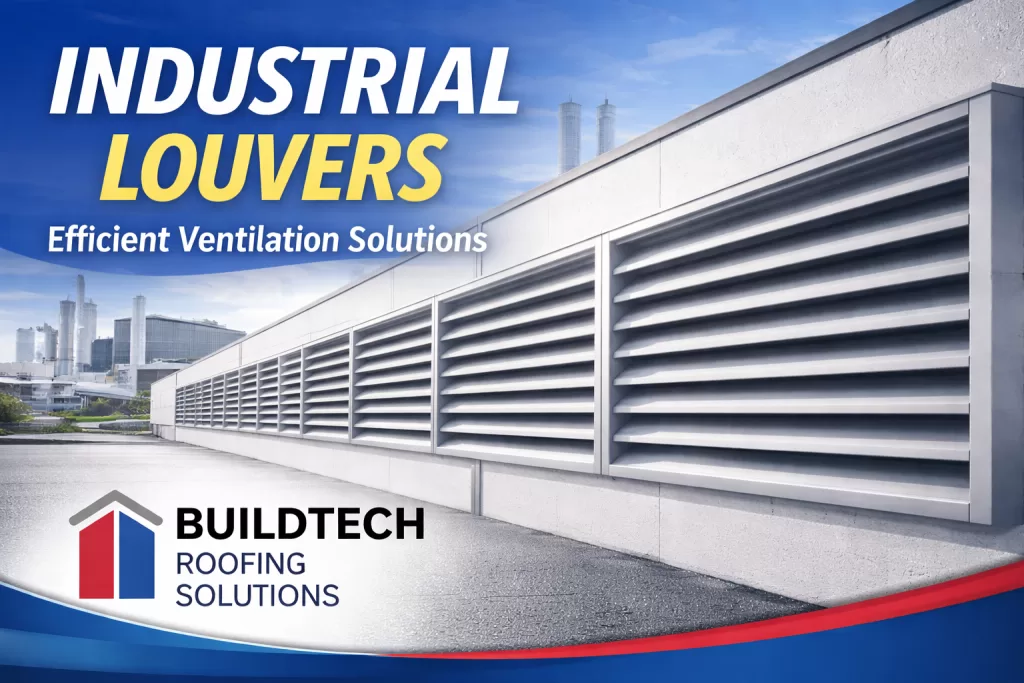
Industrial Louvers – Efficient Ventilation Solutions for Modern Industrial Buildings
Introduction Proper ventilation is essential for maintaining a safe, comfortable, and productive industrial environment. Without effective airflow management, factories and warehouses can suffer from heat buildup, moisture accumulation, and poor air quality. Industrial louvers are one of the most reliable solutions for controlling airflow while protecting buildings from rain, dust, and external elements. At Buildtech Roofing Solutions, we design and supply high-quality industrial louvers that combine durability, efficiency, and custom engineering to suit diverse industrial applications. What Are Industrial Louvers? Industrial louvers are fixed or adjustable slatted structures installed on walls, roofs, or ventilation openings. Their primary function is to allow fresh air to enter and stale air to exit while preventing rainwater, debris, and excessive sunlight from entering the building. They are widely used in factories, warehouses, power plants, and commercial buildings where controlled ventilation is required. Why Industrial Louvers Are Important Efficient ventilation directly impacts building performance and workforce comfort. Industrial louvers help: As a result, buildings equipped with proper louvers experience improved operational efficiency and reduced maintenance costs. Types of Industrial Louvers 1. Fixed Louvers Fixed louvers are permanently angled slats that provide continuous airflow. They are cost-effective and ideal for areas where constant ventilation is required. 2. Adjustable Louvers Adjustable louvers allow control over airflow direction and volume. These are suitable for areas requiring variable ventilation depending on weather or operational needs. 3. Weatherproof Louvers Designed with special blade profiles, weatherproof louvers block rain penetration while maintaining airflow efficiency. 4. Acoustic Louvers Used in noise-sensitive zones, acoustic louvers reduce sound transmission while ensuring proper ventilation. Materials Used in Industrial Louvers Buildtech Roofing Solutions manufactures louvers using high-quality materials such as: These materials offer excellent corrosion resistance, strength, and long-term durability in harsh industrial environments. Key Features of Buildtech Industrial Louvers Each louver system is fabricated to meet specific project requirements. Applications of Industrial Louvers Industrial louvers are suitable for a wide range of applications, including: They can be integrated seamlessly with roofing, wall cladding, and ventilation systems. Technical Specifications (Typical) Parameter Specification Material GI / PPGI / PPGL / Aluminium Thickness 0.45 – 0.80 mm Blade Type Z-type / Aerofoil Finish Galvanized / Colour-coated Installation Wall-mounted / Panel-mounted Customization Size & colour as required Installation Best Practices Proper installation ensures optimal performance and longevity. Buildtech follows industry best practices such as: Why Choose Buildtech Roofing Solutions Buildtech Roofing Solutions is a trusted name in industrial roofing and ventilation systems. Clients choose us for: Our industrial louvers are designed to perform reliably in demanding environments. Integration with Complete Roofing Systems Industrial louvers work best when integrated with a complete roofing solution. Buildtech also supplies: This integrated approach ensures compatibility, efficiency, and long-term value. Conclusion Industrial louvers play a crucial role in maintaining airflow, protecting structures, and enhancing indoor comfort in industrial buildings. With Buildtech Roofing Solutions, you get durable, efficient, and customized louver systems engineered for performance and reliability. For expert consultation and installation support, Buildtech Roofing Solutions delivers ventilation solutions you can trust. 📞 Contact Buildtech Roofing Solutions 📞 Phone: 9158340909📩 Get in touch today to discuss your industrial louver requirements.
Industrial Louvers – Efficient Ventilation Solutions for Modern Industrial Buildings Read More »