
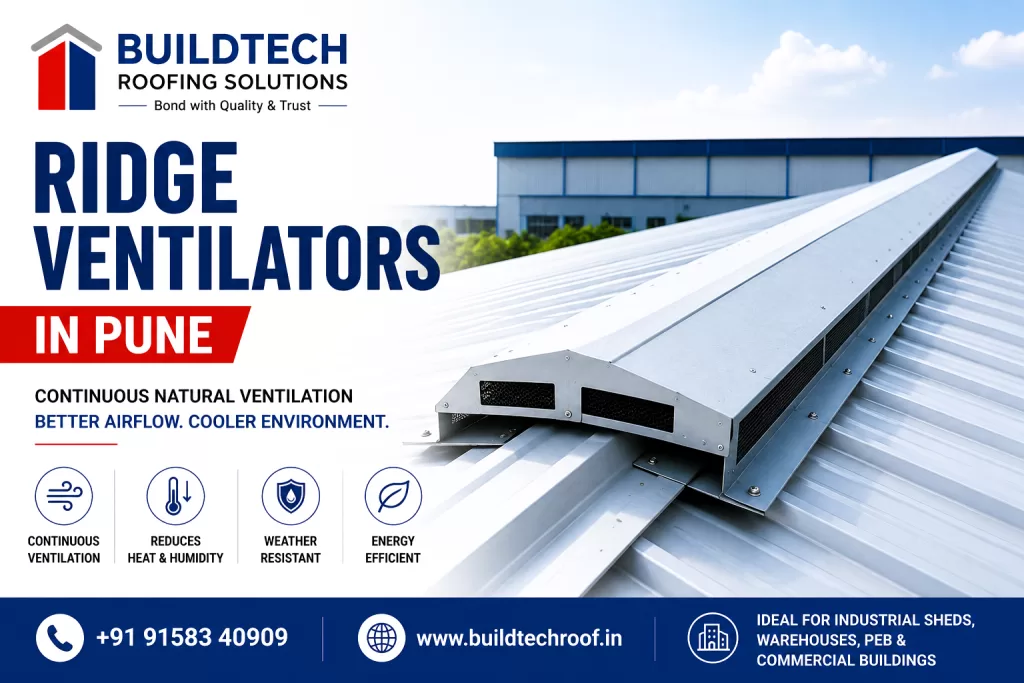
Ridge Ventilators in Pune for Industrial Roof Ventilation
Introduction
Proper roof ventilation is essential for maintaining a comfortable, safe, and energy-efficient industrial building. During daily operations, factories, warehouses, manufacturing plants, logistics parks, and Pre-Engineered Buildings (PEBs) generate significant amounts of heat, moisture, fumes, and dust. If this trapped hot air is not removed efficiently, it can increase indoor temperatures, reduce worker productivity, affect machinery performance, and shorten the life of roofing materials.
A Ridge Ventilator is one of the most effective passive ventilation systems designed to provide continuous airflow across the entire length of a building’s roof ridge. Unlike individual roof-mounted ventilators, Ridge Ventilators create uniform ventilation by allowing hot air to escape naturally through the highest point of the roof while preventing rainwater from entering.
At Buildtech Roofing Solutions, Pune, we manufacture and supply high-performance Ridge Ventilators designed for industrial sheds, warehouses, factories, commercial buildings, and PEB structures throughout Maharashtra. Our systems are engineered for durability, weather resistance, and efficient natural ventilation without consuming electricity.
Whether you are planning a new industrial project or upgrading an existing building, installing a Ridge Ventilator can significantly improve indoor air quality, reduce heat buildup, and lower long-term operating costs.
What is a Ridge Ventilator?
A Ridge Ventilator is a continuous roof ventilation system installed along the ridge (highest point) of a sloped roof. It allows naturally rising hot air, humidity, smoke, and stale air to escape while preventing rainwater, birds, and debris from entering the building.
Unlike powered exhaust systems, Ridge Ventilators operate using natural thermal convection and wind pressure, providing energy-efficient ventilation without electrical power.
Why Ridge Ventilators are Important
Industrial buildings generate large amounts of heat from:
- Manufacturing machinery
- Welding operations
- Boilers and furnaces
- Solar heat gain
- Industrial processing
- Large equipment
Without proper ventilation, this heat becomes trapped beneath the roof.
A Ridge Ventilator continuously removes this hot air, helping to:
- Improve indoor comfort
- Reduce roof temperatures
- Control humidity
- Minimise condensation
- Improve air quality
- Protect machinery and stored materials
- Reduce cooling costs
Working Principle of Ridge Ventilators
Ridge Ventilators work on the principle of natural convection.
Step-1 – Heat Generation
Heat produced inside the building rises naturally towards the roof.
Step-2 – Air Movement
Warm air accumulates beneath the roof ridge, creating upward air pressure.
Step-3 – Natural Exhaust
The Ridge Ventilator provides a continuous opening along the roof ridge, allowing the hot air to escape naturally.
Step-4 – Fresh Air Intake
As hot air exits, fresh air enters the building through wall louvers, doors, windows, or intake vents, creating a continuous natural airflow cycle.
Advantages of Ridge Ventilators
Continuous Roof Ventilation
Unlike point ventilation systems, Ridge Ventilators provide ventilation across the entire roof length.
Electricity-Free Operation
No motors or electrical components are required, reducing energy consumption and maintenance costs.
Heat Reduction
Continuous hot-air extraction helps lower indoor temperatures and improve employee comfort.
Moisture Control
Ridge Ventilators reduce condensation, protecting roofing systems, insulation, machinery, and stored products.
Improved Indoor Air Quality
Effective ventilation removes smoke, dust, fumes, and stale air, creating a healthier workplace.
Long Service Life
Manufactured using corrosion-resistant materials, Ridge Ventilators provide reliable long-term performance.
Environmentally Friendly
By relying on natural airflow rather than electricity, Ridge Ventilators support sustainable industrial building design.
Types of Ridge Ventilators
Continuous Ridge Ventilators
Installed along the entire roof ridge, these systems provide uniform airflow across the building and are commonly used in factories, warehouses, and PEB structures.
Best Applications
- Large industrial sheds
- Warehouses
- Manufacturing plants
- Logistics parks
Gravity Ridge Ventilators
These ventilators rely solely on natural thermal convection to exhaust hot air.
Advantages
- No moving parts
- Minimal maintenance
- Reliable operation
- Energy efficient
Aerodynamic Ridge Ventilators
Designed with optimised profiles that improve airflow while minimising rainwater entry.
Benefits
- Better airflow performance
- Enhanced weather protection
- Suitable for high-rainfall regions
Custom Ridge Ventilators
Custom-engineered Ridge Ventilators are designed to suit:
- Roof width
- Building length
- Ventilation requirements
- Roof profile
- Industrial process conditions
Major Components
A typical Ridge Ventilator system includes:
- Ridge Capping
- Side Louvers
- Weather Baffles
- Flashings
- End Caps
- Bird Mesh (Optional)
- Insect Screens (Optional)
- Fasteners
- Waterproof Sealants
- Support Brackets
Key Features of Buildtech Ridge Ventilators
Buildtech Roofing Solutions manufactures Ridge Ventilators with:
- High airflow efficiency
- Corrosion-resistant construction
- Weatherproof design
- Low maintenance
- Long operational life
- Custom fabrication options
- Compatibility with industrial roofing systems
- Professional installation support
Common Applications
Our Ridge Ventilators are widely used in:
- Industrial Sheds
- Warehouses
- Manufacturing Plants
- PEB Buildings
- Logistics Parks
- Engineering Workshops
- Food Processing Units
- Pharmaceutical Facilities
- Textile Mills
- Automobile Plants
- Commercial Buildings
- Agricultural Structures
Technical Specifications of Ridge Ventilators
Selecting the correct Ridge Ventilator is essential for achieving efficient natural ventilation, long service life, and optimum building performance. The design should match the building dimensions, roof slope, ventilation requirements, and industrial processes.
At Buildtech Roofing Solutions, Ridge Ventilators are engineered to provide continuous airflow while offering excellent protection against rain, dust, and birds.
Typical Technical Specifications
| Parameter | Specification |
|---|---|
| Material | Galvanised Steel (GI), Galvalume Steel (GL), Aluminium |
| Material Thickness | 0.50mm – 2.00mm (Project Dependent) |
| Length | Custom Fabricated as per Building Length |
| Width | Project Specific |
| Coating Options | Polyester, SMP, PVDF, Powder Coated |
| Installation | Continuous Roof Ridge Mounting |
| Airflow System | Passive Natural Ventilation |
| Rain Protection | Aerodynamic Weather Baffles |
| Fasteners | Self-Drilling Screws with EPDM Washers |
| Maintenance | Minimal |
Material Grades
The quality of materials directly affects the durability, weather resistance, and lifespan of Ridge Ventilators.
Galvanised Steel (GI)
GI Ridge Ventilators are suitable for general industrial applications.
Advantages
- Excellent strength
- Economical
- Corrosion resistant
- Long service life
- Easy installation
Galvalume Steel (GL)
Galvalume steel combines aluminium and zinc coatings for superior corrosion resistance.
Benefits
- Excellent heat reflectivity
- Longer lifespan
- Better weather resistance
- Ideal for industrial roofing
Aluminium Ridge Ventilators
Aluminium is lightweight and naturally resistant to corrosion.
Recommended For
- Coastal projects
- Food processing plants
- Pharmaceutical facilities
- Commercial buildings
- High-humidity environments
Surface Finishes
Different protective finishes are available to suit environmental conditions and architectural requirements.
Polyester Coating
Suitable for standard industrial applications with good colour retention.
SMP (Silicone Modified Polyester)
Provides improved resistance to weathering and UV exposure.
PVDF Coating
Offers exceptional colour stability, corrosion resistance, and durability in harsh environments.
Powder Coating
Recommended where an attractive finish and additional surface protection are required.
Manufacturing Process
Buildtech Roofing Solutions follows a quality-controlled manufacturing process to ensure reliable performance.
Step-1 – Raw Material Inspection
Certified steel or aluminium coils are inspected for:
- Material grade
- Thickness
- Coating quality
- Surface finish
- Mechanical properties
Step-2 – Precision Cutting
CNC-controlled equipment cuts sheets accurately according to project drawings.
Benefits include:
- Uniform dimensions
- Clean edges
- Reduced wastage
Step-3 – Roll Forming
The Ridge Ventilator profiles are formed using precision roll-forming machines to achieve consistent geometry and structural strength.
Step-4 – Component Fabrication
Individual components are fabricated, including:
- Ridge Covers
- Weather Baffles
- Side Panels
- Flashings
- End Caps
- Support Brackets
Step-5 – Surface Finishing
Depending on project specifications, components receive:
- Polyester coating
- SMP coating
- PVDF coating
- Powder coating
Step-6 – Quality Inspection
Each Ridge Ventilator is checked for:
- Dimensional accuracy
- Surface finish
- Structural integrity
- Proper alignment
- Coating quality
Installation Guide
Proper installation is critical for achieving efficient ventilation and weather protection.
Step-1 – Site Survey
The installation team evaluates:
- Building dimensions
- Roof slope
- Wind direction
- Heat generation
- Airflow requirements
Step-2 – Roof Preparation
The roof ridge is prepared according to approved engineering drawings while maintaining structural integrity.
Step-3 – Support Structure Installation
Support brackets are installed securely along the roof ridge to provide a stable mounting base.
Step-4 – Ridge Ventilator Installation
The Ridge Ventilator sections are aligned, connected, and securely fixed using corrosion-resistant fasteners.
Step-5 – Waterproof Flashing
Flashings and weatherproof sealants are installed to prevent water ingress during heavy rainfall.
Step-6 – Final Inspection
The completed installation is checked for:
- Alignment
- Structural stability
- Waterproof sealing
- Proper ventilation
- Secure fasteners
Performance Characteristics
Properly designed Ridge Ventilators provide:
- Continuous roof ventilation
- Uniform airflow across the building
- Heat extraction
- Moisture control
- Reduced condensation
- Low maintenance
- Long operational life
- Excellent weather resistance
Ridge Ventilator vs Turbo Ventilator
| Feature | Ridge Ventilator | Turbo Ventilator |
|---|---|---|
| Ventilation Type | Continuous Along Roof Ridge | Point Ventilation |
| Airflow Coverage | Entire Building Length | Localized Area |
| Moving Parts | None | Rotating Turbine |
| Electricity Required | No | No |
| Maintenance | Very Low | Low |
| Best Application | Large Industrial Buildings | Existing Buildings & Local Heat Extraction |
When to Choose a Ridge Ventilator
- Large-span industrial sheds
- PEB warehouses
- Manufacturing facilities
- Buildings requiring uniform airflow
- Projects where low maintenance is a priority
Ridge Ventilator vs Roof Louvers
| Feature | Ridge Ventilator | Roof Louvers |
|---|---|---|
| Installation | Roof Ridge | Roof Surface |
| Ventilation Area | Continuous | Localized |
| Airflow Efficiency | High | Moderate |
| Rain Protection | Excellent | Excellent |
| Maintenance | Very Low | Very Low |
| Best Use | Industrial Roof Ventilation | Supplementary Natural Ventilation |
Design Considerations
Before selecting a Ridge Ventilator, engineers should evaluate:
- Building width
- Roof pitch
- Internal heat load
- Ventilation requirements
- Prevailing wind direction
- Industrial process type
- Local rainfall conditions
- Structural loading
Proper design ensures optimum airflow and long-term performance.
Quality Standards
Buildtech Roofing Solutions manufactures Ridge Ventilators in accordance with applicable Indian standards and project-specific engineering requirements.
Quality assurance includes:
- Certified raw materials
- Dimensional inspection
- Coating thickness verification
- Structural strength testing
- Weather resistance evaluation
- Final visual inspection
Integration with Buildtech Roofing Systems
Ridge Ventilators are designed to integrate seamlessly with the complete Buildtech Roofing Solutions product range:
Roofing Products
Structural Systems
Ventilation Systems
Daylighting Solutions
This integrated approach delivers a high-performance roofing and ventilation system for industrial and commercial buildings.
Industrial Applications of Ridge Ventilators
Ridge Ventilators are one of the most efficient passive ventilation systems for large industrial and commercial buildings. Installed continuously along the roof ridge, they provide uniform airflow, reduce heat accumulation, and improve indoor environmental conditions without consuming electricity.
Because Ridge Ventilators span the entire roof length, they offer more consistent ventilation than localised roof-mounted systems, making them an ideal choice for large-span industrial structures.
1. Pre-Engineered Buildings (PEBs)
Modern PEB structures depend on effective roof ventilation to maintain indoor comfort and improve operational efficiency.
Benefits for PEB Buildings
- Continuous heat extraction
- Improved air circulation
- Reduced roof temperature
- Better employee comfort
- Lower cooling costs
- Increased roof lifespan
- Reduced condensation beneath roofing sheets
Ridge Ventilators integrate seamlessly with steel roofing systems, making them one of the preferred ventilation solutions for PEB warehouses and factories.
2. Industrial Manufacturing Plants
Manufacturing facilities generate substantial heat from machinery, welding operations, furnaces, compressors, and production equipment.
Ridge Ventilators help:
- Remove accumulated hot air
- Improve air quality
- Reduce heat stress
- Enhance worker productivity
- Protect sensitive equipment
3. Warehouses & Distribution Centres
Large warehouses require proper ventilation to maintain suitable storage conditions and prevent excessive heat buildup.
Advantages
- Better airflow throughout the building
- Reduced condensation
- Protection of stored products
- Improved employee comfort
- Lower maintenance costs
4. Logistics Parks
Logistics facilities operate continuously and require consistent ventilation for loading bays, storage areas, and operational zones.
Ridge Ventilators provide:
- Uniform airflow
- Improved working conditions
- Lower roof temperatures
- Energy-efficient ventilation
5. Food Processing Industries
Food manufacturing environments require effective ventilation to control moisture and maintain hygiene.
Ridge Ventilators help by:
- Removing steam
- Reducing humidity
- Improving fresh air circulation
- Supporting food safety practices
- Creating a healthier production environment
6. Pharmaceutical Industries
Temperature and humidity control are important in pharmaceutical production.
Ridge Ventilators assist by:
- Reducing heat buildup
- Improving natural airflow
- Minimizing condensation
- Supporting cleaner indoor environments
7. Textile Industries
Textile manufacturing generates heat, lint, and moisture that require continuous ventilation.
Benefits include:
- Reduced humidity
- Better employee comfort
- Improved machine performance
- Enhanced indoor air quality
8. Automobile & Engineering Industries
Automobile plants, fabrication workshops, and engineering units benefit from efficient roof ventilation.
Typical applications include:
- Welding shops
- Assembly plants
- CNC workshops
- Steel fabrication units
- Heavy engineering industries
Industries Served
Buildtech Roofing Solutions supplies Ridge Ventilators for:
- Industrial Manufacturing
- Warehousing & Logistics
- Engineering Industries
- Automobile Manufacturing
- Food Processing Plants
- Pharmaceutical Industries
- Textile Mills
- Chemical Industries
- Cement Plants
- Infrastructure Projects
- Commercial Buildings
- Educational Institutions
- Government Projects
- Agricultural Buildings
- MIDC Industrial Estates
Benefits of Ridge Ventilators
Continuous Natural Ventilation
Unlike individual roof ventilators, Ridge Ventilators provide uninterrupted ventilation across the full roof length, ensuring balanced airflow throughout the building.
Improved Indoor Air Quality
They help remove:
- Hot air
- Smoke
- Dust
- Chemical fumes
- Moisture
- Stale indoor air
This contributes to a healthier and more productive workplace.
Heat Reduction
By continuously exhausting trapped hot air, Ridge Ventilators help reduce indoor temperatures and improve employee comfort, especially during summer.
Moisture & Condensation Control
Effective ventilation reduces moisture accumulation that can damage:
- Roofing sheets
- Structural steel
- Electrical equipment
- Insulation materials
- Stored inventory
Lower Energy Consumption
Natural ventilation reduces the need for powered exhaust fans and can lessen the cooling load on air-conditioning systems where applicable.
Reduced Maintenance Costs
With no moving mechanical components, Ridge Ventilators require very little routine maintenance, reducing lifecycle costs.
Longer Roof Life
Removing trapped heat and moisture helps protect roofing sheets, structural members, and insulation systems from premature deterioration.
Sustainable Building Solution
Ridge Ventilators operate without electricity, supporting environmentally responsible and energy-efficient industrial building designs.
Energy Efficiency Benefits
Natural ventilation plays a significant role in reducing operational expenses.
By improving airflow, Ridge Ventilators help:
- Lower indoor temperatures
- Reduce dependence on mechanical ventilation
- Improve overall building efficiency
- Support sustainable construction practices
- Contribute toward green building objectives
Cost Factors in Pune
The cost of a Ridge Ventilator system depends on several project-specific factors, including:
- Building length
- Roof width
- Ventilator width
- Material selection (GI, Galvalume, Aluminium)
- Material thickness
- Surface coating
- Installation complexity
- Roof profile
- Accessories and flashings
- Transportation and site location
For accurate project pricing, a site survey and ventilation assessment should be completed before preparing a quotation.
Maintenance Best Practices
Although Ridge Ventilators require minimal maintenance, regular inspections help ensure long-term performance.
Inspect the Ridge Opening
Ensure the continuous ventilation opening remains free from dust, leaves, and other obstructions.
Clean Weather Baffles
Remove accumulated dirt and debris to maintain unrestricted airflow.
Check Fasteners
Inspect screws, brackets, and flashings periodically to ensure the system remains securely fixed.
Inspect Sealants
Examine waterproof sealants and flashing joints to prevent water leakage.
Monitor Bird Mesh
Where bird or insect mesh is installed, clean it regularly to maintain ventilation efficiency.
Why Choose Buildtech Roofing Solutions?
Buildtech Roofing Solutions has extensive experience supplying industrial roofing and ventilation systems throughout Pune and Maharashtra.
Our Advantages
- Premium-quality raw materials
- Precision engineering
- Project-specific Ridge Ventilator designs
- Modern manufacturing facilities
- Experienced technical team
- Competitive pricing
- Timely project execution
- Installation guidance
- Quality assurance
- Reliable after-sales support
Our objective is to deliver ventilation systems that improve workplace comfort, protect industrial assets, and reduce long-term operating costs.
Service Areas
Buildtech Roofing Solutions serves customers across Maharashtra, including:
- Pune
- Mumbai
- Thane
- Nashik
- Kolhapur
- Satara
- Sangli
- Ahmednagar
- Chhatrapati Sambhajinagar (Aurangabad)
- Solapur
- Ratnagiri
- Nagpur
- Jalgaon
- Amravati
We also support industrial projects across MIDC estates and major infrastructure developments throughout the state.
Frequently Asked Questions
1. What is a Ridge Ventilator?
A Ridge Ventilator is a continuous roof-mounted ventilation system installed along the highest point (ridge) of a sloped roof. It naturally exhausts hot air, moisture, smoke, and stale air from industrial and commercial buildings without using electricity.
2. How does a Ridge Ventilator work?
A Ridge Ventilator works using natural convection. Warm air generated inside the building rises toward the roof and escapes through the ridge opening. Fresh air then enters through wall louvers, doors, or intake vents, creating continuous natural airflow.
3. What are the benefits of installing a Ridge Ventilator?
Major benefits include:
- Continuous natural ventilation
- Lower indoor temperatures
- Improved indoor air quality
- Reduced condensation
- Lower energy consumption
- Better employee comfort
- Longer roof life
- Minimal maintenance
4. What is the difference between a Ridge Ventilator and a Turbo Ventilator?
A Ridge Ventilator provides continuous ventilation along the entire roof ridge and is ideal for large-span industrial buildings. A Turbo Ventilator is a wind-driven point ventilation system that extracts air from specific roof locations. Both are electricity-free, but Ridge Ventilators generally provide more uniform airflow across large buildings.
5. Are Ridge Ventilators suitable for PEB Buildings?
Yes. Ridge Ventilators are one of the most effective ventilation solutions for Pre-Engineered Buildings (PEBs) because they integrate seamlessly with steel roofing systems and provide continuous ventilation across the roof length.
6. Which industries commonly use Ridge Ventilators?
They are widely used in:
- Industrial Sheds
- Warehouses
- Manufacturing Plants
- Logistics Parks
- Food Processing Units
- Pharmaceutical Industries
- Textile Mills
- Automobile Plants
- Engineering Workshops
- Commercial Buildings
7. Do Ridge Ventilators require electricity?
No. Ridge Ventilators operate entirely on natural airflow and thermal convection, making them an energy-efficient and environmentally friendly ventilation solution.
8. What maintenance is required?
Routine maintenance generally includes:
- Cleaning debris from the ridge opening
- Inspecting flashings and sealants
- Checking fasteners
- Cleaning bird mesh (if installed)
- Ensuring unobstructed airflow
Conclusion
Ridge Ventilators are among the most effective passive roof ventilation systems for industrial and commercial buildings. Their continuous design ensures uniform airflow across the entire roof, helping remove heat, humidity, smoke, and stale air while reducing energy consumption and improving indoor comfort.
Whether you are constructing a new PEB warehouse, upgrading an industrial shed, or designing a modern manufacturing facility, Ridge Ventilators offer a dependable, low-maintenance, and environmentally responsible solution for long-term ventilation performance.
With Buildtech Roofing Solutions, you benefit from high-quality materials, precision engineering, professional support, and customised solutions that enhance the efficiency and durability of your roofing system.