
Introduction
In industrial and commercial buildings, poor ventilation can cause excessive heat buildup, humidity, condensation, stale air, reduced worker productivity, equipment stress, and higher energy consumption. Modern facilities require efficient airflow management to maintain comfortable working conditions and protect operations.
Ventilation Solutions help remove hot air, moisture, fumes, dust, and pollutants while introducing fresh air into the building. Properly designed industrial ventilation systems improve indoor air quality, reduce roof temperatures, and support healthier, more productive work environments.
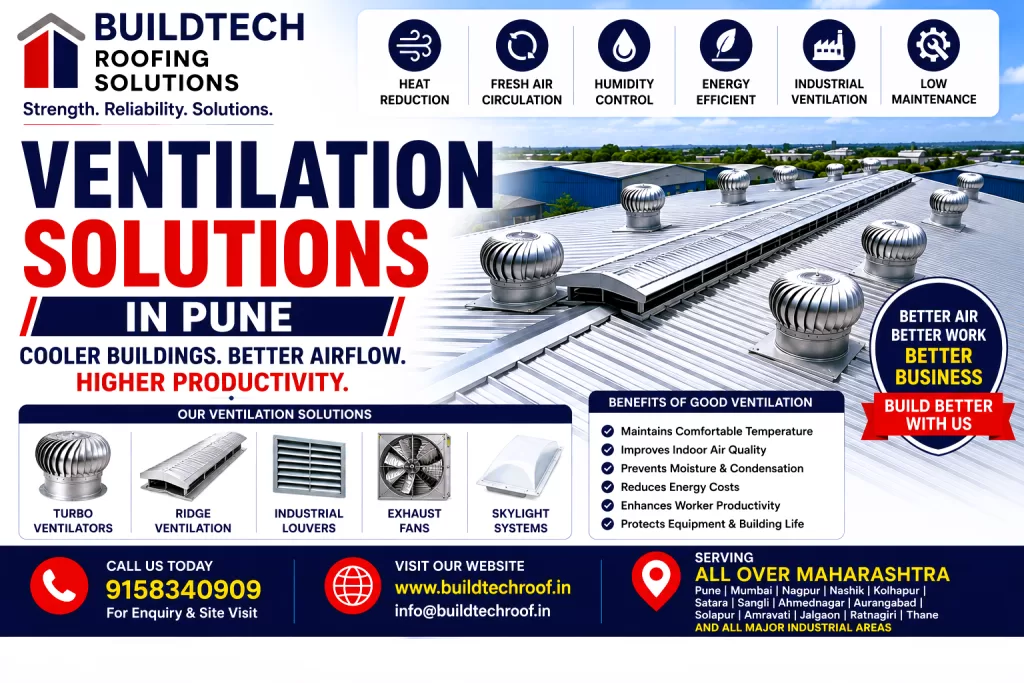
Buildtech Roofing Solutions provides complete Ventilation Solutions in Pune and across Maharashtra, including turbo ventilators, ridge ventilation systems, industrial louvers, natural ventilation systems, and customised airflow solutions for factories, warehouses, PEB buildings, and commercial structures.
What Are Ventilation Solutions?
Ventilation solutions are systems designed to control air movement within a building.
They help:
- Remove hot air
- Reduce humidity
- Extract fumes and pollutants
- Improve indoor air quality
- Lower energy consumption
- Enhance occupant comfort
Industrial ventilation systems can be natural, mechanical, or hybrid, depending on building requirements.
Why Ventilation Matters
Industrial buildings generate heat from machinery, production processes, lighting systems, and environmental conditions.
Without proper ventilation:
- Indoor temperatures rise significantly.
- Humidity increases.
- Condensation forms on roof surfaces.
- Workers experience heat stress.
- Equipment performance may decline.
- Energy costs increase due to cooling requirements.
Effective ventilation creates a healthier, safer, and more efficient facility.
Types of Ventilation Solutions
1. Turbo Ventilators
Wind-driven roof ventilators that operate without electricity.
Benefits:
- Zero power consumption
- Continuous airflow
- Heat extraction
- Low maintenance
Applications:
- Factories
- Warehouses
- Industrial sheds
- PEB buildings
2. Ridge Ventilation Systems
Continuous ventilation is installed along the roof ridge.
Benefits:
- Uniform airflow
- Excellent heat removal
- Natural ventilation performance
Ideal for:
- Large industrial roofs
- Warehouses
- Manufacturing plants
3. Industrial Louvers
Wall-mounted ventilation openings that allow airflow while protecting against rain and debris.
Benefits:
- Fresh air intake
- Weather protection
- Improved cross ventilation
4. Natural Ventilation Systems
Uses building design, roof openings, and wall vents to create airflow without mechanical equipment.
Advantages:
- Energy efficient
- Low operating cost
- Sustainable solution
5. Mechanical Ventilation
Uses fans, blowers, and exhaust systems for controlled airflow.
Suitable for:
- High heat environments
- Fume extraction
- Controlled air movement
Key Benefits of Ventilation Solutions
1. Heat Reduction
Ventilation removes trapped hot air from the building.
Benefits:
- Lower indoor temperatures
- Improved comfort
- Reduced heat stress
2. Improved Indoor Air Quality
Removes:
- Dust
- Fumes
- Smoke
- Moisture
- Stale air
3. Energy Savings
Natural ventilation reduces dependence on air conditioning and exhaust systems.
Result: Lower operating costs.
4. Condensation Control
Reduces moisture accumulation on roofs and walls.
Prevents:
- Corrosion
- Mold growth
- Water damage
5. Better Worker Productivity
Comfortable indoor conditions support:
- Higher productivity
- Better concentration
- Improved workplace safety
6. Equipment Protection
Lower temperatures help protect machinery and electrical systems from excessive heat exposure.
7. Environment Friendly
Natural ventilation systems operate with minimal energy consumption, supporting sustainable building practices.
Applications of Ventilation Solutions
Manufacturing Plants
Removes process heat and industrial fumes.
Warehouses
Improves airflow and storage conditions.
PEB Buildings
Enhances energy efficiency and comfort.
Pharmaceutical Facilities
Supports clean airflow requirements.
Food Processing Units
Helps control heat and humidity.
Textile Industries
Improves worker comfort and moisture control.
Logistics Centers
Maintains better warehouse environments.
Commercial Buildings
Supports occupant comfort and air quality.
Ventilation Design Considerations
Effective ventilation design depends on:
- Building size
- Roof height
- Heat generation levels
- Occupancy density
- Process requirements
- Climate conditions
- Air exchange requirements
Professional assessment ensures the correct combination of ventilators, louvers, and airflow pathways.
Natural vs Mechanical Ventilation
| Feature | Natural Ventilation | Mechanical Ventilation |
| Power Requirement | No | Yes |
| Operating Cost | Very Low | Higher |
| Maintenance | Low | Moderate |
| Airflow Control | Moderate | High |
| Best For | Large industrial spaces | Controlled environments |
Many facilities use a hybrid approach combining natural and mechanical systems.
Common Ventilation Problems
Excessive Heat
Caused by inadequate air exchange.
Solution: Turbo ventilators, ridge ventilation, and louvers.
High Humidity
Leads to condensation and corrosion.
Solution: Improved exhaust and airflow systems.
Poor Air Circulation
Creates stagnant air zones.
Solution: Cross ventilation design.
Dust & Fume Accumulation
Affects worker health and equipment.
Solution: Exhaust ventilation and fresh air intake systems.
Ventilation Installation Process
- Site inspection and airflow analysis
- Heat load evaluation
- Ventilation system design
- Equipment selection
- Installation planning
- System installation
- Performance testing
- Final commissioning
Maintenance Tips
- Clean ventilators periodically.
- Inspect louvers and vents.
- Check fasteners and seals.
- Remove debris from airflow paths.
- Inspect bearings in turbo ventilators.
- Verify airflow performance regularly.
Cost of Ventilation Solutions in Pune
Pricing depends on:
- Building size
- Ventilation type
- Number of ventilators
- Louver quantity
- Installation complexity
Approximate Cost Range
₹3,500 – ₹15,000 per turbo ventilator
Louver and custom ventilation system pricing varies by project requirements.
Why Choose Buildtech Roofing Solutions?
Our Advantages:
- Complete ventilation design and installation
- Industrial roofing expertise
- Premium-quality ventilators and louvers
- Customized airflow solutions
- Fast project execution
- Competitive pricing
- Service across Maharashtra
Industries Served
- Manufacturing Plants
- Warehouses
- Logistics Parks
- Food Processing Units
- Pharmaceutical Facilities
- Textile Industries
- Commercial Buildings
- Infrastructure Projects
Service Areas
Serving All Over Maharashtra
- Pune
- Mumbai
- Nagpur
- Nashik
- Kolhapur
- Satara
- Sangli
- Ahmednagar
- Aurangabad
- Solapur
- Amravati
- Jalgaon
- Ratnagiri
- Thane
- And All Major Industrial Zones Across Maharashtra
Frequently Asked Questions
What is the best ventilation system for factories?
For many industrial buildings, a combination of turbo ventilators, ridge ventilation, and louvers provides effective natural airflow.
Do turbo ventilators require electricity?
No. Turbo ventilators operate using natural wind energy and thermal air movement.
Can ventilation reduce factory temperatures?
Yes. Proper ventilation helps remove trapped hot air and improve indoor comfort.
How often should ventilation systems be maintained?
Most systems should be inspected and cleaned periodically, typically at least once a year or more frequently in dusty environments.
Conclusion
An effective ventilation system is essential for maintaining a comfortable, productive, and energy-efficient industrial environment. Whether you need turbo ventilators, ridge ventilation systems, industrial louvers, or a complete roof ventilation solution, Buildtech Roofing Solutions delivers reliable and customized Ventilation Solutions in Pune that improve airflow and enhance building performance.