Roof Ventilation Installation

Installation of turbo ventilators, ridge ventilators, roof louvers, and industrial ventilation systems.

Ridge Ventilator Systems in Pune Product Guide for Industrial Roof Ventilation

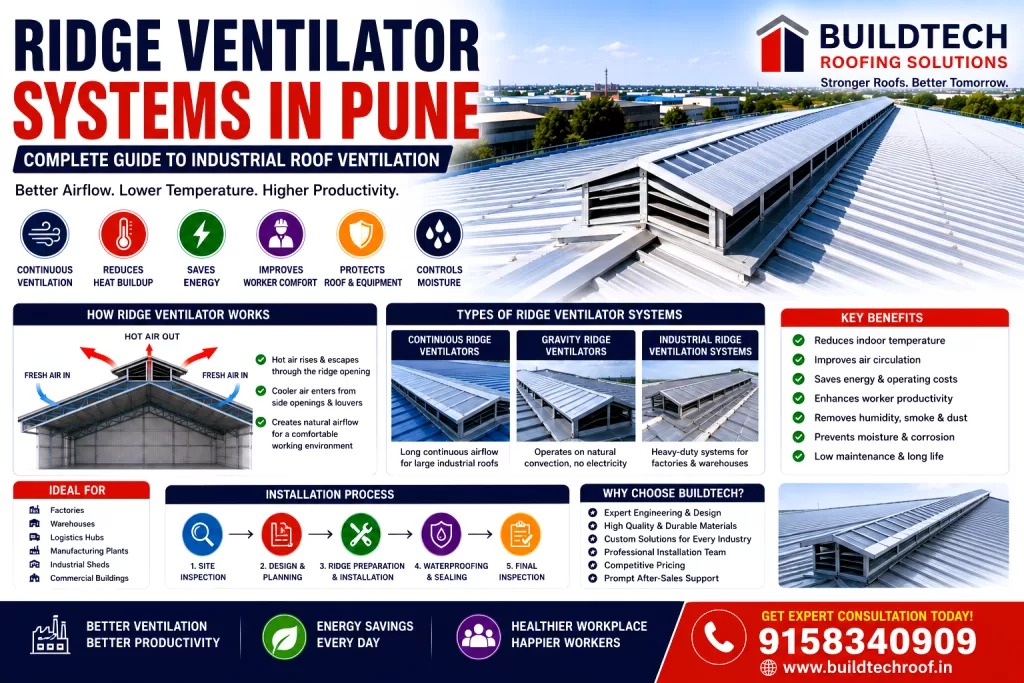
Ridge Ventilator Systems Product Guide for Industrial Roof Ventilation

Introduction Industrial buildings generate excessive heat due to machinery, roofing systems, manufacturing operations, and environmental conditions. Without proper airflow management, factories and warehouses become hot, uncomfortable, and inefficient. Poor ventilation inside industrial buildings can lead to: Modern industries now focus on advanced natural ventilation systems that improve airflow without increasing energy consumption. One of the most efficient solutions for industrial roof ventilation is the Ridge Ventilator System. Ridge ventilators provide continuous natural airflow across the entire roof structure, helping remove hot air and maintain comfortable indoor conditions. This is where Ridge Ventilator Pune solutions by Buildtech Roofing Solutions provide advanced industrial ventilation systems for factories, warehouses, logistics hubs, and commercial sheds. This comprehensive guide explains everything about ridge ventilators, including working principles, types, benefits, applications, installation process, maintenance, and cost considerations. What Are Ridge Ventilator Systems? Ridge ventilators are roof-mounted ventilation systems installed along the ridge (highest point) of industrial roofs. They allow continuous exhaust of: Ridge ventilators use natural airflow principles and do not require electricity for operation. How Ridge Ventilators Work Ridge ventilators work based on: Hot air inside industrial buildings naturally rises toward the roof. The ridge ventilator creates an escape path for hot air, while fresh cooler air enters through side openings and louvers. This creates balanced and continuous ventilation throughout the building. Why Industries Need Ridge Ventilation Systems Industrial roofing systems absorb large amounts of heat during the daytime. Without ventilation: Ridge ventilators help maintain proper airflow and improve workplace comfort naturally. Benefits of Ridge Ventilator Systems 1. Continuous Natural Ventilation Ridge ventilators provide uninterrupted airflow across the building. 2. Heat Reduction Hot air is continuously exhausted through the ridge opening. This significantly reduces indoor temperature. 3. Energy Savings Ridge ventilators reduce dependency on: This lowers electricity consumption. 4. Improved Worker Productivity Cooler and fresher work environments improve operational efficiency. 5. Moisture & Condensation Control Industrial buildings often face condensation problems due to trapped humid air. Ridge ventilators help remove moisture and reduce: 6. Better Air Quality Ventilation improves indoor air circulation and removes pollutants. 7. Low Maintenance System Ridge ventilators are durable systems requiring minimal maintenance. Types of Ridge Ventilator Systems 1. Continuous Ridge Ventilators Installed continuously along the roof ridge for maximum airflow. Features: 2. Gravity Ridge Ventilators Operate using thermal air movement and natural convection. Benefits: 3. Industrial Ridge Ventilation Systems Heavy-duty systems designed for industrial sheds and warehouses. Applications: Components of Ridge Ventilator Systems A typical ridge ventilator system includes: Proper flashing and waterproof sealing prevent rainwater entry. Applications of Ridge Ventilator Systems The Ridge ventilators are widely used in: Ridge Vent vs Turbo Ventilators Feature Ridge Ventilators Turbo Ventilators Airflow Coverage Continuous Point-based Ventilation Efficiency Very High High Maintenance Low Low Electricity Requirement No No Best For Large Industrial Buildings Medium & Large Buildings Ridge Vent vs Exhaust Fan Feature Ridge Ventilator Exhaust Fan Electricity Usage No Yes Operating Cost Very Low High Noise Silent Moderate Airflow Natural Continuous Mechanical Importance of Proper Industrial Ventilation Proper ventilation improves: ✔ Worker comfort✔ Machine performance✔ Indoor air quality✔ Heat reduction✔ Energy efficiency Poor ventilation can increase operational costs and affect productivity. Ridge Ventilator Installation Process Step-1 – Site Inspection Analyse building dimensions and airflow requirements. Step-2 – Ventilation Design Determine the ridge opening size and airflow requirement. Step-3 – Roof Preparation Prepare the roof ridge for installation. Step-4 – Ridge Ventilator Installation Install the ridge ventilation structure securely. Step-5 – Waterproof Sealing Apply flashing and waterproof protection. Step-6 – Final Inspection Check ventilation performance and installation quality. Factors Affecting Ridge Ventilator Performance 1. Building Width Large buildings require proper ventilation planning. 2. Roof Height Higher roofs improve natural airflow movement. 3. Ventilator Size Correct sizing ensures balanced airflow. 4. Air Intake Design Proper side airflow improves ventilation efficiency. 5. Roof Design Roof slope affects airflow movement. Common Industrial Ventilation Problems 1. Heat Buildup Metal roofing traps excessive heat. 2. Poor Air Circulation Insufficient airflow affects working conditions. 3. Moisture Accumulation Leads to rust and structural damage. 4. Smoke & Dust Retention Industrial pollutants affect air quality. Advantages of Ridge Ventilation for Warehouses Warehouses benefit from ridge ventilators because they: This helps protect inventory and improve operational efficiency. Energy Efficiency Benefits Ridge ventilators reduce energy usage by minimising dependence on: This leads to long-term operational cost savings. Maintenance Tips for Ridge Ventilator Systems Although ridge ventilators require low maintenance, periodic inspection is recommended. Maintenance Checklist: Common Mistakes to Avoid 1. Improper Ridge Opening Design Reduces airflow performance. 2. Poor Waterproofing Can lead to roof leakage. 3. Using Low-Quality Materials Reduces system lifespan. 4. Incorrect Installation Improper alignment affects ventilation efficiency. Cost of Ridge Ventilator Systems in Pune The cost depends on: Approximate Cost Range: ₹350 – ₹1,200 per running foot (approx.) 💡 Note: Large industrial projects require customised ventilation design. Why Choose Buildtech Roofing Solutions Pune Buildtech Roofing Solutions provides advanced ridge ventilation systems designed for industrial performance and durability. Key Advantages: ✔ Expert ventilation planning✔ High-quality ridge ventilators✔ Customised airflow solutions✔ Professional installation team✔ Competitive pricing✔ Fast project execution Industries Served Service Areas Pune | Mumbai | Nashik | Kolhapur | Sangli | Satara | Ahmednagar Future of Industrial Ventilation Systems Industrial ventilation systems are evolving with: Ridge ventilators are becoming a standard solution for modern industrial infrastructure. Conclusion Ridge ventilator systems provide one of the most effective natural ventilation solutions for industrial buildings. They help improve airflow, reduce heat buildup, enhance worker comfort, and lower energy consumption. With Ridge Ventilator Pune solutions by Buildtech Roofing Solutions, industries can achieve durable, energy-efficient, and long-lasting industrial ventilation systems.

Ridge Ventilator Systems Product Guide for Industrial Roof Ventilation Read More »
Ventilation Solutions in Pune | Industrial Roof Ventilation Systems

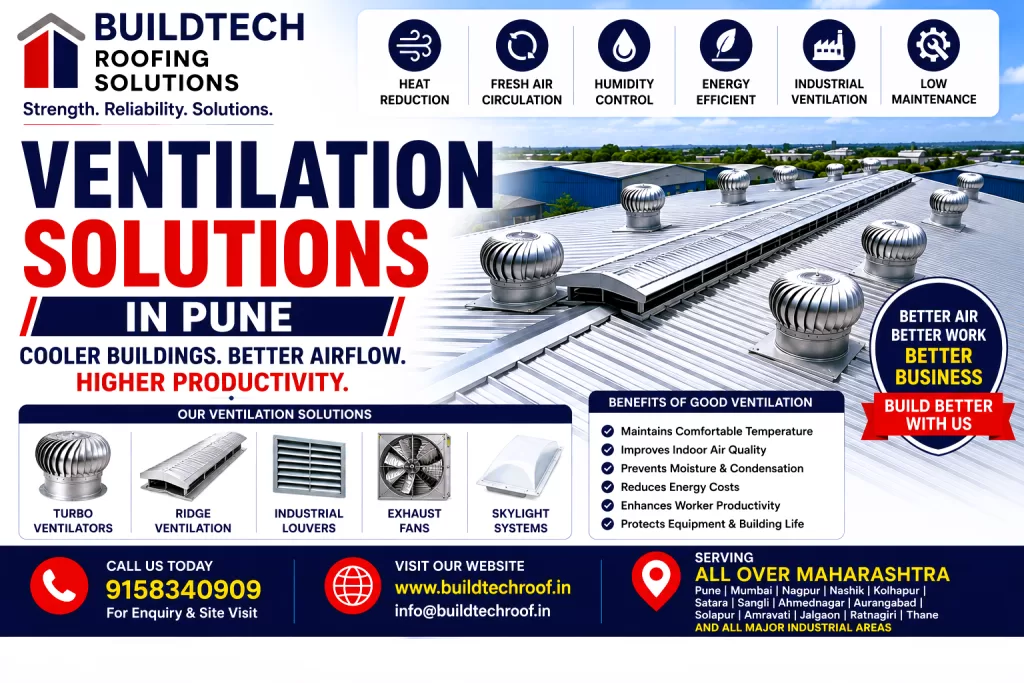
Ventilation Solutions in Pune | Industrial Roof Ventilation Systems

Introduction In industrial and commercial buildings, poor ventilation can cause excessive heat buildup, humidity, condensation, stale air, reduced worker productivity, equipment stress, and higher energy consumption. Modern facilities require efficient airflow management to maintain comfortable working conditions and protect operations. Ventilation Solutions help remove hot air, moisture, fumes, dust, and pollutants while introducing fresh air into the building. Properly designed industrial ventilation systems improve indoor air quality, reduce roof temperatures, and support healthier, more productive work environments. Buildtech Roofing Solutions provides complete Ventilation Solutions in Pune and across Maharashtra, including turbo ventilators, ridge ventilation systems, industrial louvers, natural ventilation systems, and customised airflow solutions for factories, warehouses, PEB buildings, and commercial structures. What Are Ventilation Solutions? Ventilation solutions are systems designed to control air movement within a building. They help: Industrial ventilation systems can be natural, mechanical, or hybrid, depending on building requirements. Why Ventilation Matters Industrial buildings generate heat from machinery, production processes, lighting systems, and environmental conditions. Without proper ventilation: Effective ventilation creates a healthier, safer, and more efficient facility. Types of Ventilation Solutions 1. Turbo Ventilators Wind-driven roof ventilators that operate without electricity. Benefits: Applications: 2. Ridge Ventilation Systems Continuous ventilation is installed along the roof ridge. Benefits: Ideal for: 3. Industrial Louvers Wall-mounted ventilation openings that allow airflow while protecting against rain and debris. Benefits: 4. Natural Ventilation Systems Uses building design, roof openings, and wall vents to create airflow without mechanical equipment. Advantages: 5. Mechanical Ventilation Uses fans, blowers, and exhaust systems for controlled airflow. Suitable for: Key Benefits of Ventilation Solutions 1. Heat Reduction Ventilation removes trapped hot air from the building. Benefits: 2. Improved Indoor Air Quality Removes: 3. Energy Savings Natural ventilation reduces dependence on air conditioning and exhaust systems. Result: Lower operating costs. 4. Condensation Control Reduces moisture accumulation on roofs and walls. Prevents: 5. Better Worker Productivity Comfortable indoor conditions support: 6. Equipment Protection Lower temperatures help protect machinery and electrical systems from excessive heat exposure. 7. Environment Friendly Natural ventilation systems operate with minimal energy consumption, supporting sustainable building practices. Applications of Ventilation Solutions Manufacturing Plants Removes process heat and industrial fumes. Warehouses Improves airflow and storage conditions. PEB Buildings Enhances energy efficiency and comfort. Pharmaceutical Facilities Supports clean airflow requirements. Food Processing Units Helps control heat and humidity. Textile Industries Improves worker comfort and moisture control. Logistics Centers Maintains better warehouse environments. Commercial Buildings Supports occupant comfort and air quality. Ventilation Design Considerations Effective ventilation design depends on: Professional assessment ensures the correct combination of ventilators, louvers, and airflow pathways. Natural vs Mechanical Ventilation Feature Natural Ventilation Mechanical Ventilation Power Requirement No Yes Operating Cost Very Low Higher Maintenance Low Moderate Airflow Control Moderate High Best For Large industrial spaces Controlled environments Many facilities use a hybrid approach combining natural and mechanical systems. Common Ventilation Problems Excessive Heat Caused by inadequate air exchange. Solution: Turbo ventilators, ridge ventilation, and louvers. High Humidity Leads to condensation and corrosion. Solution: Improved exhaust and airflow systems. Poor Air Circulation Creates stagnant air zones. Solution: Cross ventilation design. Dust & Fume Accumulation Affects worker health and equipment. Solution: Exhaust ventilation and fresh air intake systems. Ventilation Installation Process Maintenance Tips Cost of Ventilation Solutions in Pune Pricing depends on: Approximate Cost Range ₹3,500 – ₹15,000 per turbo ventilator Louver and custom ventilation system pricing varies by project requirements. Why Choose Buildtech Roofing Solutions? Our Advantages: Industries Served Service Areas Serving All Over Maharashtra Frequently Asked Questions What is the best ventilation system for factories? For many industrial buildings, a combination of turbo ventilators, ridge ventilation, and louvers provides effective natural airflow. Do turbo ventilators require electricity? No. Turbo ventilators operate using natural wind energy and thermal air movement. Can ventilation reduce factory temperatures? Yes. Proper ventilation helps remove trapped hot air and improve indoor comfort. How often should ventilation systems be maintained? Most systems should be inspected and cleaned periodically, typically at least once a year or more frequently in dusty environments. Conclusion An effective ventilation system is essential for maintaining a comfortable, productive, and energy-efficient industrial environment. Whether you need turbo ventilators, ridge ventilation systems, industrial louvers, or a complete roof ventilation solution, Buildtech Roofing Solutions delivers reliable and customized Ventilation Solutions in Pune that improve airflow and enhance building performance.

Ventilation Solutions in Pune | Industrial Roof Ventilation Systems Read More »

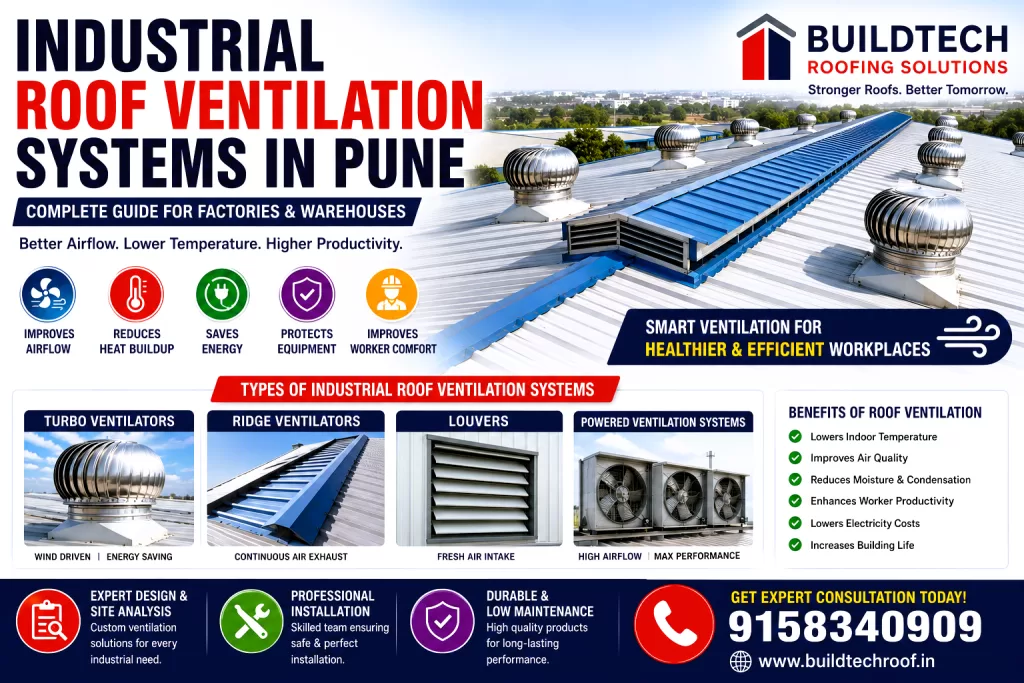
Industrial Roof Ventilation Systems in Pune – Complete Guide for Factories & Warehouses

Industrial Roof Ventilation Systems in Pune – Complete Guide for Factories & Warehouses

Industrial Roof Ventilation Systems in Pune – Guide for Better Airflow & Heat Reduction Introduction Industrial buildings such as factories, warehouses, manufacturing plants, and logistics hubs generate substantial internal heat every day. This heat comes from production machinery, metal roofing systems, manpower, and harsh external weather conditions—especially in Pune’s hot climate. Without proper ventilation, industrial spaces often face: That’s why investing in Industrial Roof Ventilation Systems Pune is essential for every modern industrial facility. At Buildtech Roofing Solutions, we provide advanced industrial ventilation systems designed to improve airflow, reduce roof heat, and create healthier, more productive work environments. This complete guide explains everything you need to know about industrial roof ventilation systems, including types, benefits, installation methods, costs, and how to choose the right solution. What Are Industrial Roof Ventilation Systems? Industrial roof ventilation systems are engineered airflow solutions installed on industrial roofs to remove trapped hot air and improve internal air circulation. Their primary purpose is to: ✔ Remove hot air from inside the building✔ Reduce indoor temperature✔ Control humidity and moisture✔ Improve worker comfort✔ Enhance energy efficiency Proper ventilation helps maintain balanced airflow, which directly impacts operational performance. Why Roof Ventilation Is Important for Industrial Buildings 1. Reduces Excessive Heat Metal roofs absorb intense solar heat. Without ventilation, this heat gets trapped inside. Ventilation removes this trapped hot air and lowers the indoor temperature. 2. Improves Worker Productivity A cooler workplace leads to: 3. Lowers Electricity Bills When ventilation improves naturally, industries rely less on: This significantly reduces energy costs. 4. Prevents Moisture & Condensation Poor airflow causes condensation, leading to: Proper ventilation prevents moisture buildup. 5. Protects Machinery & Inventory Excess heat and humidity can damage: Ventilation protects valuable assets. Types of Industrial Roof Ventilation Systems 1. Turbo Ventilators Turbo ventilators are among the most widely used industrial roof ventilation systems. They are wind-driven rotating ventilators installed on rooftops. Features: ✔ No electricity required✔ Continuous natural ventilation✔ Low maintenance✔ Long lifespan Benefits: Best For: 2. Ridge Ventilators Ridge ventilators are installed along the highest point (ridge) of the roof. They allow continuous hot air exhaust. Features: ✔ Uniform ventilation✔ Natural airflow system✔ Weather-resistant design Benefits: 3. Industrial Louvers Louvers are wall-mounted airflow systems installed on side walls. They allow fresh air intake into the building. Benefits: 4. Powered Roof Ventilators Powered systems use electric motors for forced ventilation. Suitable For: Benefits: ✔ Strong airflow✔ Controlled ventilation✔ High efficiency How Industrial Roof Ventilation Systems Work Industrial ventilation works on three principles: 1. Natural Airflow Cool air enters through side openings or louvers. 2. Hot Air Rise Principle Hot air naturally rises upward. Ventilators installed on the roof remove this hot air. 3. Wind Pressure Movement Wind increases suction inside turbo ventilators, accelerating exhaust. This creates continuous airflow. Benefits of Industrial Roof Ventilation Systems Installing proper roof ventilation offers multiple advantages: ✔ Lowers indoor temperature by 4–10°C✔ Improves air circulation✔ Reduces electricity consumption✔ Prevents moisture damage✔ Enhances worker comfort✔ Increases equipment lifespan✔ Improves overall workplace safety Applications of Industrial Roof Ventilation Roof ventilation systems are ideal for: Roof Ventilation System Installation Process Step-1 – Site Inspection Experts inspect: Step-2 – Airflow Analysis Ventilation requirements are calculated based on: Step-3 – System Design Selection of: Step-4 – Installation Ventilators are installed with: Step-5 – Final Inspection System performance is tested for airflow efficiency. Common Industrial Ventilation Problems Without proper ventilation, industries face: 1. Heat Buildup Causes uncomfortable work environments. 2. Poor Air Circulation Creates stagnant air pockets. 3. Condensation Leads to corrosion and leakage. 4. High Cooling Costs More dependence on electrical cooling. Cost of Industrial Roof Ventilation Systems in Pune Approximate costs vary depending on: Indicative Pricing: System Type Approx Cost Turbo Ventilators ₹8,000 – ₹25,000/unit Ridge Ventilators ₹300 – ₹700/running ft Louvers ₹150 – ₹500/sq.ft Powered Systems Custom quotation 💡 Tip: Proper ventilation delivers long-term ROI through energy savings. Maintenance Tips for Roof Ventilation Systems To maximise performance: Low maintenance ensures long service life. Why Choose Buildtech Roofing Solutions Pune? Buildtech Roofing Solutions is a trusted industrial roofing and ventilation expert. Our Advantages: ✔ Expert airflow analysis✔ High-quality turbo & ridge ventilators✔ Customised ventilation design✔ Competitive pricing✔ Fast installation✔ Complete industrial roofing solutions Industries We Serve Service Areas We serve across Maharashtra and some specific areas: 📍 Pune📍 Mumbai📍 Nashik📍 Kolhapur📍 Sangli📍 Satara📍 Ahmednagar Future of Industrial Ventilation Modern industrial ventilation is moving toward: Ventilation is now a strategic investment—not just a utility. Conclusion Industrial roof ventilation systems are essential for maintaining a cooler, healthier, and more efficient workplace. Whether you need turbo ventilators, ridge ventilators, or a custom airflow solution, Buildtech Roofing Solutions provides reliable and cost-effective industrial ventilation systems tailored to your facility. For expert Industrial Roof Ventilation Systems in Pune, trust Buildtech Roofing Solutions. 📞 Call Now: 9158340909🌐 Buildtech Roofing Solutions

Industrial Roof Ventilation Systems in Pune – Complete Guide for Factories & Warehouses Read More »

Industrial Roofing Ventilation Systems: Improve Airflow

Introduction: Why Industrial Roof Ventilation Is Essential Industrial buildings generate and retain large amounts of heat due to machinery operation, solar exposure, and expansive roof surfaces. Without proper airflow, hot air accumulates beneath roofing sheets, increasing indoor temperature and energy consumption. In Pune’s hot climate, poor ventilation leads to uncomfortable working environments, reduced productivity, and higher cooling costs. Properly designed industrial roofing ventilation systems remove trapped heat naturally, improving operational efficiency while extending roof lifespan. How Heat Builds Up Inside Industrial Buildings Industrial structures experience a natural heat cycle: This phenomenon, known as the stack effect, continuously increases indoor temperature unless ventilation systems release hot air. Benefits of Industrial Roofing Ventilation Effective ventilation systems provide: Ventilation is one of the most cost-effective industrial upgrades. Types of Industrial Roofing Ventilation Systems 1️⃣ Turbo Ventilators (Wind-Driven Ventilation) Turbo ventilators rotate using wind energy to extract hot air. Advantages Commonly installed in factories and warehouses. 2️⃣ Ridge Ventilators Installed along the roof ridge for uniform exhaust. Benefits 3️⃣ Louvers & Air Intake Systems Ventilation requires both air exhaust and air intake. Louvers allow fresh air entry while ventilators remove hot air, creating balanced airflow. 4️⃣ Powered Ventilation Systems Electric exhaust systems are used when natural ventilation is insufficient. Best suited for: Turbo Ventilator vs Ridge Ventilator Comparison Feature Turbo Ventilator Ridge Ventilator Power Requirement None None Airflow Coverage Localized Continuous Installation Type Retrofit friendly New construction ideal Maintenance Low Very low Both systems may be combined for optimal performance. Key Ventilation Design Factors Professional design considers: Incorrect placement reduces effectiveness. Ventilation and Energy Efficiency Ventilation directly impacts energy consumption. By removing hot air naturally: Natural airflow improves sustainability and operational savings. Signs Your Factory Needs Roof Ventilation You may require ventilation if you notice: These symptoms indicate trapped heat. Industrial Ventilation Installation Process Engineering planning ensures optimal airflow performance. Maintenance of Industrial Ventilation Systems Recommended maintenance includes: Preventive maintenance ensures consistent performance. Common Ventilation Mistakes Industries Make Professional installation prevents these issues. Why Professional Ventilation Design Matters Industrial ventilation must integrate with the roofing structure and waterproofing systems. Professional design ensures: Why Industries Choose Buildtech Roofing Solutions Buildtech Roofing Solutions provides: This ensures long-term ventilation efficiency. FAQs: Industrial Roofing Ventilation Systems How many turbo ventilators are required for a factory?Quantity depends on building size, heat load, and airflow calculations. Do turbo ventilators reduce heat?Yes, they continuously remove hot air, lowering the indoor temperature. Are ridge ventilators better than turbo ventilators?Ridge ventilators provide uniform airflow, while turbo ventilators are ideal for retrofits. Does ventilation reduce electricity costs?Yes, natural ventilation reduces dependency on cooling systems. Conclusion: Ventilation Turns Hot Buildings Into Efficient Workspaces Industrial roofing ventilation systems are essential for maintaining comfortable, efficient, and energy-optimised industrial environments. Proper airflow design improves productivity, protects roofing materials, and reduces operating costs. For professional industrial roof ventilation assessment and installation in Pune, Buildtech Roofing Solutions delivers engineered solutions tailored to industrial performance requirements.

Industrial Roofing Ventilation Systems: Improve Airflow Read More »

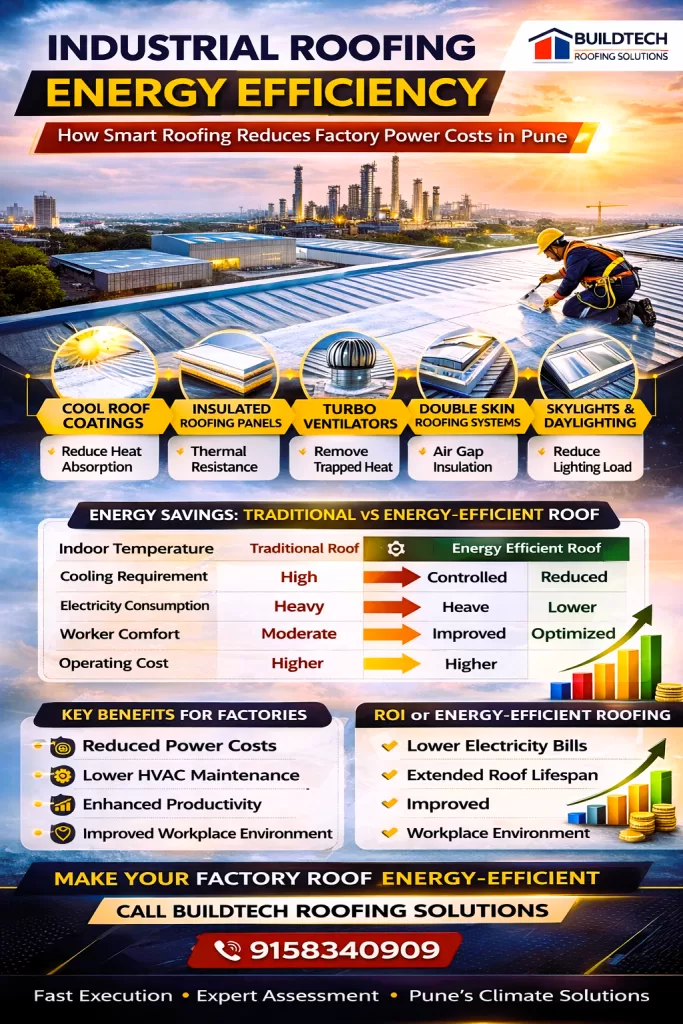
Reduce Factory Power Costs in Pune

Industrial Roofing Energy Efficiency: How Smart Roofing Reduces Factory Power Costs Introduction: Why Industrial Roofing Energy Efficiency Matters in Pune Industrial roofing energy efficiency plays a critical role in controlling factory operating costs. In Pune’s climate, industrial roofs absorb intense solar radiation for most of the year. As a result, indoor temperatures rise, cooling systems work harder, and electricity bills increase. Many factories focus on machinery efficiency but overlook roofing performance. However, improving industrial roofing energy efficiency can significantly reduce heat gain, lower HVAC load, and improve worker comfort. Therefore, smart roofing design is not just a structural decision — it is an energy strategy. How Industrial Roofs Influence Energy Consumption Heat enters industrial buildings primarily through the roof. Because it is the largest exposed surface area, even small design inefficiencies create a measurable cost impact. Key heat transfer mechanisms include: Consequently, improving roofing design directly reduces power consumption. Signs of Poor Industrial Roofing Energy Efficiency Factories often experience warning signs long before taking action: If these indicators appear consistently, your roof may be costing more than it should. Core Solutions That Improve Industrial Roofing Energy Efficiency 1️⃣ Cool Roof Coatings Reflective coatings reduce solar heat absorption and lower roof surface temperatures. Benefits include: Cool roofing is one of the fastest retrofitting solutions available. 2️⃣ Insulated Roofing Panels Insulated panels create thermal resistance between external heat and interior spaces. Advantages: For temperature-sensitive industries, insulated roofing significantly improves efficiency. 3️⃣ Turbo Ventilators & Ridge Ventilation Hot air naturally rises. Proper ventilation removes trapped heat without electricity. This passive system: As a result, operational costs decline steadily. 4️⃣ Double Skin Roofing Systems Double-layer roofing creates an air gap that acts as thermal insulation. This system: Modern industrial sheds increasingly adopt this design for performance optimisation. 5️⃣ Daylighting & Skylight Integration Strategic daylighting reduces artificial lighting demand. When properly designed, skylights: Balanced integration prevents overheating while enhancing efficiency. ROI of Industrial Roofing Energy Efficiency Industrial roofing energy efficiency generates measurable financial returns. Savings occur through: Over time, annual energy savings significantly exceed the initial investment. Energy Efficiency in Pune’s Climate Conditions Pune experiences: Therefore, industrial roofing systems must be designed specifically for local environmental stress. Climate-responsive roofing improves stability across seasons. Common Energy Efficiency Mistakes Factories often unintentionally reduce performance by: Correcting these issues restores efficiency quickly. Retrofitting Existing Industrial Roofs Energy efficiency improvements do not always require full replacement. Retrofit options include: Retrofitting often provides rapid ROI. How Buildtech Roofing Solutions Enhances Industrial Roofing Energy Efficiency Buildtech Roofing Solutions follows an engineering-led approach: This structured methodology ensures energy performance, durability, and long-term cost control for factories and warehouses in Pune. FAQs: Industrial Roofing Energy Efficiency How does industrial roofing energy efficiency reduce power costs?By lowering heat gain, cooling systems operate less frequently, reducing electricity consumption. What is a cool roof system?A reflective roofing solution designed to minimize solar heat absorption. Are turbo ventilators energy efficient?Yes. They remove hot air using wind energy without electricity. Can existing industrial roofs be upgraded?Yes. Coatings, insulation, and ventilation retrofits improve performance significantly. Conclusion: Energy-Efficient Roofing Strengthens Operational Stability Industrial roofing energy efficiency is a strategic operational decision, not just a construction upgrade. By reducing heat gain and optimising ventilation, factories and warehouses in Pune lower power costs, improve working conditions, and extend infrastructure lifespan. Businesses that invest in energy-efficient roofing benefit from long-term financial savings and predictable operating performance. For professional assessment and energy-efficient industrial roofing solutions in Pune, Buildtech Roofing Solutions provides engineering-driven execution and lifecycle-focused planning.

Reduce Factory Power Costs in Pune Read More »

©2023 buildtechroof. All Rights Reserved.