
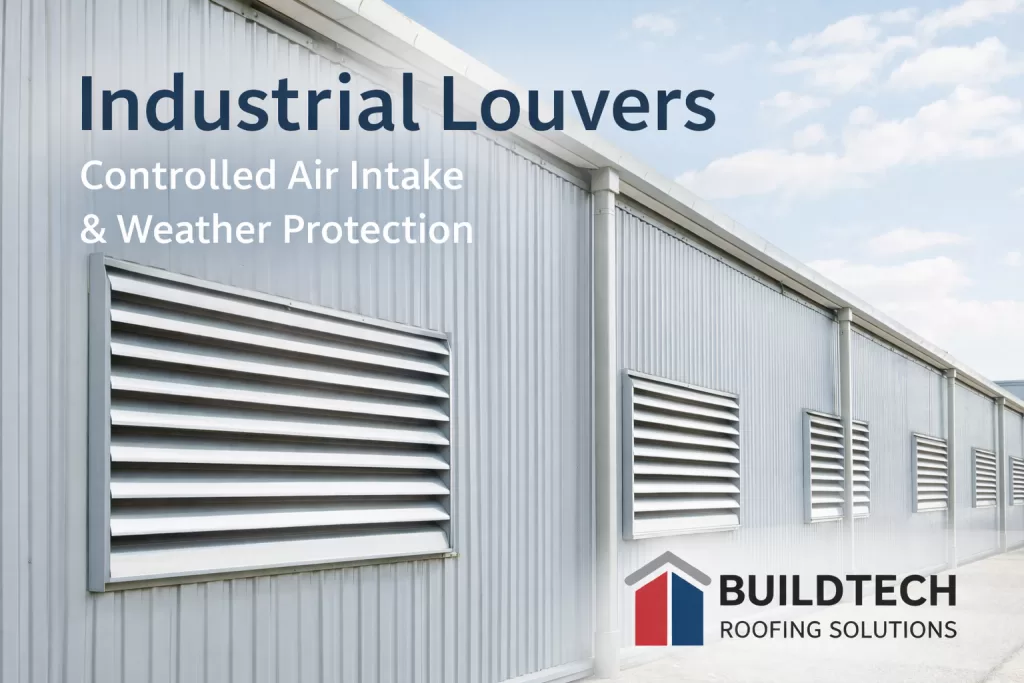
Introduction: Why Industrial Louvers Matter in Modern Industrial Buildings
Ventilation is a foundational requirement in industrial and commercial building design. Facilities such as factories, warehouses, manufacturing units, and power plants continuously generate heat, dust, fumes, and moisture. If these elements are not managed effectively, they can affect worker safety, reduce equipment lifespan, and increase operational costs.
While roof-based ventilation systems like ridge ventilators and turbo ventilators help release hot air, they cannot function efficiently without a controlled air intake system. This is where industrial louvers become essential.
Industrial louvers regulate how fresh air enters and exits a building while protecting interiors from rain, dust, birds, and external contaminants. When designed and installed correctly, they form a critical part of a balanced, energy-efficient ventilation system.
This comprehensive buyer’s guide explains industrial louvers in detail, covering their function, types, materials, applications, technical specifications, and selection guidelines for long-term performance.
What Are Industrial Louvers?
Industrial louvers are engineered airflow management systems installed on building walls, facades, or ventilation openings. They allow controlled air movement while restricting unwanted elements such as rainwater, debris, insects, and birds from entering the structure.
Unlike open windows or unprotected vents, louvers use angled blades or fins that direct airflow efficiently and safely. This design ensures ventilation without compromising protection.
How Industrial Louvers Work
Industrial louvers operate on a passive airflow principle:
- Fresh air enters through the louver opening
- Angled blades guide airflow inward
- Rainwater and dust are deflected outward
- Warm or contaminated air exits through roof or exhaust systems
- Continuous airflow improves indoor conditions
When paired with ridge ventilators or turbo ventilators, louvers help establish a stable air circulation cycle, enhancing natural ventilation throughout the building.
Why Industrial Louvers Are Critical for Industrial Environments
Industrial facilities require controlled airflow rather than exposed openings. Louvers deliver this control by managing intake and exhaust in a predictable manner.
Without proper louver systems, buildings often face:
- Uncontrolled dust ingress
- Rainwater leakage during monsoons
- Poor ventilation balance
- Higher maintenance and repair costs
Industrial louvers address these challenges while improving indoor comfort and safety.
Key Benefits of Industrial Louvers
1. Controlled Airflow
Louvers regulate air volume, preventing pressure imbalance and sudden airflow changes inside the building.
2. Weather Protection
Special blade geometry blocks rainwater even during heavy rainfall or strong winds.
3. Dust and Debris Reduction
Industrial designs minimize dust, sand, and external particle entry.
4. Improved Indoor Air Quality
Fresh air circulation reduces heat, humidity, and airborne contaminants.
5. Low Maintenance Requirements
With no moving parts, industrial louvers require minimal upkeep.
6. Seamless Integration with Ventilation Systems
Louvers complement natural and mechanical ventilation solutions effectively.
Types of Industrial Louvers
1. Fixed Industrial Louvers
These louvers have non-movable blades and are widely used for general ventilation.
Key Features:
- Cost-effective
- Simple design
- Reliable airflow
Applications: Warehouses, factories, utility areas
2. Z-Type Industrial Louvers
Z-shaped blades enhance rain protection and airflow control.
Key Features:
- Improved water resistance
- Strong structural design
Applications: Manufacturing units, electrical rooms
3. Rain-Proof Industrial Louvers
Designed for regions with high rainfall intensity.
Key Features:
- Advanced blade overlap
- Superior water drainage
Applications: Coastal and high-rainfall zones
4. Sand Trap Louvers
Engineered for dusty and sandy environments.
Key Features:
- Multi-stage airflow path
- Reduces fine particle entry
Applications: Cement plants, mining facilities
5. Bird-Proof Louvers
Equipped with bird mesh or integrated protection.
Key Features:
- Prevents nesting
- Maintains hygiene
Applications: Food processing units, warehouses
Materials Used in Industrial Louvers
Material selection directly affects durability, corrosion resistance, and lifecycle cost.
Common Materials
- Galvanized Iron (GI) – Economical and corrosion-resistant
- PPGI / Colour-Coated Steel – Enhanced aesthetics and durability
- Aluminium – Lightweight and corrosion-resistant
- Stainless Steel – Used in corrosive or hygienic environments
Importance of Material Selection
- Environmental exposure resistance
- Structural integrity
- Maintenance frequency
- Long-term performance
Technical Specifications of Industrial Louvers (Typical Range)
| Parameter | Specification |
|---|---|
| Material | GI / PPGI / Aluminium |
| Thickness | 0.50 – 1.00 mm |
| Blade Type | Fixed / Z-Type |
| Finish | Plain / Colour-Coated |
| Installation | Wall-mounted |
| Maintenance | Minimal |
Applications of Industrial Louvers
Industrial louvers are widely used across multiple sectors, including:
- Factories and manufacturing plants
- Warehouses and logistics hubs
- Power plants and generator rooms
- Boiler and compressor rooms
- Chemical processing facilities
- Commercial and utility buildings
They are particularly important where fresh air intake and environmental protection must function together.
Industrial Louvers vs Open Windows
| Aspect | Industrial Louvers | Open Windows |
|---|---|---|
| Airflow Control | Controlled | Uncontrolled |
| Weather Protection | High | Low |
| Dust Resistance | High | Low |
| Industrial Suitability | Ideal | Not recommended |
| Maintenance | Low | Moderate |
Design Considerations When Choosing Industrial Louvers
Airflow Requirement
Determine airflow volume based on building size, heat load, and ventilation strategy.
Environmental Conditions
Dusty, coastal, or high-rainfall regions require specialized louver designs.
Installation Location
Wall orientation impacts airflow efficiency and weather exposure.
Integration with Ventilation Systems
Louvers should complement ridge or turbo ventilators for optimal performance.
Installation Process Overview
Proper installation ensures durability and performance.
Typical Steps Include:
- Site inspection
- Opening preparation
- Frame alignment
- Secure fastening
- Sealing and finishing
- Airflow testing
Correct sealing prevents leakage, vibration, and long-term issues.
Common Buyer Mistakes to Avoid
- Selecting the wrong louver type
- Ignoring local weather conditions
- Choosing substandard materials
- Poor sealing during installation
Avoiding these mistakes significantly reduces future maintenance costs.
Energy Efficiency and Sustainability Benefits
Industrial louvers contribute to sustainable building practices by:
- Enhancing natural ventilation
- Reducing dependence on exhaust fans
- Lowering electricity consumption
- Improving indoor environmental quality
They support energy-efficient and eco-conscious industrial infrastructure.
Why Choose Buildtech Roofing Solutions
Buildtech Roofing Solutions delivers complete industrial louver systems designed for performance and longevity.
Our Strengths Include:
- Custom-engineered louver solutions
- Quality-certified materials
- Precision fabrication
- Professional installation teams
- Integrated roofing and ventilation expertise
We focus on durability, efficiency, and long-term value.
Frequently Asked Questions (FAQ)
Q1. Are industrial louvers waterproof?
Yes. Rain-proof designs effectively prevent water ingress.
Q2. Do louvers help reduce heat inside buildings?
Yes. They improve airflow and support roof ventilation systems.
Q3. How much maintenance do industrial louvers require?
Minimal maintenance is needed due to their fixed design.
Q4. Can industrial louvers be customized?
Yes. Size, material, thickness, and finish can be customized.
Conclusion
Industrial louvers are a critical component of efficient industrial ventilation systems. They provide controlled airflow, protect interiors from environmental elements, and enhance indoor air quality.
Selecting the right industrial louver system improves worker comfort, safeguards equipment, and reduces operational costs over time. When integrated with a well-designed ventilation strategy, industrial louvers deliver lasting performance and energy efficiency.
Final Call to Action
📞 Call: 9158340909
📩 Request a Professional Industrial Louver Consultation Today