Commercial Roofing Services

Roofing solutions for commercial buildings, retail outlets, offices, malls, and institutional projects. We provide commercial roofing services for offices, malls, institutions, and business facilities. Our roofing systems offer a long lifespan and strong protection against heat, rain, and environmental conditions. They are also energy-efficient and require low maintenance.

Warehouse Roofing Solutions in Pune – Complete Guide for Durable & Energy-Efficient Roofing

Warehouse Roofing Solutions in Pune

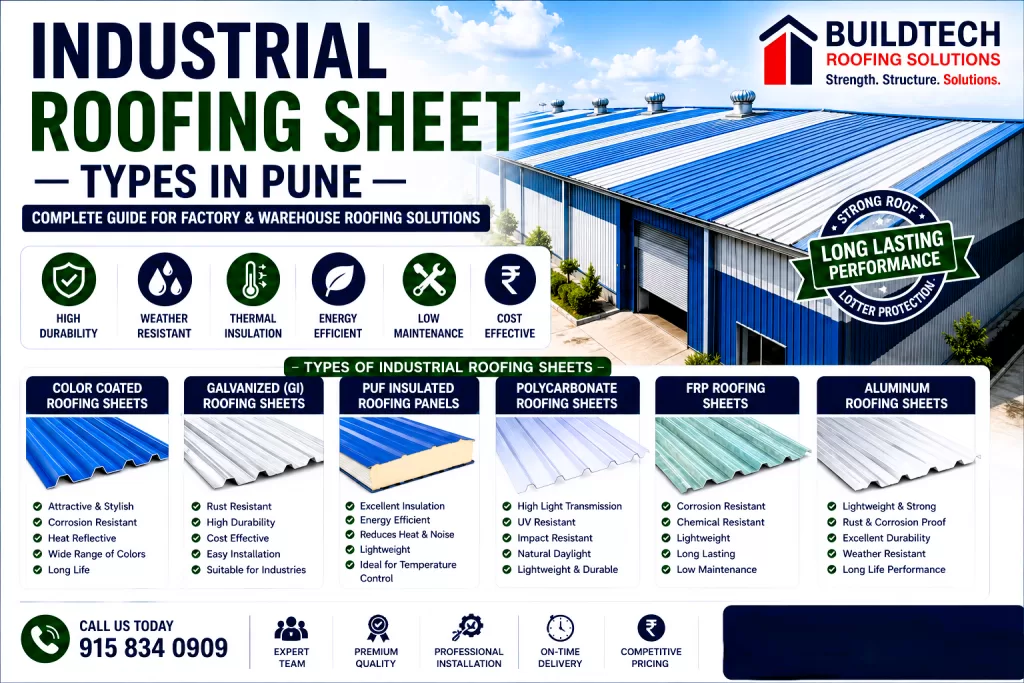
Introduction Warehouses are critical infrastructure for industries, logistics companies, e-commerce businesses, and manufacturing units. A strong and efficient warehouse roofing system protects inventory, machinery, and operations from environmental damage while improving energy efficiency and operational safety. In Pune’s rapidly expanding industrial and logistics sector, modern warehouse roofing systems are becoming essential for long-term durability and performance. This is where Warehouse Roofing Solutions Pune by Buildtech Roofing Solutions provide advanced roofing systems designed for industrial-grade protection, insulation, and weather resistance. This comprehensive guide explains everything about warehouse roofing, including roofing types, insulation systems, waterproofing, ventilation, maintenance, and cost considerations. Importance of Warehouse Roofing Systems A warehouse roof does more than cover the building. It provides: A poorly designed roof can result in leakage, heat buildup, and high maintenance costs. Types of Warehouse Roofing Systems 1. Colour Coated Roofing Sheets Popular for warehouses due to durability and affordability. Features: 2. PUF Insulated Roofing Panels Ideal for temperature-controlled warehouses. Benefits: 3. GI Roofing Sheets Cost-effective galvanised roofing solution. 4. Polycarbonate Skylight Sheets Provides natural daylight inside warehouses. Key Features of Modern Warehouse Roofing 1. Waterproof Protection 2. Heat Reduction 3. Ventilation Systems 4. Structural Strength 5. Low Maintenance Importance of Ventilation in Warehouses Ventilation systems help: Common Ventilation Systems: Heat Reduction Solutions for Warehouses 1. Heat Reflective Coatings 2. PUF Insulation Panels 3. Ventilation Systems 4. Double Roof Systems Waterproofing Solutions for Warehouse Roofs Warehouse roofs require waterproofing to prevent leakage and inventory damage. Waterproofing Methods: Common Warehouse Roofing Problems 1. Leakage 2. Corrosion 3. Heat Buildup 4. Loose Fasteners 5. Structural Damage Warehouse Roofing Installation Process Step-1 – Site Inspection Step-2 – Roofing Material Selection Step-3 – Structural Preparation Step-4 – Roofing Installation Step-5 – Waterproofing & Sealing Step-6 – Final Inspection Cost of Warehouse Roofing in Pune The cost depends on: Benefits of High-Quality Warehouse Roofing ✔ Long lifespan✔ Reduced maintenance cost✔ Better energy efficiency✔ Improved safety✔ Protection of inventory Why Choose Buildtech Roofing Solutions Pune ✔ Industrial-grade roofing systems✔ Waterproof & insulated solutions✔ Expert installation team✔ Competitive pricing✔ Fast project execution Industries Served Service Areas | Pune | Mumbai | Nashik | Kolhapur | Sangli | Satara | And More | Conclusion Warehouse roofing is essential for protecting industrial operations, inventory, and infrastructure. With Warehouse Roofing Solutions Pune by Buildtech Roofing Solutions, businesses can achieve durable, energy-efficient, and long-lasting roofing systems.

Warehouse Roofing Solutions in Pune Read More »
How to Choose the Right Industrial Roofing Contractor in Pune

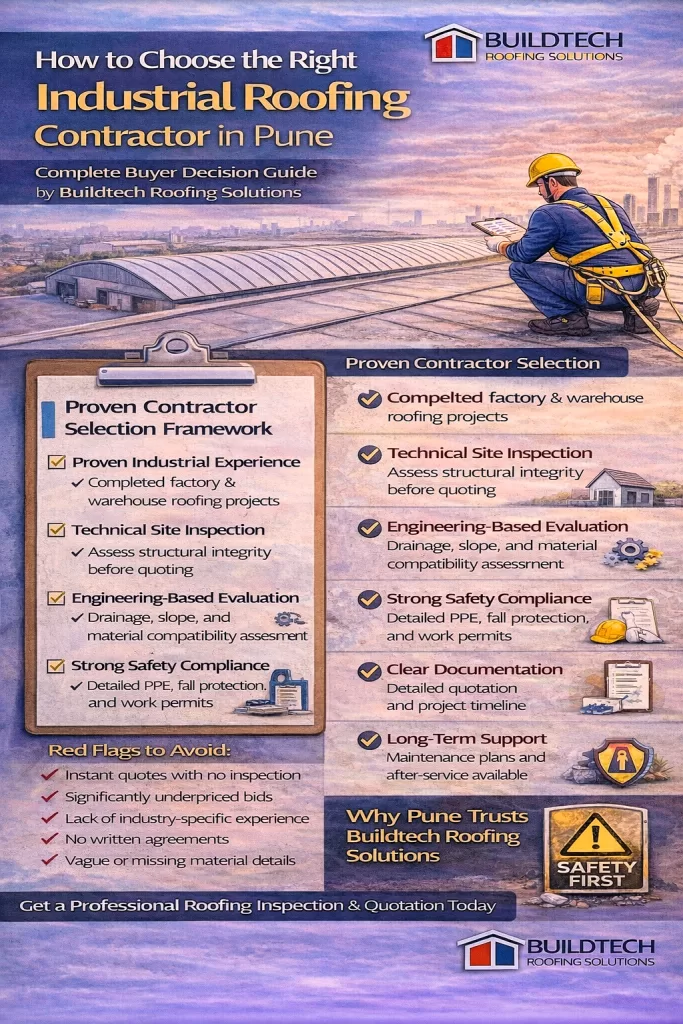
Introduction: The Contractor You Choose Determines Roof Performance Industrial roofing success depends less on materials and more on who installs them. Even premium roofing sheets can fail if installed incorrectly, while properly engineered installation can extend roof lifespan for decades. Factories and warehouses in Pune often face recurring leakage, corrosion, or repair costs not because of poor materials—but because of choosing the wrong contractor. This guide explains how to evaluate contractors professionally so your roofing investment delivers long-term reliability. Why Industrial Roofing Requires Specialized Contractors Industrial roofing differs significantly from residential or small commercial roofing. Industrial roofing involves: A general contractor may handle construction, but industrial roofing requires technical expertise and system-level understanding. Essential Qualities of a Professional Industrial Roofing Contractor 1️⃣ Proven Industrial Project Experience Look for contractors who have completed: Experience with similar structures reduces execution risks. Ask for: project photos, case studies, and references. 2️⃣ Engineering-Based Approach Professional contractors evaluate before recommending solutions. They should assess: If a contractor recommends solutions without inspection, it is a warning sign. 3️⃣ Deep Material Knowledge A qualified contractor explains: They guide decisions instead of pushing one product. 4️⃣ Safety & Compliance Standards Industrial roofing is high-risk work at height. Professional contractors must provide: Safety reflects professionalism and protects your organization legally. 5️⃣ Clear Scope and Documentation Reliable contractors provide: Transparency prevents disputes later. Red Flags When Choosing Roofing Contractors Avoid contractors who: Low-cost shortcuts usually result in higher long-term expenses. Questions You Must Ask Before Hiring Use these questions during evaluation: Professional contractors answer clearly and confidently. Why Site Inspection Is Non-Negotiable Every industrial roof is unique. Inspection helps determine: Without inspection, quotations are assumptions—not solutions. Contractor Comparison Checklist Criteria Contractor A Contractor B Industrial Experience Engineering Assessment Safety Compliance Documentation Warranty Maintenance Support This structured comparison improves decision quality. Why the Cheapest Contractor Is Usually the Most Expensive Short-term savings often create long-term problems: Lifecycle cost—not quotation price—defines true value. Importance of After-Service Support Roofing is not a one-time activity. Professional contractors provide: After-service support ensures sustained performance. How Professional Contractors Improve Roofing ROI A specialized contractor increases ROI by: Professional execution converts roofing into a long-term asset. Why Industries in Pune Choose Buildtech Roofing Solutions Buildtech Roofing Solutions follows an engineering-led process: This approach minimizes risk while maximizing durability and return on investment. Final Contractor Selection Framework Choose a contractor who provides: ✔ Technical inspection before quotation✔ Engineering-based recommendations✔ Safety compliance procedures✔ Clear documentation✔ Proven industrial experience✔ Long-term support If any of these elements are missing, reconsider the decision. FAQs: Industrial Roofing Contractor Selection How do I choose an industrial roofing contractor?Evaluate experience, engineering approach, safety compliance, and documentation—not just price. Should I choose the lowest quote?Not necessarily. Lower quotes often exclude critical long-term protections. Why is inspection important before quotation?Because roofing solutions must match structural and environmental conditions. Do contractors provide maintenance support?Professional industrial roofing contractors usually offer maintenance programs. Conclusion: The Right Contractor Protects Your Investment Selecting the right industrial roofing contractor determines whether your roof becomes a reliable asset or a recurring problem. Careful evaluation, proper inspection, and choosing expertise over price ensure durable performance and predictable costs. For professional consultation and industrial roofing solutions in Pune, Buildtech Roofing Solutions provides engineering-driven planning, safe execution, and long-term support.

How to Choose the Right Industrial Roofing Contractor in Pune Read More »

Industrial Roofing ROI Cost vs Long-Term Savings

Introduction: Roofing Is an Investment, Not an Expense Industrial roofing decisions are often treated like routine purchases, evaluated only on initial price. In reality, a roof is a long-term operational asset that directly affects production continuity, maintenance budgets, and facility lifespan. The cheapest quotation rarely delivers the best value. What matters is return on investment (ROI)—how much money the roof saves over its lifetime compared to what it costs. Understanding industrial roofing ROI allows factory owners, procurement teams, and financial managers in Pune to justify capital decisions based on measurable savings rather than assumptions. This guide explains how roofing generates financial returns, what hidden costs buyers overlook, and how to calculate ROI realistically. Understanding ROI in Industrial Roofing ROI Formula(Return − Investment) ÷ Investment In industrial roofing, “returns” are not direct revenue but cost savings and risk reduction, such as: A well-designed roofing system produces continuous operational savings year after year. Where Industrial Roofing Generates Financial Returns 1. Lower Maintenance Costs High-quality roofing systems require fewer repairs. Properly installed metal or PEB roofing typically needs only periodic inspections and minor resealing, significantly reducing annual expenditure. 2. Reduced Production Downtime Roof leaks can halt production lines, damage materials, and disrupt schedules. Even a few hours of downtime can cost more than preventive roofing maintenance for an entire year. 3. Energy Efficiency Gains Reflective coatings, insulation systems, and ventilation reduce internal heat. This lowers cooling costs and improves working conditions. 4. Longer Service Life Premium roofing materials last longer. Extending roof lifespan by even five years dramatically improves ROI because replacement costs are postponed. ROI Comparison: Cheap Roofing vs Engineered Roofing Factor Low-Cost Roofing Engineered Roofing Initial Cost Low Medium Repairs Frequent Rare Downtime Risk High Minimal Lifespan Short Long Maintenance Cost High Low ROI Low High The cheapest roof is rarely the most economical in the long run. Hidden Costs Most Buyers Ignore Many industries underestimate indirect costs caused by poor roofing: These costs rarely appear in quotations but strongly affect ROI. ROI by Roofing Type Metal Roofing Provides strong ROI due to durability, moderate cost, and low maintenance. Ideal for most factories and warehouses. PEB Roofing Systems Often deliver the highest ROI for large facilities because of engineered design, optimized material usage, and minimal structural stress. Concrete Roofing Typically lower ROI for industrial sheds because of higher maintenance and waterproofing requirements. Insulated Panels Offer high ROI in facilities where temperature control reduces energy consumption or protects sensitive goods. Realistic ROI Scenario (Illustrative Example) Consider two factories choosing between roofing options: Factory A – Low-Cost Roof Factory B – Engineered Roof After several years, Factory B’s total cost becomes significantly lower—even though its starting price was higher. This is the core principle of ROI. How to Calculate Roofing ROI for Your Facility Follow this practical framework: When these factors are combined, ROI becomes measurable rather than theoretical. When Investing More Upfront Is Financially Smarter Higher initial investment makes sense when: In such facilities, durability and reliability outweigh upfront savings. Signs Your Current Roof Is Costing You Money Your roof may be producing negative ROI if you notice: These indicators suggest the roof is consuming more money than it saves. How Professional Roofing Improves ROI Professional industrial roofing contractors enhance returns through: Quality execution reduces long-term operational costs. Financial Impact of Preventive Maintenance Preventive maintenance plays a major role in ROI. Without maintenance With maintenance Maintenance turns roofing into a predictable expense instead of a surprise liability. ROI Decision Checklist for Industrial Buyers Before approving a roofing project, decision-makers should verify: This checklist prevents short-term decisions that harm long-term ROI. Why Industries Choose Buildtech for High-ROI Roofing Industries across Pune select Buildtech Roofing Solutions because of its lifecycle-focused approach: This method ensures roofing investments deliver measurable financial returns. FAQs: Industrial Roofing ROI What is ROI in industrial roofing?It measures how much cost savings and operational benefits a roofing system delivers compared to its investment cost. Is expensive roofing cheaper in the long run?Often yes. Higher-quality systems usually require fewer repairs and last longer. Which roofing type has the best ROI?PEB and well-designed metal roofing systems generally provide the highest returns for industrial facilities. How can I estimate my roof’s ROI?Add repair savings, downtime reduction, and lifespan extension, then compare against installation cost. Conclusion: Smart Roofing Investments Deliver Long-Term Profit Industrial roofing decisions influence maintenance costs, productivity, and infrastructure reliability for decades. Evaluating industrial roofing ROI helps businesses move beyond price comparisons and choose systems that deliver long-term financial value. Factories and warehouses in Pune that invest in engineered roofing solutions typically experience fewer disruptions, lower maintenance expenses, and stronger operational stability. For a professional ROI assessment tailored to your facility, Buildtech Roofing Solutions provides data-driven recommendations and execution designed for lasting performance.

Industrial Roofing ROI Cost vs Long-Term Savings Read More »

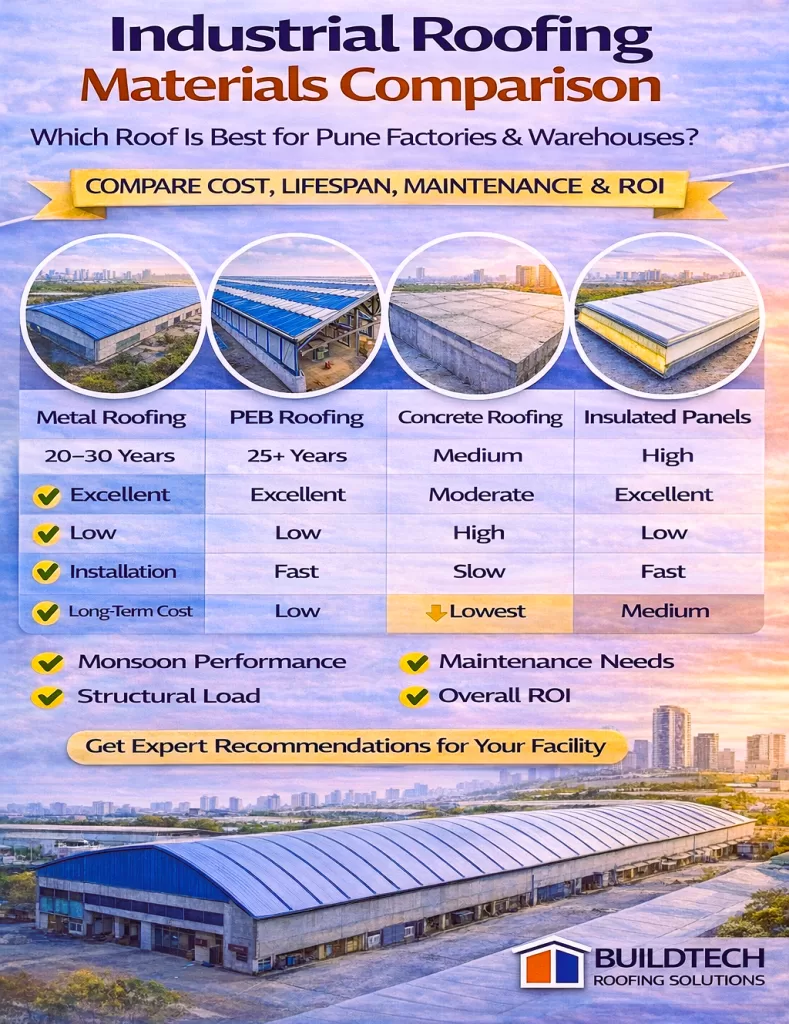
Industrial Roofing Materials Comparison: Which Roof Is Best for Pune Factories & Warehouses?

Introduction: Why Roofing Material Choice Decides Long-Term Performance For industrial buildings, the roof is not a cosmetic element—it is a mission-critical system. The wrong material can lead to leakage, overheating, corrosion, frequent repairs, and operational downtime. Pune’s climate—heavy monsoon rainfall, high summer temperatures, and industrial pollution—makes material selection the single most important roofing decision. This industrial roofing materials comparison explains how common options perform in real factory and warehouse conditions. You’ll see clear differences in lifespan, monsoon behaviour, maintenance needs, and long-term cost—so you can choose based on performance and ROI, not just initial price. Section 1: Common Industrial Roofing Materials Explained 1) Metal Roofing Sheets (Most Widely Used) Metal roofing uses color-coated or galvanized steel sheets engineered for strength and weather resistance. Strengths Considerations Best for: Manufacturing units, warehouses, logistics hubs, retrofits. 2) PEB Shed Roofing Systems PEB (Pre-Engineered Building) roofing integrates engineered steel frames with optimized metal roofing for large clear spans. Strengths Considerations Best for: Warehouses, logistics parks, large factories. 3) Concrete (RCC) Roofing Reinforced concrete slabs are traditionally used in some industrial and commercial buildings. Strengths Limitations Best for: Multi-storey structures where slab floors are required (not ideal for large sheds). 4) Insulated Roofing Panels (PUF / Sandwich Panels) Factory-made panels with insulation cores between metal skins. Strengths Considerations Best for: Cold storage, pharma, food processing, electronics. 5) Legacy Asbestos Roofing (Being Replaced) Older industrial buildings may still have asbestos sheets. Limitations Best practice: Replace with metal or PEB roofing. Section 2: Industrial Roofing Materials Comparison Table (Core Decision View) Parameter Metal Roofing PEB Roofing Concrete (RCC) Insulated Panels Lifespan High (20–30 yrs) Very High (25+ yrs) Medium High Monsoon Performance Excellent Excellent Moderate Excellent Heat Control Good Good Poor Excellent Maintenance Low Low High Low Installation Speed Fast Very Fast Slow Fast Structural Load Low Optimized Very High Low Long-Term Cost Low Lowest High Medium Takeaway: For most Pune industries, metal or PEB roofing delivers the best balance of performance and ROI. Section 3: Best Roofing Material by Industrial Use-Case Manufacturing Units Warehouses & Logistics Cold Storage, Pharma, Food Processing Older Industrial Buildings (Retrofit) Section 4: Monsoon Performance Comparison (Pune Focus) Metal / PEB Roofing Concrete Roofing Insulated Panels Verdict: Monsoon resilience favours metal-based systems with professional detailing. Section 5: Maintenance & Repair Perspective A roof that is easy to maintain reduces annual costs and avoids emergency shutdowns. Section 6: Cost vs Lifecycle ROI (Buyer Decision Section) Initial cost can mislead.When evaluated over 20 years: Rule of thumb: Choose based on lifecycle ROI, not the lowest quotation. Section 7: Common Buyer Mistakes When Choosing Roofing Materials Avoiding these mistakes can save years of repairs and lost productivity. Section 8: Expert Recommendations (Practical Guidance) A site-specific assessment ensures the right balance of cost, performance, and lifespan. Section 9: FAQs (Snippet-Ready) Which industrial roofing material lasts the longest?PEB roofing systems typically offer the longest service life with the lowest lifecycle cost. Is metal roofing better than concrete for factories?Yes. Metal roofing is lighter, faster to install, easier to maintain, and more monsoon-resilient. What roofing is best for Pune monsoon conditions?Engineered metal or PEB roofing with proper drainage and sealing. Which roofing option needs the least maintenance?PEB roofing and insulated panels, when installed correctly. Conclusion: Choose Materials That Protect Operations—not Just Buildings This industrial roofing materials comparison shows that the best roofing choice is the one that protects operations, reduces downtime, and minimizes long-term cost. For most Pune factories and warehouses, metal or PEB roofing delivers the strongest combination of durability, monsoon performance, and ROI. For material selection based on real site conditions, Buildtech Roofing Solutions provides engineering-led guidance that helps industries invest once—and perform for decades.

Industrial Roofing Materials Comparison: Which Roof Is Best for Pune Factories & Warehouses? Read More »

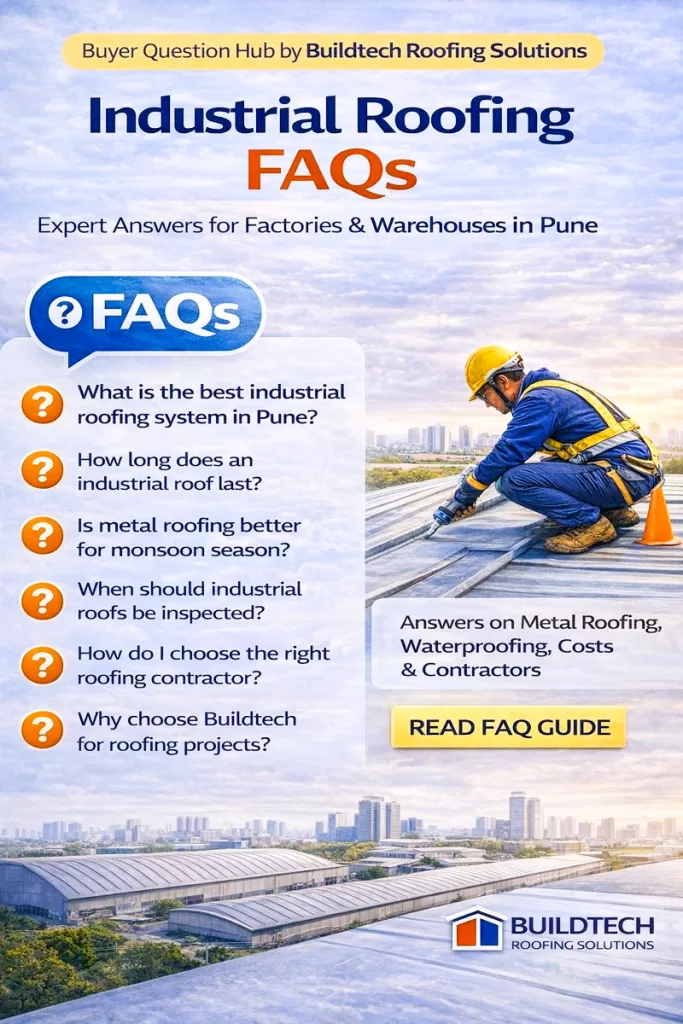
Industrial Roofing FAQs: Expert Answers for Factories & Warehouses in Pune

Introduction: Why Industrial Roofing FAQs Matter Before You Decide Industrial roofing is a high-value, long-term investment. Yet most factory owners, warehouse managers, and developers face confusion due to mixed advice, inconsistent pricing, and unclear technical details. A wrong decision can result in leakage, overheating, corrosion, and repeated repair costs. This Industrial Roofing FAQs guide answers the most common and critical questions buyers ask before finalizing a roofing contractor or system in Pune. These answers are based on real site conditions, monsoon performance, and long-term maintenance experience—helping you make informed, risk-free decisions. SECTION 1: General Industrial Roofing Questions Q1. What is the best roofing system for industrial buildings in Pune? For Pune’s climate and industrial requirements, metal roofing systems (color-coated or galvanized steel) are the most reliable. They offer excellent monsoon performance, fast installation, low maintenance, and long service life when professionally installed. Q2. How long does an industrial roof last? A well-designed and maintained industrial roof typically lasts: Q3. Is industrial roofing different from commercial or residential roofing? Yes. Industrial roofing involves: Industrial roofs are designed as engineered systems rather than mere coverings SECTION 2: Metal Roofing FAQs Q4. Is metal roofing suitable for Pune’s monsoon climate? Absolutely. Metal roofing performs exceptionally well during heavy rainfall when: Most leakage issues come from poor installation, not the material itself. Q5. Is metal roofing noisy during rain? No—when installed correctly. Noise concerns arise only when: Proper fixing and optional insulation significantly reduce noise levels. Q6. What thickness of metal roofing sheet is recommended? For industrial applications, thickness selection depends on span and wind load. Typically: Thickness should always be decided after structural assessment. Q7. Does metal roofing require waterproofing? Yes. While metal sheets shed water efficiently, waterproofing is critical at joints, fasteners, and penetrations. Professional sealing and protective coatings prevent long-term seepage and corrosion. SECTION 3: Industrial Shed Roofing FAQs Q8. What is PEB roofing and why is it preferred? PEB (Pre-Engineered Building) roofing uses factory-designed components that are assembled on site. Benefits include: PEB roofing is ideal for warehouses, logistics hubs, and manufacturing units. Q9. How are ventilation and skylights planned in industrial sheds? Ventilation and daylighting are integrated at the design stage using: These systems reduce heat buildup, improve air quality, and lower energy costs. Q10. Can existing industrial sheds be upgraded? Yes. Existing sheds can be upgraded with: Upgrades significantly improve performance without full replacement. SECTION 4: Waterproofing FAQs Q11. When should roof waterproofing be done? The ideal time is before monsoon. However, waterproofing can be done year-round if surface conditions allow proper curing. Q12. Which waterproofing system is best for industrial roofs? The best system depends on roof type: A site inspection determines the most effective solution. Q13. How long does waterproofing last? Depending on the system and exposure: Waterproofing longevity improves significantly with maintenance. SECTION 5: Roof Repair & Maintenance FAQs Q14. How often should industrial roofs be inspected? At least once a year, with a mandatory pre-monsoon inspection. High-use facilities benefit from mid-monsoon checks as well. Q15. Can roof repairs be done without stopping operations? In most cases, yes. Repairs can be: Professional planning minimizes disruption. Q16. What are signs that immediate roof repair is needed? Ignoring these signs leads to higher repair costs later. SECTION 6: Cost & Contractor FAQs (High Buyer Intent) Q17. What is the average industrial roofing cost in Pune? Costs vary by design and material. As a general range: Accurate pricing requires site inspection and specification finalization. Q18. Why do roofing quotes vary so much between contractors? Price differences usually reflect: The lowest quote often excludes critical long-term protections. Q19. How do I choose the right industrial roofing contractor? Look for: A contractor should think beyond installation. SECTION 7: Buildtech-Specific Trust FAQs Q20. Why choose Buildtech Roofing Solutions? Buildtech Roofing Solutions focuses on: The approach prioritizes durability, safety, and ROI. Q21. Do you provide inspection reports and warranties? Yes. Projects include: Documentation supports compliance and future maintenance planning. Q22. Can you handle turnkey industrial roofing projects? Yes. Services include: Clients benefit from a single accountable partner. SECTION 8: Pre-Monsoon & Seasonal FAQs Q23. What maintenance is required before monsoon? Pre-monsoon maintenance includes: This prevents emergency failures during peak rainfall. Q24. Can regular maintenance prevent roof replacement? In many cases, yes. Timely maintenance can delay roof replacement by several years, saving significant capital expenditure. Why This Industrial Roofing FAQs Guide Matters This FAQ hub: It is designed to help you choose correctly—once. Conclusion: Clarity Leads to Better Roofing Decisions Industrial roofing decisions should be based on facts, not assumptions. By understanding materials, costs, maintenance, and contractor selection, factory and warehouse owners can avoid costly mistakes and ensure long-term performance. For expert consultation and reliable execution across Pune and Maharashtra, Buildtech Roofing Solutions provides industrial roofing systems designed to perform—not just to install.

Industrial Roofing FAQs: Expert Answers for Factories & Warehouses in Pune Read More »

©2023 buildtechroof. All Rights Reserved.