FRP Roofing Sheets for Industrial Buildings | Buildtech Roofing Solutions
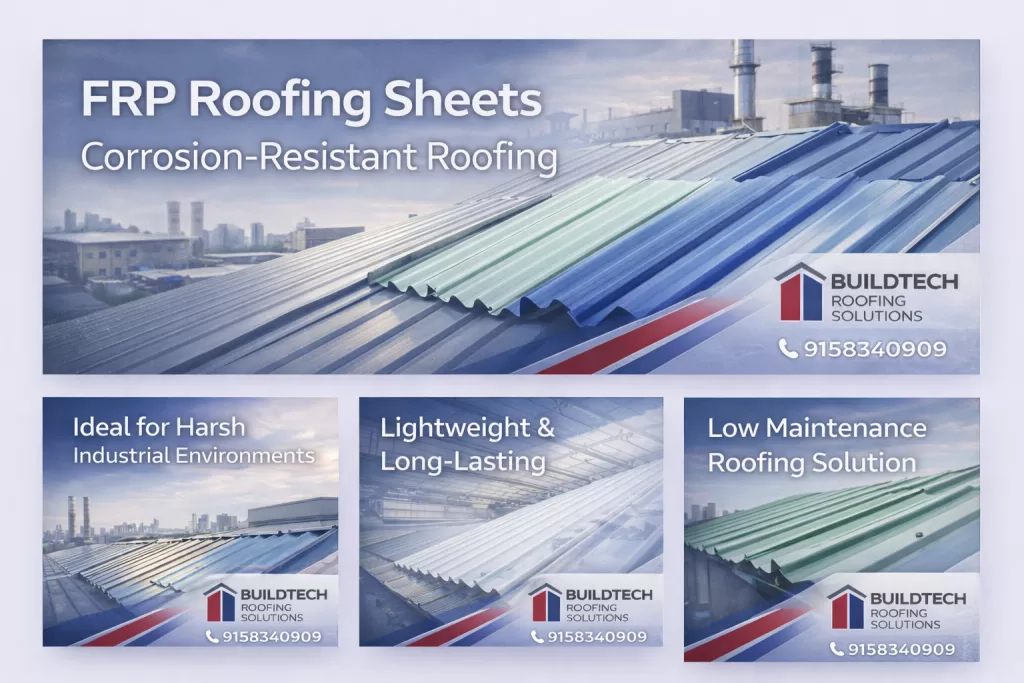
FRP Roofing Sheets – Lightweight & Corrosion-Resistant Industrial Roofing Industrial and commercial environments demand roofing materials that can withstand corrosion, chemicals, moisture, and harsh weather conditions. FRP roofing sheets (Fiber Reinforced Plastic) provide a durable, lightweight, and low-maintenance roofing solution for such demanding applications. At Buildtech Roofing Solutions, we supply and install high-performance FRP roofing sheets engineered for long service life, chemical resistance, and reliable protection across diverse industrial sectors. What Are FRP Roofing Sheets? FRP roofing sheets are composite roofing materials manufactured by reinforcing high-strength fibers within a polymer resin matrix. This construction delivers superior resistance to corrosion, chemicals, and moisture compared to conventional metal roofing. Because FRP sheets do not rust, conduct electricity, or degrade easily, they are widely used in chemical plants, coastal buildings, factories, and utility structures. Key Features & Benefits Corrosion & Chemical ResistanceIdeal for aggressive industrial and coastal environments. Lightweight ConstructionReduces structural load and speeds up installation. Long Service LifeMaintains performance with minimal maintenance. Weather & UV ResistantPerforms reliably under sunlight, rain, and humidity. Non-Conductive & SafeSuitable for electrical and utility installations. Low Maintenance Roofing SolutionNo frequent painting or corrosion treatment required. Applications of FRP Roofing Sheets FRP roofing sheets are widely used in: Types of FRP Roofing Sheets Corrugated FRP Sheets Commonly used for industrial roofing and cladding. Trapezoidal FRP Sheets Provides higher strength and modern profile aesthetics. Translucent FRP Daylight Sheets Allows natural daylight while maintaining durability. Custom Profile FRP Sheets Manufactured to match existing roofing profiles. Typical Technical Specifications Feature Specification Material Fiber Reinforced Plastic (FRP) Thickness 1.0 – 3.0 mm Profile Corrugated / Trapezoidal Color Options Clear, Green, Blue, White UV Protection Yes Installation Screw-fixed with washers Installation Process Buildtech’s experienced teams ensure leak-free installation and long-term performance. Why Choose Buildtech Roofing Solutions? Conclusion FRP roofing sheets are an excellent choice for industrial buildings requiring corrosion resistance, durability, and lightweight construction. With Buildtech Roofing Solutions, clients receive dependable materials and professional execution designed for real-world industrial conditions.
FRP Roofing Sheets for Industrial Buildings | Buildtech Roofing Solutions Read More »