
Introduction
Industrial buildings generate excessive heat due to machinery, roofing systems, manufacturing operations, and environmental conditions. Without proper airflow management, factories and warehouses become hot, uncomfortable, and inefficient.
Poor ventilation inside industrial buildings can lead to:
- Heat buildup
- Poor air circulation
- Worker discomfort
- Increased electricity costs
- Moisture accumulation
- Reduced productivity
Modern industries now focus on advanced natural ventilation systems that improve airflow without increasing energy consumption.
One of the most efficient solutions for industrial roof ventilation is the Ridge Ventilator System.
Ridge ventilators provide continuous natural airflow across the entire roof structure, helping remove hot air and maintain comfortable indoor conditions.
This is where Ridge Ventilator Pune solutions by Buildtech Roofing Solutions provide advanced industrial ventilation systems for factories, warehouses, logistics hubs, and commercial sheds.
This comprehensive guide explains everything about ridge ventilators, including working principles, types, benefits, applications, installation process, maintenance, and cost considerations.
What Are Ridge Ventilator Systems?
Ridge ventilators are roof-mounted ventilation systems installed along the ridge (highest point) of industrial roofs.
They allow continuous exhaust of:
- Hot air
- Humid air
- Dust
- Smoke
- Industrial fumes
Ridge ventilators use natural airflow principles and do not require electricity for operation.
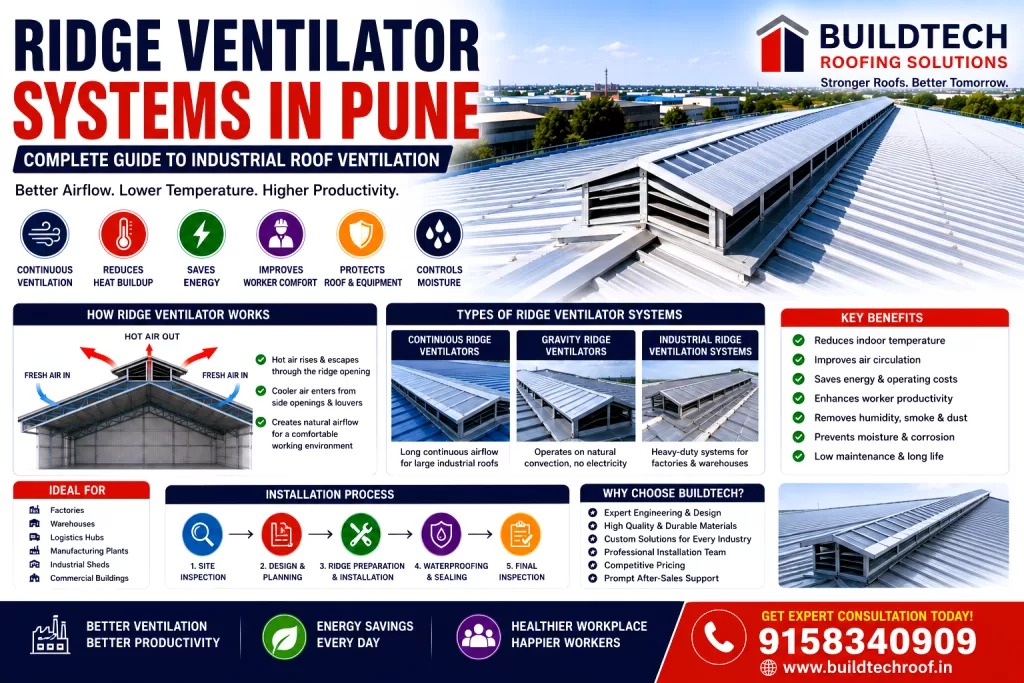
How Ridge Ventilators Work
Ridge ventilators work based on:
- Natural convection
- Thermal air movement
- Wind pressure
Hot air inside industrial buildings naturally rises toward the roof.
The ridge ventilator creates an escape path for hot air, while fresh cooler air enters through side openings and louvers.
This creates balanced and continuous ventilation throughout the building.
Why Industries Need Ridge Ventilation Systems
Industrial roofing systems absorb large amounts of heat during the daytime.
Without ventilation:
- Indoor temperatures rise rapidly
- Humidity increases
- Worker productivity decreases
- Equipment overheating occurs
Ridge ventilators help maintain proper airflow and improve workplace comfort naturally.
Benefits of Ridge Ventilator Systems
1. Continuous Natural Ventilation
Ridge ventilators provide uninterrupted airflow across the building.
2. Heat Reduction
Hot air is continuously exhausted through the ridge opening.
This significantly reduces indoor temperature.
3. Energy Savings
Ridge ventilators reduce dependency on:
- Exhaust fans
- Cooling systems
- Air conditioning
This lowers electricity consumption.
4. Improved Worker Productivity
Cooler and fresher work environments improve operational efficiency.
5. Moisture & Condensation Control
Industrial buildings often face condensation problems due to trapped humid air.
Ridge ventilators help remove moisture and reduce:
- Corrosion
- Rust formation
- Mold growth
6. Better Air Quality
Ventilation improves indoor air circulation and removes pollutants.
7. Low Maintenance System
Ridge ventilators are durable systems requiring minimal maintenance.
Types of Ridge Ventilator Systems
1. Continuous Ridge Ventilators
Installed continuously along the roof ridge for maximum airflow.
Features:
- Uniform ventilation
- High airflow efficiency
- Suitable for large buildings
2. Gravity Ridge Ventilators
Operate using thermal air movement and natural convection.
Benefits:
- No electricity required
- Cost-effective solution
3. Industrial Ridge Ventilation Systems
Heavy-duty systems designed for industrial sheds and warehouses.
Applications:
- Manufacturing plants
- Logistics hubs
- Large industrial facilities
Components of Ridge Ventilator Systems
A typical ridge ventilator system includes:
- Ridge hood
- Side flashing
- Support structure
- Air outlet section
- Weather protection system
Proper flashing and waterproof sealing prevent rainwater entry.
Applications of Ridge Ventilator Systems
The Ridge ventilators are widely used in:
- Industrial sheds
- Warehouses
- Manufacturing plants
- Textile industries
- Logistics centers
- Commercial buildings
- Food processing units
Ridge Vent vs Turbo Ventilators
| Feature | Ridge Ventilators | Turbo Ventilators |
|---|---|---|
| Airflow Coverage | Continuous | Point-based |
| Ventilation Efficiency | Very High | High |
| Maintenance | Low | Low |
| Electricity Requirement | No | No |
| Best For | Large Industrial Buildings | Medium & Large Buildings |
Ridge Vent vs Exhaust Fan
| Feature | Ridge Ventilator | Exhaust Fan |
|---|---|---|
| Electricity Usage | No | Yes |
| Operating Cost | Very Low | High |
| Noise | Silent | Moderate |
| Airflow | Natural Continuous | Mechanical |
Importance of Proper Industrial Ventilation
Proper ventilation improves:
✔ Worker comfort
✔ Machine performance
✔ Indoor air quality
✔ Heat reduction
✔ Energy efficiency
Poor ventilation can increase operational costs and affect productivity.
Ridge Ventilator Installation Process
Step-1 – Site Inspection
Analyse building dimensions and airflow requirements.
Step-2 – Ventilation Design
Determine the ridge opening size and airflow requirement.
Step-3 – Roof Preparation
Prepare the roof ridge for installation.
Step-4 – Ridge Ventilator Installation
Install the ridge ventilation structure securely.
Step-5 – Waterproof Sealing
Apply flashing and waterproof protection.
Step-6 – Final Inspection
Check ventilation performance and installation quality.
Factors Affecting Ridge Ventilator Performance
1. Building Width
Large buildings require proper ventilation planning.
2. Roof Height
Higher roofs improve natural airflow movement.
3. Ventilator Size
Correct sizing ensures balanced airflow.
4. Air Intake Design
Proper side airflow improves ventilation efficiency.
5. Roof Design
Roof slope affects airflow movement.
Common Industrial Ventilation Problems
1. Heat Buildup
Metal roofing traps excessive heat.
2. Poor Air Circulation
Insufficient airflow affects working conditions.
3. Moisture Accumulation
Leads to rust and structural damage.
4. Smoke & Dust Retention
Industrial pollutants affect air quality.
Advantages of Ridge Ventilation for Warehouses
Warehouses benefit from ridge ventilators because they:
- Improve storage conditions
- Reduce moisture damage
- Improve worker comfort
- Reduce heat buildup
This helps protect inventory and improve operational efficiency.
Energy Efficiency Benefits
Ridge ventilators reduce energy usage by minimising dependence on:
- Industrial cooling systems
- Exhaust fans
- Air conditioning systems
This leads to long-term operational cost savings.
Maintenance Tips for Ridge Ventilator Systems
Although ridge ventilators require low maintenance, periodic inspection is recommended.
Maintenance Checklist:
- Inspect flashing and joints
- Remove dust accumulation
- Check structural supports
- Ensure proper airflow passage
- Inspect waterproof sealing
Common Mistakes to Avoid
1. Improper Ridge Opening Design
Reduces airflow performance.
2. Poor Waterproofing
Can lead to roof leakage.
3. Using Low-Quality Materials
Reduces system lifespan.
4. Incorrect Installation
Improper alignment affects ventilation efficiency.
Cost of Ridge Ventilator Systems in Pune
The cost depends on:
- Building size
- Ridge length
- Material quality
- Installation complexity
Approximate Cost Range:
₹350 – ₹1,200 per running foot (approx.)
💡 Note: Large industrial projects require customised ventilation design.
Why Choose Buildtech Roofing Solutions Pune
Buildtech Roofing Solutions provides advanced ridge ventilation systems designed for industrial performance and durability.
Key Advantages:
✔ Expert ventilation planning
✔ High-quality ridge ventilators
✔ Customised airflow solutions
✔ Professional installation team
✔ Competitive pricing
✔ Fast project execution
Industries Served
- Manufacturing plants
- Warehouses
- Logistics hubs
- Pharmaceutical industries
- Textile industries
- Food processing industries
- Engineering units
Service Areas
Pune | Mumbai | Nashik | Kolhapur | Sangli | Satara | Ahmednagar
Future of Industrial Ventilation Systems
Industrial ventilation systems are evolving with:
- Sustainable ventilation solutions
- Smart airflow systems
- Energy-efficient industrial buildings
- Eco-friendly ventilation technology
Ridge ventilators are becoming a standard solution for modern industrial infrastructure.
Conclusion
Ridge ventilator systems provide one of the most effective natural ventilation solutions for industrial buildings.
They help improve airflow, reduce heat buildup, enhance worker comfort, and lower energy consumption.
With Ridge Ventilator Pune solutions by Buildtech Roofing Solutions, industries can achieve durable, energy-efficient, and long-lasting industrial ventilation systems.