
Introduction
Industrial construction has undergone a significant transformation over the last decade. Businesses today demand structures that are not only strong and durable but also cost-effective, quick to build, and energy efficient.
Traditional construction methods often fall short due to longer timelines, higher costs, and inefficiencies. This has led to the rise of modern construction techniques like Pre-Engineered Buildings (PEB).
In Pune, a rapidly growing industrial hub, PEB structures are widely used for factories, warehouses, logistics centres, and commercial buildings.
This is where Pre Engineered Buildings Pune solutions by Buildtech Roofing Solutions provide cutting-edge construction solutions that combine speed, precision, and performance.
This comprehensive guide covers everything about PEB structures, including components, benefits, applications, design process, cost factors, and why they are the future of industrial construction.
What Are Pre-Engineered Buildings (PEB)?
Pre-Engineered Buildings (PEB) are steel structures designed and fabricated in a factory and assembled on-site.
All components are pre-designed using advanced engineering techniques, ensuring accuracy and efficiency.
How PEB Structures Work
PEB structures follow a streamlined process:
- Design using engineering software
- Fabrication of components in a factory
- Transportation to the site
- Assembly and installation
This reduces construction time significantly.
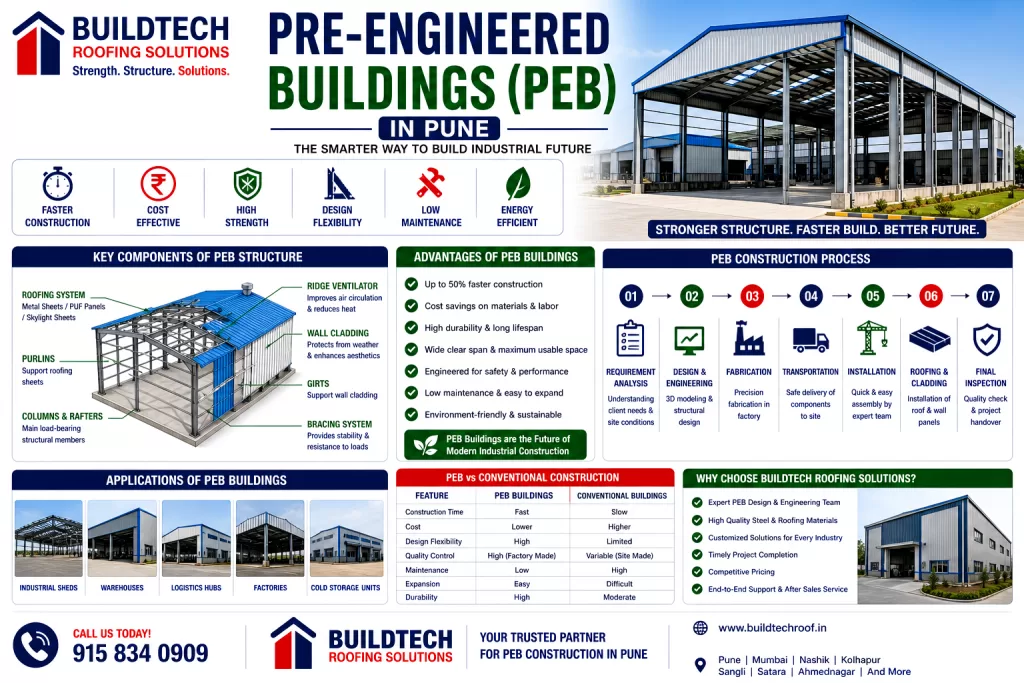
Key Components of PEB Structures
1. Primary Frame
The main structural system includes:
- Columns
- Rafters
These provide overall strength and load-bearing capacity.
2. Secondary Members
Includes:
- Purlins
- Girts
They support roofing and wall cladding.
3. Roofing System
Options include:
- Metal roofing sheets
- PUF insulated panels
- Skylight sheets
4. Wall Cladding
Provides protection and improves aesthetics.
5. Bracing System
Ensures stability and resistance to wind and seismic loads.
6. Fasteners & Accessories
Includes bolts, screws, sealants, and fittings.
Types of PEB Structures
1. Industrial PEB Buildings
Used for manufacturing units and factories.
2. Warehouse Structures
Designed for storage and logistics operations.
3. Commercial PEB Buildings
Used for showrooms, malls, and offices.
4. Cold Storage PEB
Temperature-controlled buildings.
Advantages of PEB Structures
1. Faster Construction
PEB buildings can be completed in weeks instead of months.
2. Cost Efficiency
Reduced material wastage and labour costs.
3. High Strength & Durability
Engineered for long-term performance.
4. Design Flexibility
Customizable layouts and sizes.
5. Low Maintenance
Requires minimal upkeep.
6. Energy Efficiency
Supports insulated panels and ventilation systems.
7. Eco-Friendly
Reduces construction waste.
Applications of PEB Buildings
PEB structures are widely used in:
- Industrial sheds
- Warehouses
- Logistics hubs
- Manufacturing plants
- Commercial buildings
- Cold storage units
- Agricultural buildings
PEB vs Conventional Construction
| Feature | PEB | Conventional |
|---|---|---|
| Construction Time | Fast | Slow |
| Cost | Lower | Higher |
| Flexibility | High | Medium |
| Quality | High | Variable |
| Maintenance | Low | High |
Step-by-Step PEB Construction Process
Step-1 – Requirement Analysis
Understand project needs and specifications.
Step-2 – Design & Engineering
Create a structural design using software.
Step-3 – Fabrication
Manufacture components in the factory.
Step-4 – Transportation
Deliver components to the site.
Step-5 – Installation
Assemble structure on-site.
Step-6 – Roofing & Cladding
Install roofing sheets and wall panels.
Step-7 – Final Inspection
Ensure quality and safety.
Factors Affecting PEB Cost in Pune
1. Building Size
2. Design Complexity
3. Material Quality
4. Roofing System
5. Insulation Requirements
6. Location & Logistics
Approximate Cost of PEB Buildings in Pune
₹1,200 – ₹2,500 per sq.m (approx.)
💡 Note: Cost varies based on specifications and customisation.
Design Considerations for PEB Structures
1. Load Calculation
Includes wind, seismic, and live loads.
2. Span Width
Large spans require advanced engineering.
3. Ventilation
Essential for industrial comfort.
4. Lighting
Use skylights for natural lighting.
5. Expansion Capability
Future scalability is important.
Benefits of PEB for Industrial Projects
✔ Faster project completion
✔ Reduced cost
✔ High structural efficiency
✔ Better quality control
✔ Energy-efficient buildings
Maintenance Tips for PEB Structures
- Regular inspection
- Cleaning the roofing system
- Checking fasteners
- Applying protective coatings
Common Mistakes to Avoid
1. Poor Design Planning
2. Low-Quality Materials
3. Improper Installation
4. Ignoring Ventilation
Why Choose Buildtech Roofing Solutions Pune
Buildtech Roofing Solutions is a trusted provider of PEB structures.
Key Advantages:
✔ Expert engineering team
✔ High-quality materials
✔ Customised solutions
✔ Cost-effective construction
✔ Timely project execution
Industries Served
- Manufacturing plants
- Warehouses
- Logistics hubs
- Pharmaceutical industries
- Food processing units
- Textile industries
Service Areas
Pune | Mumbai | Nashik | Kolhapur | Sangli | Satara | Ahmednagar
Future of PEB Construction
PEB structures are becoming the standard for industrial construction due to:
- Smart engineering
- Sustainable design
- Faster execution
- Energy efficiency
Conclusion
Pre-Engineered Buildings offer a modern, efficient, and cost-effective solution for industrial construction.
With Pre Engineered Buildings Pune solutions by Buildtech Roofing Solutions, businesses can build high-performance, durable, and scalable industrial infrastructure.