
Introduction: Why Ventilation Is Critical in Industrial Buildings
Industrial buildings generate substantial heat due to heavy machinery, continuous production processes, artificial lighting, and high workforce density. Without proper ventilation, this heat accumulates near the roof level, leading to poor working conditions, higher energy costs, equipment inefficiency, and potential safety risks.
Conventional mechanical ventilation systems consume electricity, require ongoing maintenance, and increase operational expenses. As industries increasingly focus on energy efficiency and sustainability, ridge ventilators have become a preferred solution for natural, power-free roof ventilation.
Ridge ventilators are now widely used in factories, warehouses, manufacturing plants, logistics centers, and industrial sheds, where continuous heat removal is essential.
This buyer’s guide explains what ridge ventilators are, how they work, their benefits, technical specifications, applications, and how to select the right system for your industrial facility.
What Are Ridge Ventilators?
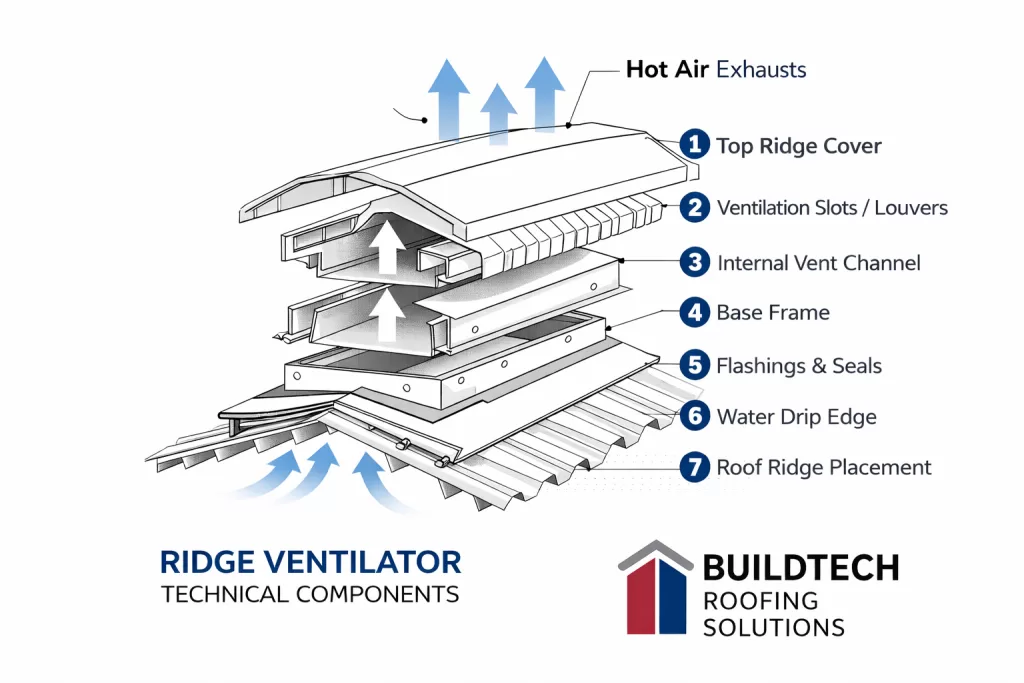
Ridge ventilators are continuous natural ventilation systems installed along the ridge line (highest point) of an industrial roof. Their primary function is to allow hot air, fumes, and moisture to escape naturally from inside the building.
They work on the principle of natural convection, where hot air rises and exits through the ridge, creating a pressure difference that draws fresh air inside from side openings, louvers, or doors.
Unlike mechanical exhaust systems, ridge ventilators:
- Do not require electricity
- Have no moving parts
- Operate continuously (24×7)
- Require minimal maintenance
- Offer long service life
How Ridge Ventilators Work (Natural Ventilation Principle)
Understanding the working principle helps buyers make informed decisions.
Step-by-Step Working Mechanism
- Heat generated inside the building rises naturally
- Hot air accumulates near the roof apex
- Ridge ventilator openings allow trapped hot air to escape
- As hot air exits, cooler fresh air enters from lower openings
- Continuous airflow maintains balanced internal temperature
This natural cycle runs round the clock without power, making ridge ventilators highly reliable for industrial use.
Why Ridge Ventilators Are Ideal for Industrial Buildings
Industrial structures differ significantly from residential or commercial buildings due to:
- Large floor areas
- High roof heights
- Continuous heat-generating processes
- Long operating hours
Ridge ventilators are specifically designed to handle these conditions.
Key Reasons Industries Prefer Ridge Ventilators
- Continuous heat exhaust without interruption
- Improved indoor air quality
- Reduced dependence on exhaust fans
- Lower electricity consumption
- Better worker comfort and productivity
Key Benefits of Ridge Ventilators
1. Power-Free Operation
Ridge ventilators operate without electricity, reducing operational costs and carbon footprint.
2. Continuous Ventilation
They function 24×7, unlike exhaust fans that rely on manual operation or power availability.
3. Lower Indoor Temperature
Efficient heat removal significantly reduces internal temperature buildup.
4. Moisture & Fume Control
Prevents condensation, corrosion, and accumulation of industrial fumes.
5. Minimal Maintenance
No motors, belts, or electrical components mean fewer breakdowns.
6. Long Service Life
Manufactured from corrosion-resistant materials suitable for harsh environments.
Types of Ridge Ventilators
1. Box Type Ridge Ventilators
- Rectangular design
- High exhaust capacity
- Commonly used in factories and warehouses
2. Aerodynamic Ridge Ventilators
- Optimized airflow design
- Enhanced rain protection
- Suitable for high-wind regions
3. Continuous Ridge Ventilators
- Installed along the entire ridge length
- Uniform ventilation across large roof spans
- Ideal for large industrial facilities
Materials Used in Ridge Ventilators
Material selection plays a vital role in performance and durability.
Commonly Used Materials
- GI (Galvanized Iron)
- PPGI (Pre-Painted Galvanized Iron)
- Aluminium
- Stainless Steel (special environments)
Why Material Selection Matters
- Corrosion resistance
- Weather durability
- Structural stability
- Long-term reliability
Technical Specifications (Typical Range)
| Parameter | Specification |
|---|---|
| Material | GI / PPGI / Aluminium |
| Thickness | 0.45 – 0.80 mm |
| Ventilator Length | Continuous / Modular |
| Installation | Roof ridge mounted |
| Power Requirement | Nil |
| Maintenance | Minimal |
Applications of Ridge Ventilators
Ridge ventilators are suitable for a wide range of industrial and commercial buildings, including:
- Manufacturing plants
- Warehouses & logistics centers
- Industrial sheds
- Power plants
- Chemical processing units
- Automobile workshops
- Textile and garment factories
They are especially effective for buildings with large roof spans and high heat loads.
Ridge Ventilator vs Other Ventilation Systems
| Aspect | Ridge Ventilators | Exhaust Fans |
|---|---|---|
| Power Consumption | None | High |
| Maintenance | Low | Moderate |
| Operation | Continuous | Manual |
| Noise | Silent | Noisy |
| Running Cost | Zero | Ongoing |
Ridge Ventilators vs Turbo Ventilators
- Ridge ventilators provide uniform airflow along the entire roof
- Turbo ventilators operate at specific points
- Ridge ventilators are more effective for large industrial spans
Installation Process
Proper installation ensures maximum performance and leak-free operation.
Typical Installation Steps
- Roof ridge assessment
- Structural compatibility check
- Custom fabrication as per roof profile
- Secure fixing with proper flashing
- Waterproof sealing
- Final inspection
Professional installation prevents leakage and ensures long service life.
How to Choose the Right Ridge Ventilator
Evaluate Roof Design
- Roof slope
- Ridge length
- Sheet profile
Assess Heat Load
- Machinery output
- Number of workers
- Internal processes
Consider Environmental Conditions
- Rainfall intensity
- Wind pressure
- Corrosive atmosphere
Budget Planning
- Initial investment
- Long-term energy savings
Common Buyer Mistakes to Avoid
- Underestimating ventilation requirements
- Choosing incorrect material thickness
- Poor waterproofing during installation
- Ignoring professional design consultation
Avoiding these mistakes ensures reliable and efficient ventilation.
Energy Efficiency & Sustainability Benefits
Ridge ventilators directly support green building practices by:
- Reducing electricity usage
- Lowering HVAC load
- Minimizing carbon emissions
- Enhancing natural airflow
They contribute significantly to sustainable industrial infrastructure.
Why Choose Buildtech Roofing Solutions
Buildtech Roofing Solutions offers complete ridge ventilator solutions, including:
- Custom-designed ridge ventilators
- High-quality, corrosion-resistant materials
- Precision fabrication
- Professional installation
- Integrated roofing & ventilation expertise
Our approach ensures performance, safety, and long-term value.
Frequently Asked Questions (FAQs)
Do ridge ventilators work without wind?
Yes. They primarily rely on heat convection, not wind pressure.
Are ridge ventilators suitable for all roof types?
Yes. They can be customized for most industrial roof profiles.
Can ridge ventilators reduce electricity bills?
Yes. They reduce reliance on exhaust fans and air conditioning systems.
Are ridge ventilators waterproof?
Yes. Properly designed systems include rain protection and flashing.
Conclusion
Ridge ventilators are one of the most effective, economical, and sustainable ventilation solutions for industrial buildings. Their power-free operation, continuous performance, and low maintenance make them ideal for modern industrial facilities.
Choosing the right ridge ventilator system improves worker comfort, energy efficiency, and roof longevity.
Final Call to Action
📞 Call: 9158340909
📩 Request a Ridge Ventilator Consultation Today