
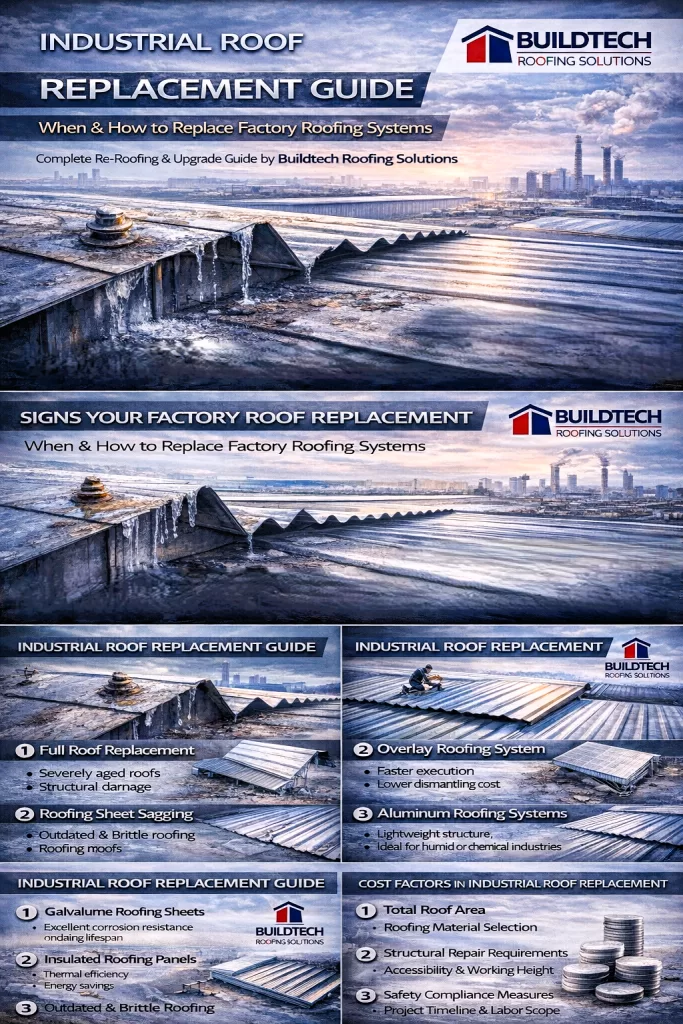
Complete Re-Roofing & Upgrade Guide by Buildtech Roofing Solutions
Introduction: Why Industrial Roof Replacement Becomes Necessary
Industrial roofs are engineered for long service life, but continuous exposure to sunlight, monsoon rainfall, wind loads, and operational vibration gradually degrades roofing systems. Ageing materials, corrosion, structural fatigue, and repeated leak repairs eventually reduce performance and safety.
When maintenance costs rise and repairs become frequent, industrial roof replacement becomes the most practical long-term solution. A professionally executed replacement restores structural reliability, improves energy efficiency, and protects factory operations for decades.
For industries in Pune, where climate stress accelerates roofing wear, timely re-roofing prevents operational disruption and asset damage.
When Does an Industrial Roof Need Replacement?
Roof replacement is recommended when performance declines beyond economical repair.
Key Indicators
- Repeated leak repairs fail to stop water ingress
- Widespread rust and corrosion across roofing sheets
- Structural deformation or visible sagging
- Roofing exceeds expected material lifespan
- Maintenance expenses approach replacement cost
- Insulation failure increases indoor heat
Early evaluation prevents emergency shutdowns.
Roof Repair vs Roof Replacement
Understanding the difference helps industries choose wisely.
| Roof Repair | Roof Replacement |
|---|---|
| Fixes localized damage | Complete roofing system upgrade |
| Lower immediate expense | Higher long-term value |
| Temporary lifespan extension | 20–30 years durability |
| Suitable for minor issues | Required for major deterioration |
Repair works when damage is limited. Replacement is essential when the roofing system is broadly compromised.
Types of Industrial Roof Replacement
1️⃣ Full Roof Replacement
The entire roofing system is removed and replaced with new materials.
Best for
- Severely aged roofs
- Structural damage
- Outdated roofing systems
This option delivers maximum durability and performance.
2️⃣ Overlay Roofing System
New roofing sheets are installed over the existing roof structure.
Advantages
- Faster execution
- Lower dismantling cost
- Reduced waste generation
- Minimal operational disruption
Overlay systems are ideal when the base structure remains stable.
3️⃣ Partial Roof Replacement
Only damaged sections of the roof are replaced.
Suitable for
- Localized corrosion
- Sectional structural damage
- Budget-controlled upgrades
This approach balances cost and performance.
Industrial Roof Replacement Materials
Material selection determines long-term performance.
Galvalume Roofing Sheets
- Excellent corrosion resistance
- Long lifespan
- Suitable for industrial environments
Insulated Roofing Panels
- Thermal efficiency
- Reduced indoor heat
- Energy savings
Aluminum Roofing Systems
- Lightweight structure
- High corrosion resistance
- Ideal for humid or chemical industries
Deck Sheet Roofing Systems
- Strong structural support
- Suitable for large spans
Choosing durable materials ensures better lifecycle value.
Industrial Roof Replacement Process
Professional re-roofing follows a structured workflow:
- Structural inspection and safety planning
- Dismantling of old roofing sheets
- Surface cleaning and preparation
- Structural repairs and reinforcement
- Installation of a new roofing system
- Waterproof sealing and joint treatment
- Quality inspection and performance testing
Engineering supervision ensures safety and durability.
Cost Factors in Industrial Roof Replacement
Replacement cost varies depending on:
- Total roof area
- Roofing material selection
- Structural repair requirements
- Accessibility and working height
- Safety compliance measures
- Project timeline and labor scope
Accurate inspection provides realistic budgeting.
Benefits of Industrial Roof Replacement
Replacing an ageing roof delivers major operational advantages.
Structural Safety
New roofing eliminates weakened components.
Leak Elimination
Modern waterproof systems prevent seepage.
Energy Efficiency
Insulated systems reduce heat gain and cooling costs.
Reduced Maintenance
Lower frequency of repair interventions.
Increased Asset Value
Upgraded infrastructure enhances property worth.
Signs You Should Not Delay Replacement
Postponing replacement can cause serious risks.
- Persistent water leakage
- Extensive corrosion spread
- Loose or vibrating roof sheets
- Structural sagging
- Rising indoor temperature
- Frequent emergency repairs
Delays increase cost and operational risk.
Replacement Planning Best Practices
Effective planning ensures smooth project execution.
- Conduct a professional roof assessment
- Compare the lifecycle cost of materials
- Select climate-appropriate roofing systems
- Plan phased execution to avoid downtime
- Ensure industrial safety compliance
Strategic planning minimizes disruption.
Why Professional Roof Replacement Matters
Industrial roofing is a structural engineering task. Professional execution ensures:
- Proper load distribution
- Correct material compatibility
- Leak-proof installation
- Compliance with safety standards
- Long-term performance reliability
Unskilled work can lead to premature failure.
Why Industries Choose Buildtech Roofing Solutions
Buildtech Roofing Solutions delivers reliable re-roofing services through:
- Engineering-led roof inspections
- Industrial replacement expertise
- Climate-optimised material planning
- Safety-compliant installation practices
- Lifecycle roofing management
This ensures dependable long-term protection for factories and warehouses.
FAQs: Industrial Roof Replacement
How long does an industrial roof replacement last?
Typically 20–30 years, depending on materials and maintenance.
Is replacement better than repair?
If damage is widespread or the roof’s lifespan is over, replacement offers better value.
Can factory operations continue during replacement?
Yes. Phased work planning minimizes operational disruption.
What affects roof replacement cost?
Roof size, materials, structural condition, and safety requirements influence pricing.
Conclusion: Upgrade Ageing Roofs for Long-Term Reliability
Industrial roof replacement is a strategic infrastructure upgrade that enhances structural safety, energy efficiency, and operational continuity. Replacing deteriorated roofing systems prevents recurring problems and protects industrial investments.
For professional industrial roof replacement assessment and execution in Pune, Buildtech Roofing Solutions provides engineered re-roofing solutions tailored to long-term performance.